
Shadow Politics, August 16, 2026
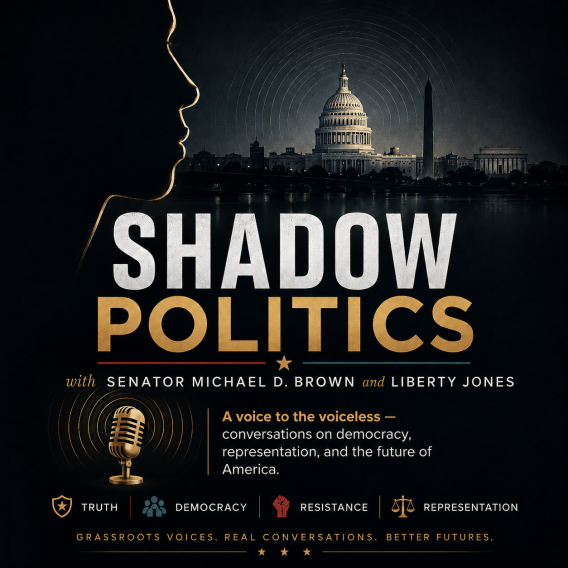

Shadow Politics with Senator Michael D. Brown
Across the Divide: Trump, Iran, the National Guard, Immigration, and America’s Political Future
Debating Trump Across the Political Divide
Michael D. Brown and Liberty Jones welcome returning guest Steve after a last-minute cancellation and make clear from the beginning that Steve’s support for Donald Trump differs sharply from their own views. The hosts frame the conversation as an effort to hear both sides rather than avoid disagreement. The opening exchanges focus on Trump’s public branding, the Kennedy Center, other institutions and programs carrying his name, and disputes over a legal case connected with vandalism in Washington. Steve remains supportive of Trump, while Brown and Jones question whether the president’s conduct reflects excessive ego, inconsistent principles, or misuse of office.
Iran, War, and the Limits of Military Power
A large part of the episode centers on the U.S. confrontation with Iran. Steve argues that the United States may need to apply more military pressure and repeatedly emphasizes the strength of the American armed forces. Brown and Jones challenge that view, citing the continuing conflict, the Strait of Hormuz, nuclear material, military costs, weapons inventories, and what they see as shifting objectives. Liberty argues that a military strategy should be judged by whether it accomplishes clearly defined goals, while Brown invokes lessons from Vietnam, Afghanistan, Gaza, and other conflicts to argue that “boots on the ground” do not guarantee success.
National Guard Deployment and Civilian Safety
The speakers then clash over the deployment of the National Guard in Washington, D.C. Steve says the Guard makes him feel safer and strongly defends service members from protesters who insult or harass them. Brown agrees that individual soldiers should be treated respectfully but says military forces in civilian streets can create danger, invoking Kent State and other historical examples. Liberty emphasizes the symbolism of military power over a civilian population and argues that deployment is difficult to justify if crime was already declining. All three distinguish, to varying degrees, between criticizing policy makers and attacking troops who are carrying out orders.
Democrats, Republicans, Leadership, and Term Limits
The discussion shifts into election politics, Democratic moderates and progressives, Republican loyalty to Trump, and the public desire for decisive leadership. Steve worries that progressive policies can hurt Democrats in competitive states, while Brown says he is encouraged by moderate Democratic candidates. Liberty describes herself as a moderate Democrat and argues that both parties suffer from disrespect, ignorance, and lack of compassion. They also debate a hypothetical Trump third term, the 22nd Amendment, Franklin D. Roosevelt, George Washington’s two-term precedent, congressional term limits, and whether voters should be trusted to remove officials they no longer support.
Immigration, Race, and Political Rhetoric
The most heated part of the program concerns immigration, Somali communities in Minnesota, Islam, political demonstrations, and the slogan “Death to America.” Steve argues that people who openly express hostility to the United States should face consequences and defends Trump’s immigration enforcement. Brown counters that America is a nation of immigrants, criticizes rhetoric that portrays whole ethnic or immigrant populations as dangerous, and argues that immigrant workers are often among the hardest-working people in their communities. Liberty challenges the way alienation and enforcement can feed anger, while Brown connects current rhetoric to broader American histories of racism, discrimination, and exclusion.
Free Speech, Democracy, and the Need to Listen
The conversation closes on the tension between offensive speech and constitutional freedom. Brown invokes the ACLU’s defense of Nazi demonstrators in Skokie to argue that the First Amendment protects speech people deeply dislike. Liberty presses Steve on immigration enforcement and alleged harms to citizens as well as immigrants, but the show runs out of time before he can fully respond. Brown jokingly dedicates “Stand by Me” to Steve and Donald Trump, while also thanking Steve for appearing and reiterating that a functioning democracy requires people to hear opposing views. The final message combines strong partisan disagreement with an insistence that election outcomes, democratic process, open debate, and the next generation’s participation still matter.
SEO Keywords / Key Phrases
Donald Trump policies, Iran war debate, U.S. military strategy, National Guard deployment, immigration policy debate, political polarization, presidential term limits, First Amendment free speech, Democratic Party leadership, Republican Party future
Shadow Politics
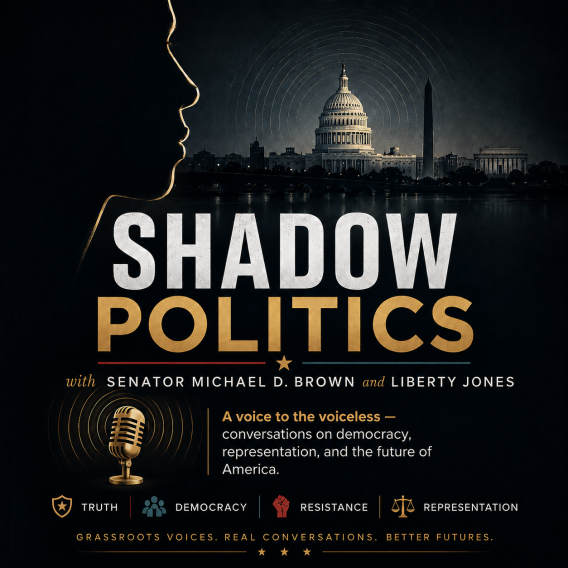

Shadow Politics is a grass roots talk show giving a voice to the voiceless. For more than 200 years the people of the Nation's Capital have ironically been excluded from the national political conversation. With no voting member of either house of Congress, Washingtonians have lacked the representation they need to be equal and to have their voices heard. Shadow Politics will provide a platform for them, as well as the millions of others nationwide who feel politically disenfranchised and disconnected, to be included in a national dialog.
We need to start a new conversation in America, one that is more inclusive and diverse and one that will lead our great nation forward to meet the challenges of the 21st century. At Shadow Politics, we hope to get this conversation started by bringing Americans together to talk about issues important to them. We look forward to having you be part of the discussion so call in and join the conversation. America is calling and we're listening… Shadow Politics is about America hearing what you have to say. It's your chance to talk to an elected official who has spent more than 30 years in Washington politics. We believe that if we start a dialog and others add their voices, we will create a chorus. Even if those other politicians in Washington don't hear you — Senator Brown will. He's on a mission to listen to what America has to say and use it to start a productive dialog to make our democracy stronger and more inclusive. If we are all part of the solution, we can solve any problem.
Across the Divide: Trump, Iran, the National Guard, Immigration, and America’s Political Future
Speaker Identification
Speaker 1 – Prerecorded Theme / Announcer Voice
The opening and closing theme material is separate from the live discussion and introduces the program, its mission, the host, co-host, call-in number, and voting-rights theme.
Speaker 2 – Host, Michael D. Brown
The prerecorded introduction identifies Michael D. Brown by name and describes him as “United States Senator Emeritus.” He leads the interview, challenges the guest’s support for Donald Trump, discusses Washington, D.C., foreign policy, the National Guard, immigration, elections, constitutional limits, and closes the program.
Speaker 3 – Co-host, Liberty Jones
The automated opening renders the co-host’s first name as “Wibri,” but throughout the live program both Michael Brown and the guest repeatedly address her as Liberty or Ms. Jones. She questions the guest about presidential branding, Iran, military strategy, National Guard deployment, Democratic politics, immigration, and free speech.
Speaker 4 – Guest, Steve
The guest is repeatedly addressed as Steve and is identified as a returning guest who supports Donald Trump and is brought on after a last-minute cancellation. His surname is not stated clearly enough in the transcript to identify him further without outside verification.
...................
Speaker 1 – Prerecorded Theme / Announcer Voice:
No taxation without representation.
Two hundred years of exploitation
in the capital of this nation.
No representation
in the capital of this nation.
Two hundred years of exploitation.
Give the people their right to vote.
Somebody, somebody, somebody.
Someone asked me, “Was it true?
The voting rights of the District—
well, it won’t go overdue.”
Good evening, and welcome to Shadow Politics, an hour-long grassroots talk show that is on a mission to make America think again.
I’m your host, Michael D. Brown, United States Senator Emeritus, and along with my amazing co-host, Liberty Jones, we are interviewing the people who are making it happen—not always in friendly company, but always ahead of the curve.
We’re not going to tell you how to feel or who to vote for. We’re just putting out the information, because it’s what goes on in the shadows that really makes the world go round.
So come listen and learn, because the vote is a terrible thing to waste.
And now, more than ever, we need everybody listening, learning, and engaged if we’re going to make America sane again.
Got a question? Call in: 888-627-6008.
Speaker 2 – Host, Michael D. Brown:
Tonight, we want to welcome Steve back to the show.
It’s amazing that you’re joining us, Steve. Thank you so much.
We had a last-minute cancellation of a guest, and Steve stepped up to fill in.
He’s an amazing guy with a really interesting perspective.
And you know what? We’re going to be right up front.
Liberty and I are not very fond of Donald Trump, but we both understand that we all have to come together in this country to make it happen.
So we’ve got to listen to both sides.
Here’s a guy from the other side—somebody I respect and like.
Steve, thanks so much for being on the show.
Speaker 4 – Guest, Steve:
Thank you so much, Senator Brown.
It’s great to be here.
And hello, Ms. Jones. How are you this evening?
Speaker 3 – Co-host, Liberty Jones:
I’m doing great.
Thank you for asking. Better now, and ready to get into this brilliant conversation we’re about to have.
Speaker 2 – Host, Michael D. Brown:
Okay, you’re done flirting with my co-host.
Speaker 4 – Guest, Steve:
Never, Senator Brown. You know what Trump supporters—
Speaker 2 – Host, Michael D. Brown:
Well, yeah, that’s unfortunately what happens when you get pretty girls—and brilliant girls.
But anyway, let’s start with this.
Do you still like Donald Trump?
Do you still like him after everything that has happened in the last couple of weeks?
Speaker 4 – Guest, Steve:
I still love him, sir.
Yeah, I still like him.
Speaker 2 – Host, Michael D. Brown:
Well, let me ask you about the reflecting-pool situation.
He’s after Judge Jeanine Pirro over a case that was dismissed, and now they want to bring the case up again.
I saw a newly confirmed federal official on Meet the Press this morning saying they have evidence connected with people who vandalized the reflecting pool.
So what do you think about that?
Shouldn’t they give it up?
The guy was an Olympic athlete.
The story would go away if Trump would just leave it alone, but he won’t leave it alone.
What do you say?
Speaker 4 – Guest, Steve:
I didn’t watch the shows this morning.
Usually I do watch them to get another perspective, but I missed them.
So I don’t know what was said.
Speaker 2 – Host, Michael D. Brown:
He said they have evidence.
Speaker 4 – Guest, Steve:
Okay.
Well, if they supposedly have evidence, then I guess they should bring it back up.
Maybe, at the time the judge dismissed it, that evidence wasn’t available.
I don’t know much about the story.
Honestly, I don’t care that much.
I think the guy was told many times to step away, and he did what he did.
Speaker 2 – Host, Michael D. Brown:
Yeah, yeah.
I think you’re making a big mistake.
Liberty, you want to jump in here?
Speaker 3 – Co-host, Liberty Jones:
I do want to jump in here.
Earlier today, Senator Brown and I were talking about how Trump has decided to rename the Kennedy Center the Trump Center.
My question to you is: why do you think it’s necessary for him?
I don’t know if you’ve been to D.C. recently, but his face is everywhere. His name is everywhere.
It’s no longer just the United States Institute of Peace; his name is connected with that.
He has his own Gold Card.
Now he has a federal health-card portal called TrumpRx.
What do you think is the point of putting his name and face everywhere?
Speaker 4 – Guest, Steve:
I think all presidents want to put their names everywhere.
I mean, didn’t we have Obamacare?
They could have named it something else, but everybody called it Obamacare.
Speaker 2 – Host, Michael D. Brown:
No, they didn’t name it Obamacare.
Republicans named it Obamacare.
The official legislation was never called Obamacare.
They called it Obamacare in order to trash it.
It was the Affordable Care Act.
Speaker 4 – Guest, Steve:
Going back to the Kennedy Center, he did have his name on there recently with Kennedy’s name.
I was just there a couple of months ago, and I saw his name with Kennedy’s name.
Speaker 2 – Host, Michael D. Brown:
Well, check it out.
They were talking about taking the Kennedy Center name away.
The court said he couldn’t simply change the name.
So the people he put on the board found another way around it.
Now the plan is to keep John F. Kennedy in the name, renovate the place, close it for a period of time, and add language saying it was renovated by President Donald J. Trump.
So they found a way around it to get his name back on there.
But I think the simple answer is that the man has an ego the size of Texas.
Let’s move on to some things that might be a little more impactful for the American people.
The war is going very badly, don’t you think?
In Iran?
Speaker 4 – Guest, Steve:
I don’t think it’s going badly, but that’s just my opinion.
I think he’s looking for peace right now.
I know he just sent his son-in-law over to negotiate on his behalf, and I think Benjamin Netanyahu is involved.
I’m hoping we’ll have some good news and that they can get a deal in place.
But it seems like whatever deal we get in place, Iran is always backing off or backing out.
Now they’re saying they want to charge a toll on ships going through the Strait of Hormuz.
Did you hear today that they supposedly put a price tag of, I think, $25,000 on every American military person killed or captured?
That’s crazy talk.
Speaker 2 – Host, Michael D. Brown:
They don’t want to be too mean?
Speaker 4 – Guest, Steve:
They don’t want to be.
That’s for sure.
They’re crazy.
Speaker 2 – Host, Michael D. Brown:
Well, let me tell you.
The first thing I learned in politics is an old expression: never poke a skunk.
And Iran is a skunk.
The man poked them for no reason.
The Strait of Hormuz was open.
They did not have a nuclear weapon.
So, in my view, he started this.
Now he’s also saying they’re going to declare part of the Strait of Hormuz part of the United States.
Everybody knows you can’t just do that.
It doesn’t belong to us.
Part of it may fall under Iranian jurisdiction and part under international navigation rights, but you can’t just go take it over.
And I have another question for you.
There is oil equipment being unloaded in Greenland for a company that, according to the claim being discussed, has ties to his family.
They’re supposedly going to start drilling for oil in Greenland even though they don’t have permission from the Danes.
What would you say if a bunch of Chinese companies pulled up in North Carolina and started drilling for oil without asking anybody?
Speaker 4 – Guest, Steve:
Chinese companies already own a bunch of farmland across rural America.
Speaker 2 – Host, Michael D. Brown:
Well, if they bought it legally, that’s one thing.
But I’m talking about going somewhere without permission and drilling.
And the person Trump sent over to negotiate is also connected, according to the discussion, with the group that just bought the Los Angeles Lakers.
I studied Herbert Hoover in college because I had to do a paper on him.
I thought corruption was bad then.
I think what we’re seeing now is ten times worse.
What do you think about that?
Trump made $2 billion last year, according to the figure being reported here, while serving as president.
Isn’t that crazy?
Speaker 4 – Guest, Steve:
To tell you the truth, Senator Brown, I don’t really think about it.
He’s a businessman.
That’s why he came into office.
He was different from other presidents, and he’s still making things happen.
I have to tell you this, and it’s not going to be a very popular answer, but I think we need to do more in Iran.
I don’t want to say boots on the ground, but it’s getting to that point where they’re not taking us very seriously.
We have the strongest military in the world, sir.
And we haven’t even unleashed everything we have on them yet.
Speaker 2 – Host, Michael D. Brown:
There are about 92 million Iranians.
If you sent one Marine for every thousand Iranians, you’d be talking about roughly a hundred thousand troops.
It would be one of the biggest invasions since the Second World War.
There’s no way.
I hate to disagree with you, Steve, but we have experience from Afghanistan, Vietnam, and all sorts of places.
Boots on the ground don’t solve everything.
We are the world’s most powerful military, but I’m not sure that means we can simply impose an outcome on Iran.
Look at Israel and Gaza.
The Israeli army is still there. They’re still fighting.
Boots on the ground could be the final nail in Donald Trump’s coffin if he actually goes that direction.
Speaker 4 – Guest, Steve:
They’re still there?
Speaker 2 – Host, Michael D. Brown:
Oh, yeah.
They’re still fighting.
Speaker 4 – Guest, Steve:
That’s crazy too.
They don’t want peace.
They don’t want to come to the table.
Speaker 2 – Host, Michael D. Brown:
And with Iran, it bothered me when Trump said he was going to get rid of their nuclear ambitions.
How do you get rid of somebody’s ambition?
Liberty, jump in here.
Save Steve before we get out of control.
Speaker 3 – Co-host, Liberty Jones:
I’m not sure I can save him.
But as a young person who spends a lot of time with media, I think my generation puts a lot of focus on how people portray themselves versus reality.
A big issue for me is that Trump doesn’t have consistency as a president.
He initially campaigned on ending America’s endless wars, and now, with the actions against Iran, the story keeps changing.
At what point do you think a president of the United States has to acknowledge that a military strategy isn’t working?
We can see that the objective of this war is constantly changing.
What constitutes a failure for you?
Speaker 4 – Guest, Steve:
I would say it isn’t a failure.
How do you say it’s a failure?
Speaker 3 – Co-host, Liberty Jones:
What would constitute a failure in your eyes?
I think striking in the first place was a failure to begin with, but I’m biased.
I believe the military is here to defend the American people.
I don’t think this is a war of defense.
I think this is a war of instigation.
If there were a clear defensive reason behind it, obviously that would be different.
But I believe it’s a failure because I don’t see a clear reason, and the justification keeps changing.
At the end of the day, everybody says they’re worried about taxpayer dollars.
So why are we investing in wars that are unnecessary?
I think that is a failure.
Speaker 4 – Guest, Steve:
I was worried about taxpayer dollars going to the military too.
Speaker 2 – Host, Michael D. Brown:
I’d add that, in my view, he’s accomplished nothing.
The Strait of Hormuz is closed now. It was open before the war.
We’ve spent more than $100 billion, according to the figure we’re discussing.
The war still goes on.
He dropped bunker-buster bombs and didn’t get the nuclear material.
Those were objectives.
Just like Liberty said: get the nuclear material, keep them from getting a nuclear bomb, keep the Strait of Hormuz open.
From my perspective, those things haven’t happened.
And we’ve lost 35 systems or aircraft that, according to the number being cited, cost taxpayers about $1.3 billion.
Maybe that’s not the biggest issue in the world, but I think it’s unnecessary—especially when, a couple of months ago, people were being taken off food assistance.
Speaker 4 – Guest, Steve:
Earlier you said, Senator Brown, they didn’t have nuclear bombs.
Now you’re admitting they have nuclear material.
Speaker 2 – Host, Michael D. Brown:
They have nuclear material.
Speaker 4 – Guest, Steve:
And you don’t think they could have made a bomb already?
Come on.
They’re very talented people over there.
Speaker 2 – Host, Michael D. Brown:
We have no established report in this discussion that they already have a bomb.
Even Trump’s stated objective was to keep them from getting one.
Nobody on this program has established that they already have a nuclear weapon.
They have material that could contribute to making one.
And yes, ultimately, maybe they would make one.
Speaker 4 – Guest, Steve:
And who would they go after, my friend?
They would go after Israel.
If they go after Israel, there’s World War III.
All hell is going to break loose.
Speaker 2 – Host, Michael D. Brown:
So why start the war?
Speaker 4 – Guest, Steve:
Because we have to protect our allies.
Israel is a great ally of ours.
South Korea may not always be a great ally.
Germany may not always be a great ally right now.
And Trump said recently he was stopping certain military exercises with South Korea because they weren’t helping us with the Iran war.
We spend millions of dollars keeping these countries safe.
We have troops in Korea.
We have troops in Germany.
Speaker 3 – Co-host, Liberty Jones:
At the same time, Sharon from Pennsylvania has a comment.
She says assessments by defense analysts, including the Center for Strategic and International Studies, indicate that it could take one to five years to restore inventories to prewar levels, creating major strategic concerns.
If we’re worried about creating World War III, why are we continuously acting in ways that could increase that risk?
Speaker 4 – Guest, Steve:
We’ve got to make sure it doesn’t happen.
Speaker 2 – Host, Michael D. Brown:
What Liberty just said matters.
The Russians know every missile that was fired.
The Chinese know every missile that was fired.
They keep track of this stuff.
Our adversaries understand when our inventories are low.
Trump wants to prosecute people for leaking information, but a lot of the underlying information isn’t secret from other major powers.
They know it.
And, in my view, this has made us more vulnerable.
I’d say one more thing to you, Steve.
You have a son in the Navy, and there have been reports or claims about people going overboard from aircraft carriers because conditions are so bad.
Doesn’t that concern you?
Speaker 4 – Guest, Steve:
Not really.
I think people are making a bigger deal out of it than it is.
Where I work, I have tons of friends who served in Afghanistan and Iraq.
Have you ever heard of MREs?
Those guys had to eat MREs for days.
Now, have these sailors been out there a long time?
Absolutely.
Maybe 200 days or something like that.
I appreciate their service.
I pray for them nightly.
Our military is the strongest military around.
They’ll be home soon.
But I think Democrats are picking on every little thing.
And I have a friend in the Navy who tells me sailors sometimes jump into the water recreationally to cool off.
I see stories like this being used everywhere.
Speaker 2 – Host, Michael D. Brown:
Steve, nobody is jumping off an aircraft carrier for fun.
That’s like jumping off the Empire State Building.
We do have the world’s strongest military, but there’s an old saying often attributed to Asian military thought: the best military strategy is to win without going to war.
The most important battles can be won without firing a shot.
There’s a lot of truth to that.
Having the strongest military is one thing.
Restraint in using it can be just as important.
Speaker 3 – Co-host, Liberty Jones:
Especially when we’re using it in situations like deploying the National Guard.
We’re spending up to $1.3 billion on that project, according to the figures being discussed, and I see it as a severe overextension and an overreach of federal power.
It also creates safety risks for troops.
What are your thoughts on that?
Speaker 4 – Guest, Steve:
I love it.
Keep the Guard there.
Leave my people alone.
They’re serving.
I hate seeing people go up to them, spit at them, tell them to go home, and disrespect them.
These people are following orders.
And I think they’re making D.C. a lot safer.
Speaker 2 – Host, Michael D. Brown:
Safer?
Look, man, I lived there for 35 years.
We never locked our front door.
It was never the kind of unsafe place being portrayed now.
I think this myth has been stirred up to scare people.
Scaring people is one of the easiest ways to get them on your side.
And I think Trump spends a lot of time trying to scare people.
Speaker 4 – Guest, Steve:
Does the National Guard really scare you?
Speaker 2 – Host, Michael D. Brown:
Hell, yeah.
It can.
I’ve seen situations where civilians were killed.
I remember Kent State.
I knew of a person who died there—not personally, but she went to a high school near mine.
Why did she die?
Because troops were sent into a volatile situation, and it got out of hand.
Speaker 4 – Guest, Steve:
Senator Brown, that was many, many years ago.
Speaker 2 – Host, Michael D. Brown:
My brother was a Guardsman.
People call them weekend warriors for a reason.
When there was a huge protest at the Pentagon after Kent State, seasoned troops were used because commanders understood what had happened before.
Tens of thousands of protesters showed up, and the troops handled it without repeating that catastrophe.
Experienced people knew what they were doing.
So yes, the idea of troops in civilian streets can scare the hell out of me.
At the same time, I respect them.
I’ve never passed a veteran in uniform without thanking that person for their service.
Speaker 4 – Guest, Steve:
That’s exactly what bothers me.
People go up to them, yell at them, spit at them, tell them to go home.
They’re following orders.
Speaker 3 – Co-host, Liberty Jones:
I completely agree with you about being respectful toward the National Guard.
I feel a lot of compassion for them because I’m sure many of them don’t want to be put in that position.
But I think the greater problem is the symbolism of it.
Senator Brown has said this many times: crime was already trending downward before they were deployed.
So their presence creates parallels to a militarized government.
If the data didn’t justify deployment, then we’re spending huge amounts of money while placing military power on top of a civilian population.
I think the bigger issue is making citizens feel like the government is not there to support them but to control them.
Speaker 4 – Guest, Steve:
I feel safer.
I feel the opposite.
When I see the National Guard, I feel safe.
I go up to them and say, “Thank you for your service. Thank you for keeping me safe.”
I have no fear of them because I know that if something goes down, they’re there to protect us.
I think eventually they’ll leave.
D.C. is pretty much cleaned up.
But then we have vandalism again—like the woman accused of spray-painting a World War II memorial or fountain.
That makes me angry too.
My grandfather served in World War II.
He was in the Navy.
Why do people do this?
Speaker 2 – Host, Michael D. Brown:
There are extremists on the left just as there are extremists on the right.
There are people on the far left who behave like people on the far right.
Yes, there are people who yell at the National Guard.
I’ve never yelled at a Guardsman.
I would never yell at a Guardsman because I know the soldier is there following orders.
If you’re going to get angry with somebody, get angry with the person making the policy.
In my opinion, that person is Donald Trump—not the soldiers trying to serve their country.
Let me ask you this.
Donald Trump’s approval rating, according to the polling numbers I’ve seen, is the lowest of any president since polling began, down in the 30s, with disapproval as high as 64 percent.
Experts are talking about what could happen in November.
I’ve been a Democrat for a long time, so I never underestimate Democrats’ ability to snatch defeat from the jaws of victory.
I don’t know what will happen.
But if the pundits are right and Republicans are badly defeated, when Democrats get back in power, don’t you think they’re going to do to Republicans what Republicans have done to them?
Don’t you think they’ll overturn things and investigate Republicans?
Doesn’t that bother you?
Speaker 4 – Guest, Steve:
Not really.
And I was going to ask you a question.
Speaker 2 – Host, Michael D. Brown:
Go ahead.
Speaker 4 – Guest, Steve:
This leads right into it.
We’ve had some elections a couple of weeks ago.
One of my concerns is progressive policies on the left.
Do you think they energize voters, or do they hurt Democrats in competitive states?
For example, there was a woman running for governor in Wisconsin.
She was ahead by, I think, 30 points the week before voting, and then on election night she lost.
Her name was transcribed to me as Francesca Holland.
Were you surprised by that?
Speaker 2 – Host, Michael D. Brown:
No, I’m not surprised because I think some of the labels are overplayed.
You have people in the White House calling Democrats communists, and I think that gets overused.
I’m glad to see moderates in the Democratic Party winning.
I don’t want to brag too much, but a woman who just won a Democratic primary in Minnesota is someone I helped train about 20 years ago.
I’m very proud of that.
She could become the first Native American to serve in the United States Senate.
So I’m glad moderates are winning.
Look, Democrats don’t have a monopoly on being the good guys.
We have our crazies too.
The mayor of New York City drives me crazy sometimes.
One proposal I heard about involved rerouting hot air from the subway into buildings for heating.
Have you ever been in the New York subway?
When you’re in a New York subway, the only thing you care about is getting the hell out.
Who wants the smell of dead rats and urine in their apartment?
I also heard him talking about arresting Netanyahu.
Netanyahu is the leader of another country and a major U.S. ally.
There are obvious diplomatic and legal questions there.
Who’s he going to arrest next, the prime minister of Canada?
So I don’t like left-wing crazies any more than I like right-wing crazies.
And I do worry when people call themselves democratic socialists because many voters don’t understand what that means.
They don’t understand the difference between communism, socialism, and fascism.
It becomes a buzzword, and that can be dangerous for Democrats.
Speaker 4 – Guest, Steve:
I agree with you.
Let me ask Liberty.
Liberty, I know you’re a young person.
Do you tend more toward the progressive side, or are you more of a moderate Democrat?
Speaker 3 – Co-host, Liberty Jones:
I tend to be more of a moderate Democrat.
I think we’ve given progressives a bad name in some ways.
At the end of the day, the Democratic Party is supposed to be progressive in the broad sense of moving forward.
But in the current political climate, that word doesn’t have the same flexibility it used to have.
I definitely agree that there’s ignorance on both sides.
There’s disrespect on both sides and a lack of compassion.
That’s why I think we need a leader who can unite people instead of divide them.
If we had that kind of leadership, we wouldn’t even need to have some of these conversations.
Speaker 4 – Guest, Steve:
Who’s that leader in your party?
Speaker 3 – Co-host, Liberty Jones:
Who’s that leader in your party?
Speaker 4 – Guest, Steve:
Of course it’s Trump.
Speaker 3 – Co-host, Liberty Jones:
But why would Trump care about left-leaning progressives?
Speaker 4 – Guest, Steve:
Because—
Speaker 3 – Co-host, Liberty Jones:
That’s a percentage of the people he’s supposed to represent.
He’s supposed to represent everybody.
Speaker 2 – Host, Michael D. Brown:
You know what?
I say let him run for a third time.
Let him run for a third time and let us go kick his ass at the ballot box.
Because if they change the Constitution—which I don’t think they’re going to do—that would open the door conceptually for former Democratic presidents too.
Obama could run.
Clinton could run.
Any number of candidates could step up.
Speaker 4 – Guest, Steve:
Hillary?
We would love that.
Speaker 2 – Host, Michael D. Brown:
Hillary wasn’t quite as popular as Bill was.
And Bill Clinton has faced serious sexual-misconduct allegations too.
We don’t know everything in the Trump-related files people keep arguing about either.
But either Clinton could potentially step up if the rules changed.
I don’t know if they’d be crazy enough to do it.
I think you’re right, though, that we have a lack of leadership on the left.
That worries me because Liberty and I recently had guests on this show saying the same thing: young people are looking for leadership.
One thing I have to say about Donald Trump is that he comes off as a leader.
I strongly disagree with where I think he’s leading America, but he comes off as decisive.
He doesn’t say, “Maybe we should do this. Maybe we should do that.”
He says, “I’m right. This is the way to go.”
A lot of young people take that bombast and personality as leadership.
In my opinion, he’s often leading toward his own financial benefit.
The figure we’ve discussed is $2 billion in a year.
Steve calls him a businessman.
I don’t think you can point to a long list of successful businesses comparable to the success he’s had monetizing the presidency.
I believe he takes money and favors in ways that raise serious ethical questions.
There was also the reported $400 million plane from Qatar.
If somebody gave me something worth $400 million when I was in public office, I’d probably be very nice to them.
That’s the problem.
His family is also involved in major business deals.
From my point of view, they’re profiting in front of our eyes, and Congress isn’t doing enough about it.
Speaker 4 – Guest, Steve:
How does his son-in-law’s business have anything to do with politics?
I don’t understand.
Jerry Jones owns the Cowboys, right?
Mark Davis owns the Raiders.
They aren’t in politics.
Speaker 2 – Host, Michael D. Brown:
Jerry Jones’s father isn’t the sitting president directing money and policy.
And by the way, I hate the Dallas Cowboys.
But the concern is whether presidential power is being used in ways that benefit family members.
You can promise money or funnel opportunity to family without writing a check directly.
That’s one of the oldest tricks in the book.
Speaker 4 – Guest, Steve:
His son-in-law had his own money beforehand.
Speaker 2 – Host, Michael D. Brown:
I’d like to see whether he had enough money for the size of the purchase being discussed.
The number mentioned is about $2.2 billion for the team.
Speaker 4 – Guest, Steve:
It wasn’t just him.
It was a group of people.
Speaker 2 – Host, Michael D. Brown:
Right.
There were other investors.
Speaker 4 – Guest, Steve:
You know, if I had enough money, I might buy a team too.
Speaker 2 – Host, Michael D. Brown:
But look at all the money tied to cryptocurrency and these other ventures.
The figure I keep coming back to is $2 billion.
Not Don Jr., not Eric, not some distant family member—the claim is that Trump himself made $2 billion.
That’s an extraordinary amount of money for a sitting president.
Speaker 4 – Guest, Steve:
You brought up a good point earlier about Trump running for a third term.
I don’t think I’d like to see that.
Because if that happens, then eventually a Democrat gets in there and says, “Well, now I want a third term.”
What comes around goes around.
I’m not down for that.
I don’t think the country is ready for it.
I think eight years is sufficient.
And I think there should be term limits on members of Congress and senators too, if you want my opinion.
Speaker 2 – Host, Michael D. Brown:
A lot of people believe that.
I’m not sure why.
In a sense, every congressman and senator already has a term limit imposed by the voters.
A House member has to face the voters every two years.
A senator has to face them every six years.
If you don’t like them, vote them out.
A mandatory term limit almost says voters are too stupid to decide who they want.
Imagine if you had to go before every person your government agency served every two years and ask whether you could have your job back.
That’s a pretty serious accountability system already.
So to me, saying we need mandatory limits is almost saying we don’t trust citizens to decide.
Liberty, what do you think about term limits?
Speaker 3 – Co-host, Liberty Jones:
I think the 22nd Amendment establishes the two-term limit on the presidency.
The fact that we’re even having a conversation about bending the Constitution shows how much our political perspective has shifted during this presidency.
My question to Steve is this:
Do you think Donald Trump has strengthened the Republican Party by fundamentally changing what it stands for?
Or do you think he has weakened it by making loyalty to one individual more important than the party’s traditional principles?
Speaker 4 – Guest, Steve:
I think he’s strengthened it.
But that being said, I still think a president should only serve two terms.
Speaker 2 – Host, Michael D. Brown:
I agree.
Franklin Delano Roosevelt was the only president elected more than twice.
Before there was a constitutional amendment, presidents generally followed George Washington’s example.
After his second term, Washington stepped aside, and that became a powerful tradition.
That practice held until Roosevelt, who was elected four times.
After that, the country decided to codify the two-term limit in the Constitution.
But let me ask you about a third term from another angle.
Trump ran on certain things.
He ran on bringing down prices.
He ran on keeping America out of foreign wars.
Yet, according to the way I see current events, the country is now involved militarily in multiple places, and he has talked about other territorial or military ambitions.
He has talked about Cuba, Canada, Greenland, and more.
He may be one of the most expansionist presidents we’ve seen in modern times.
He talks about affordability too.
But prices haven’t come down the way he promised.
He hasn’t stopped wars the way he promised.
Give me one campaign promise, besides tightening the border, that you think he has clearly accomplished.
Speaker 4 – Guest, Steve:
Immigration.
That’s the number-one thing.
I think he has accomplished a lot on immigration.
The border, ICE, vetting people through the system—that’s a big deal.
And now he’s addressing issues involving Somalis in Minnesota.
Speaker 2 – Host, Michael D. Brown:
Minnesota?
Speaker 4 – Guest, Steve:
Did you hear about what happened there?
There was an incident involving a Christian.
And now I’ve heard that thousands of bikers may be coming into town for a council meeting on Tuesday.
Speaker 2 – Host, Michael D. Brown:
What are the bikers calling themselves?
Speaker 4 – Guest, Steve:
Something like a Christian crusade.
I don’t know the exact name.
It’s related to opposition to Islam, from what I understand.
Speaker 2 – Host, Michael D. Brown:
But this is being ginned up politically.
Somalis aren’t new to Minnesota.
The Somali community has been there a long time.
And I’m not aware of evidence from this transcript showing that they commit more crime per capita than people in places like Illinois or New Jersey.
What Trump says to people, in my view, is basically: they’re brown, they’re not your color, they’re dangerous, stay away from them.
That is rhetoric I associate with the Ku Klux Klan, Nazis, and fascist movements.
I think he’s using the same kind of fear.
Speaker 4 – Guest, Steve:
I don’t think this was invented by him.
People saw things on the news.
And enough is enough.
If somebody hates my country, lives here, and says “Death to America,” then I’m going to say, “Get out of my country.”
That’s how I feel.
Speaker 2 – Host, Michael D. Brown:
Who hates America?
Speaker 4 – Guest, Steve:
You guys aren’t watching.
People are chanting “Death to America.”
Speaker 2 – Host, Michael D. Brown:
Wait.
Is there a problem with that under free speech?
Speaker 4 – Guest, Steve:
Hell, yeah, it bothers me.
I don’t like hearing it.
Speaker 2 – Host, Michael D. Brown:
Don’t Americans sometimes say things like “Death to China” or “Death to North Korea”?
Speaker 4 – Guest, Steve:
I’ve never said “Death to China” or “Death to Russia.”
And I’ve never personally met a Somali who said “Death to America.”
But that brings up a good point.
If you’re in China and you’re an American saying “Death to China,” what do you think is going to happen to you?
You’re not going to be treated like you are here.
Speaker 2 – Host, Michael D. Brown:
That’s because they don’t have the same free-speech law.
Speaker 4 – Guest, Steve:
And in Iran, you could face terrible consequences for saying “Death to Iran.”
Speaker 2 – Host, Michael D. Brown:
We did say “Death to Iran” at times.
Let me tell you something.
Some of the people taken hostage in Iran were friends of mine.
I worked for Jimmy Carter.
Those were our people who were taken hostage.
Speaker 4 – Guest, Steve:
But, Senator Brown, you were in the United States, where freedom of speech is allowed.
Speaker 2 – Host, Michael D. Brown:
Exactly.
So how is freedom of speech real if you say people can’t say “Death to America”?
Speaker 4 – Guest, Steve:
They can say whatever they want, but there are consequences to what you say.
That’s all I’m going to say.
Speaker 2 – Host, Michael D. Brown:
There’s another myth I want to address.
People who are undocumented don’t automatically have access to every welfare program.
Speaker 4 – Guest, Steve:
You don’t know what’s happening because your past president brought them all in.
Speaker 2 – Host, Michael D. Brown:
You know who immigrants are?
They’re your grandfather.
They’re my grandfather.
They’re everybody’s grandfather in America.
We are a country of immigrants.
I just told you I’m proud to have helped train a Native American woman who may go to the United States Senate.
Think about that.
Indigenous people were here before the rest of us, and representation has still been extraordinarily limited.
We have a history of racism and misogyny.
To put all our problems onto another population because they’re the wrong color is wrong.
Speaker 4 – Guest, Steve:
It has nothing to do with color.
Trump criticizes white people too.
He criticizes Joe Biden.
He talks about Trump Derangement Syndrome.
He attacks Adam Schiff, Nancy Pelosi, Bernie Sanders, AOC.
Speaker 2 – Host, Michael D. Brown:
Yes, but he doesn’t condemn white people as a population because they’re white.
My concern is when he talks about entire groups of immigrants as if they’re dangerous because of who they are.
I remember the “good people on both sides” controversy.
And when we talk about the Ku Klux Klan, I don’t think there are “good” Klansmen.
Speaker 4 – Guest, Steve:
Where did the Ku Klux Klan come from historically?
Speaker 2 – Host, Michael D. Brown:
From America.
And what did I just say?
We’re not holy.
We have a past.
We stood in doorways.
We stopped Black children from going to school in the South.
That’s true.
We act sometimes like we descended from perfection, and we didn’t.
We have a past.
Speaker 4 – Guest, Steve:
We all have a past.
None of us is perfect in this world.
Speaker 2 – Host, Michael D. Brown:
Exactly.
But we’re talking about the present too.
And like you said before, we all have to come together because we’re all Americans.
Speaker 4 – Guest, Steve:
Yes.
Speaker 2 – Host, Michael D. Brown:
And we don’t do that by vilifying an entire population.
Do you really think Somali mothers spend their whole day thinking about “Death to America”?
I’ll tell you what most mothers care about: sending their kids to school, feeding them, paying the mortgage, keeping the family together.
They’re not all derelicts.
I live in a housing development where houses are being built every day.
I would be willing to bet that many of the people building those houses are immigrants and many don’t speak English as their first language.
They stand on roofs in 100-degree heat.
They show up on Sundays.
They show up around holidays.
These are some of the hardest-working people I’ve seen.
And for a president to stand there and call immigrants rapists and murderers—I don’t think the evidence supports saying immigrant populations as a whole commit more crimes than the general population.
I think vilifying them is wrong.
That’s my view.
Speaker 3 – Co-host, Liberty Jones:
The phrase “Death to America” has existed for decades, and we’ve heard it come up again in recent political demonstrations.
To me, that’s part of the sign of the times.
We are reliving parts of history.
And I’m surprised this is such a central issue for you, Steve, because in a way it seems to confirm the story some people want to tell.
Two years ago, people celebrated “the American dream.”
Now, when people feel attacked or alienated, some may express anger against America.
Isn’t the response we should want for people to become less alienated rather than more?
Speaker 2 – Host, Michael D. Brown:
We fired Liberty up.
That was a mistake.
Speaker 3 – Co-host, Liberty Jones:
I was already fired up.
Speaker 2 – Host, Michael D. Brown:
By the way, there was also an incident in April 2024 at a rally in Dearborn, Michigan, where “Death to America” was reportedly chanted, and Tlaib was criticized by some people over her response.
Do you think the American population wants to hear “Death to America”?
Of course not.
But that’s where the First Amendment becomes difficult.
Free speech protects speech you hate too.
The American Civil Liberties Union defended the right of Nazis to demonstrate in Skokie, Illinois, a community with many Holocaust survivors.
The ACLU’s argument was that if you believe in freedom of speech, you have to defend ugly speech as well as speech you like.
You don’t have to like it.
Speaker 3 – Co-host, Liberty Jones:
And if “Death to America” is the problem, then why are policies also hurting Americans?
My concern is that immigration enforcement is not only harming immigrants; there are reports and allegations involving American citizens too.
Speaker 2 – Host, Michael D. Brown:
Okay, Steve, we’re out of time.
You lucked out.
Speaker 4 – Guest, Steve:
I guess I don’t get to answer that question.
Speaker 2 – Host, Michael D. Brown:
You’ll have to come back.
And my advice is: if you see Liberty on the street, go to the other side.
You got her fired up.
Speaker 4 – Guest, Steve:
She’s tough.
Speaker 2 – Host, Michael D. Brown:
All right.
Tonight, our closing song is dedicated to Steve and his guy, Donald Trump.
Here’s “Stand by Me” by Ben E. King.
You keep on standing by him, buddy, because you may be standing alone very soon.
Speaker 4 – Guest, Steve:
Thanks for having me.
Speaker 3 – Co-host, Liberty Jones:
Thank you.
Speaker 2 – Host, Michael D. Brown:
No, thank you for coming.
We appreciate you standing in on short notice.
And really, we do have to understand both sides.
We all agreed to live in a democracy where the majority of voters determine who governs.
The majority of Americans who voted in the election chose Donald Trump under our system, and we need to honor the constitutional process.
But thank God for Liberty and young people like her, because they’re going to change the world.
Thanks for being with us.
Thank you, America.
We’ll see you next week.
Speaker 1 – Prerecorded Closing Theme / Music:
When the night has come
and the land is dark...
No taxation without representation
in the capital of this nation.
Give the people their right to vote.
Give the people their right to vote.
Give the people their right to vote.
Six-Paragraph Summary
Debating Trump Across the Political Divide
Michael D. Brown and Liberty Jones welcome returning guest Steve after a last-minute cancellation and make clear from the beginning that Steve’s support for Donald Trump differs sharply from their own views. The hosts frame the conversation as an effort to hear both sides rather than avoid disagreement. The opening exchanges focus on Trump’s public branding, the Kennedy Center, other institutions and programs carrying his name, and disputes over a legal case connected with vandalism in Washington. Steve remains supportive of Trump, while Brown and Jones question whether the president’s conduct reflects excessive ego, inconsistent principles, or misuse of office.
Iran, War, and the Limits of Military Power
A large part of the episode centers on the U.S. confrontation with Iran. Steve argues that the United States may need to apply more military pressure and repeatedly emphasizes the strength of the American armed forces. Brown and Jones challenge that view, citing the continuing conflict, the Strait of Hormuz, nuclear material, military costs, weapons inventories, and what they see as shifting objectives. Liberty argues that a military strategy should be judged by whether it accomplishes clearly defined goals, while Brown invokes lessons from Vietnam, Afghanistan, Gaza, and other conflicts to argue that “boots on the ground” do not guarantee success.
National Guard Deployment and Civilian Safety
The speakers then clash over the deployment of the National Guard in Washington, D.C. Steve says the Guard makes him feel safer and strongly defends service members from protesters who insult or harass them. Brown agrees that individual soldiers should be treated respectfully but says military forces in civilian streets can create danger, invoking Kent State and other historical examples. Liberty emphasizes the symbolism of military power over a civilian population and argues that deployment is difficult to justify if crime was already declining. All three distinguish, to varying degrees, between criticizing policy makers and attacking troops who are carrying out orders.
Democrats, Republicans, Leadership, and Term Limits
The discussion shifts into election politics, Democratic moderates and progressives, Republican loyalty to Trump, and the public desire for decisive leadership. Steve worries that progressive policies can hurt Democrats in competitive states, while Brown says he is encouraged by moderate Democratic candidates. Liberty describes herself as a moderate Democrat and argues that both parties suffer from disrespect, ignorance, and lack of compassion. They also debate a hypothetical Trump third term, the 22nd Amendment, Franklin D. Roosevelt, George Washington’s two-term precedent, congressional term limits, and whether voters should be trusted to remove officials they no longer support.
Immigration, Race, and Political Rhetoric
The most heated part of the program concerns immigration, Somali communities in Minnesota, Islam, political demonstrations, and the slogan “Death to America.” Steve argues that people who openly express hostility to the United States should face consequences and defends Trump’s immigration enforcement. Brown counters that America is a nation of immigrants, criticizes rhetoric that portrays whole ethnic or immigrant populations as dangerous, and argues that immigrant workers are often among the hardest-working people in their communities. Liberty challenges the way alienation and enforcement can feed anger, while Brown connects current rhetoric to broader American histories of racism, discrimination, and exclusion.
Free Speech, Democracy, and the Need to Listen
The conversation closes on the tension between offensive speech and constitutional freedom. Brown invokes the ACLU’s defense of Nazi demonstrators in Skokie to argue that the First Amendment protects speech people deeply dislike. Liberty presses Steve on immigration enforcement and alleged harms to citizens as well as immigrants, but the show runs out of time before he can fully respond. Brown jokingly dedicates “Stand by Me” to Steve and Donald Trump, while also thanking Steve for appearing and reiterating that a functioning democracy requires people to hear opposing views. The final message combines strong partisan disagreement with an insistence that election outcomes, democratic process, open debate, and the next generation’s participation still matter.
SEO Keywords / Key Phrases
Donald Trump policies, Iran war debate, U.S. military strategy, National Guard deployment, immigration policy debate, political polarization, presidential term limits, First Amendment free speech, Democratic Party leadership, Republican Party futureAcross the Divide: Trump, Iran, the National Guard, Immigration, and America’s Political Future
Speaker Identification
Speaker 1 – Prerecorded Theme / Announcer Voice
The opening and closing theme material is separate from the live discussion and introduces the program, its mission, the host, co-host, call-in number, and voting-rights theme.
Speaker 2 – Host, Michael D. Brown
The prerecorded introduction identifies Michael D. Brown by name and describes him as “United States Senator Emeritus.” He leads the interview, challenges the guest’s support for Donald Trump, discusses Washington, D.C., foreign policy, the National Guard, immigration, elections, constitutional limits, and closes the program.
Speaker 3 – Co-host, Liberty Jones
The automated opening renders the co-host’s first name as “Wibri,” but throughout the live program both Michael Brown and the guest repeatedly address her as Liberty or Ms. Jones. She questions the guest about presidential branding, Iran, military strategy, National Guard deployment, Democratic politics, immigration, and free speech.
Speaker 4 – Guest, Steve
The guest is repeatedly addressed as Steve and is identified as a returning guest who supports Donald Trump and is brought on after a last-minute cancellation. His surname is not stated clearly enough in the transcript to identify him further without outside verification.
...................
Speaker 1 – Prerecorded Theme / Announcer Voice:
No taxation without representation.
Two hundred years of exploitation
in the capital of this nation.
No representation
in the capital of this nation.
Two hundred years of exploitation.
Give the people their right to vote.
Somebody, somebody, somebody.
Someone asked me, “Was it true?
The voting rights of the District—
well, it won’t go overdue.”
Good evening, and welcome to Shadow Politics, an hour-long grassroots talk show that is on a mission to make America think again.
I’m your host, Michael D. Brown, United States Senator Emeritus, and along with my amazing co-host, Liberty Jones, we are interviewing the people who are making it happen—not always in friendly company, but always ahead of the curve.
We’re not going to tell you how to feel or who to vote for. We’re just putting out the information, because it’s what goes on in the shadows that really makes the world go round.
So come listen and learn, because the vote is a terrible thing to waste.
And now, more than ever, we need everybody listening, learning, and engaged if we’re going to make America sane again.
Got a question? Call in: 888-627-6008.
Speaker 2 – Host, Michael D. Brown:
Tonight, we want to welcome Steve back to the show.
It’s amazing that you’re joining us, Steve. Thank you so much.
We had a last-minute cancellation of a guest, and Steve stepped up to fill in.
He’s an amazing guy with a really interesting perspective.
And you know what? We’re going to be right up front.
Liberty and I are not very fond of Donald Trump, but we both understand that we all have to come together in this country to make it happen.
So we’ve got to listen to both sides.
Here’s a guy from the other side—somebody I respect and like.
Steve, thanks so much for being on the show.
Speaker 4 – Guest, Steve:
Thank you so much, Senator Brown.
It’s great to be here.
And hello, Ms. Jones. How are you this evening?
Speaker 3 – Co-host, Liberty Jones:
I’m doing great.
Thank you for asking. Better now, and ready to get into this brilliant conversation we’re about to have.
Speaker 2 – Host, Michael D. Brown:
Okay, you’re done flirting with my co-host.
Speaker 4 – Guest, Steve:
Never, Senator Brown. You know what Trump supporters—
Speaker 2 – Host, Michael D. Brown:
Well, yeah, that’s unfortunately what happens when you get pretty girls—and brilliant girls.
But anyway, let’s start with this.
Do you still like Donald Trump?
Do you still like him after everything that has happened in the last couple of weeks?
Speaker 4 – Guest, Steve:
I still love him, sir.
Yeah, I still like him.
Speaker 2 – Host, Michael D. Brown:
Well, let me ask you about the reflecting-pool situation.
He’s after Judge Jeanine Pirro over a case that was dismissed, and now they want to bring the case up again.
I saw a newly confirmed federal official on Meet the Press this morning saying they have evidence connected with people who vandalized the reflecting pool.
So what do you think about that?
Shouldn’t they give it up?
The guy was an Olympic athlete.
The story would go away if Trump would just leave it alone, but he won’t leave it alone.
What do you say?
Speaker 4 – Guest, Steve:
I didn’t watch the shows this morning.
Usually I do watch them to get another perspective, but I missed them.
So I don’t know what was said.
Speaker 2 – Host, Michael D. Brown:
He said they have evidence.
Speaker 4 – Guest, Steve:
Okay.
Well, if they supposedly have evidence, then I guess they should bring it back up.
Maybe, at the time the judge dismissed it, that evidence wasn’t available.
I don’t know much about the story.
Honestly, I don’t care that much.
I think the guy was told many times to step away, and he did what he did.
Speaker 2 – Host, Michael D. Brown:
Yeah, yeah.
I think you’re making a big mistake.
Liberty, you want to jump in here?
Speaker 3 – Co-host, Liberty Jones:
I do want to jump in here.
Earlier today, Senator Brown and I were talking about how Trump has decided to rename the Kennedy Center the Trump Center.
My question to you is: why do you think it’s necessary for him?
I don’t know if you’ve been to D.C. recently, but his face is everywhere. His name is everywhere.
It’s no longer just the United States Institute of Peace; his name is connected with that.
He has his own Gold Card.
Now he has a federal health-card portal called TrumpRx.
What do you think is the point of putting his name and face everywhere?
Speaker 4 – Guest, Steve:
I think all presidents want to put their names everywhere.
I mean, didn’t we have Obamacare?
They could have named it something else, but everybody called it Obamacare.
Speaker 2 – Host, Michael D. Brown:
No, they didn’t name it Obamacare.
Republicans named it Obamacare.
The official legislation was never called Obamacare.
They called it Obamacare in order to trash it.
It was the Affordable Care Act.
Speaker 4 – Guest, Steve:
Going back to the Kennedy Center, he did have his name on there recently with Kennedy’s name.
I was just there a couple of months ago, and I saw his name with Kennedy’s name.
Speaker 2 – Host, Michael D. Brown:
Well, check it out.
They were talking about taking the Kennedy Center name away.
The court said he couldn’t simply change the name.
So the people he put on the board found another way around it.
Now the plan is to keep John F. Kennedy in the name, renovate the place, close it for a period of time, and add language saying it was renovated by President Donald J. Trump.
So they found a way around it to get his name back on there.
But I think the simple answer is that the man has an ego the size of Texas.
Let’s move on to some things that might be a little more impactful for the American people.
The war is going very badly, don’t you think?
In Iran?
Speaker 4 – Guest, Steve:
I don’t think it’s going badly, but that’s just my opinion.
I think he’s looking for peace right now.
I know he just sent his son-in-law over to negotiate on his behalf, and I think Benjamin Netanyahu is involved.
I’m hoping we’ll have some good news and that they can get a deal in place.
But it seems like whatever deal we get in place, Iran is always backing off or backing out.
Now they’re saying they want to charge a toll on ships going through the Strait of Hormuz.
Did you hear today that they supposedly put a price tag of, I think, $25,000 on every American military person killed or captured?
That’s crazy talk.
Speaker 2 – Host, Michael D. Brown:
They don’t want to be too mean?
Speaker 4 – Guest, Steve:
They don’t want to be.
That’s for sure.
They’re crazy.
Speaker 2 – Host, Michael D. Brown:
Well, let me tell you.
The first thing I learned in politics is an old expression: never poke a skunk.
And Iran is a skunk.
The man poked them for no reason.
The Strait of Hormuz was open.
They did not have a nuclear weapon.
So, in my view, he started this.
Now he’s also saying they’re going to declare part of the Strait of Hormuz part of the United States.
Everybody knows you can’t just do that.
It doesn’t belong to us.
Part of it may fall under Iranian jurisdiction and part under international navigation rights, but you can’t just go take it over.
And I have another question for you.
There is oil equipment being unloaded in Greenland for a company that, according to the claim being discussed, has ties to his family.
They’re supposedly going to start drilling for oil in Greenland even though they don’t have permission from the Danes.
What would you say if a bunch of Chinese companies pulled up in North Carolina and started drilling for oil without asking anybody?
Speaker 4 – Guest, Steve:
Chinese companies already own a bunch of farmland across rural America.
Speaker 2 – Host, Michael D. Brown:
Well, if they bought it legally, that’s one thing.
But I’m talking about going somewhere without permission and drilling.
And the person Trump sent over to negotiate is also connected, according to the discussion, with the group that just bought the Los Angeles Lakers.
I studied Herbert Hoover in college because I had to do a paper on him.
I thought corruption was bad then.
I think what we’re seeing now is ten times worse.
What do you think about that?
Trump made $2 billion last year, according to the figure being reported here, while serving as president.
Isn’t that crazy?
Speaker 4 – Guest, Steve:
To tell you the truth, Senator Brown, I don’t really think about it.
He’s a businessman.
That’s why he came into office.
He was different from other presidents, and he’s still making things happen.
I have to tell you this, and it’s not going to be a very popular answer, but I think we need to do more in Iran.
I don’t want to say boots on the ground, but it’s getting to that point where they’re not taking us very seriously.
We have the strongest military in the world, sir.
And we haven’t even unleashed everything we have on them yet.
Speaker 2 – Host, Michael D. Brown:
There are about 92 million Iranians.
If you sent one Marine for every thousand Iranians, you’d be talking about roughly a hundred thousand troops.
It would be one of the biggest invasions since the Second World War.
There’s no way.
I hate to disagree with you, Steve, but we have experience from Afghanistan, Vietnam, and all sorts of places.
Boots on the ground don’t solve everything.
We are the world’s most powerful military, but I’m not sure that means we can simply impose an outcome on Iran.
Look at Israel and Gaza.
The Israeli army is still there. They’re still fighting.
Boots on the ground could be the final nail in Donald Trump’s coffin if he actually goes that direction.
Speaker 4 – Guest, Steve:
They’re still there?
Speaker 2 – Host, Michael D. Brown:
Oh, yeah.
They’re still fighting.
Speaker 4 – Guest, Steve:
That’s crazy too.
They don’t want peace.
They don’t want to come to the table.
Speaker 2 – Host, Michael D. Brown:
And with Iran, it bothered me when Trump said he was going to get rid of their nuclear ambitions.
How do you get rid of somebody’s ambition?
Liberty, jump in here.
Save Steve before we get out of control.
Speaker 3 – Co-host, Liberty Jones:
I’m not sure I can save him.
But as a young person who spends a lot of time with media, I think my generation puts a lot of focus on how people portray themselves versus reality.
A big issue for me is that Trump doesn’t have consistency as a president.
He initially campaigned on ending America’s endless wars, and now, with the actions against Iran, the story keeps changing.
At what point do you think a president of the United States has to acknowledge that a military strategy isn’t working?
We can see that the objective of this war is constantly changing.
What constitutes a failure for you?
Speaker 4 – Guest, Steve:
I would say it isn’t a failure.
How do you say it’s a failure?
Speaker 3 – Co-host, Liberty Jones:
What would constitute a failure in your eyes?
I think striking in the first place was a failure to begin with, but I’m biased.
I believe the military is here to defend the American people.
I don’t think this is a war of defense.
I think this is a war of instigation.
If there were a clear defensive reason behind it, obviously that would be different.
But I believe it’s a failure because I don’t see a clear reason, and the justification keeps changing.
At the end of the day, everybody says they’re worried about taxpayer dollars.
So why are we investing in wars that are unnecessary?
I think that is a failure.
Speaker 4 – Guest, Steve:
I was worried about taxpayer dollars going to the military too.
Speaker 2 – Host, Michael D. Brown:
I’d add that, in my view, he’s accomplished nothing.
The Strait of Hormuz is closed now. It was open before the war.
We’ve spent more than $100 billion, according to the figure we’re discussing.
The war still goes on.
He dropped bunker-buster bombs and didn’t get the nuclear material.
Those were objectives.
Just like Liberty said: get the nuclear material, keep them from getting a nuclear bomb, keep the Strait of Hormuz open.
From my perspective, those things haven’t happened.
And we’ve lost 35 systems or aircraft that, according to the number being cited, cost taxpayers about $1.3 billion.
Maybe that’s not the biggest issue in the world, but I think it’s unnecessary—especially when, a couple of months ago, people were being taken off food assistance.
Speaker 4 – Guest, Steve:
Earlier you said, Senator Brown, they didn’t have nuclear bombs.
Now you’re admitting they have nuclear material.
Speaker 2 – Host, Michael D. Brown:
They have nuclear material.
Speaker 4 – Guest, Steve:
And you don’t think they could have made a bomb already?
Come on.
They’re very talented people over there.
Speaker 2 – Host, Michael D. Brown:
We have no established report in this discussion that they already have a bomb.
Even Trump’s stated objective was to keep them from getting one.
Nobody on this program has established that they already have a nuclear weapon.
They have material that could contribute to making one.
And yes, ultimately, maybe they would make one.
Speaker 4 – Guest, Steve:
And who would they go after, my friend?
They would go after Israel.
If they go after Israel, there’s World War III.
All hell is going to break loose.
Speaker 2 – Host, Michael D. Brown:
So why start the war?
Speaker 4 – Guest, Steve:
Because we have to protect our allies.
Israel is a great ally of ours.
South Korea may not always be a great ally.
Germany may not always be a great ally right now.
And Trump said recently he was stopping certain military exercises with South Korea because they weren’t helping us with the Iran war.
We spend millions of dollars keeping these countries safe.
We have troops in Korea.
We have troops in Germany.
Speaker 3 – Co-host, Liberty Jones:
At the same time, Sharon from Pennsylvania has a comment.
She says assessments by defense analysts, including the Center for Strategic and International Studies, indicate that it could take one to five years to restore inventories to prewar levels, creating major strategic concerns.
If we’re worried about creating World War III, why are we continuously acting in ways that could increase that risk?
Speaker 4 – Guest, Steve:
We’ve got to make sure it doesn’t happen.
Speaker 2 – Host, Michael D. Brown:
What Liberty just said matters.
The Russians know every missile that was fired.
The Chinese know every missile that was fired.
They keep track of this stuff.
Our adversaries understand when our inventories are low.
Trump wants to prosecute people for leaking information, but a lot of the underlying information isn’t secret from other major powers.
They know it.
And, in my view, this has made us more vulnerable.
I’d say one more thing to you, Steve.
You have a son in the Navy, and there have been reports or claims about people going overboard from aircraft carriers because conditions are so bad.
Doesn’t that concern you?
Speaker 4 – Guest, Steve:
Not really.
I think people are making a bigger deal out of it than it is.
Where I work, I have tons of friends who served in Afghanistan and Iraq.
Have you ever heard of MREs?
Those guys had to eat MREs for days.
Now, have these sailors been out there a long time?
Absolutely.
Maybe 200 days or something like that.
I appreciate their service.
I pray for them nightly.
Our military is the strongest military around.
They’ll be home soon.
But I think Democrats are picking on every little thing.
And I have a friend in the Navy who tells me sailors sometimes jump into the water recreationally to cool off.
I see stories like this being used everywhere.
Speaker 2 – Host, Michael D. Brown:
Steve, nobody is jumping off an aircraft carrier for fun.
That’s like jumping off the Empire State Building.
We do have the world’s strongest military, but there’s an old saying often attributed to Asian military thought: the best military strategy is to win without going to war.
The most important battles can be won without firing a shot.
There’s a lot of truth to that.
Having the strongest military is one thing.
Restraint in using it can be just as important.
Speaker 3 – Co-host, Liberty Jones:
Especially when we’re using it in situations like deploying the National Guard.
We’re spending up to $1.3 billion on that project, according to the figures being discussed, and I see it as a severe overextension and an overreach of federal power.
It also creates safety risks for troops.
What are your thoughts on that?
Speaker 4 – Guest, Steve:
I love it.
Keep the Guard there.
Leave my people alone.
They’re serving.
I hate seeing people go up to them, spit at them, tell them to go home, and disrespect them.
These people are following orders.
And I think they’re making D.C. a lot safer.
Speaker 2 – Host, Michael D. Brown:
Safer?
Look, man, I lived there for 35 years.
We never locked our front door.
It was never the kind of unsafe place being portrayed now.
I think this myth has been stirred up to scare people.
Scaring people is one of the easiest ways to get them on your side.
And I think Trump spends a lot of time trying to scare people.
Speaker 4 – Guest, Steve:
Does the National Guard really scare you?
Speaker 2 – Host, Michael D. Brown:
Hell, yeah.
It can.
I’ve seen situations where civilians were killed.
I remember Kent State.
I knew of a person who died there—not personally, but she went to a high school near mine.
Why did she die?
Because troops were sent into a volatile situation, and it got out of hand.
Speaker 4 – Guest, Steve:
Senator Brown, that was many, many years ago.
Speaker 2 – Host, Michael D. Brown:
My brother was a Guardsman.
People call them weekend warriors for a reason.
When there was a huge protest at the Pentagon after Kent State, seasoned troops were used because commanders understood what had happened before.
Tens of thousands of protesters showed up, and the troops handled it without repeating that catastrophe.
Experienced people knew what they were doing.
So yes, the idea of troops in civilian streets can scare the hell out of me.
At the same time, I respect them.
I’ve never passed a veteran in uniform without thanking that person for their service.
Speaker 4 – Guest, Steve:
That’s exactly what bothers me.
People go up to them, yell at them, spit at them, tell them to go home.
They’re following orders.
Speaker 3 – Co-host, Liberty Jones:
I completely agree with you about being respectful toward the National Guard.
I feel a lot of compassion for them because I’m sure many of them don’t want to be put in that position.
But I think the greater problem is the symbolism of it.
Senator Brown has said this many times: crime was already trending downward before they were deployed.
So their presence creates parallels to a militarized government.
If the data didn’t justify deployment, then we’re spending huge amounts of money while placing military power on top of a civilian population.
I think the bigger issue is making citizens feel like the government is not there to support them but to control them.
Speaker 4 – Guest, Steve:
I feel safer.
I feel the opposite.
When I see the National Guard, I feel safe.
I go up to them and say, “Thank you for your service. Thank you for keeping me safe.”
I have no fear of them because I know that if something goes down, they’re there to protect us.
I think eventually they’ll leave.
D.C. is pretty much cleaned up.
But then we have vandalism again—like the woman accused of spray-painting a World War II memorial or fountain.
That makes me angry too.
My grandfather served in World War II.
He was in the Navy.
Why do people do this?
Speaker 2 – Host, Michael D. Brown:
There are extremists on the left just as there are extremists on the right.
There are people on the far left who behave like people on the far right.
Yes, there are people who yell at the National Guard.
I’ve never yelled at a Guardsman.
I would never yell at a Guardsman because I know the soldier is there following orders.
If you’re going to get angry with somebody, get angry with the person making the policy.
In my opinion, that person is Donald Trump—not the soldiers trying to serve their country.
Let me ask you this.
Donald Trump’s approval rating, according to the polling numbers I’ve seen, is the lowest of any president since polling began, down in the 30s, with disapproval as high as 64 percent.
Experts are talking about what could happen in November.
I’ve been a Democrat for a long time, so I never underestimate Democrats’ ability to snatch defeat from the jaws of victory.
I don’t know what will happen.
But if the pundits are right and Republicans are badly defeated, when Democrats get back in power, don’t you think they’re going to do to Republicans what Republicans have done to them?
Don’t you think they’ll overturn things and investigate Republicans?
Doesn’t that bother you?
Speaker 4 – Guest, Steve:
Not really.
And I was going to ask you a question.
Speaker 2 – Host, Michael D. Brown:
Go ahead.
Speaker 4 – Guest, Steve:
This leads right into it.
We’ve had some elections a couple of weeks ago.
One of my concerns is progressive policies on the left.
Do you think they energize voters, or do they hurt Democrats in competitive states?
For example, there was a woman running for governor in Wisconsin.
She was ahead by, I think, 30 points the week before voting, and then on election night she lost.
Her name was transcribed to me as Francesca Holland.
Were you surprised by that?
Speaker 2 – Host, Michael D. Brown:
No, I’m not surprised because I think some of the labels are overplayed.
You have people in the White House calling Democrats communists, and I think that gets overused.
I’m glad to see moderates in the Democratic Party winning.
I don’t want to brag too much, but a woman who just won a Democratic primary in Minnesota is someone I helped train about 20 years ago.
I’m very proud of that.
She could become the first Native American to serve in the United States Senate.
So I’m glad moderates are winning.
Look, Democrats don’t have a monopoly on being the good guys.
We have our crazies too.
The mayor of New York City drives me crazy sometimes.
One proposal I heard about involved rerouting hot air from the subway into buildings for heating.
Have you ever been in the New York subway?
When you’re in a New York subway, the only thing you care about is getting the hell out.
Who wants the smell of dead rats and urine in their apartment?
I also heard him talking about arresting Netanyahu.
Netanyahu is the leader of another country and a major U.S. ally.
There are obvious diplomatic and legal questions there.
Who’s he going to arrest next, the prime minister of Canada?
So I don’t like left-wing crazies any more than I like right-wing crazies.
And I do worry when people call themselves democratic socialists because many voters don’t understand what that means.
They don’t understand the difference between communism, socialism, and fascism.
It becomes a buzzword, and that can be dangerous for Democrats.
Speaker 4 – Guest, Steve:
I agree with you.
Let me ask Liberty.
Liberty, I know you’re a young person.
Do you tend more toward the progressive side, or are you more of a moderate Democrat?
Speaker 3 – Co-host, Liberty Jones:
I tend to be more of a moderate Democrat.
I think we’ve given progressives a bad name in some ways.
At the end of the day, the Democratic Party is supposed to be progressive in the broad sense of moving forward.
But in the current political climate, that word doesn’t have the same flexibility it used to have.
I definitely agree that there’s ignorance on both sides.
There’s disrespect on both sides and a lack of compassion.
That’s why I think we need a leader who can unite people instead of divide them.
If we had that kind of leadership, we wouldn’t even need to have some of these conversations.
Speaker 4 – Guest, Steve:
Who’s that leader in your party?
Speaker 3 – Co-host, Liberty Jones:
Who’s that leader in your party?
Speaker 4 – Guest, Steve:
Of course it’s Trump.
Speaker 3 – Co-host, Liberty Jones:
But why would Trump care about left-leaning progressives?
Speaker 4 – Guest, Steve:
Because—
Speaker 3 – Co-host, Liberty Jones:
That’s a percentage of the people he’s supposed to represent.
He’s supposed to represent everybody.
Speaker 2 – Host, Michael D. Brown:
You know what?
I say let him run for a third time.
Let him run for a third time and let us go kick his ass at the ballot box.
Because if they change the Constitution—which I don’t think they’re going to do—that would open the door conceptually for former Democratic presidents too.
Obama could run.
Clinton could run.
Any number of candidates could step up.
Speaker 4 – Guest, Steve:
Hillary?
We would love that.
Speaker 2 – Host, Michael D. Brown:
Hillary wasn’t quite as popular as Bill was.
And Bill Clinton has faced serious sexual-misconduct allegations too.
We don’t know everything in the Trump-related files people keep arguing about either.
But either Clinton could potentially step up if the rules changed.
I don’t know if they’d be crazy enough to do it.
I think you’re right, though, that we have a lack of leadership on the left.
That worries me because Liberty and I recently had guests on this show saying the same thing: young people are looking for leadership.
One thing I have to say about Donald Trump is that he comes off as a leader.
I strongly disagree with where I think he’s leading America, but he comes off as decisive.
He doesn’t say, “Maybe we should do this. Maybe we should do that.”
He says, “I’m right. This is the way to go.”
A lot of young people take that bombast and personality as leadership.
In my opinion, he’s often leading toward his own financial benefit.
The figure we’ve discussed is $2 billion in a year.
Steve calls him a businessman.
I don’t think you can point to a long list of successful businesses comparable to the success he’s had monetizing the presidency.
I believe he takes money and favors in ways that raise serious ethical questions.
There was also the reported $400 million plane from Qatar.
If somebody gave me something worth $400 million when I was in public office, I’d probably be very nice to them.
That’s the problem.
His family is also involved in major business deals.
From my point of view, they’re profiting in front of our eyes, and Congress isn’t doing enough about it.
Speaker 4 – Guest, Steve:
How does his son-in-law’s business have anything to do with politics?
I don’t understand.
Jerry Jones owns the Cowboys, right?
Mark Davis owns the Raiders.
They aren’t in politics.
Speaker 2 – Host, Michael D. Brown:
Jerry Jones’s father isn’t the sitting president directing money and policy.
And by the way, I hate the Dallas Cowboys.
But the concern is whether presidential power is being used in ways that benefit family members.
You can promise money or funnel opportunity to family without writing a check directly.
That’s one of the oldest tricks in the book.
Speaker 4 – Guest, Steve:
His son-in-law had his own money beforehand.
Speaker 2 – Host, Michael D. Brown:
I’d like to see whether he had enough money for the size of the purchase being discussed.
The number mentioned is about $2.2 billion for the team.
Speaker 4 – Guest, Steve:
It wasn’t just him.
It was a group of people.
Speaker 2 – Host, Michael D. Brown:
Right.
There were other investors.
Speaker 4 – Guest, Steve:
You know, if I had enough money, I might buy a team too.
Speaker 2 – Host, Michael D. Brown:
But look at all the money tied to cryptocurrency and these other ventures.
The figure I keep coming back to is $2 billion.
Not Don Jr., not Eric, not some distant family member—the claim is that Trump himself made $2 billion.
That’s an extraordinary amount of money for a sitting president.
Speaker 4 – Guest, Steve:
You brought up a good point earlier about Trump running for a third term.
I don’t think I’d like to see that.
Because if that happens, then eventually a Democrat gets in there and says, “Well, now I want a third term.”
What comes around goes around.
I’m not down for that.
I don’t think the country is ready for it.
I think eight years is sufficient.
And I think there should be term limits on members of Congress and senators too, if you want my opinion.
Speaker 2 – Host, Michael D. Brown:
A lot of people believe that.
I’m not sure why.
In a sense, every congressman and senator already has a term limit imposed by the voters.
A House member has to face the voters every two years.
A senator has to face them every six years.
If you don’t like them, vote them out.
A mandatory term limit almost says voters are too stupid to decide who they want.
Imagine if you had to go before every person your government agency served every two years and ask whether you could have your job back.
That’s a pretty serious accountability system already.
So to me, saying we need mandatory limits is almost saying we don’t trust citizens to decide.
Liberty, what do you think about term limits?
Speaker 3 – Co-host, Liberty Jones:
I think the 22nd Amendment establishes the two-term limit on the presidency.
The fact that we’re even having a conversation about bending the Constitution shows how much our political perspective has shifted during this presidency.
My question to Steve is this:
Do you think Donald Trump has strengthened the Republican Party by fundamentally changing what it stands for?
Or do you think he has weakened it by making loyalty to one individual more important than the party’s traditional principles?
Speaker 4 – Guest, Steve:
I think he’s strengthened it.
But that being said, I still think a president should only serve two terms.
Speaker 2 – Host, Michael D. Brown:
I agree.
Franklin Delano Roosevelt was the only president elected more than twice.
Before there was a constitutional amendment, presidents generally followed George Washington’s example.
After his second term, Washington stepped aside, and that became a powerful tradition.
That practice held until Roosevelt, who was elected four times.
After that, the country decided to codify the two-term limit in the Constitution.
But let me ask you about a third term from another angle.
Trump ran on certain things.
He ran on bringing down prices.
He ran on keeping America out of foreign wars.
Yet, according to the way I see current events, the country is now involved militarily in multiple places, and he has talked about other territorial or military ambitions.
He has talked about Cuba, Canada, Greenland, and more.
He may be one of the most expansionist presidents we’ve seen in modern times.
He talks about affordability too.
But prices haven’t come down the way he promised.
He hasn’t stopped wars the way he promised.
Give me one campaign promise, besides tightening the border, that you think he has clearly accomplished.
Speaker 4 – Guest, Steve:
Immigration.
That’s the number-one thing.
I think he has accomplished a lot on immigration.
The border, ICE, vetting people through the system—that’s a big deal.
And now he’s addressing issues involving Somalis in Minnesota.
Speaker 2 – Host, Michael D. Brown:
Minnesota?
Speaker 4 – Guest, Steve:
Did you hear about what happened there?
There was an incident involving a Christian.
And now I’ve heard that thousands of bikers may be coming into town for a council meeting on Tuesday.
Speaker 2 – Host, Michael D. Brown:
What are the bikers calling themselves?
Speaker 4 – Guest, Steve:
Something like a Christian crusade.
I don’t know the exact name.
It’s related to opposition to Islam, from what I understand.
Speaker 2 – Host, Michael D. Brown:
But this is being ginned up politically.
Somalis aren’t new to Minnesota.
The Somali community has been there a long time.
And I’m not aware of evidence from this transcript showing that they commit more crime per capita than people in places like Illinois or New Jersey.
What Trump says to people, in my view, is basically: they’re brown, they’re not your color, they’re dangerous, stay away from them.
That is rhetoric I associate with the Ku Klux Klan, Nazis, and fascist movements.
I think he’s using the same kind of fear.
Speaker 4 – Guest, Steve:
I don’t think this was invented by him.
People saw things on the news.
And enough is enough.
If somebody hates my country, lives here, and says “Death to America,” then I’m going to say, “Get out of my country.”
That’s how I feel.
Speaker 2 – Host, Michael D. Brown:
Who hates America?
Speaker 4 – Guest, Steve:
You guys aren’t watching.
People are chanting “Death to America.”
Speaker 2 – Host, Michael D. Brown:
Wait.
Is there a problem with that under free speech?
Speaker 4 – Guest, Steve:
Hell, yeah, it bothers me.
I don’t like hearing it.
Speaker 2 – Host, Michael D. Brown:
Don’t Americans sometimes say things like “Death to China” or “Death to North Korea”?
Speaker 4 – Guest, Steve:
I’ve never said “Death to China” or “Death to Russia.”
And I’ve never personally met a Somali who said “Death to America.”
But that brings up a good point.
If you’re in China and you’re an American saying “Death to China,” what do you think is going to happen to you?
You’re not going to be treated like you are here.
Speaker 2 – Host, Michael D. Brown:
That’s because they don’t have the same free-speech law.
Speaker 4 – Guest, Steve:
And in Iran, you could face terrible consequences for saying “Death to Iran.”
Speaker 2 – Host, Michael D. Brown:
We did say “Death to Iran” at times.
Let me tell you something.
Some of the people taken hostage in Iran were friends of mine.
I worked for Jimmy Carter.
Those were our people who were taken hostage.
Speaker 4 – Guest, Steve:
But, Senator Brown, you were in the United States, where freedom of speech is allowed.
Speaker 2 – Host, Michael D. Brown:
Exactly.
So how is freedom of speech real if you say people can’t say “Death to America”?
Speaker 4 – Guest, Steve:
They can say whatever they want, but there are consequences to what you say.
That’s all I’m going to say.
Speaker 2 – Host, Michael D. Brown:
There’s another myth I want to address.
People who are undocumented don’t automatically have access to every welfare program.
Speaker 4 – Guest, Steve:
You don’t know what’s happening because your past president brought them all in.
Speaker 2 – Host, Michael D. Brown:
You know who immigrants are?
They’re your grandfather.
They’re my grandfather.
They’re everybody’s grandfather in America.
We are a country of immigrants.
I just told you I’m proud to have helped train a Native American woman who may go to the United States Senate.
Think about that.
Indigenous people were here before the rest of us, and representation has still been extraordinarily limited.
We have a history of racism and misogyny.
To put all our problems onto another population because they’re the wrong color is wrong.
Speaker 4 – Guest, Steve:
It has nothing to do with color.
Trump criticizes white people too.
He criticizes Joe Biden.
He talks about Trump Derangement Syndrome.
He attacks Adam Schiff, Nancy Pelosi, Bernie Sanders, AOC.
Speaker 2 – Host, Michael D. Brown:
Yes, but he doesn’t condemn white people as a population because they’re white.
My concern is when he talks about entire groups of immigrants as if they’re dangerous because of who they are.
I remember the “good people on both sides” controversy.
And when we talk about the Ku Klux Klan, I don’t think there are “good” Klansmen.
Speaker 4 – Guest, Steve:
Where did the Ku Klux Klan come from historically?
Speaker 2 – Host, Michael D. Brown:
From America.
And what did I just say?
We’re not holy.
We have a past.
We stood in doorways.
We stopped Black children from going to school in the South.
That’s true.
We act sometimes like we descended from perfection, and we didn’t.
We have a past.
Speaker 4 – Guest, Steve:
We all have a past.
None of us is perfect in this world.
Speaker 2 – Host, Michael D. Brown:
Exactly.
But we’re talking about the present too.
And like you said before, we all have to come together because we’re all Americans.
Speaker 4 – Guest, Steve:
Yes.
Speaker 2 – Host, Michael D. Brown:
And we don’t do that by vilifying an entire population.
Do you really think Somali mothers spend their whole day thinking about “Death to America”?
I’ll tell you what most mothers care about: sending their kids to school, feeding them, paying the mortgage, keeping the family together.
They’re not all derelicts.
I live in a housing development where houses are being built every day.
I would be willing to bet that many of the people building those houses are immigrants and many don’t speak English as their first language.
They stand on roofs in 100-degree heat.
They show up on Sundays.
They show up around holidays.
These are some of the hardest-working people I’ve seen.
And for a president to stand there and call immigrants rapists and murderers—I don’t think the evidence supports saying immigrant populations as a whole commit more crimes than the general population.
I think vilifying them is wrong.
That’s my view.
Speaker 3 – Co-host, Liberty Jones:
The phrase “Death to America” has existed for decades, and we’ve heard it come up again in recent political demonstrations.
To me, that’s part of the sign of the times.
We are reliving parts of history.
And I’m surprised this is such a central issue for you, Steve, because in a way it seems to confirm the story some people want to tell.
Two years ago, people celebrated “the American dream.”
Now, when people feel attacked or alienated, some may express anger against America.
Isn’t the response we should want for people to become less alienated rather than more?
Speaker 2 – Host, Michael D. Brown:
We fired Liberty up.
That was a mistake.
Speaker 3 – Co-host, Liberty Jones:
I was already fired up.
Speaker 2 – Host, Michael D. Brown:
By the way, there was also an incident in April 2024 at a rally in Dearborn, Michigan, where “Death to America” was reportedly chanted, and Tlaib was criticized by some people over her response.
Do you think the American population wants to hear “Death to America”?
Of course not.
But that’s where the First Amendment becomes difficult.
Free speech protects speech you hate too.
The American Civil Liberties Union defended the right of Nazis to demonstrate in Skokie, Illinois, a community with many Holocaust survivors.
The ACLU’s argument was that if you believe in freedom of speech, you have to defend ugly speech as well as speech you like.
You don’t have to like it.
Speaker 3 – Co-host, Liberty Jones:
And if “Death to America” is the problem, then why are policies also hurting Americans?
My concern is that immigration enforcement is not only harming immigrants; there are reports and allegations involving American citizens too.
Speaker 2 – Host, Michael D. Brown:
Okay, Steve, we’re out of time.
You lucked out.
Speaker 4 – Guest, Steve:
I guess I don’t get to answer that question.
Speaker 2 – Host, Michael D. Brown:
You’ll have to come back.
And my advice is: if you see Liberty on the street, go to the other side.
You got her fired up.
Speaker 4 – Guest, Steve:
She’s tough.
Speaker 2 – Host, Michael D. Brown:
All right.
Tonight, our closing song is dedicated to Steve and his guy, Donald Trump.
Here’s “Stand by Me” by Ben E. King.
You keep on standing by him, buddy, because you may be standing alone very soon.
Speaker 4 – Guest, Steve:
Thanks for having me.
Speaker 3 – Co-host, Liberty Jones:
Thank you.
Speaker 2 – Host, Michael D. Brown:
No, thank you for coming.
We appreciate you standing in on short notice.
And really, we do have to understand both sides.
We all agreed to live in a democracy where the majority of voters determine who governs.
The majority of Americans who voted in the election chose Donald Trump under our system, and we need to honor the constitutional process.
But thank God for Liberty and young people like her, because they’re going to change the world.
Thanks for being with us.
Thank you, America.
We’ll see you next week.
Speaker 1 – Prerecorded Closing Theme / Music:
When the night has come
and the land is dark...
No taxation without representation
in the capital of this nation.
Give the people their right to vote.
Give the people their right to vote.
Give the people their right to vote.
Six-Paragraph Summary
Debating Trump Across the Political Divide
Michael D. Brown and Liberty Jones welcome returning guest Steve after a last-minute cancellation and make clear from the beginning that Steve’s support for Donald Trump differs sharply from their own views. The hosts frame the conversation as an effort to hear both sides rather than avoid disagreement. The opening exchanges focus on Trump’s public branding, the Kennedy Center, other institutions and programs carrying his name, and disputes over a legal case connected with vandalism in Washington. Steve remains supportive of Trump, while Brown and Jones question whether the president’s conduct reflects excessive ego, inconsistent principles, or misuse of office.
Iran, War, and the Limits of Military Power
A large part of the episode centers on the U.S. confrontation with Iran. Steve argues that the United States may need to apply more military pressure and repeatedly emphasizes the strength of the American armed forces. Brown and Jones challenge that view, citing the continuing conflict, the Strait of Hormuz, nuclear material, military costs, weapons inventories, and what they see as shifting objectives. Liberty argues that a military strategy should be judged by whether it accomplishes clearly defined goals, while Brown invokes lessons from Vietnam, Afghanistan, Gaza, and other conflicts to argue that “boots on the ground” do not guarantee success.
National Guard Deployment and Civilian Safety
The speakers then clash over the deployment of the National Guard in Washington, D.C. Steve says the Guard makes him feel safer and strongly defends service members from protesters who insult or harass them. Brown agrees that individual soldiers should be treated respectfully but says military forces in civilian streets can create danger, invoking Kent State and other historical examples. Liberty emphasizes the symbolism of military power over a civilian population and argues that deployment is difficult to justify if crime was already declining. All three distinguish, to varying degrees, between criticizing policy makers and attacking troops who are carrying out orders.
Democrats, Republicans, Leadership, and Term Limits
The discussion shifts into election politics, Democratic moderates and progressives, Republican loyalty to Trump, and the public desire for decisive leadership. Steve worries that progressive policies can hurt Democrats in competitive states, while Brown says he is encouraged by moderate Democratic candidates. Liberty describes herself as a moderate Democrat and argues that both parties suffer from disrespect, ignorance, and lack of compassion. They also debate a hypothetical Trump third term, the 22nd Amendment, Franklin D. Roosevelt, George Washington’s two-term precedent, congressional term limits, and whether voters should be trusted to remove officials they no longer support.
Immigration, Race, and Political Rhetoric
The most heated part of the program concerns immigration, Somali communities in Minnesota, Islam, political demonstrations, and the slogan “Death to America.” Steve argues that people who openly express hostility to the United States should face consequences and defends Trump’s immigration enforcement. Brown counters that America is a nation of immigrants, criticizes rhetoric that portrays whole ethnic or immigrant populations as dangerous, and argues that immigrant workers are often among the hardest-working people in their communities. Liberty challenges the way alienation and enforcement can feed anger, while Brown connects current rhetoric to broader American histories of racism, discrimination, and exclusion.
Free Speech, Democracy, and the Need to Listen
The conversation closes on the tension between offensive speech and constitutional freedom. Brown invokes the ACLU’s defense of Nazi demonstrators in Skokie to argue that the First Amendment protects speech people deeply dislike. Liberty presses Steve on immigration enforcement and alleged harms to citizens as well as immigrants, but the show runs out of time before he can fully respond. Brown jokingly dedicates “Stand by Me” to Steve and Donald Trump, while also thanking Steve for appearing and reiterating that a functioning democracy requires people to hear opposing views. The final message combines strong partisan disagreement with an insistence that election outcomes, democratic process, open debate, and the next generation’s participation still matter.
SEO Keywords / Key Phrases
Donald Trump policies, Iran war debate, U.S. military strategy, National Guard deployment, immigration policy debate, political polarization, presidential term limits, First Amendment free speech, Democratic Party leadership, Republican Party futureAcross the Divide: Trump, Iran, the National Guard, Immigration, and America’s Political Future
Speaker Identification
Speaker 1 – Prerecorded Theme / Announcer Voice
The opening and closing theme material is separate from the live discussion and introduces the program, its mission, the host, co-host, call-in number, and voting-rights theme.
Speaker 2 – Host, Michael D. Brown
The prerecorded introduction identifies Michael D. Brown by name and describes him as “United States Senator Emeritus.” He leads the interview, challenges the guest’s support for Donald Trump, discusses Washington, D.C., foreign policy, the National Guard, immigration, elections, constitutional limits, and closes the program.
Speaker 3 – Co-host, Liberty Jones
The automated opening renders the co-host’s first name as “Wibri,” but throughout the live program both Michael Brown and the guest repeatedly address her as Liberty or Ms. Jones. She questions the guest about presidential branding, Iran, military strategy, National Guard deployment, Democratic politics, immigration, and free speech.
Speaker 4 – Guest, Steve
The guest is repeatedly addressed as Steve and is identified as a returning guest who supports Donald Trump and is brought on after a last-minute cancellation. His surname is not stated clearly enough in the transcript to identify him further without outside verification.
...................
Speaker 1 – Prerecorded Theme / Announcer Voice:
No taxation without representation.
Two hundred years of exploitation
in the capital of this nation.
No representation
in the capital of this nation.
Two hundred years of exploitation.
Give the people their right to vote.
Somebody, somebody, somebody.
Someone asked me, “Was it true?
The voting rights of the District—
well, it won’t go overdue.”
Good evening, and welcome to Shadow Politics, an hour-long grassroots talk show that is on a mission to make America think again.
I’m your host, Michael D. Brown, United States Senator Emeritus, and along with my amazing co-host, Liberty Jones, we are interviewing the people who are making it happen—not always in friendly company, but always ahead of the curve.
We’re not going to tell you how to feel or who to vote for. We’re just putting out the information, because it’s what goes on in the shadows that really makes the world go round.
So come listen and learn, because the vote is a terrible thing to waste.
And now, more than ever, we need everybody listening, learning, and engaged if we’re going to make America sane again.
Got a question? Call in: 888-627-6008.
Speaker 2 – Host, Michael D. Brown:
Tonight, we want to welcome Steve back to the show.
It’s amazing that you’re joining us, Steve. Thank you so much.
We had a last-minute cancellation of a guest, and Steve stepped up to fill in.
He’s an amazing guy with a really interesting perspective.
And you know what? We’re going to be right up front.
Liberty and I are not very fond of Donald Trump, but we both understand that we all have to come together in this country to make it happen.
So we’ve got to listen to both sides.
Here’s a guy from the other side—somebody I respect and like.
Steve, thanks so much for being on the show.
Speaker 4 – Guest, Steve:
Thank you so much, Senator Brown.
It’s great to be here.
And hello, Ms. Jones. How are you this evening?
Speaker 3 – Co-host, Liberty Jones:
I’m doing great.
Thank you for asking. Better now, and ready to get into this brilliant conversation we’re about to have.
Speaker 2 – Host, Michael D. Brown:
Okay, you’re done flirting with my co-host.
Speaker 4 – Guest, Steve:
Never, Senator Brown. You know what Trump supporters—
Speaker 2 – Host, Michael D. Brown:
Well, yeah, that’s unfortunately what happens when you get pretty girls—and brilliant girls.
But anyway, let’s start with this.
Do you still like Donald Trump?
Do you still like him after everything that has happened in the last couple of weeks?
Speaker 4 – Guest, Steve:
I still love him, sir.
Yeah, I still like him.
Speaker 2 – Host, Michael D. Brown:
Well, let me ask you about the reflecting-pool situation.
He’s after Judge Jeanine Pirro over a case that was dismissed, and now they want to bring the case up again.
I saw a newly confirmed federal official on Meet the Press this morning saying they have evidence connected with people who vandalized the reflecting pool.
So what do you think about that?
Shouldn’t they give it up?
The guy was an Olympic athlete.
The story would go away if Trump would just leave it alone, but he won’t leave it alone.
What do you say?
Speaker 4 – Guest, Steve:
I didn’t watch the shows this morning.
Usually I do watch them to get another perspective, but I missed them.
So I don’t know what was said.
Speaker 2 – Host, Michael D. Brown:
He said they have evidence.
Speaker 4 – Guest, Steve:
Okay.
Well, if they supposedly have evidence, then I guess they should bring it back up.
Maybe, at the time the judge dismissed it, that evidence wasn’t available.
I don’t know much about the story.
Honestly, I don’t care that much.
I think the guy was told many times to step away, and he did what he did.
Speaker 2 – Host, Michael D. Brown:
Yeah, yeah.
I think you’re making a big mistake.
Liberty, you want to jump in here?
Speaker 3 – Co-host, Liberty Jones:
I do want to jump in here.
Earlier today, Senator Brown and I were talking about how Trump has decided to rename the Kennedy Center the Trump Center.
My question to you is: why do you think it’s necessary for him?
I don’t know if you’ve been to D.C. recently, but his face is everywhere. His name is everywhere.
It’s no longer just the United States Institute of Peace; his name is connected with that.
He has his own Gold Card.
Now he has a federal health-card portal called TrumpRx.
What do you think is the point of putting his name and face everywhere?
Speaker 4 – Guest, Steve:
I think all presidents want to put their names everywhere.
I mean, didn’t we have Obamacare?
They could have named it something else, but everybody called it Obamacare.
Speaker 2 – Host, Michael D. Brown:
No, they didn’t name it Obamacare.
Republicans named it Obamacare.
The official legislation was never called Obamacare.
They called it Obamacare in order to trash it.
It was the Affordable Care Act.
Speaker 4 – Guest, Steve:
Going back to the Kennedy Center, he did have his name on there recently with Kennedy’s name.
I was just there a couple of months ago, and I saw his name with Kennedy’s name.
Speaker 2 – Host, Michael D. Brown:
Well, check it out.
They were talking about taking the Kennedy Center name away.
The court said he couldn’t simply change the name.
So the people he put on the board found another way around it.
Now the plan is to keep John F. Kennedy in the name, renovate the place, close it for a period of time, and add language saying it was renovated by President Donald J. Trump.
So they found a way around it to get his name back on there.
But I think the simple answer is that the man has an ego the size of Texas.
Let’s move on to some things that might be a little more impactful for the American people.
The war is going very badly, don’t you think?
In Iran?
Speaker 4 – Guest, Steve:
I don’t think it’s going badly, but that’s just my opinion.
I think he’s looking for peace right now.
I know he just sent his son-in-law over to negotiate on his behalf, and I think Benjamin Netanyahu is involved.
I’m hoping we’ll have some good news and that they can get a deal in place.
But it seems like whatever deal we get in place, Iran is always backing off or backing out.
Now they’re saying they want to charge a toll on ships going through the Strait of Hormuz.
Did you hear today that they supposedly put a price tag of, I think, $25,000 on every American military person killed or captured?
That’s crazy talk.
Speaker 2 – Host, Michael D. Brown:
They don’t want to be too mean?
Speaker 4 – Guest, Steve:
They don’t want to be.
That’s for sure.
They’re crazy.
Speaker 2 – Host, Michael D. Brown:
Well, let me tell you.
The first thing I learned in politics is an old expression: never poke a skunk.
And Iran is a skunk.
The man poked them for no reason.
The Strait of Hormuz was open.
They did not have a nuclear weapon.
So, in my view, he started this.
Now he’s also saying they’re going to declare part of the Strait of Hormuz part of the United States.
Everybody knows you can’t just do that.
It doesn’t belong to us.
Part of it may fall under Iranian jurisdiction and part under international navigation rights, but you can’t just go take it over.
And I have another question for you.
There is oil equipment being unloaded in Greenland for a company that, according to the claim being discussed, has ties to his family.
They’re supposedly going to start drilling for oil in Greenland even though they don’t have permission from the Danes.
What would you say if a bunch of Chinese companies pulled up in North Carolina and started drilling for oil without asking anybody?
Speaker 4 – Guest, Steve:
Chinese companies already own a bunch of farmland across rural America.
Speaker 2 – Host, Michael D. Brown:
Well, if they bought it legally, that’s one thing.
But I’m talking about going somewhere without permission and drilling.
And the person Trump sent over to negotiate is also connected, according to the discussion, with the group that just bought the Los Angeles Lakers.
I studied Herbert Hoover in college because I had to do a paper on him.
I thought corruption was bad then.
I think what we’re seeing now is ten times worse.
What do you think about that?
Trump made $2 billion last year, according to the figure being reported here, while serving as president.
Isn’t that crazy?
Speaker 4 – Guest, Steve:
To tell you the truth, Senator Brown, I don’t really think about it.
He’s a businessman.
That’s why he came into office.
He was different from other presidents, and he’s still making things happen.
I have to tell you this, and it’s not going to be a very popular answer, but I think we need to do more in Iran.
I don’t want to say boots on the ground, but it’s getting to that point where they’re not taking us very seriously.
We have the strongest military in the world, sir.
And we haven’t even unleashed everything we have on them yet.
Speaker 2 – Host, Michael D. Brown:
There are about 92 million Iranians.
If you sent one Marine for every thousand Iranians, you’d be talking about roughly a hundred thousand troops.
It would be one of the biggest invasions since the Second World War.
There’s no way.
I hate to disagree with you, Steve, but we have experience from Afghanistan, Vietnam, and all sorts of places.
Boots on the ground don’t solve everything.
We are the world’s most powerful military, but I’m not sure that means we can simply impose an outcome on Iran.
Look at Israel and Gaza.
The Israeli army is still there. They’re still fighting.
Boots on the ground could be the final nail in Donald Trump’s coffin if he actually goes that direction.
Speaker 4 – Guest, Steve:
They’re still there?
Speaker 2 – Host, Michael D. Brown:
Oh, yeah.
They’re still fighting.
Speaker 4 – Guest, Steve:
That’s crazy too.
They don’t want peace.
They don’t want to come to the table.
Speaker 2 – Host, Michael D. Brown:
And with Iran, it bothered me when Trump said he was going to get rid of their nuclear ambitions.
How do you get rid of somebody’s ambition?
Liberty, jump in here.
Save Steve before we get out of control.
Speaker 3 – Co-host, Liberty Jones:
I’m not sure I can save him.
But as a young person who spends a lot of time with media, I think my generation puts a lot of focus on how people portray themselves versus reality.
A big issue for me is that Trump doesn’t have consistency as a president.
He initially campaigned on ending America’s endless wars, and now, with the actions against Iran, the story keeps changing.
At what point do you think a president of the United States has to acknowledge that a military strategy isn’t working?
We can see that the objective of this war is constantly changing.
What constitutes a failure for you?
Speaker 4 – Guest, Steve:
I would say it isn’t a failure.
How do you say it’s a failure?
Speaker 3 – Co-host, Liberty Jones:
What would constitute a failure in your eyes?
I think striking in the first place was a failure to begin with, but I’m biased.
I believe the military is here to defend the American people.
I don’t think this is a war of defense.
I think this is a war of instigation.
If there were a clear defensive reason behind it, obviously that would be different.
But I believe it’s a failure because I don’t see a clear reason, and the justification keeps changing.
At the end of the day, everybody says they’re worried about taxpayer dollars.
So why are we investing in wars that are unnecessary?
I think that is a failure.
Speaker 4 – Guest, Steve:
I was worried about taxpayer dollars going to the military too.
Speaker 2 – Host, Michael D. Brown:
I’d add that, in my view, he’s accomplished nothing.
The Strait of Hormuz is closed now. It was open before the war.
We’ve spent more than $100 billion, according to the figure we’re discussing.
The war still goes on.
He dropped bunker-buster bombs and didn’t get the nuclear material.
Those were objectives.
Just like Liberty said: get the nuclear material, keep them from getting a nuclear bomb, keep the Strait of Hormuz open.
From my perspective, those things haven’t happened.
And we’ve lost 35 systems or aircraft that, according to the number being cited, cost taxpayers about $1.3 billion.
Maybe that’s not the biggest issue in the world, but I think it’s unnecessary—especially when, a couple of months ago, people were being taken off food assistance.
Speaker 4 – Guest, Steve:
Earlier you said, Senator Brown, they didn’t have nuclear bombs.
Now you’re admitting they have nuclear material.
Speaker 2 – Host, Michael D. Brown:
They have nuclear material.
Speaker 4 – Guest, Steve:
And you don’t think they could have made a bomb already?
Come on.
They’re very talented people over there.
Speaker 2 – Host, Michael D. Brown:
We have no established report in this discussion that they already have a bomb.
Even Trump’s stated objective was to keep them from getting one.
Nobody on this program has established that they already have a nuclear weapon.
They have material that could contribute to making one.
And yes, ultimately, maybe they would make one.
Speaker 4 – Guest, Steve:
And who would they go after, my friend?
They would go after Israel.
If they go after Israel, there’s World War III.
All hell is going to break loose.
Speaker 2 – Host, Michael D. Brown:
So why start the war?
Speaker 4 – Guest, Steve:
Because we have to protect our allies.
Israel is a great ally of ours.
South Korea may not always be a great ally.
Germany may not always be a great ally right now.
And Trump said recently he was stopping certain military exercises with South Korea because they weren’t helping us with the Iran war.
We spend millions of dollars keeping these countries safe.
We have troops in Korea.
We have troops in Germany.
Speaker 3 – Co-host, Liberty Jones:
At the same time, Sharon from Pennsylvania has a comment.
She says assessments by defense analysts, including the Center for Strategic and International Studies, indicate that it could take one to five years to restore inventories to prewar levels, creating major strategic concerns.
If we’re worried about creating World War III, why are we continuously acting in ways that could increase that risk?
Speaker 4 – Guest, Steve:
We’ve got to make sure it doesn’t happen.
Speaker 2 – Host, Michael D. Brown:
What Liberty just said matters.
The Russians know every missile that was fired.
The Chinese know every missile that was fired.
They keep track of this stuff.
Our adversaries understand when our inventories are low.
Trump wants to prosecute people for leaking information, but a lot of the underlying information isn’t secret from other major powers.
They know it.
And, in my view, this has made us more vulnerable.
I’d say one more thing to you, Steve.
You have a son in the Navy, and there have been reports or claims about people going overboard from aircraft carriers because conditions are so bad.
Doesn’t that concern you?
Speaker 4 – Guest, Steve:
Not really.
I think people are making a bigger deal out of it than it is.
Where I work, I have tons of friends who served in Afghanistan and Iraq.
Have you ever heard of MREs?
Those guys had to eat MREs for days.
Now, have these sailors been out there a long time?
Absolutely.
Maybe 200 days or something like that.
I appreciate their service.
I pray for them nightly.
Our military is the strongest military around.
They’ll be home soon.
But I think Democrats are picking on every little thing.
And I have a friend in the Navy who tells me sailors sometimes jump into the water recreationally to cool off.
I see stories like this being used everywhere.
Speaker 2 – Host, Michael D. Brown:
Steve, nobody is jumping off an aircraft carrier for fun.
That’s like jumping off the Empire State Building.
We do have the world’s strongest military, but there’s an old saying often attributed to Asian military thought: the best military strategy is to win without going to war.
The most important battles can be won without firing a shot.
There’s a lot of truth to that.
Having the strongest military is one thing.
Restraint in using it can be just as important.
Speaker 3 – Co-host, Liberty Jones:
Especially when we’re using it in situations like deploying the National Guard.
We’re spending up to $1.3 billion on that project, according to the figures being discussed, and I see it as a severe overextension and an overreach of federal power.
It also creates safety risks for troops.
What are your thoughts on that?
Speaker 4 – Guest, Steve:
I love it.
Keep the Guard there.
Leave my people alone.
They’re serving.
I hate seeing people go up to them, spit at them, tell them to go home, and disrespect them.
These people are following orders.
And I think they’re making D.C. a lot safer.
Speaker 2 – Host, Michael D. Brown:
Safer?
Look, man, I lived there for 35 years.
We never locked our front door.
It was never the kind of unsafe place being portrayed now.
I think this myth has been stirred up to scare people.
Scaring people is one of the easiest ways to get them on your side.
And I think Trump spends a lot of time trying to scare people.
Speaker 4 – Guest, Steve:
Does the National Guard really scare you?
Speaker 2 – Host, Michael D. Brown:
Hell, yeah.
It can.
I’ve seen situations where civilians were killed.
I remember Kent State.
I knew of a person who died there—not personally, but she went to a high school near mine.
Why did she die?
Because troops were sent into a volatile situation, and it got out of hand.
Speaker 4 – Guest, Steve:
Senator Brown, that was many, many years ago.
Speaker 2 – Host, Michael D. Brown:
My brother was a Guardsman.
People call them weekend warriors for a reason.
When there was a huge protest at the Pentagon after Kent State, seasoned troops were used because commanders understood what had happened before.
Tens of thousands of protesters showed up, and the troops handled it without repeating that catastrophe.
Experienced people knew what they were doing.
So yes, the idea of troops in civilian streets can scare the hell out of me.
At the same time, I respect them.
I’ve never passed a veteran in uniform without thanking that person for their service.
Speaker 4 – Guest, Steve:
That’s exactly what bothers me.
People go up to them, yell at them, spit at them, tell them to go home.
They’re following orders.
Speaker 3 – Co-host, Liberty Jones:
I completely agree with you about being respectful toward the National Guard.
I feel a lot of compassion for them because I’m sure many of them don’t want to be put in that position.
But I think the greater problem is the symbolism of it.
Senator Brown has said this many times: crime was already trending downward before they were deployed.
So their presence creates parallels to a militarized government.
If the data didn’t justify deployment, then we’re spending huge amounts of money while placing military power on top of a civilian population.
I think the bigger issue is making citizens feel like the government is not there to support them but to control them.
Speaker 4 – Guest, Steve:
I feel safer.
I feel the opposite.
When I see the National Guard, I feel safe.
I go up to them and say, “Thank you for your service. Thank you for keeping me safe.”
I have no fear of them because I know that if something goes down, they’re there to protect us.
I think eventually they’ll leave.
D.C. is pretty much cleaned up.
But then we have vandalism again—like the woman accused of spray-painting a World War II memorial or fountain.
That makes me angry too.
My grandfather served in World War II.
He was in the Navy.
Why do people do this?
Speaker 2 – Host, Michael D. Brown:
There are extremists on the left just as there are extremists on the right.
There are people on the far left who behave like people on the far right.
Yes, there are people who yell at the National Guard.
I’ve never yelled at a Guardsman.
I would never yell at a Guardsman because I know the soldier is there following orders.
If you’re going to get angry with somebody, get angry with the person making the policy.
In my opinion, that person is Donald Trump—not the soldiers trying to serve their country.
Let me ask you this.
Donald Trump’s approval rating, according to the polling numbers I’ve seen, is the lowest of any president since polling began, down in the 30s, with disapproval as high as 64 percent.
Experts are talking about what could happen in November.
I’ve been a Democrat for a long time, so I never underestimate Democrats’ ability to snatch defeat from the jaws of victory.
I don’t know what will happen.
But if the pundits are right and Republicans are badly defeated, when Democrats get back in power, don’t you think they’re going to do to Republicans what Republicans have done to them?
Don’t you think they’ll overturn things and investigate Republicans?
Doesn’t that bother you?
Speaker 4 – Guest, Steve:
Not really.
And I was going to ask you a question.
Speaker 2 – Host, Michael D. Brown:
Go ahead.
Speaker 4 – Guest, Steve:
This leads right into it.
We’ve had some elections a couple of weeks ago.
One of my concerns is progressive policies on the left.
Do you think they energize voters, or do they hurt Democrats in competitive states?
For example, there was a woman running for governor in Wisconsin.
She was ahead by, I think, 30 points the week before voting, and then on election night she lost.
Her name was transcribed to me as Francesca Holland.
Were you surprised by that?
Speaker 2 – Host, Michael D. Brown:
No, I’m not surprised because I think some of the labels are overplayed.
You have people in the White House calling Democrats communists, and I think that gets overused.
I’m glad to see moderates in the Democratic Party winning.
I don’t want to brag too much, but a woman who just won a Democratic primary in Minnesota is someone I helped train about 20 years ago.
I’m very proud of that.
She could become the first Native American to serve in the United States Senate.
So I’m glad moderates are winning.
Look, Democrats don’t have a monopoly on being the good guys.
We have our crazies too.
The mayor of New York City drives me crazy sometimes.
One proposal I heard about involved rerouting hot air from the subway into buildings for heating.
Have you ever been in the New York subway?
When you’re in a New York subway, the only thing you care about is getting the hell out.
Who wants the smell of dead rats and urine in their apartment?
I also heard him talking about arresting Netanyahu.
Netanyahu is the leader of another country and a major U.S. ally.
There are obvious diplomatic and legal questions there.
Who’s he going to arrest next, the prime minister of Canada?
So I don’t like left-wing crazies any more than I like right-wing crazies.
And I do worry when people call themselves democratic socialists because many voters don’t understand what that means.
They don’t understand the difference between communism, socialism, and fascism.
It becomes a buzzword, and that can be dangerous for Democrats.
Speaker 4 – Guest, Steve:
I agree with you.
Let me ask Liberty.
Liberty, I know you’re a young person.
Do you tend more toward the progressive side, or are you more of a moderate Democrat?
Speaker 3 – Co-host, Liberty Jones:
I tend to be more of a moderate Democrat.
I think we’ve given progressives a bad name in some ways.
At the end of the day, the Democratic Party is supposed to be progressive in the broad sense of moving forward.
But in the current political climate, that word doesn’t have the same flexibility it used to have.
I definitely agree that there’s ignorance on both sides.
There’s disrespect on both sides and a lack of compassion.
That’s why I think we need a leader who can unite people instead of divide them.
If we had that kind of leadership, we wouldn’t even need to have some of these conversations.
Speaker 4 – Guest, Steve:
Who’s that leader in your party?
Speaker 3 – Co-host, Liberty Jones:
Who’s that leader in your party?
Speaker 4 – Guest, Steve:
Of course it’s Trump.
Speaker 3 – Co-host, Liberty Jones:
But why would Trump care about left-leaning progressives?
Speaker 4 – Guest, Steve:
Because—
Speaker 3 – Co-host, Liberty Jones:
That’s a percentage of the people he’s supposed to represent.
He’s supposed to represent everybody.
Speaker 2 – Host, Michael D. Brown:
You know what?
I say let him run for a third time.
Let him run for a third time and let us go kick his ass at the ballot box.
Because if they change the Constitution—which I don’t think they’re going to do—that would open the door conceptually for former Democratic presidents too.
Obama could run.
Clinton could run.
Any number of candidates could step up.
Speaker 4 – Guest, Steve:
Hillary?
We would love that.
Speaker 2 – Host, Michael D. Brown:
Hillary wasn’t quite as popular as Bill was.
And Bill Clinton has faced serious sexual-misconduct allegations too.
We don’t know everything in the Trump-related files people keep arguing about either.
But either Clinton could potentially step up if the rules changed.
I don’t know if they’d be crazy enough to do it.
I think you’re right, though, that we have a lack of leadership on the left.
That worries me because Liberty and I recently had guests on this show saying the same thing: young people are looking for leadership.
One thing I have to say about Donald Trump is that he comes off as a leader.
I strongly disagree with where I think he’s leading America, but he comes off as decisive.
He doesn’t say, “Maybe we should do this. Maybe we should do that.”
He says, “I’m right. This is the way to go.”
A lot of young people take that bombast and personality as leadership.
In my opinion, he’s often leading toward his own financial benefit.
The figure we’ve discussed is $2 billion in a year.
Steve calls him a businessman.
I don’t think you can point to a long list of successful businesses comparable to the success he’s had monetizing the presidency.
I believe he takes money and favors in ways that raise serious ethical questions.
There was also the reported $400 million plane from Qatar.
If somebody gave me something worth $400 million when I was in public office, I’d probably be very nice to them.
That’s the problem.
His family is also involved in major business deals.
From my point of view, they’re profiting in front of our eyes, and Congress isn’t doing enough about it.
Speaker 4 – Guest, Steve:
How does his son-in-law’s business have anything to do with politics?
I don’t understand.
Jerry Jones owns the Cowboys, right?
Mark Davis owns the Raiders.
They aren’t in politics.
Speaker 2 – Host, Michael D. Brown:
Jerry Jones’s father isn’t the sitting president directing money and policy.
And by the way, I hate the Dallas Cowboys.
But the concern is whether presidential power is being used in ways that benefit family members.
You can promise money or funnel opportunity to family without writing a check directly.
That’s one of the oldest tricks in the book.
Speaker 4 – Guest, Steve:
His son-in-law had his own money beforehand.
Speaker 2 – Host, Michael D. Brown:
I’d like to see whether he had enough money for the size of the purchase being discussed.
The number mentioned is about $2.2 billion for the team.
Speaker 4 – Guest, Steve:
It wasn’t just him.
It was a group of people.
Speaker 2 – Host, Michael D. Brown:
Right.
There were other investors.
Speaker 4 – Guest, Steve:
You know, if I had enough money, I might buy a team too.
Speaker 2 – Host, Michael D. Brown:
But look at all the money tied to cryptocurrency and these other ventures.
The figure I keep coming back to is $2 billion.
Not Don Jr., not Eric, not some distant family member—the claim is that Trump himself made $2 billion.
That’s an extraordinary amount of money for a sitting president.
Speaker 4 – Guest, Steve:
You brought up a good point earlier about Trump running for a third term.
I don’t think I’d like to see that.
Because if that happens, then eventually a Democrat gets in there and says, “Well, now I want a third term.”
What comes around goes around.
I’m not down for that.
I don’t think the country is ready for it.
I think eight years is sufficient.
And I think there should be term limits on members of Congress and senators too, if you want my opinion.
Speaker 2 – Host, Michael D. Brown:
A lot of people believe that.
I’m not sure why.
In a sense, every congressman and senator already has a term limit imposed by the voters.
A House member has to face the voters every two years.
A senator has to face them every six years.
If you don’t like them, vote them out.
A mandatory term limit almost says voters are too stupid to decide who they want.
Imagine if you had to go before every person your government agency served every two years and ask whether you could have your job back.
That’s a pretty serious accountability system already.
So to me, saying we need mandatory limits is almost saying we don’t trust citizens to decide.
Liberty, what do you think about term limits?
Speaker 3 – Co-host, Liberty Jones:
I think the 22nd Amendment establishes the two-term limit on the presidency.
The fact that we’re even having a conversation about bending the Constitution shows how much our political perspective has shifted during this presidency.
My question to Steve is this:
Do you think Donald Trump has strengthened the Republican Party by fundamentally changing what it stands for?
Or do you think he has weakened it by making loyalty to one individual more important than the party’s traditional principles?
Speaker 4 – Guest, Steve:
I think he’s strengthened it.
But that being said, I still think a president should only serve two terms.
Speaker 2 – Host, Michael D. Brown:
I agree.
Franklin Delano Roosevelt was the only president elected more than twice.
Before there was a constitutional amendment, presidents generally followed George Washington’s example.
After his second term, Washington stepped aside, and that became a powerful tradition.
That practice held until Roosevelt, who was elected four times.
After that, the country decided to codify the two-term limit in the Constitution.
But let me ask you about a third term from another angle.
Trump ran on certain things.
He ran on bringing down prices.
He ran on keeping America out of foreign wars.
Yet, according to the way I see current events, the country is now involved militarily in multiple places, and he has talked about other territorial or military ambitions.
He has talked about Cuba, Canada, Greenland, and more.
He may be one of the most expansionist presidents we’ve seen in modern times.
He talks about affordability too.
But prices haven’t come down the way he promised.
He hasn’t stopped wars the way he promised.
Give me one campaign promise, besides tightening the border, that you think he has clearly accomplished.
Speaker 4 – Guest, Steve:
Immigration.
That’s the number-one thing.
I think he has accomplished a lot on immigration.
The border, ICE, vetting people through the system—that’s a big deal.
And now he’s addressing issues involving Somalis in Minnesota.
Speaker 2 – Host, Michael D. Brown:
Minnesota?
Speaker 4 – Guest, Steve:
Did you hear about what happened there?
There was an incident involving a Christian.
And now I’ve heard that thousands of bikers may be coming into town for a council meeting on Tuesday.
Speaker 2 – Host, Michael D. Brown:
What are the bikers calling themselves?
Speaker 4 – Guest, Steve:
Something like a Christian crusade.
I don’t know the exact name.
It’s related to opposition to Islam, from what I understand.
Speaker 2 – Host, Michael D. Brown:
But this is being ginned up politically.
Somalis aren’t new to Minnesota.
The Somali community has been there a long time.
And I’m not aware of evidence from this transcript showing that they commit more crime per capita than people in places like Illinois or New Jersey.
What Trump says to people, in my view, is basically: they’re brown, they’re not your color, they’re dangerous, stay away from them.
That is rhetoric I associate with the Ku Klux Klan, Nazis, and fascist movements.
I think he’s using the same kind of fear.
Speaker 4 – Guest, Steve:
I don’t think this was invented by him.
People saw things on the news.
And enough is enough.
If somebody hates my country, lives here, and says “Death to America,” then I’m going to say, “Get out of my country.”
That’s how I feel.
Speaker 2 – Host, Michael D. Brown:
Who hates America?
Speaker 4 – Guest, Steve:
You guys aren’t watching.
People are chanting “Death to America.”
Speaker 2 – Host, Michael D. Brown:
Wait.
Is there a problem with that under free speech?
Speaker 4 – Guest, Steve:
Hell, yeah, it bothers me.
I don’t like hearing it.
Speaker 2 – Host, Michael D. Brown:
Don’t Americans sometimes say things like “Death to China” or “Death to North Korea”?
Speaker 4 – Guest, Steve:
I’ve never said “Death to China” or “Death to Russia.”
And I’ve never personally met a Somali who said “Death to America.”
But that brings up a good point.
If you’re in China and you’re an American saying “Death to China,” what do you think is going to happen to you?
You’re not going to be treated like you are here.
Speaker 2 – Host, Michael D. Brown:
That’s because they don’t have the same free-speech law.
Speaker 4 – Guest, Steve:
And in Iran, you could face terrible consequences for saying “Death to Iran.”
Speaker 2 – Host, Michael D. Brown:
We did say “Death to Iran” at times.
Let me tell you something.
Some of the people taken hostage in Iran were friends of mine.
I worked for Jimmy Carter.
Those were our people who were taken hostage.
Speaker 4 – Guest, Steve:
But, Senator Brown, you were in the United States, where freedom of speech is allowed.
Speaker 2 – Host, Michael D. Brown:
Exactly.
So how is freedom of speech real if you say people can’t say “Death to America”?
Speaker 4 – Guest, Steve:
They can say whatever they want, but there are consequences to what you say.
That’s all I’m going to say.
Speaker 2 – Host, Michael D. Brown:
There’s another myth I want to address.
People who are undocumented don’t automatically have access to every welfare program.
Speaker 4 – Guest, Steve:
You don’t know what’s happening because your past president brought them all in.
Speaker 2 – Host, Michael D. Brown:
You know who immigrants are?
They’re your grandfather.
They’re my grandfather.
They’re everybody’s grandfather in America.
We are a country of immigrants.
I just told you I’m proud to have helped train a Native American woman who may go to the United States Senate.
Think about that.
Indigenous people were here before the rest of us, and representation has still been extraordinarily limited.
We have a history of racism and misogyny.
To put all our problems onto another population because they’re the wrong color is wrong.
Speaker 4 – Guest, Steve:
It has nothing to do with color.
Trump criticizes white people too.
He criticizes Joe Biden.
He talks about Trump Derangement Syndrome.
He attacks Adam Schiff, Nancy Pelosi, Bernie Sanders, AOC.
Speaker 2 – Host, Michael D. Brown:
Yes, but he doesn’t condemn white people as a population because they’re white.
My concern is when he talks about entire groups of immigrants as if they’re dangerous because of who they are.
I remember the “good people on both sides” controversy.
And when we talk about the Ku Klux Klan, I don’t think there are “good” Klansmen.
Speaker 4 – Guest, Steve:
Where did the Ku Klux Klan come from historically?
Speaker 2 – Host, Michael D. Brown:
From America.
And what did I just say?
We’re not holy.
We have a past.
We stood in doorways.
We stopped Black children from going to school in the South.
That’s true.
We act sometimes like we descended from perfection, and we didn’t.
We have a past.
Speaker 4 – Guest, Steve:
We all have a past.
None of us is perfect in this world.
Speaker 2 – Host, Michael D. Brown:
Exactly.
But we’re talking about the present too.
And like you said before, we all have to come together because we’re all Americans.
Speaker 4 – Guest, Steve:
Yes.
Speaker 2 – Host, Michael D. Brown:
And we don’t do that by vilifying an entire population.
Do you really think Somali mothers spend their whole day thinking about “Death to America”?
I’ll tell you what most mothers care about: sending their kids to school, feeding them, paying the mortgage, keeping the family together.
They’re not all derelicts.
I live in a housing development where houses are being built every day.
I would be willing to bet that many of the people building those houses are immigrants and many don’t speak English as their first language.
They stand on roofs in 100-degree heat.
They show up on Sundays.
They show up around holidays.
These are some of the hardest-working people I’ve seen.
And for a president to stand there and call immigrants rapists and murderers—I don’t think the evidence supports saying immigrant populations as a whole commit more crimes than the general population.
I think vilifying them is wrong.
That’s my view.
Speaker 3 – Co-host, Liberty Jones:
The phrase “Death to America” has existed for decades, and we’ve heard it come up again in recent political demonstrations.
To me, that’s part of the sign of the times.
We are reliving parts of history.
And I’m surprised this is such a central issue for you, Steve, because in a way it seems to confirm the story some people want to tell.
Two years ago, people celebrated “the American dream.”
Now, when people feel attacked or alienated, some may express anger against America.
Isn’t the response we should want for people to become less alienated rather than more?
Speaker 2 – Host, Michael D. Brown:
We fired Liberty up.
That was a mistake.
Speaker 3 – Co-host, Liberty Jones:
I was already fired up.
Speaker 2 – Host, Michael D. Brown:
By the way, there was also an incident in April 2024 at a rally in Dearborn, Michigan, where “Death to America” was reportedly chanted, and Tlaib was criticized by some people over her response.
Do you think the American population wants to hear “Death to America”?
Of course not.
But that’s where the First Amendment becomes difficult.
Free speech protects speech you hate too.
The American Civil Liberties Union defended the right of Nazis to demonstrate in Skokie, Illinois, a community with many Holocaust survivors.
The ACLU’s argument was that if you believe in freedom of speech, you have to defend ugly speech as well as speech you like.
You don’t have to like it.
Speaker 3 – Co-host, Liberty Jones:
And if “Death to America” is the problem, then why are policies also hurting Americans?
My concern is that immigration enforcement is not only harming immigrants; there are reports and allegations involving American citizens too.
Speaker 2 – Host, Michael D. Brown:
Okay, Steve, we’re out of time.
You lucked out.
Speaker 4 – Guest, Steve:
I guess I don’t get to answer that question.
Speaker 2 – Host, Michael D. Brown:
You’ll have to come back.
And my advice is: if you see Liberty on the street, go to the other side.
You got her fired up.
Speaker 4 – Guest, Steve:
She’s tough.
Speaker 2 – Host, Michael D. Brown:
All right.
Tonight, our closing song is dedicated to Steve and his guy, Donald Trump.
Here’s “Stand by Me” by Ben E. King.
You keep on standing by him, buddy, because you may be standing alone very soon.
Speaker 4 – Guest, Steve:
Thanks for having me.
Speaker 3 – Co-host, Liberty Jones:
Thank you.
Speaker 2 – Host, Michael D. Brown:
No, thank you for coming.
We appreciate you standing in on short notice.
And really, we do have to understand both sides.
We all agreed to live in a democracy where the majority of voters determine who governs.
The majority of Americans who voted in the election chose Donald Trump under our system, and we need to honor the constitutional process.
But thank God for Liberty and young people like her, because they’re going to change the world.
Thanks for being with us.
Thank you, America.
We’ll see you next week.
Speaker 1 – Prerecorded Closing Theme / Music:
When the night has come
and the land is dark...
No taxation without representation
in the capital of this nation.
Give the people their right to vote.
Give the people their right to vote.
Give the people their right to vote.
Six-Paragraph Summary
Debating Trump Across the Political Divide
Michael D. Brown and Liberty Jones welcome returning guest Steve after a last-minute cancellation and make clear from the beginning that Steve’s support for Donald Trump differs sharply from their own views. The hosts frame the conversation as an effort to hear both sides rather than avoid disagreement. The opening exchanges focus on Trump’s public branding, the Kennedy Center, other institutions and programs carrying his name, and disputes over a legal case connected with vandalism in Washington. Steve remains supportive of Trump, while Brown and Jones question whether the president’s conduct reflects excessive ego, inconsistent principles, or misuse of office.
Iran, War, and the Limits of Military Power
A large part of the episode centers on the U.S. confrontation with Iran. Steve argues that the United States may need to apply more military pressure and repeatedly emphasizes the strength of the American armed forces. Brown and Jones challenge that view, citing the continuing conflict, the Strait of Hormuz, nuclear material, military costs, weapons inventories, and what they see as shifting objectives. Liberty argues that a military strategy should be judged by whether it accomplishes clearly defined goals, while Brown invokes lessons from Vietnam, Afghanistan, Gaza, and other conflicts to argue that “boots on the ground” do not guarantee success.
National Guard Deployment and Civilian Safety
The speakers then clash over the deployment of the National Guard in Washington, D.C. Steve says the Guard makes him feel safer and strongly defends service members from protesters who insult or harass them. Brown agrees that individual soldiers should be treated respectfully but says military forces in civilian streets can create danger, invoking Kent State and other historical examples. Liberty emphasizes the symbolism of military power over a civilian population and argues that deployment is difficult to justify if crime was already declining. All three distinguish, to varying degrees, between criticizing policy makers and attacking troops who are carrying out orders.
Democrats, Republicans, Leadership, and Term Limits
The discussion shifts into election politics, Democratic moderates and progressives, Republican loyalty to Trump, and the public desire for decisive leadership. Steve worries that progressive policies can hurt Democrats in competitive states, while Brown says he is encouraged by moderate Democratic candidates. Liberty describes herself as a moderate Democrat and argues that both parties suffer from disrespect, ignorance, and lack of compassion. They also debate a hypothetical Trump third term, the 22nd Amendment, Franklin D. Roosevelt, George Washington’s two-term precedent, congressional term limits, and whether voters should be trusted to remove officials they no longer support.
Immigration, Race, and Political Rhetoric
The most heated part of the program concerns immigration, Somali communities in Minnesota, Islam, political demonstrations, and the slogan “Death to America.” Steve argues that people who openly express hostility to the United States should face consequences and defends Trump’s immigration enforcement. Brown counters that America is a nation of immigrants, criticizes rhetoric that portrays whole ethnic or immigrant populations as dangerous, and argues that immigrant workers are often among the hardest-working people in their communities. Liberty challenges the way alienation and enforcement can feed anger, while Brown connects current rhetoric to broader American histories of racism, discrimination, and exclusion.
Free Speech, Democracy, and the Need to Listen
The conversation closes on the tension between offensive speech and constitutional freedom. Brown invokes the ACLU’s defense of Nazi demonstrators in Skokie to argue that the First Amendment protects speech people deeply dislike. Liberty presses Steve on immigration enforcement and alleged harms to citizens as well as immigrants, but the show runs out of time before he can fully respond. Brown jokingly dedicates “Stand by Me” to Steve and Donald Trump, while also thanking Steve for appearing and reiterating that a functioning democracy requires people to hear opposing views. The final message combines strong partisan disagreement with an insistence that election outcomes, democratic process, open debate, and the next generation’s participation still matter.
SEO Keywords / Key Phrases
Donald Trump policies, Iran war debate, U.S. military strategy, National Guard deployment, immigration policy debate, political polarization, presidential term limits, First Amendment free speech, Democratic Party leadership, Republican Party futureAcross the Divide: Trump, Iran, the National Guard, Immigration, and America’s Political Future
Speaker Identification
Speaker 1 – Prerecorded Theme / Announcer Voice
The opening and closing theme material is separate from the live discussion and introduces the program, its mission, the host, co-host, call-in number, and voting-rights theme.
Speaker 2 – Host, Michael D. Brown
The prerecorded introduction identifies Michael D. Brown by name and describes him as “United States Senator Emeritus.” He leads the interview, challenges the guest’s support for Donald Trump, discusses Washington, D.C., foreign policy, the National Guard, immigration, elections, constitutional limits, and closes the program.
Speaker 3 – Co-host, Liberty Jones
The automated opening renders the co-host’s first name as “Wibri,” but throughout the live program both Michael Brown and the guest repeatedly address her as Liberty or Ms. Jones. She questions the guest about presidential branding, Iran, military strategy, National Guard deployment, Democratic politics, immigration, and free speech.
Speaker 4 – Guest, Steve
The guest is repeatedly addressed as Steve and is identified as a returning guest who supports Donald Trump and is brought on after a last-minute cancellation. His surname is not stated clearly enough in the transcript to identify him further without outside verification.
...................
Speaker 1 – Prerecorded Theme / Announcer Voice:
No taxation without representation.
Two hundred years of exploitation
in the capital of this nation.
No representation
in the capital of this nation.
Two hundred years of exploitation.
Give the people their right to vote.
Somebody, somebody, somebody.
Someone asked me, “Was it true?
The voting rights of the District—
well, it won’t go overdue.”
Good evening, and welcome to Shadow Politics, an hour-long grassroots talk show that is on a mission to make America think again.
I’m your host, Michael D. Brown, United States Senator Emeritus, and along with my amazing co-host, Liberty Jones, we are interviewing the people who are making it happen—not always in friendly company, but always ahead of the curve.
We’re not going to tell you how to feel or who to vote for. We’re just putting out the information, because it’s what goes on in the shadows that really makes the world go round.
So come listen and learn, because the vote is a terrible thing to waste.
And now, more than ever, we need everybody listening, learning, and engaged if we’re going to make America sane again.
Got a question? Call in: 888-627-6008.
Speaker 2 – Host, Michael D. Brown:
Tonight, we want to welcome Steve back to the show.
It’s amazing that you’re joining us, Steve. Thank you so much.
We had a last-minute cancellation of a guest, and Steve stepped up to fill in.
He’s an amazing guy with a really interesting perspective.
And you know what? We’re going to be right up front.
Liberty and I are not very fond of Donald Trump, but we both understand that we all have to come together in this country to make it happen.
So we’ve got to listen to both sides.
Here’s a guy from the other side—somebody I respect and like.
Steve, thanks so much for being on the show.
Speaker 4 – Guest, Steve:
Thank you so much, Senator Brown.
It’s great to be here.
And hello, Ms. Jones. How are you this evening?
Speaker 3 – Co-host, Liberty Jones:
I’m doing great.
Thank you for asking. Better now, and ready to get into this brilliant conversation we’re about to have.
Speaker 2 – Host, Michael D. Brown:
Okay, you’re done flirting with my co-host.
Speaker 4 – Guest, Steve:
Never, Senator Brown. You know what Trump supporters—
Speaker 2 – Host, Michael D. Brown:
Well, yeah, that’s unfortunately what happens when you get pretty girls—and brilliant girls.
But anyway, let’s start with this.
Do you still like Donald Trump?
Do you still like him after everything that has happened in the last couple of weeks?
Speaker 4 – Guest, Steve:
I still love him, sir.
Yeah, I still like him.
Speaker 2 – Host, Michael D. Brown:
Well, let me ask you about the reflecting-pool situation.
He’s after Judge Jeanine Pirro over a case that was dismissed, and now they want to bring the case up again.
I saw a newly confirmed federal official on Meet the Press this morning saying they have evidence connected with people who vandalized the reflecting pool.
So what do you think about that?
Shouldn’t they give it up?
The guy was an Olympic athlete.
The story would go away if Trump would just leave it alone, but he won’t leave it alone.
What do you say?
Speaker 4 – Guest, Steve:
I didn’t watch the shows this morning.
Usually I do watch them to get another perspective, but I missed them.
So I don’t know what was said.
Speaker 2 – Host, Michael D. Brown:
He said they have evidence.
Speaker 4 – Guest, Steve:
Okay.
Well, if they supposedly have evidence, then I guess they should bring it back up.
Maybe, at the time the judge dismissed it, that evidence wasn’t available.
I don’t know much about the story.
Honestly, I don’t care that much.
I think the guy was told many times to step away, and he did what he did.
Speaker 2 – Host, Michael D. Brown:
Yeah, yeah.
I think you’re making a big mistake.
Liberty, you want to jump in here?
Speaker 3 – Co-host, Liberty Jones:
I do want to jump in here.
Earlier today, Senator Brown and I were talking about how Trump has decided to rename the Kennedy Center the Trump Center.
My question to you is: why do you think it’s necessary for him?
I don’t know if you’ve been to D.C. recently, but his face is everywhere. His name is everywhere.
It’s no longer just the United States Institute of Peace; his name is connected with that.
He has his own Gold Card.
Now he has a federal health-card portal called TrumpRx.
What do you think is the point of putting his name and face everywhere?
Speaker 4 – Guest, Steve:
I think all presidents want to put their names everywhere.
I mean, didn’t we have Obamacare?
They could have named it something else, but everybody called it Obamacare.
Speaker 2 – Host, Michael D. Brown:
No, they didn’t name it Obamacare.
Republicans named it Obamacare.
The official legislation was never called Obamacare.
They called it Obamacare in order to trash it.
It was the Affordable Care Act.
Speaker 4 – Guest, Steve:
Going back to the Kennedy Center, he did have his name on there recently with Kennedy’s name.
I was just there a couple of months ago, and I saw his name with Kennedy’s name.
Speaker 2 – Host, Michael D. Brown:
Well, check it out.
They were talking about taking the Kennedy Center name away.
The court said he couldn’t simply change the name.
So the people he put on the board found another way around it.
Now the plan is to keep John F. Kennedy in the name, renovate the place, close it for a period of time, and add language saying it was renovated by President Donald J. Trump.
So they found a way around it to get his name back on there.
But I think the simple answer is that the man has an ego the size of Texas.
Let’s move on to some things that might be a little more impactful for the American people.
The war is going very badly, don’t you think?
In Iran?
Speaker 4 – Guest, Steve:
I don’t think it’s going badly, but that’s just my opinion.
I think he’s looking for peace right now.
I know he just sent his son-in-law over to negotiate on his behalf, and I think Benjamin Netanyahu is involved.
I’m hoping we’ll have some good news and that they can get a deal in place.
But it seems like whatever deal we get in place, Iran is always backing off or backing out.
Now they’re saying they want to charge a toll on ships going through the Strait of Hormuz.
Did you hear today that they supposedly put a price tag of, I think, $25,000 on every American military person killed or captured?
That’s crazy talk.
Speaker 2 – Host, Michael D. Brown:
They don’t want to be too mean?
Speaker 4 – Guest, Steve:
They don’t want to be.
That’s for sure.
They’re crazy.
Speaker 2 – Host, Michael D. Brown:
Well, let me tell you.
The first thing I learned in politics is an old expression: never poke a skunk.
And Iran is a skunk.
The man poked them for no reason.
The Strait of Hormuz was open.
They did not have a nuclear weapon.
So, in my view, he started this.
Now he’s also saying they’re going to declare part of the Strait of Hormuz part of the United States.
Everybody knows you can’t just do that.
It doesn’t belong to us.
Part of it may fall under Iranian jurisdiction and part under international navigation rights, but you can’t just go take it over.
And I have another question for you.
There is oil equipment being unloaded in Greenland for a company that, according to the claim being discussed, has ties to his family.
They’re supposedly going to start drilling for oil in Greenland even though they don’t have permission from the Danes.
What would you say if a bunch of Chinese companies pulled up in North Carolina and started drilling for oil without asking anybody?
Speaker 4 – Guest, Steve:
Chinese companies already own a bunch of farmland across rural America.
Speaker 2 – Host, Michael D. Brown:
Well, if they bought it legally, that’s one thing.
But I’m talking about going somewhere without permission and drilling.
And the person Trump sent over to negotiate is also connected, according to the discussion, with the group that just bought the Los Angeles Lakers.
I studied Herbert Hoover in college because I had to do a paper on him.
I thought corruption was bad then.
I think what we’re seeing now is ten times worse.
What do you think about that?
Trump made $2 billion last year, according to the figure being reported here, while serving as president.
Isn’t that crazy?
Speaker 4 – Guest, Steve:
To tell you the truth, Senator Brown, I don’t really think about it.
He’s a businessman.
That’s why he came into office.
He was different from other presidents, and he’s still making things happen.
I have to tell you this, and it’s not going to be a very popular answer, but I think we need to do more in Iran.
I don’t want to say boots on the ground, but it’s getting to that point where they’re not taking us very seriously.
We have the strongest military in the world, sir.
And we haven’t even unleashed everything we have on them yet.
Speaker 2 – Host, Michael D. Brown:
There are about 92 million Iranians.
If you sent one Marine for every thousand Iranians, you’d be talking about roughly a hundred thousand troops.
It would be one of the biggest invasions since the Second World War.
There’s no way.
I hate to disagree with you, Steve, but we have experience from Afghanistan, Vietnam, and all sorts of places.
Boots on the ground don’t solve everything.
We are the world’s most powerful military, but I’m not sure that means we can simply impose an outcome on Iran.
Look at Israel and Gaza.
The Israeli army is still there. They’re still fighting.
Boots on the ground could be the final nail in Donald Trump’s coffin if he actually goes that direction.
Speaker 4 – Guest, Steve:
They’re still there?
Speaker 2 – Host, Michael D. Brown:
Oh, yeah.
They’re still fighting.
Speaker 4 – Guest, Steve:
That’s crazy too.
They don’t want peace.
They don’t want to come to the table.
Speaker 2 – Host, Michael D. Brown:
And with Iran, it bothered me when Trump said he was going to get rid of their nuclear ambitions.
How do you get rid of somebody’s ambition?
Liberty, jump in here.
Save Steve before we get out of control.
Speaker 3 – Co-host, Liberty Jones:
I’m not sure I can save him.
But as a young person who spends a lot of time with media, I think my generation puts a lot of focus on how people portray themselves versus reality.
A big issue for me is that Trump doesn’t have consistency as a president.
He initially campaigned on ending America’s endless wars, and now, with the actions against Iran, the story keeps changing.
At what point do you think a president of the United States has to acknowledge that a military strategy isn’t working?
We can see that the objective of this war is constantly changing.
What constitutes a failure for you?
Speaker 4 – Guest, Steve:
I would say it isn’t a failure.
How do you say it’s a failure?
Speaker 3 – Co-host, Liberty Jones:
What would constitute a failure in your eyes?
I think striking in the first place was a failure to begin with, but I’m biased.
I believe the military is here to defend the American people.
I don’t think this is a war of defense.
I think this is a war of instigation.
If there were a clear defensive reason behind it, obviously that would be different.
But I believe it’s a failure because I don’t see a clear reason, and the justification keeps changing.
At the end of the day, everybody says they’re worried about taxpayer dollars.
So why are we investing in wars that are unnecessary?
I think that is a failure.
Speaker 4 – Guest, Steve:
I was worried about taxpayer dollars going to the military too.
Speaker 2 – Host, Michael D. Brown:
I’d add that, in my view, he’s accomplished nothing.
The Strait of Hormuz is closed now. It was open before the war.
We’ve spent more than $100 billion, according to the figure we’re discussing.
The war still goes on.
He dropped bunker-buster bombs and didn’t get the nuclear material.
Those were objectives.
Just like Liberty said: get the nuclear material, keep them from getting a nuclear bomb, keep the Strait of Hormuz open.
From my perspective, those things haven’t happened.
And we’ve lost 35 systems or aircraft that, according to the number being cited, cost taxpayers about $1.3 billion.
Maybe that’s not the biggest issue in the world, but I think it’s unnecessary—especially when, a couple of months ago, people were being taken off food assistance.
Speaker 4 – Guest, Steve:
Earlier you said, Senator Brown, they didn’t have nuclear bombs.
Now you’re admitting they have nuclear material.
Speaker 2 – Host, Michael D. Brown:
They have nuclear material.
Speaker 4 – Guest, Steve:
And you don’t think they could have made a bomb already?
Come on.
They’re very talented people over there.
Speaker 2 – Host, Michael D. Brown:
We have no established report in this discussion that they already have a bomb.
Even Trump’s stated objective was to keep them from getting one.
Nobody on this program has established that they already have a nuclear weapon.
They have material that could contribute to making one.
And yes, ultimately, maybe they would make one.
Speaker 4 – Guest, Steve:
And who would they go after, my friend?
They would go after Israel.
If they go after Israel, there’s World War III.
All hell is going to break loose.
Speaker 2 – Host, Michael D. Brown:
So why start the war?
Speaker 4 – Guest, Steve:
Because we have to protect our allies.
Israel is a great ally of ours.
South Korea may not always be a great ally.
Germany may not always be a great ally right now.
And Trump said recently he was stopping certain military exercises with South Korea because they weren’t helping us with the Iran war.
We spend millions of dollars keeping these countries safe.
We have troops in Korea.
We have troops in Germany.
Speaker 3 – Co-host, Liberty Jones:
At the same time, Sharon from Pennsylvania has a comment.
She says assessments by defense analysts, including the Center for Strategic and International Studies, indicate that it could take one to five years to restore inventories to prewar levels, creating major strategic concerns.
If we’re worried about creating World War III, why are we continuously acting in ways that could increase that risk?
Speaker 4 – Guest, Steve:
We’ve got to make sure it doesn’t happen.
Speaker 2 – Host, Michael D. Brown:
What Liberty just said matters.
The Russians know every missile that was fired.
The Chinese know every missile that was fired.
They keep track of this stuff.
Our adversaries understand when our inventories are low.
Trump wants to prosecute people for leaking information, but a lot of the underlying information isn’t secret from other major powers.
They know it.
And, in my view, this has made us more vulnerable.
I’d say one more thing to you, Steve.
You have a son in the Navy, and there have been reports or claims about people going overboard from aircraft carriers because conditions are so bad.
Doesn’t that concern you?
Speaker 4 – Guest, Steve:
Not really.
I think people are making a bigger deal out of it than it is.
Where I work, I have tons of friends who served in Afghanistan and Iraq.
Have you ever heard of MREs?
Those guys had to eat MREs for days.
Now, have these sailors been out there a long time?
Absolutely.
Maybe 200 days or something like that.
I appreciate their service.
I pray for them nightly.
Our military is the strongest military around.
They’ll be home soon.
But I think Democrats are picking on every little thing.
And I have a friend in the Navy who tells me sailors sometimes jump into the water recreationally to cool off.
I see stories like this being used everywhere.
Speaker 2 – Host, Michael D. Brown:
Steve, nobody is jumping off an aircraft carrier for fun.
That’s like jumping off the Empire State Building.
We do have the world’s strongest military, but there’s an old saying often attributed to Asian military thought: the best military strategy is to win without going to war.
The most important battles can be won without firing a shot.
There’s a lot of truth to that.
Having the strongest military is one thing.
Restraint in using it can be just as important.
Speaker 3 – Co-host, Liberty Jones:
Especially when we’re using it in situations like deploying the National Guard.
We’re spending up to $1.3 billion on that project, according to the figures being discussed, and I see it as a severe overextension and an overreach of federal power.
It also creates safety risks for troops.
What are your thoughts on that?
Speaker 4 – Guest, Steve:
I love it.
Keep the Guard there.
Leave my people alone.
They’re serving.
I hate seeing people go up to them, spit at them, tell them to go home, and disrespect them.
These people are following orders.
And I think they’re making D.C. a lot safer.
Speaker 2 – Host, Michael D. Brown:
Safer?
Look, man, I lived there for 35 years.
We never locked our front door.
It was never the kind of unsafe place being portrayed now.
I think this myth has been stirred up to scare people.
Scaring people is one of the easiest ways to get them on your side.
And I think Trump spends a lot of time trying to scare people.
Speaker 4 – Guest, Steve:
Does the National Guard really scare you?
Speaker 2 – Host, Michael D. Brown:
Hell, yeah.
It can.
I’ve seen situations where civilians were killed.
I remember Kent State.
I knew of a person who died there—not personally, but she went to a high school near mine.
Why did she die?
Because troops were sent into a volatile situation, and it got out of hand.
Speaker 4 – Guest, Steve:
Senator Brown, that was many, many years ago.
Speaker 2 – Host, Michael D. Brown:
My brother was a Guardsman.
People call them weekend warriors for a reason.
When there was a huge protest at the Pentagon after Kent State, seasoned troops were used because commanders understood what had happened before.
Tens of thousands of protesters showed up, and the troops handled it without repeating that catastrophe.
Experienced people knew what they were doing.
So yes, the idea of troops in civilian streets can scare the hell out of me.
At the same time, I respect them.
I’ve never passed a veteran in uniform without thanking that person for their service.
Speaker 4 – Guest, Steve:
That’s exactly what bothers me.
People go up to them, yell at them, spit at them, tell them to go home.
They’re following orders.
Speaker 3 – Co-host, Liberty Jones:
I completely agree with you about being respectful toward the National Guard.
I feel a lot of compassion for them because I’m sure many of them don’t want to be put in that position.
But I think the greater problem is the symbolism of it.
Senator Brown has said this many times: crime was already trending downward before they were deployed.
So their presence creates parallels to a militarized government.
If the data didn’t justify deployment, then we’re spending huge amounts of money while placing military power on top of a civilian population.
I think the bigger issue is making citizens feel like the government is not there to support them but to control them.
Speaker 4 – Guest, Steve:
I feel safer.
I feel the opposite.
When I see the National Guard, I feel safe.
I go up to them and say, “Thank you for your service. Thank you for keeping me safe.”
I have no fear of them because I know that if something goes down, they’re there to protect us.
I think eventually they’ll leave.
D.C. is pretty much cleaned up.
But then we have vandalism again—like the woman accused of spray-painting a World War II memorial or fountain.
That makes me angry too.
My grandfather served in World War II.
He was in the Navy.
Why do people do this?
Speaker 2 – Host, Michael D. Brown:
There are extremists on the left just as there are extremists on the right.
There are people on the far left who behave like people on the far right.
Yes, there are people who yell at the National Guard.
I’ve never yelled at a Guardsman.
I would never yell at a Guardsman because I know the soldier is there following orders.
If you’re going to get angry with somebody, get angry with the person making the policy.
In my opinion, that person is Donald Trump—not the soldiers trying to serve their country.
Let me ask you this.
Donald Trump’s approval rating, according to the polling numbers I’ve seen, is the lowest of any president since polling began, down in the 30s, with disapproval as high as 64 percent.
Experts are talking about what could happen in November.
I’ve been a Democrat for a long time, so I never underestimate Democrats’ ability to snatch defeat from the jaws of victory.
I don’t know what will happen.
But if the pundits are right and Republicans are badly defeated, when Democrats get back in power, don’t you think they’re going to do to Republicans what Republicans have done to them?
Don’t you think they’ll overturn things and investigate Republicans?
Doesn’t that bother you?
Speaker 4 – Guest, Steve:
Not really.
And I was going to ask you a question.
Speaker 2 – Host, Michael D. Brown:
Go ahead.
Speaker 4 – Guest, Steve:
This leads right into it.
We’ve had some elections a couple of weeks ago.
One of my concerns is progressive policies on the left.
Do you think they energize voters, or do they hurt Democrats in competitive states?
For example, there was a woman running for governor in Wisconsin.
She was ahead by, I think, 30 points the week before voting, and then on election night she lost.
Her name was transcribed to me as Francesca Holland.
Were you surprised by that?
Speaker 2 – Host, Michael D. Brown:
No, I’m not surprised because I think some of the labels are overplayed.
You have people in the White House calling Democrats communists, and I think that gets overused.
I’m glad to see moderates in the Democratic Party winning.
I don’t want to brag too much, but a woman who just won a Democratic primary in Minnesota is someone I helped train about 20 years ago.
I’m very proud of that.
She could become the first Native American to serve in the United States Senate.
So I’m glad moderates are winning.
Look, Democrats don’t have a monopoly on being the good guys.
We have our crazies too.
The mayor of New York City drives me crazy sometimes.
One proposal I heard about involved rerouting hot air from the subway into buildings for heating.
Have you ever been in the New York subway?
When you’re in a New York subway, the only thing you care about is getting the hell out.
Who wants the smell of dead rats and urine in their apartment?
I also heard him talking about arresting Netanyahu.
Netanyahu is the leader of another country and a major U.S. ally.
There are obvious diplomatic and legal questions there.
Who’s he going to arrest next, the prime minister of Canada?
So I don’t like left-wing crazies any more than I like right-wing crazies.
And I do worry when people call themselves democratic socialists because many voters don’t understand what that means.
They don’t understand the difference between communism, socialism, and fascism.
It becomes a buzzword, and that can be dangerous for Democrats.
Speaker 4 – Guest, Steve:
I agree with you.
Let me ask Liberty.
Liberty, I know you’re a young person.
Do you tend more toward the progressive side, or are you more of a moderate Democrat?
Speaker 3 – Co-host, Liberty Jones:
I tend to be more of a moderate Democrat.
I think we’ve given progressives a bad name in some ways.
At the end of the day, the Democratic Party is supposed to be progressive in the broad sense of moving forward.
But in the current political climate, that word doesn’t have the same flexibility it used to have.
I definitely agree that there’s ignorance on both sides.
There’s disrespect on both sides and a lack of compassion.
That’s why I think we need a leader who can unite people instead of divide them.
If we had that kind of leadership, we wouldn’t even need to have some of these conversations.
Speaker 4 – Guest, Steve:
Who’s that leader in your party?
Speaker 3 – Co-host, Liberty Jones:
Who’s that leader in your party?
Speaker 4 – Guest, Steve:
Of course it’s Trump.
Speaker 3 – Co-host, Liberty Jones:
But why would Trump care about left-leaning progressives?
Speaker 4 – Guest, Steve:
Because—
Speaker 3 – Co-host, Liberty Jones:
That’s a percentage of the people he’s supposed to represent.
He’s supposed to represent everybody.
Speaker 2 – Host, Michael D. Brown:
You know what?
I say let him run for a third time.
Let him run for a third time and let us go kick his ass at the ballot box.
Because if they change the Constitution—which I don’t think they’re going to do—that would open the door conceptually for former Democratic presidents too.
Obama could run.
Clinton could run.
Any number of candidates could step up.
Speaker 4 – Guest, Steve:
Hillary?
We would love that.
Speaker 2 – Host, Michael D. Brown:
Hillary wasn’t quite as popular as Bill was.
And Bill Clinton has faced serious sexual-misconduct allegations too.
We don’t know everything in the Trump-related files people keep arguing about either.
But either Clinton could potentially step up if the rules changed.
I don’t know if they’d be crazy enough to do it.
I think you’re right, though, that we have a lack of leadership on the left.
That worries me because Liberty and I recently had guests on this show saying the same thing: young people are looking for leadership.
One thing I have to say about Donald Trump is that he comes off as a leader.
I strongly disagree with where I think he’s leading America, but he comes off as decisive.
He doesn’t say, “Maybe we should do this. Maybe we should do that.”
He says, “I’m right. This is the way to go.”
A lot of young people take that bombast and personality as leadership.
In my opinion, he’s often leading toward his own financial benefit.
The figure we’ve discussed is $2 billion in a year.
Steve calls him a businessman.
I don’t think you can point to a long list of successful businesses comparable to the success he’s had monetizing the presidency.
I believe he takes money and favors in ways that raise serious ethical questions.
There was also the reported $400 million plane from Qatar.
If somebody gave me something worth $400 million when I was in public office, I’d probably be very nice to them.
That’s the problem.
His family is also involved in major business deals.
From my point of view, they’re profiting in front of our eyes, and Congress isn’t doing enough about it.
Speaker 4 – Guest, Steve:
How does his son-in-law’s business have anything to do with politics?
I don’t understand.
Jerry Jones owns the Cowboys, right?
Mark Davis owns the Raiders.
They aren’t in politics.
Speaker 2 – Host, Michael D. Brown:
Jerry Jones’s father isn’t the sitting president directing money and policy.
And by the way, I hate the Dallas Cowboys.
But the concern is whether presidential power is being used in ways that benefit family members.
You can promise money or funnel opportunity to family without writing a check directly.
That’s one of the oldest tricks in the book.
Speaker 4 – Guest, Steve:
His son-in-law had his own money beforehand.
Speaker 2 – Host, Michael D. Brown:
I’d like to see whether he had enough money for the size of the purchase being discussed.
The number mentioned is about $2.2 billion for the team.
Speaker 4 – Guest, Steve:
It wasn’t just him.
It was a group of people.
Speaker 2 – Host, Michael D. Brown:
Right.
There were other investors.
Speaker 4 – Guest, Steve:
You know, if I had enough money, I might buy a team too.
Speaker 2 – Host, Michael D. Brown:
But look at all the money tied to cryptocurrency and these other ventures.
The figure I keep coming back to is $2 billion.
Not Don Jr., not Eric, not some distant family member—the claim is that Trump himself made $2 billion.
That’s an extraordinary amount of money for a sitting president.
Speaker 4 – Guest, Steve:
You brought up a good point earlier about Trump running for a third term.
I don’t think I’d like to see that.
Because if that happens, then eventually a Democrat gets in there and says, “Well, now I want a third term.”
What comes around goes around.
I’m not down for that.
I don’t think the country is ready for it.
I think eight years is sufficient.
And I think there should be term limits on members of Congress and senators too, if you want my opinion.
Speaker 2 – Host, Michael D. Brown:
A lot of people believe that.
I’m not sure why.
In a sense, every congressman and senator already has a term limit imposed by the voters.
A House member has to face the voters every two years.
A senator has to face them every six years.
If you don’t like them, vote them out.
A mandatory term limit almost says voters are too stupid to decide who they want.
Imagine if you had to go before every person your government agency served every two years and ask whether you could have your job back.
That’s a pretty serious accountability system already.
So to me, saying we need mandatory limits is almost saying we don’t trust citizens to decide.
Liberty, what do you think about term limits?
Speaker 3 – Co-host, Liberty Jones:
I think the 22nd Amendment establishes the two-term limit on the presidency.
The fact that we’re even having a conversation about bending the Constitution shows how much our political perspective has shifted during this presidency.
My question to Steve is this:
Do you think Donald Trump has strengthened the Republican Party by fundamentally changing what it stands for?
Or do you think he has weakened it by making loyalty to one individual more important than the party’s traditional principles?
Speaker 4 – Guest, Steve:
I think he’s strengthened it.
But that being said, I still think a president should only serve two terms.
Speaker 2 – Host, Michael D. Brown:
I agree.
Franklin Delano Roosevelt was the only president elected more than twice.
Before there was a constitutional amendment, presidents generally followed George Washington’s example.
After his second term, Washington stepped aside, and that became a powerful tradition.
That practice held until Roosevelt, who was elected four times.
After that, the country decided to codify the two-term limit in the Constitution.
But let me ask you about a third term from another angle.
Trump ran on certain things.
He ran on bringing down prices.
He ran on keeping America out of foreign wars.
Yet, according to the way I see current events, the country is now involved militarily in multiple places, and he has talked about other territorial or military ambitions.
He has talked about Cuba, Canada, Greenland, and more.
He may be one of the most expansionist presidents we’ve seen in modern times.
He talks about affordability too.
But prices haven’t come down the way he promised.
He hasn’t stopped wars the way he promised.
Give me one campaign promise, besides tightening the border, that you think he has clearly accomplished.
Speaker 4 – Guest, Steve:
Immigration.
That’s the number-one thing.
I think he has accomplished a lot on immigration.
The border, ICE, vetting people through the system—that’s a big deal.
And now he’s addressing issues involving Somalis in Minnesota.
Speaker 2 – Host, Michael D. Brown:
Minnesota?
Speaker 4 – Guest, Steve:
Did you hear about what happened there?
There was an incident involving a Christian.
And now I’ve heard that thousands of bikers may be coming into town for a council meeting on Tuesday.
Speaker 2 – Host, Michael D. Brown:
What are the bikers calling themselves?
Speaker 4 – Guest, Steve:
Something like a Christian crusade.
I don’t know the exact name.
It’s related to opposition to Islam, from what I understand.
Speaker 2 – Host, Michael D. Brown:
But this is being ginned up politically.
Somalis aren’t new to Minnesota.
The Somali community has been there a long time.
And I’m not aware of evidence from this transcript showing that they commit more crime per capita than people in places like Illinois or New Jersey.
What Trump says to people, in my view, is basically: they’re brown, they’re not your color, they’re dangerous, stay away from them.
That is rhetoric I associate with the Ku Klux Klan, Nazis, and fascist movements.
I think he’s using the same kind of fear.
Speaker 4 – Guest, Steve:
I don’t think this was invented by him.
People saw things on the news.
And enough is enough.
If somebody hates my country, lives here, and says “Death to America,” then I’m going to say, “Get out of my country.”
That’s how I feel.
Speaker 2 – Host, Michael D. Brown:
Who hates America?
Speaker 4 – Guest, Steve:
You guys aren’t watching.
People are chanting “Death to America.”
Speaker 2 – Host, Michael D. Brown:
Wait.
Is there a problem with that under free speech?
Speaker 4 – Guest, Steve:
Hell, yeah, it bothers me.
I don’t like hearing it.
Speaker 2 – Host, Michael D. Brown:
Don’t Americans sometimes say things like “Death to China” or “Death to North Korea”?
Speaker 4 – Guest, Steve:
I’ve never said “Death to China” or “Death to Russia.”
And I’ve never personally met a Somali who said “Death to America.”
But that brings up a good point.
If you’re in China and you’re an American saying “Death to China,” what do you think is going to happen to you?
You’re not going to be treated like you are here.
Speaker 2 – Host, Michael D. Brown:
That’s because they don’t have the same free-speech law.
Speaker 4 – Guest, Steve:
And in Iran, you could face terrible consequences for saying “Death to Iran.”
Speaker 2 – Host, Michael D. Brown:
We did say “Death to Iran” at times.
Let me tell you something.
Some of the people taken hostage in Iran were friends of mine.
I worked for Jimmy Carter.
Those were our people who were taken hostage.
Speaker 4 – Guest, Steve:
But, Senator Brown, you were in the United States, where freedom of speech is allowed.
Speaker 2 – Host, Michael D. Brown:
Exactly.
So how is freedom of speech real if you say people can’t say “Death to America”?
Speaker 4 – Guest, Steve:
They can say whatever they want, but there are consequences to what you say.
That’s all I’m going to say.
Speaker 2 – Host, Michael D. Brown:
There’s another myth I want to address.
People who are undocumented don’t automatically have access to every welfare program.
Speaker 4 – Guest, Steve:
You don’t know what’s happening because your past president brought them all in.
Speaker 2 – Host, Michael D. Brown:
You know who immigrants are?
They’re your grandfather.
They’re my grandfather.
They’re everybody’s grandfather in America.
We are a country of immigrants.
I just told you I’m proud to have helped train a Native American woman who may go to the United States Senate.
Think about that.
Indigenous people were here before the rest of us, and representation has still been extraordinarily limited.
We have a history of racism and misogyny.
To put all our problems onto another population because they’re the wrong color is wrong.
Speaker 4 – Guest, Steve:
It has nothing to do with color.
Trump criticizes white people too.
He criticizes Joe Biden.
He talks about Trump Derangement Syndrome.
He attacks Adam Schiff, Nancy Pelosi, Bernie Sanders, AOC.
Speaker 2 – Host, Michael D. Brown:
Yes, but he doesn’t condemn white people as a population because they’re white.
My concern is when he talks about entire groups of immigrants as if they’re dangerous because of who they are.
I remember the “good people on both sides” controversy.
And when we talk about the Ku Klux Klan, I don’t think there are “good” Klansmen.
Speaker 4 – Guest, Steve:
Where did the Ku Klux Klan come from historically?
Speaker 2 – Host, Michael D. Brown:
From America.
And what did I just say?
We’re not holy.
We have a past.
We stood in doorways.
We stopped Black children from going to school in the South.
That’s true.
We act sometimes like we descended from perfection, and we didn’t.
We have a past.
Speaker 4 – Guest, Steve:
We all have a past.
None of us is perfect in this world.
Speaker 2 – Host, Michael D. Brown:
Exactly.
But we’re talking about the present too.
And like you said before, we all have to come together because we’re all Americans.
Speaker 4 – Guest, Steve:
Yes.
Speaker 2 – Host, Michael D. Brown:
And we don’t do that by vilifying an entire population.
Do you really think Somali mothers spend their whole day thinking about “Death to America”?
I’ll tell you what most mothers care about: sending their kids to school, feeding them, paying the mortgage, keeping the family together.
They’re not all derelicts.
I live in a housing development where houses are being built every day.
I would be willing to bet that many of the people building those houses are immigrants and many don’t speak English as their first language.
They stand on roofs in 100-degree heat.
They show up on Sundays.
They show up around holidays.
These are some of the hardest-working people I’ve seen.
And for a president to stand there and call immigrants rapists and murderers—I don’t think the evidence supports saying immigrant populations as a whole commit more crimes than the general population.
I think vilifying them is wrong.
That’s my view.
Speaker 3 – Co-host, Liberty Jones:
The phrase “Death to America” has existed for decades, and we’ve heard it come up again in recent political demonstrations.
To me, that’s part of the sign of the times.
We are reliving parts of history.
And I’m surprised this is such a central issue for you, Steve, because in a way it seems to confirm the story some people want to tell.
Two years ago, people celebrated “the American dream.”
Now, when people feel attacked or alienated, some may express anger against America.
Isn’t the response we should want for people to become less alienated rather than more?
Speaker 2 – Host, Michael D. Brown:
We fired Liberty up.
That was a mistake.
Speaker 3 – Co-host, Liberty Jones:
I was already fired up.
Speaker 2 – Host, Michael D. Brown:
By the way, there was also an incident in April 2024 at a rally in Dearborn, Michigan, where “Death to America” was reportedly chanted, and Tlaib was criticized by some people over her response.
Do you think the American population wants to hear “Death to America”?
Of course not.
But that’s where the First Amendment becomes difficult.
Free speech protects speech you hate too.
The American Civil Liberties Union defended the right of Nazis to demonstrate in Skokie, Illinois, a community with many Holocaust survivors.
The ACLU’s argument was that if you believe in freedom of speech, you have to defend ugly speech as well as speech you like.
You don’t have to like it.
Speaker 3 – Co-host, Liberty Jones:
And if “Death to America” is the problem, then why are policies also hurting Americans?
My concern is that immigration enforcement is not only harming immigrants; there are reports and allegations involving American citizens too.
Speaker 2 – Host, Michael D. Brown:
Okay, Steve, we’re out of time.
You lucked out.
Speaker 4 – Guest, Steve:
I guess I don’t get to answer that question.
Speaker 2 – Host, Michael D. Brown:
You’ll have to come back.
And my advice is: if you see Liberty on the street, go to the other side.
You got her fired up.
Speaker 4 – Guest, Steve:
She’s tough.
Speaker 2 – Host, Michael D. Brown:
All right.
Tonight, our closing song is dedicated to Steve and his guy, Donald Trump.
Here’s “Stand by Me” by Ben E. King.
You keep on standing by him, buddy, because you may be standing alone very soon.
Speaker 4 – Guest, Steve:
Thanks for having me.
Speaker 3 – Co-host, Liberty Jones:
Thank you.
Speaker 2 – Host, Michael D. Brown:
No, thank you for coming.
We appreciate you standing in on short notice.
And really, we do have to understand both sides.
We all agreed to live in a democracy where the majority of voters determine who governs.
The majority of Americans who voted in the election chose Donald Trump under our system, and we need to honor the constitutional process.
But thank God for Liberty and young people like her, because they’re going to change the world.
Thanks for being with us.
Thank you, America.
We’ll see you next week.
Speaker 1 – Prerecorded Closing Theme / Music:
When the night has come
and the land is dark...
No taxation without representation
in the capital of this nation.
Give the people their right to vote.
Give the people their right to vote.
Give the people their right to vote.
Six-Paragraph Summary
Debating Trump Across the Political Divide
Michael D. Brown and Liberty Jones welcome returning guest Steve after a last-minute cancellation and make clear from the beginning that Steve’s support for Donald Trump differs sharply from their own views. The hosts frame the conversation as an effort to hear both sides rather than avoid disagreement. The opening exchanges focus on Trump’s public branding, the Kennedy Center, other institutions and programs carrying his name, and disputes over a legal case connected with vandalism in Washington. Steve remains supportive of Trump, while Brown and Jones question whether the president’s conduct reflects excessive ego, inconsistent principles, or misuse of office.
Iran, War, and the Limits of Military Power
A large part of the episode centers on the U.S. confrontation with Iran. Steve argues that the United States may need to apply more military pressure and repeatedly emphasizes the strength of the American armed forces. Brown and Jones challenge that view, citing the continuing conflict, the Strait of Hormuz, nuclear material, military costs, weapons inventories, and what they see as shifting objectives. Liberty argues that a military strategy should be judged by whether it accomplishes clearly defined goals, while Brown invokes lessons from Vietnam, Afghanistan, Gaza, and other conflicts to argue that “boots on the ground” do not guarantee success.
National Guard Deployment and Civilian Safety
The speakers then clash over the deployment of the National Guard in Washington, D.C. Steve says the Guard makes him feel safer and strongly defends service members from protesters who insult or harass them. Brown agrees that individual soldiers should be treated respectfully but says military forces in civilian streets can create danger, invoking Kent State and other historical examples. Liberty emphasizes the symbolism of military power over a civilian population and argues that deployment is difficult to justify if crime was already declining. All three distinguish, to varying degrees, between criticizing policy makers and attacking troops who are carrying out orders.
Democrats, Republicans, Leadership, and Term Limits
The discussion shifts into election politics, Democratic moderates and progressives, Republican loyalty to Trump, and the public desire for decisive leadership. Steve worries that progressive policies can hurt Democrats in competitive states, while Brown says he is encouraged by moderate Democratic candidates. Liberty describes herself as a moderate Democrat and argues that both parties suffer from disrespect, ignorance, and lack of compassion. They also debate a hypothetical Trump third term, the 22nd Amendment, Franklin D. Roosevelt, George Washington’s two-term precedent, congressional term limits, and whether voters should be trusted to remove officials they no longer support.
Immigration, Race, and Political Rhetoric
The most heated part of the program concerns immigration, Somali communities in Minnesota, Islam, political demonstrations, and the slogan “Death to America.” Steve argues that people who openly express hostility to the United States should face consequences and defends Trump’s immigration enforcement. Brown counters that America is a nation of immigrants, criticizes rhetoric that portrays whole ethnic or immigrant populations as dangerous, and argues that immigrant workers are often among the hardest-working people in their communities. Liberty challenges the way alienation and enforcement can feed anger, while Brown connects current rhetoric to broader American histories of racism, discrimination, and exclusion.
Free Speech, Democracy, and the Need to Listen
The conversation closes on the tension between offensive speech and constitutional freedom. Brown invokes the ACLU’s defense of Nazi demonstrators in Skokie to argue that the First Amendment protects speech people deeply dislike. Liberty presses Steve on immigration enforcement and alleged harms to citizens as well as immigrants, but the show runs out of time before he can fully respond. Brown jokingly dedicates “Stand by Me” to Steve and Donald Trump, while also thanking Steve for appearing and reiterating that a functioning democracy requires people to hear opposing views. The final message combines strong partisan disagreement with an insistence that election outcomes, democratic process, open debate, and the next generation’s participation still matter.
SEO Keywords / Key Phrases
Donald Trump policies, Iran war debate, U.S. military strategy, National Guard deployment, immigration policy debate, political polarization, presidential term limits, First Amendment free speech, Democratic Party leadership, Republican Party futureAcross the Divide: Trump, Iran, the National Guard, Immigration, and America’s Political Future
Speaker Identification
Speaker 1 – Prerecorded Theme / Announcer Voice
The opening and closing theme material is separate from the live discussion and introduces the program, its mission, the host, co-host, call-in number, and voting-rights theme.
Speaker 2 – Host, Michael D. Brown
The prerecorded introduction identifies Michael D. Brown by name and describes him as “United States Senator Emeritus.” He leads the interview, challenges the guest’s support for Donald Trump, discusses Washington, D.C., foreign policy, the National Guard, immigration, elections, constitutional limits, and closes the program.
Speaker 3 – Co-host, Liberty Jones
The automated opening renders the co-host’s first name as “Wibri,” but throughout the live program both Michael Brown and the guest repeatedly address her as Liberty or Ms. Jones. She questions the guest about presidential branding, Iran, military strategy, National Guard deployment, Democratic politics, immigration, and free speech.
Speaker 4 – Guest, Steve
The guest is repeatedly addressed as Steve and is identified as a returning guest who supports Donald Trump and is brought on after a last-minute cancellation. His surname is not stated clearly enough in the transcript to identify him further without outside verification.
...................
Speaker 1 – Prerecorded Theme / Announcer Voice:
No taxation without representation.
Two hundred years of exploitation
in the capital of this nation.
No representation
in the capital of this nation.
Two hundred years of exploitation.
Give the people their right to vote.
Somebody, somebody, somebody.
Someone asked me, “Was it true?
The voting rights of the District—
well, it won’t go overdue.”
Good evening, and welcome to Shadow Politics, an hour-long grassroots talk show that is on a mission to make America think again.
I’m your host, Michael D. Brown, United States Senator Emeritus, and along with my amazing co-host, Liberty Jones, we are interviewing the people who are making it happen—not always in friendly company, but always ahead of the curve.
We’re not going to tell you how to feel or who to vote for. We’re just putting out the information, because it’s what goes on in the shadows that really makes the world go round.
So come listen and learn, because the vote is a terrible thing to waste.
And now, more than ever, we need everybody listening, learning, and engaged if we’re going to make America sane again.
Got a question? Call in: 888-627-6008.
Speaker 2 – Host, Michael D. Brown:
Tonight, we want to welcome Steve back to the show.
It’s amazing that you’re joining us, Steve. Thank you so much.
We had a last-minute cancellation of a guest, and Steve stepped up to fill in.
He’s an amazing guy with a really interesting perspective.
And you know what? We’re going to be right up front.
Liberty and I are not very fond of Donald Trump, but we both understand that we all have to come together in this country to make it happen.
So we’ve got to listen to both sides.
Here’s a guy from the other side—somebody I respect and like.
Steve, thanks so much for being on the show.
Speaker 4 – Guest, Steve:
Thank you so much, Senator Brown.
It’s great to be here.
And hello, Ms. Jones. How are you this evening?
Speaker 3 – Co-host, Liberty Jones:
I’m doing great.
Thank you for asking. Better now, and ready to get into this brilliant conversation we’re about to have.
Speaker 2 – Host, Michael D. Brown:
Okay, you’re done flirting with my co-host.
Speaker 4 – Guest, Steve:
Never, Senator Brown. You know what Trump supporters—
Speaker 2 – Host, Michael D. Brown:
Well, yeah, that’s unfortunately what happens when you get pretty girls—and brilliant girls.
But anyway, let’s start with this.
Do you still like Donald Trump?
Do you still like him after everything that has happened in the last couple of weeks?
Speaker 4 – Guest, Steve:
I still love him, sir.
Yeah, I still like him.
Speaker 2 – Host, Michael D. Brown:
Well, let me ask you about the reflecting-pool situation.
He’s after Judge Jeanine Pirro over a case that was dismissed, and now they want to bring the case up again.
I saw a newly confirmed federal official on Meet the Press this morning saying they have evidence connected with people who vandalized the reflecting pool.
So what do you think about that?
Shouldn’t they give it up?
The guy was an Olympic athlete.
The story would go away if Trump would just leave it alone, but he won’t leave it alone.
What do you say?
Speaker 4 – Guest, Steve:
I didn’t watch the shows this morning.
Usually I do watch them to get another perspective, but I missed them.
So I don’t know what was said.
Speaker 2 – Host, Michael D. Brown:
He said they have evidence.
Speaker 4 – Guest, Steve:
Okay.
Well, if they supposedly have evidence, then I guess they should bring it back up.
Maybe, at the time the judge dismissed it, that evidence wasn’t available.
I don’t know much about the story.
Honestly, I don’t care that much.
I think the guy was told many times to step away, and he did what he did.
Speaker 2 – Host, Michael D. Brown:
Yeah, yeah.
I think you’re making a big mistake.
Liberty, you want to jump in here?
Speaker 3 – Co-host, Liberty Jones:
I do want to jump in here.
Earlier today, Senator Brown and I were talking about how Trump has decided to rename the Kennedy Center the Trump Center.
My question to you is: why do you think it’s necessary for him?
I don’t know if you’ve been to D.C. recently, but his face is everywhere. His name is everywhere.
It’s no longer just the United States Institute of Peace; his name is connected with that.
He has his own Gold Card.
Now he has a federal health-card portal called TrumpRx.
What do you think is the point of putting his name and face everywhere?
Speaker 4 – Guest, Steve:
I think all presidents want to put their names everywhere.
I mean, didn’t we have Obamacare?
They could have named it something else, but everybody called it Obamacare.
Speaker 2 – Host, Michael D. Brown:
No, they didn’t name it Obamacare.
Republicans named it Obamacare.
The official legislation was never called Obamacare.
They called it Obamacare in order to trash it.
It was the Affordable Care Act.
Speaker 4 – Guest, Steve:
Going back to the Kennedy Center, he did have his name on there recently with Kennedy’s name.
I was just there a couple of months ago, and I saw his name with Kennedy’s name.
Speaker 2 – Host, Michael D. Brown:
Well, check it out.
They were talking about taking the Kennedy Center name away.
The court said he couldn’t simply change the name.
So the people he put on the board found another way around it.
Now the plan is to keep John F. Kennedy in the name, renovate the place, close it for a period of time, and add language saying it was renovated by President Donald J. Trump.
So they found a way around it to get his name back on there.
But I think the simple answer is that the man has an ego the size of Texas.
Let’s move on to some things that might be a little more impactful for the American people.
The war is going very badly, don’t you think?
In Iran?
Speaker 4 – Guest, Steve:
I don’t think it’s going badly, but that’s just my opinion.
I think he’s looking for peace right now.
I know he just sent his son-in-law over to negotiate on his behalf, and I think Benjamin Netanyahu is involved.
I’m hoping we’ll have some good news and that they can get a deal in place.
But it seems like whatever deal we get in place, Iran is always backing off or backing out.
Now they’re saying they want to charge a toll on ships going through the Strait of Hormuz.
Did you hear today that they supposedly put a price tag of, I think, $25,000 on every American military person killed or captured?
That’s crazy talk.
Speaker 2 – Host, Michael D. Brown:
They don’t want to be too mean?
Speaker 4 – Guest, Steve:
They don’t want to be.
That’s for sure.
They’re crazy.
Speaker 2 – Host, Michael D. Brown:
Well, let me tell you.
The first thing I learned in politics is an old expression: never poke a skunk.
And Iran is a skunk.
The man poked them for no reason.
The Strait of Hormuz was open.
They did not have a nuclear weapon.
So, in my view, he started this.
Now he’s also saying they’re going to declare part of the Strait of Hormuz part of the United States.
Everybody knows you can’t just do that.
It doesn’t belong to us.
Part of it may fall under Iranian jurisdiction and part under international navigation rights, but you can’t just go take it over.
And I have another question for you.
There is oil equipment being unloaded in Greenland for a company that, according to the claim being discussed, has ties to his family.
They’re supposedly going to start drilling for oil in Greenland even though they don’t have permission from the Danes.
What would you say if a bunch of Chinese companies pulled up in North Carolina and started drilling for oil without asking anybody?
Speaker 4 – Guest, Steve:
Chinese companies already own a bunch of farmland across rural America.
Speaker 2 – Host, Michael D. Brown:
Well, if they bought it legally, that’s one thing.
But I’m talking about going somewhere without permission and drilling.
And the person Trump sent over to negotiate is also connected, according to the discussion, with the group that just bought the Los Angeles Lakers.
I studied Herbert Hoover in college because I had to do a paper on him.
I thought corruption was bad then.
I think what we’re seeing now is ten times worse.
What do you think about that?
Trump made $2 billion last year, according to the figure being reported here, while serving as president.
Isn’t that crazy?
Speaker 4 – Guest, Steve:
To tell you the truth, Senator Brown, I don’t really think about it.
He’s a businessman.
That’s why he came into office.
He was different from other presidents, and he’s still making things happen.
I have to tell you this, and it’s not going to be a very popular answer, but I think we need to do more in Iran.
I don’t want to say boots on the ground, but it’s getting to that point where they’re not taking us very seriously.
We have the strongest military in the world, sir.
And we haven’t even unleashed everything we have on them yet.
Speaker 2 – Host, Michael D. Brown:
There are about 92 million Iranians.
If you sent one Marine for every thousand Iranians, you’d be talking about roughly a hundred thousand troops.
It would be one of the biggest invasions since the Second World War.
There’s no way.
I hate to disagree with you, Steve, but we have experience from Afghanistan, Vietnam, and all sorts of places.
Boots on the ground don’t solve everything.
We are the world’s most powerful military, but I’m not sure that means we can simply impose an outcome on Iran.
Look at Israel and Gaza.
The Israeli army is still there. They’re still fighting.
Boots on the ground could be the final nail in Donald Trump’s coffin if he actually goes that direction.
Speaker 4 – Guest, Steve:
They’re still there?
Speaker 2 – Host, Michael D. Brown:
Oh, yeah.
They’re still fighting.
Speaker 4 – Guest, Steve:
That’s crazy too.
They don’t want peace.
They don’t want to come to the table.
Speaker 2 – Host, Michael D. Brown:
And with Iran, it bothered me when Trump said he was going to get rid of their nuclear ambitions.
How do you get rid of somebody’s ambition?
Liberty, jump in here.
Save Steve before we get out of control.
Speaker 3 – Co-host, Liberty Jones:
I’m not sure I can save him.
But as a young person who spends a lot of time with media, I think my generation puts a lot of focus on how people portray themselves versus reality.
A big issue for me is that Trump doesn’t have consistency as a president.
He initially campaigned on ending America’s endless wars, and now, with the actions against Iran, the story keeps changing.
At what point do you think a president of the United States has to acknowledge that a military strategy isn’t working?
We can see that the objective of this war is constantly changing.
What constitutes a failure for you?
Speaker 4 – Guest, Steve:
I would say it isn’t a failure.
How do you say it’s a failure?
Speaker 3 – Co-host, Liberty Jones:
What would constitute a failure in your eyes?
I think striking in the first place was a failure to begin with, but I’m biased.
I believe the military is here to defend the American people.
I don’t think this is a war of defense.
I think this is a war of instigation.
If there were a clear defensive reason behind it, obviously that would be different.
But I believe it’s a failure because I don’t see a clear reason, and the justification keeps changing.
At the end of the day, everybody says they’re worried about taxpayer dollars.
So why are we investing in wars that are unnecessary?
I think that is a failure.
Speaker 4 – Guest, Steve:
I was worried about taxpayer dollars going to the military too.
Speaker 2 – Host, Michael D. Brown:
I’d add that, in my view, he’s accomplished nothing.
The Strait of Hormuz is closed now. It was open before the war.
We’ve spent more than $100 billion, according to the figure we’re discussing.
The war still goes on.
He dropped bunker-buster bombs and didn’t get the nuclear material.
Those were objectives.
Just like Liberty said: get the nuclear material, keep them from getting a nuclear bomb, keep the Strait of Hormuz open.
From my perspective, those things haven’t happened.
And we’ve lost 35 systems or aircraft that, according to the number being cited, cost taxpayers about $1.3 billion.
Maybe that’s not the biggest issue in the world, but I think it’s unnecessary—especially when, a couple of months ago, people were being taken off food assistance.
Speaker 4 – Guest, Steve:
Earlier you said, Senator Brown, they didn’t have nuclear bombs.
Now you’re admitting they have nuclear material.
Speaker 2 – Host, Michael D. Brown:
They have nuclear material.
Speaker 4 – Guest, Steve:
And you don’t think they could have made a bomb already?
Come on.
They’re very talented people over there.
Speaker 2 – Host, Michael D. Brown:
We have no established report in this discussion that they already have a bomb.
Even Trump’s stated objective was to keep them from getting one.
Nobody on this program has established that they already have a nuclear weapon.
They have material that could contribute to making one.
And yes, ultimately, maybe they would make one.
Speaker 4 – Guest, Steve:
And who would they go after, my friend?
They would go after Israel.
If they go after Israel, there’s World War III.
All hell is going to break loose.
Speaker 2 – Host, Michael D. Brown:
So why start the war?
Speaker 4 – Guest, Steve:
Because we have to protect our allies.
Israel is a great ally of ours.
South Korea may not always be a great ally.
Germany may not always be a great ally right now.
And Trump said recently he was stopping certain military exercises with South Korea because they weren’t helping us with the Iran war.
We spend millions of dollars keeping these countries safe.
We have troops in Korea.
We have troops in Germany.
Speaker 3 – Co-host, Liberty Jones:
At the same time, Sharon from Pennsylvania has a comment.
She says assessments by defense analysts, including the Center for Strategic and International Studies, indicate that it could take one to five years to restore inventories to prewar levels, creating major strategic concerns.
If we’re worried about creating World War III, why are we continuously acting in ways that could increase that risk?
Speaker 4 – Guest, Steve:
We’ve got to make sure it doesn’t happen.
Speaker 2 – Host, Michael D. Brown:
What Liberty just said matters.
The Russians know every missile that was fired.
The Chinese know every missile that was fired.
They keep track of this stuff.
Our adversaries understand when our inventories are low.
Trump wants to prosecute people for leaking information, but a lot of the underlying information isn’t secret from other major powers.
They know it.
And, in my view, this has made us more vulnerable.
I’d say one more thing to you, Steve.
You have a son in the Navy, and there have been reports or claims about people going overboard from aircraft carriers because conditions are so bad.
Doesn’t that concern you?
Speaker 4 – Guest, Steve:
Not really.
I think people are making a bigger deal out of it than it is.
Where I work, I have tons of friends who served in Afghanistan and Iraq.
Have you ever heard of MREs?
Those guys had to eat MREs for days.
Now, have these sailors been out there a long time?
Absolutely.
Maybe 200 days or something like that.
I appreciate their service.
I pray for them nightly.
Our military is the strongest military around.
They’ll be home soon.
But I think Democrats are picking on every little thing.
And I have a friend in the Navy who tells me sailors sometimes jump into the water recreationally to cool off.
I see stories like this being used everywhere.
Speaker 2 – Host, Michael D. Brown:
Steve, nobody is jumping off an aircraft carrier for fun.
That’s like jumping off the Empire State Building.
We do have the world’s strongest military, but there’s an old saying often attributed to Asian military thought: the best military strategy is to win without going to war.
The most important battles can be won without firing a shot.
There’s a lot of truth to that.
Having the strongest military is one thing.
Restraint in using it can be just as important.
Speaker 3 – Co-host, Liberty Jones:
Especially when we’re using it in situations like deploying the National Guard.
We’re spending up to $1.3 billion on that project, according to the figures being discussed, and I see it as a severe overextension and an overreach of federal power.
It also creates safety risks for troops.
What are your thoughts on that?
Speaker 4 – Guest, Steve:
I love it.
Keep the Guard there.
Leave my people alone.
They’re serving.
I hate seeing people go up to them, spit at them, tell them to go home, and disrespect them.
These people are following orders.
And I think they’re making D.C. a lot safer.
Speaker 2 – Host, Michael D. Brown:
Safer?
Look, man, I lived there for 35 years.
We never locked our front door.
It was never the kind of unsafe place being portrayed now.
I think this myth has been stirred up to scare people.
Scaring people is one of the easiest ways to get them on your side.
And I think Trump spends a lot of time trying to scare people.
Speaker 4 – Guest, Steve:
Does the National Guard really scare you?
Speaker 2 – Host, Michael D. Brown:
Hell, yeah.
It can.
I’ve seen situations where civilians were killed.
I remember Kent State.
I knew of a person who died there—not personally, but she went to a high school near mine.
Why did she die?
Because troops were sent into a volatile situation, and it got out of hand.
Speaker 4 – Guest, Steve:
Senator Brown, that was many, many years ago.
Speaker 2 – Host, Michael D. Brown:
My brother was a Guardsman.
People call them weekend warriors for a reason.
When there was a huge protest at the Pentagon after Kent State, seasoned troops were used because commanders understood what had happened before.
Tens of thousands of protesters showed up, and the troops handled it without repeating that catastrophe.
Experienced people knew what they were doing.
So yes, the idea of troops in civilian streets can scare the hell out of me.
At the same time, I respect them.
I’ve never passed a veteran in uniform without thanking that person for their service.
Speaker 4 – Guest, Steve:
That’s exactly what bothers me.
People go up to them, yell at them, spit at them, tell them to go home.
They’re following orders.
Speaker 3 – Co-host, Liberty Jones:
I completely agree with you about being respectful toward the National Guard.
I feel a lot of compassion for them because I’m sure many of them don’t want to be put in that position.
But I think the greater problem is the symbolism of it.
Senator Brown has said this many times: crime was already trending downward before they were deployed.
So their presence creates parallels to a militarized government.
If the data didn’t justify deployment, then we’re spending huge amounts of money while placing military power on top of a civilian population.
I think the bigger issue is making citizens feel like the government is not there to support them but to control them.
Speaker 4 – Guest, Steve:
I feel safer.
I feel the opposite.
When I see the National Guard, I feel safe.
I go up to them and say, “Thank you for your service. Thank you for keeping me safe.”
I have no fear of them because I know that if something goes down, they’re there to protect us.
I think eventually they’ll leave.
D.C. is pretty much cleaned up.
But then we have vandalism again—like the woman accused of spray-painting a World War II memorial or fountain.
That makes me angry too.
My grandfather served in World War II.
He was in the Navy.
Why do people do this?
Speaker 2 – Host, Michael D. Brown:
There are extremists on the left just as there are extremists on the right.
There are people on the far left who behave like people on the far right.
Yes, there are people who yell at the National Guard.
I’ve never yelled at a Guardsman.
I would never yell at a Guardsman because I know the soldier is there following orders.
If you’re going to get angry with somebody, get angry with the person making the policy.
In my opinion, that person is Donald Trump—not the soldiers trying to serve their country.
Let me ask you this.
Donald Trump’s approval rating, according to the polling numbers I’ve seen, is the lowest of any president since polling began, down in the 30s, with disapproval as high as 64 percent.
Experts are talking about what could happen in November.
I’ve been a Democrat for a long time, so I never underestimate Democrats’ ability to snatch defeat from the jaws of victory.
I don’t know what will happen.
But if the pundits are right and Republicans are badly defeated, when Democrats get back in power, don’t you think they’re going to do to Republicans what Republicans have done to them?
Don’t you think they’ll overturn things and investigate Republicans?
Doesn’t that bother you?
Speaker 4 – Guest, Steve:
Not really.
And I was going to ask you a question.
Speaker 2 – Host, Michael D. Brown:
Go ahead.
Speaker 4 – Guest, Steve:
This leads right into it.
We’ve had some elections a couple of weeks ago.
One of my concerns is progressive policies on the left.
Do you think they energize voters, or do they hurt Democrats in competitive states?
For example, there was a woman running for governor in Wisconsin.
She was ahead by, I think, 30 points the week before voting, and then on election night she lost.
Her name was transcribed to me as Francesca Holland.
Were you surprised by that?
Speaker 2 – Host, Michael D. Brown:
No, I’m not surprised because I think some of the labels are overplayed.
You have people in the White House calling Democrats communists, and I think that gets overused.
I’m glad to see moderates in the Democratic Party winning.
I don’t want to brag too much, but a woman who just won a Democratic primary in Minnesota is someone I helped train about 20 years ago.
I’m very proud of that.
She could become the first Native American to serve in the United States Senate.
So I’m glad moderates are winning.
Look, Democrats don’t have a monopoly on being the good guys.
We have our crazies too.
The mayor of New York City drives me crazy sometimes.
One proposal I heard about involved rerouting hot air from the subway into buildings for heating.
Have you ever been in the New York subway?
When you’re in a New York subway, the only thing you care about is getting the hell out.
Who wants the smell of dead rats and urine in their apartment?
I also heard him talking about arresting Netanyahu.
Netanyahu is the leader of another country and a major U.S. ally.
There are obvious diplomatic and legal questions there.
Who’s he going to arrest next, the prime minister of Canada?
So I don’t like left-wing crazies any more than I like right-wing crazies.
And I do worry when people call themselves democratic socialists because many voters don’t understand what that means.
They don’t understand the difference between communism, socialism, and fascism.
It becomes a buzzword, and that can be dangerous for Democrats.
Speaker 4 – Guest, Steve:
I agree with you.
Let me ask Liberty.
Liberty, I know you’re a young person.
Do you tend more toward the progressive side, or are you more of a moderate Democrat?
Speaker 3 – Co-host, Liberty Jones:
I tend to be more of a moderate Democrat.
I think we’ve given progressives a bad name in some ways.
At the end of the day, the Democratic Party is supposed to be progressive in the broad sense of moving forward.
But in the current political climate, that word doesn’t have the same flexibility it used to have.
I definitely agree that there’s ignorance on both sides.
There’s disrespect on both sides and a lack of compassion.
That’s why I think we need a leader who can unite people instead of divide them.
If we had that kind of leadership, we wouldn’t even need to have some of these conversations.
Speaker 4 – Guest, Steve:
Who’s that leader in your party?
Speaker 3 – Co-host, Liberty Jones:
Who’s that leader in your party?
Speaker 4 – Guest, Steve:
Of course it’s Trump.
Speaker 3 – Co-host, Liberty Jones:
But why would Trump care about left-leaning progressives?
Speaker 4 – Guest, Steve:
Because—
Speaker 3 – Co-host, Liberty Jones:
That’s a percentage of the people he’s supposed to represent.
He’s supposed to represent everybody.
Speaker 2 – Host, Michael D. Brown:
You know what?
I say let him run for a third time.
Let him run for a third time and let us go kick his ass at the ballot box.
Because if they change the Constitution—which I don’t think they’re going to do—that would open the door conceptually for former Democratic presidents too.
Obama could run.
Clinton could run.
Any number of candidates could step up.
Speaker 4 – Guest, Steve:
Hillary?
We would love that.
Speaker 2 – Host, Michael D. Brown:
Hillary wasn’t quite as popular as Bill was.
And Bill Clinton has faced serious sexual-misconduct allegations too.
We don’t know everything in the Trump-related files people keep arguing about either.
But either Clinton could potentially step up if the rules changed.
I don’t know if they’d be crazy enough to do it.
I think you’re right, though, that we have a lack of leadership on the left.
That worries me because Liberty and I recently had guests on this show saying the same thing: young people are looking for leadership.
One thing I have to say about Donald Trump is that he comes off as a leader.
I strongly disagree with where I think he’s leading America, but he comes off as decisive.
He doesn’t say, “Maybe we should do this. Maybe we should do that.”
He says, “I’m right. This is the way to go.”
A lot of young people take that bombast and personality as leadership.
In my opinion, he’s often leading toward his own financial benefit.
The figure we’ve discussed is $2 billion in a year.
Steve calls him a businessman.
I don’t think you can point to a long list of successful businesses comparable to the success he’s had monetizing the presidency.
I believe he takes money and favors in ways that raise serious ethical questions.
There was also the reported $400 million plane from Qatar.
If somebody gave me something worth $400 million when I was in public office, I’d probably be very nice to them.
That’s the problem.
His family is also involved in major business deals.
From my point of view, they’re profiting in front of our eyes, and Congress isn’t doing enough about it.
Speaker 4 – Guest, Steve:
How does his son-in-law’s business have anything to do with politics?
I don’t understand.
Jerry Jones owns the Cowboys, right?
Mark Davis owns the Raiders.
They aren’t in politics.
Speaker 2 – Host, Michael D. Brown:
Jerry Jones’s father isn’t the sitting president directing money and policy.
And by the way, I hate the Dallas Cowboys.
But the concern is whether presidential power is being used in ways that benefit family members.
You can promise money or funnel opportunity to family without writing a check directly.
That’s one of the oldest tricks in the book.
Speaker 4 – Guest, Steve:
His son-in-law had his own money beforehand.
Speaker 2 – Host, Michael D. Brown:
I’d like to see whether he had enough money for the size of the purchase being discussed.
The number mentioned is about $2.2 billion for the team.
Speaker 4 – Guest, Steve:
It wasn’t just him.
It was a group of people.
Speaker 2 – Host, Michael D. Brown:
Right.
There were other investors.
Speaker 4 – Guest, Steve:
You know, if I had enough money, I might buy a team too.
Speaker 2 – Host, Michael D. Brown:
But look at all the money tied to cryptocurrency and these other ventures.
The figure I keep coming back to is $2 billion.
Not Don Jr., not Eric, not some distant family member—the claim is that Trump himself made $2 billion.
That’s an extraordinary amount of money for a sitting president.
Speaker 4 – Guest, Steve:
You brought up a good point earlier about Trump running for a third term.
I don’t think I’d like to see that.
Because if that happens, then eventually a Democrat gets in there and says, “Well, now I want a third term.”
What comes around goes around.
I’m not down for that.
I don’t think the country is ready for it.
I think eight years is sufficient.
And I think there should be term limits on members of Congress and senators too, if you want my opinion.
Speaker 2 – Host, Michael D. Brown:
A lot of people believe that.
I’m not sure why.
In a sense, every congressman and senator already has a term limit imposed by the voters.
A House member has to face the voters every two years.
A senator has to face them every six years.
If you don’t like them, vote them out.
A mandatory term limit almost says voters are too stupid to decide who they want.
Imagine if you had to go before every person your government agency served every two years and ask whether you could have your job back.
That’s a pretty serious accountability system already.
So to me, saying we need mandatory limits is almost saying we don’t trust citizens to decide.
Liberty, what do you think about term limits?
Speaker 3 – Co-host, Liberty Jones:
I think the 22nd Amendment establishes the two-term limit on the presidency.
The fact that we’re even having a conversation about bending the Constitution shows how much our political perspective has shifted during this presidency.
My question to Steve is this:
Do you think Donald Trump has strengthened the Republican Party by fundamentally changing what it stands for?
Or do you think he has weakened it by making loyalty to one individual more important than the party’s traditional principles?
Speaker 4 – Guest, Steve:
I think he’s strengthened it.
But that being said, I still think a president should only serve two terms.
Speaker 2 – Host, Michael D. Brown:
I agree.
Franklin Delano Roosevelt was the only president elected more than twice.
Before there was a constitutional amendment, presidents generally followed George Washington’s example.
After his second term, Washington stepped aside, and that became a powerful tradition.
That practice held until Roosevelt, who was elected four times.
After that, the country decided to codify the two-term limit in the Constitution.
But let me ask you about a third term from another angle.
Trump ran on certain things.
He ran on bringing down prices.
He ran on keeping America out of foreign wars.
Yet, according to the way I see current events, the country is now involved militarily in multiple places, and he has talked about other territorial or military ambitions.
He has talked about Cuba, Canada, Greenland, and more.
He may be one of the most expansionist presidents we’ve seen in modern times.
He talks about affordability too.
But prices haven’t come down the way he promised.
He hasn’t stopped wars the way he promised.
Give me one campaign promise, besides tightening the border, that you think he has clearly accomplished.
Speaker 4 – Guest, Steve:
Immigration.
That’s the number-one thing.
I think he has accomplished a lot on immigration.
The border, ICE, vetting people through the system—that’s a big deal.
And now he’s addressing issues involving Somalis in Minnesota.
Speaker 2 – Host, Michael D. Brown:
Minnesota?
Speaker 4 – Guest, Steve:
Did you hear about what happened there?
There was an incident involving a Christian.
And now I’ve heard that thousands of bikers may be coming into town for a council meeting on Tuesday.
Speaker 2 – Host, Michael D. Brown:
What are the bikers calling themselves?
Speaker 4 – Guest, Steve:
Something like a Christian crusade.
I don’t know the exact name.
It’s related to opposition to Islam, from what I understand.
Speaker 2 – Host, Michael D. Brown:
But this is being ginned up politically.
Somalis aren’t new to Minnesota.
The Somali community has been there a long time.
And I’m not aware of evidence from this transcript showing that they commit more crime per capita than people in places like Illinois or New Jersey.
What Trump says to people, in my view, is basically: they’re brown, they’re not your color, they’re dangerous, stay away from them.
That is rhetoric I associate with the Ku Klux Klan, Nazis, and fascist movements.
I think he’s using the same kind of fear.
Speaker 4 – Guest, Steve:
I don’t think this was invented by him.
People saw things on the news.
And enough is enough.
If somebody hates my country, lives here, and says “Death to America,” then I’m going to say, “Get out of my country.”
That’s how I feel.
Speaker 2 – Host, Michael D. Brown:
Who hates America?
Speaker 4 – Guest, Steve:
You guys aren’t watching.
People are chanting “Death to America.”
Speaker 2 – Host, Michael D. Brown:
Wait.
Is there a problem with that under free speech?
Speaker 4 – Guest, Steve:
Hell, yeah, it bothers me.
I don’t like hearing it.
Speaker 2 – Host, Michael D. Brown:
Don’t Americans sometimes say things like “Death to China” or “Death to North Korea”?
Speaker 4 – Guest, Steve:
I’ve never said “Death to China” or “Death to Russia.”
And I’ve never personally met a Somali who said “Death to America.”
But that brings up a good point.
If you’re in China and you’re an American saying “Death to China,” what do you think is going to happen to you?
You’re not going to be treated like you are here.
Speaker 2 – Host, Michael D. Brown:
That’s because they don’t have the same free-speech law.
Speaker 4 – Guest, Steve:
And in Iran, you could face terrible consequences for saying “Death to Iran.”
Speaker 2 – Host, Michael D. Brown:
We did say “Death to Iran” at times.
Let me tell you something.
Some of the people taken hostage in Iran were friends of mine.
I worked for Jimmy Carter.
Those were our people who were taken hostage.
Speaker 4 – Guest, Steve:
But, Senator Brown, you were in the United States, where freedom of speech is allowed.
Speaker 2 – Host, Michael D. Brown:
Exactly.
So how is freedom of speech real if you say people can’t say “Death to America”?
Speaker 4 – Guest, Steve:
They can say whatever they want, but there are consequences to what you say.
That’s all I’m going to say.
Speaker 2 – Host, Michael D. Brown:
There’s another myth I want to address.
People who are undocumented don’t automatically have access to every welfare program.
Speaker 4 – Guest, Steve:
You don’t know what’s happening because your past president brought them all in.
Speaker 2 – Host, Michael D. Brown:
You know who immigrants are?
They’re your grandfather.
They’re my grandfather.
They’re everybody’s grandfather in America.
We are a country of immigrants.
I just told you I’m proud to have helped train a Native American woman who may go to the United States Senate.
Think about that.
Indigenous people were here before the rest of us, and representation has still been extraordinarily limited.
We have a history of racism and misogyny.
To put all our problems onto another population because they’re the wrong color is wrong.
Speaker 4 – Guest, Steve:
It has nothing to do with color.
Trump criticizes white people too.
He criticizes Joe Biden.
He talks about Trump Derangement Syndrome.
He attacks Adam Schiff, Nancy Pelosi, Bernie Sanders, AOC.
Speaker 2 – Host, Michael D. Brown:
Yes, but he doesn’t condemn white people as a population because they’re white.
My concern is when he talks about entire groups of immigrants as if they’re dangerous because of who they are.
I remember the “good people on both sides” controversy.
And when we talk about the Ku Klux Klan, I don’t think there are “good” Klansmen.
Speaker 4 – Guest, Steve:
Where did the Ku Klux Klan come from historically?
Speaker 2 – Host, Michael D. Brown:
From America.
And what did I just say?
We’re not holy.
We have a past.
We stood in doorways.
We stopped Black children from going to school in the South.
That’s true.
We act sometimes like we descended from perfection, and we didn’t.
We have a past.
Speaker 4 – Guest, Steve:
We all have a past.
None of us is perfect in this world.
Speaker 2 – Host, Michael D. Brown:
Exactly.
But we’re talking about the present too.
And like you said before, we all have to come together because we’re all Americans.
Speaker 4 – Guest, Steve:
Yes.
Speaker 2 – Host, Michael D. Brown:
And we don’t do that by vilifying an entire population.
Do you really think Somali mothers spend their whole day thinking about “Death to America”?
I’ll tell you what most mothers care about: sending their kids to school, feeding them, paying the mortgage, keeping the family together.
They’re not all derelicts.
I live in a housing development where houses are being built every day.
I would be willing to bet that many of the people building those houses are immigrants and many don’t speak English as their first language.
They stand on roofs in 100-degree heat.
They show up on Sundays.
They show up around holidays.
These are some of the hardest-working people I’ve seen.
And for a president to stand there and call immigrants rapists and murderers—I don’t think the evidence supports saying immigrant populations as a whole commit more crimes than the general population.
I think vilifying them is wrong.
That’s my view.
Speaker 3 – Co-host, Liberty Jones:
The phrase “Death to America” has existed for decades, and we’ve heard it come up again in recent political demonstrations.
To me, that’s part of the sign of the times.
We are reliving parts of history.
And I’m surprised this is such a central issue for you, Steve, because in a way it seems to confirm the story some people want to tell.
Two years ago, people celebrated “the American dream.”
Now, when people feel attacked or alienated, some may express anger against America.
Isn’t the response we should want for people to become less alienated rather than more?
Speaker 2 – Host, Michael D. Brown:
We fired Liberty up.
That was a mistake.
Speaker 3 – Co-host, Liberty Jones:
I was already fired up.
Speaker 2 – Host, Michael D. Brown:
By the way, there was also an incident in April 2024 at a rally in Dearborn, Michigan, where “Death to America” was reportedly chanted, and Tlaib was criticized by some people over her response.
Do you think the American population wants to hear “Death to America”?
Of course not.
But that’s where the First Amendment becomes difficult.
Free speech protects speech you hate too.
The American Civil Liberties Union defended the right of Nazis to demonstrate in Skokie, Illinois, a community with many Holocaust survivors.
The ACLU’s argument was that if you believe in freedom of speech, you have to defend ugly speech as well as speech you like.
You don’t have to like it.
Speaker 3 – Co-host, Liberty Jones:
And if “Death to America” is the problem, then why are policies also hurting Americans?
My concern is that immigration enforcement is not only harming immigrants; there are reports and allegations involving American citizens too.
Speaker 2 – Host, Michael D. Brown:
Okay, Steve, we’re out of time.
You lucked out.
Speaker 4 – Guest, Steve:
I guess I don’t get to answer that question.
Speaker 2 – Host, Michael D. Brown:
You’ll have to come back.
And my advice is: if you see Liberty on the street, go to the other side.
You got her fired up.
Speaker 4 – Guest, Steve:
She’s tough.
Speaker 2 – Host, Michael D. Brown:
All right.
Tonight, our closing song is dedicated to Steve and his guy, Donald Trump.
Here’s “Stand by Me” by Ben E. King.
You keep on standing by him, buddy, because you may be standing alone very soon.
Speaker 4 – Guest, Steve:
Thanks for having me.
Speaker 3 – Co-host, Liberty Jones:
Thank you.
Speaker 2 – Host, Michael D. Brown:
No, thank you for coming.
We appreciate you standing in on short notice.
And really, we do have to understand both sides.
We all agreed to live in a democracy where the majority of voters determine who governs.
The majority of Americans who voted in the election chose Donald Trump under our system, and we need to honor the constitutional process.
But thank God for Liberty and young people like her, because they’re going to change the world.
Thanks for being with us.
Thank you, America.
We’ll see you next week.
Speaker 1 – Prerecorded Closing Theme / Music:
When the night has come
and the land is dark...
No taxation without representation
in the capital of this nation.
Give the people their right to vote.
Give the people their right to vote.
Give the people their right to vote.
Six-Paragraph Summary
Debating Trump Across the Political Divide
Michael D. Brown and Liberty Jones welcome returning guest Steve after a last-minute cancellation and make clear from the beginning that Steve’s support for Donald Trump differs sharply from their own views. The hosts frame the conversation as an effort to hear both sides rather than avoid disagreement. The opening exchanges focus on Trump’s public branding, the Kennedy Center, other institutions and programs carrying his name, and disputes over a legal case connected with vandalism in Washington. Steve remains supportive of Trump, while Brown and Jones question whether the president’s conduct reflects excessive ego, inconsistent principles, or misuse of office.
Iran, War, and the Limits of Military Power
A large part of the episode centers on the U.S. confrontation with Iran. Steve argues that the United States may need to apply more military pressure and repeatedly emphasizes the strength of the American armed forces. Brown and Jones challenge that view, citing the continuing conflict, the Strait of Hormuz, nuclear material, military costs, weapons inventories, and what they see as shifting objectives. Liberty argues that a military strategy should be judged by whether it accomplishes clearly defined goals, while Brown invokes lessons from Vietnam, Afghanistan, Gaza, and other conflicts to argue that “boots on the ground” do not guarantee success.
National Guard Deployment and Civilian Safety
The speakers then clash over the deployment of the National Guard in Washington, D.C. Steve says the Guard makes him feel safer and strongly defends service members from protesters who insult or harass them. Brown agrees that individual soldiers should be treated respectfully but says military forces in civilian streets can create danger, invoking Kent State and other historical examples. Liberty emphasizes the symbolism of military power over a civilian population and argues that deployment is difficult to justify if crime was already declining. All three distinguish, to varying degrees, between criticizing policy makers and attacking troops who are carrying out orders.
Democrats, Republicans, Leadership, and Term Limits
The discussion shifts into election politics, Democratic moderates and progressives, Republican loyalty to Trump, and the public desire for decisive leadership. Steve worries that progressive policies can hurt Democrats in competitive states, while Brown says he is encouraged by moderate Democratic candidates. Liberty describes herself as a moderate Democrat and argues that both parties suffer from disrespect, ignorance, and lack of compassion. They also debate a hypothetical Trump third term, the 22nd Amendment, Franklin D. Roosevelt, George Washington’s two-term precedent, congressional term limits, and whether voters should be trusted to remove officials they no longer support.
Immigration, Race, and Political Rhetoric
The most heated part of the program concerns immigration, Somali communities in Minnesota, Islam, political demonstrations, and the slogan “Death to America.” Steve argues that people who openly express hostility to the United States should face consequences and defends Trump’s immigration enforcement. Brown counters that America is a nation of immigrants, criticizes rhetoric that portrays whole ethnic or immigrant populations as dangerous, and argues that immigrant workers are often among the hardest-working people in their communities. Liberty challenges the way alienation and enforcement can feed anger, while Brown connects current rhetoric to broader American histories of racism, discrimination, and exclusion.
Free Speech, Democracy, and the Need to Listen
The conversation closes on the tension between offensive speech and constitutional freedom. Brown invokes the ACLU’s defense of Nazi demonstrators in Skokie to argue that the First Amendment protects speech people deeply dislike. Liberty presses Steve on immigration enforcement and alleged harms to citizens as well as immigrants, but the show runs out of time before he can fully respond. Brown jokingly dedicates “Stand by Me” to Steve and Donald Trump, while also thanking Steve for appearing and reiterating that a functioning democracy requires people to hear opposing views. The final message combines strong partisan disagreement with an insistence that election outcomes, democratic process, open debate, and the next generation’s participation still matter.
SEO Keywords / Key Phrases
Donald Trump policies, Iran war debate, U.S. military strategy, National Guard deployment, immigration policy debate, political polarization, presidential term limits, First Amendment free speech, Democratic Party leadership, Republican Party futureAcross the Divide: Trump, Iran, the National Guard, Immigration, and America’s Political Future
Speaker Identification
Speaker 1 – Prerecorded Theme / Announcer Voice
The opening and closing theme material is separate from the live discussion and introduces the program, its mission, the host, co-host, call-in number, and voting-rights theme.
Speaker 2 – Host, Michael D. Brown
The prerecorded introduction identifies Michael D. Brown by name and describes him as “United States Senator Emeritus.” He leads the interview, challenges the guest’s support for Donald Trump, discusses Washington, D.C., foreign policy, the National Guard, immigration, elections, constitutional limits, and closes the program.
Speaker 3 – Co-host, Liberty Jones
The automated opening renders the co-host’s first name as “Wibri,” but throughout the live program both Michael Brown and the guest repeatedly address her as Liberty or Ms. Jones. She questions the guest about presidential branding, Iran, military strategy, National Guard deployment, Democratic politics, immigration, and free speech.
Speaker 4 – Guest, Steve
The guest is repeatedly addressed as Steve and is identified as a returning guest who supports Donald Trump and is brought on after a last-minute cancellation. His surname is not stated clearly enough in the transcript to identify him further without outside verification.
...................
Speaker 1 – Prerecorded Theme / Announcer Voice:
No taxation without representation.
Two hundred years of exploitation
in the capital of this nation.
No representation
in the capital of this nation.
Two hundred years of exploitation.
Give the people their right to vote.
Somebody, somebody, somebody.
Someone asked me, “Was it true?
The voting rights of the District—
well, it won’t go overdue.”
Good evening, and welcome to Shadow Politics, an hour-long grassroots talk show that is on a mission to make America think again.
I’m your host, Michael D. Brown, United States Senator Emeritus, and along with my amazing co-host, Liberty Jones, we are interviewing the people who are making it happen—not always in friendly company, but always ahead of the curve.
We’re not going to tell you how to feel or who to vote for. We’re just putting out the information, because it’s what goes on in the shadows that really makes the world go round.
So come listen and learn, because the vote is a terrible thing to waste.
And now, more than ever, we need everybody listening, learning, and engaged if we’re going to make America sane again.
Got a question? Call in: 888-627-6008.
Speaker 2 – Host, Michael D. Brown:
Tonight, we want to welcome Steve back to the show.
It’s amazing that you’re joining us, Steve. Thank you so much.
We had a last-minute cancellation of a guest, and Steve stepped up to fill in.
He’s an amazing guy with a really interesting perspective.
And you know what? We’re going to be right up front.
Liberty and I are not very fond of Donald Trump, but we both understand that we all have to come together in this country to make it happen.
So we’ve got to listen to both sides.
Here’s a guy from the other side—somebody I respect and like.
Steve, thanks so much for being on the show.
Speaker 4 – Guest, Steve:
Thank you so much, Senator Brown.
It’s great to be here.
And hello, Ms. Jones. How are you this evening?
Speaker 3 – Co-host, Liberty Jones:
I’m doing great.
Thank you for asking. Better now, and ready to get into this brilliant conversation we’re about to have.
Speaker 2 – Host, Michael D. Brown:
Okay, you’re done flirting with my co-host.
Speaker 4 – Guest, Steve:
Never, Senator Brown. You know what Trump supporters—
Speaker 2 – Host, Michael D. Brown:
Well, yeah, that’s unfortunately what happens when you get pretty girls—and brilliant girls.
But anyway, let’s start with this.
Do you still like Donald Trump?
Do you still like him after everything that has happened in the last couple of weeks?
Speaker 4 – Guest, Steve:
I still love him, sir.
Yeah, I still like him.
Speaker 2 – Host, Michael D. Brown:
Well, let me ask you about the reflecting-pool situation.
He’s after Judge Jeanine Pirro over a case that was dismissed, and now they want to bring the case up again.
I saw a newly confirmed federal official on Meet the Press this morning saying they have evidence connected with people who vandalized the reflecting pool.
So what do you think about that?
Shouldn’t they give it up?
The guy was an Olympic athlete.
The story would go away if Trump would just leave it alone, but he won’t leave it alone.
What do you say?
Speaker 4 – Guest, Steve:
I didn’t watch the shows this morning.
Usually I do watch them to get another perspective, but I missed them.
So I don’t know what was said.
Speaker 2 – Host, Michael D. Brown:
He said they have evidence.
Speaker 4 – Guest, Steve:
Okay.
Well, if they supposedly have evidence, then I guess they should bring it back up.
Maybe, at the time the judge dismissed it, that evidence wasn’t available.
I don’t know much about the story.
Honestly, I don’t care that much.
I think the guy was told many times to step away, and he did what he did.
Speaker 2 – Host, Michael D. Brown:
Yeah, yeah.
I think you’re making a big mistake.
Liberty, you want to jump in here?
Speaker 3 – Co-host, Liberty Jones:
I do want to jump in here.
Earlier today, Senator Brown and I were talking about how Trump has decided to rename the Kennedy Center the Trump Center.
My question to you is: why do you think it’s necessary for him?
I don’t know if you’ve been to D.C. recently, but his face is everywhere. His name is everywhere.
It’s no longer just the United States Institute of Peace; his name is connected with that.
He has his own Gold Card.
Now he has a federal health-card portal called TrumpRx.
What do you think is the point of putting his name and face everywhere?
Speaker 4 – Guest, Steve:
I think all presidents want to put their names everywhere.
I mean, didn’t we have Obamacare?
They could have named it something else, but everybody called it Obamacare.
Speaker 2 – Host, Michael D. Brown:
No, they didn’t name it Obamacare.
Republicans named it Obamacare.
The official legislation was never called Obamacare.
They called it Obamacare in order to trash it.
It was the Affordable Care Act.
Speaker 4 – Guest, Steve:
Going back to the Kennedy Center, he did have his name on there recently with Kennedy’s name.
I was just there a couple of months ago, and I saw his name with Kennedy’s name.
Speaker 2 – Host, Michael D. Brown:
Well, check it out.
They were talking about taking the Kennedy Center name away.
The court said he couldn’t simply change the name.
So the people he put on the board found another way around it.
Now the plan is to keep John F. Kennedy in the name, renovate the place, close it for a period of time, and add language saying it was renovated by President Donald J. Trump.
So they found a way around it to get his name back on there.
But I think the simple answer is that the man has an ego the size of Texas.
Let’s move on to some things that might be a little more impactful for the American people.
The war is going very badly, don’t you think?
In Iran?
Speaker 4 – Guest, Steve:
I don’t think it’s going badly, but that’s just my opinion.
I think he’s looking for peace right now.
I know he just sent his son-in-law over to negotiate on his behalf, and I think Benjamin Netanyahu is involved.
I’m hoping we’ll have some good news and that they can get a deal in place.
But it seems like whatever deal we get in place, Iran is always backing off or backing out.
Now they’re saying they want to charge a toll on ships going through the Strait of Hormuz.
Did you hear today that they supposedly put a price tag of, I think, $25,000 on every American military person killed or captured?
That’s crazy talk.
Speaker 2 – Host, Michael D. Brown:
They don’t want to be too mean?
Speaker 4 – Guest, Steve:
They don’t want to be.
That’s for sure.
They’re crazy.
Speaker 2 – Host, Michael D. Brown:
Well, let me tell you.
The first thing I learned in politics is an old expression: never poke a skunk.
And Iran is a skunk.
The man poked them for no reason.
The Strait of Hormuz was open.
They did not have a nuclear weapon.
So, in my view, he started this.
Now he’s also saying they’re going to declare part of the Strait of Hormuz part of the United States.
Everybody knows you can’t just do that.
It doesn’t belong to us.
Part of it may fall under Iranian jurisdiction and part under international navigation rights, but you can’t just go take it over.
And I have another question for you.
There is oil equipment being unloaded in Greenland for a company that, according to the claim being discussed, has ties to his family.
They’re supposedly going to start drilling for oil in Greenland even though they don’t have permission from the Danes.
What would you say if a bunch of Chinese companies pulled up in North Carolina and started drilling for oil without asking anybody?
Speaker 4 – Guest, Steve:
Chinese companies already own a bunch of farmland across rural America.
Speaker 2 – Host, Michael D. Brown:
Well, if they bought it legally, that’s one thing.
But I’m talking about going somewhere without permission and drilling.
And the person Trump sent over to negotiate is also connected, according to the discussion, with the group that just bought the Los Angeles Lakers.
I studied Herbert Hoover in college because I had to do a paper on him.
I thought corruption was bad then.
I think what we’re seeing now is ten times worse.
What do you think about that?
Trump made $2 billion last year, according to the figure being reported here, while serving as president.
Isn’t that crazy?
Speaker 4 – Guest, Steve:
To tell you the truth, Senator Brown, I don’t really think about it.
He’s a businessman.
That’s why he came into office.
He was different from other presidents, and he’s still making things happen.
I have to tell you this, and it’s not going to be a very popular answer, but I think we need to do more in Iran.
I don’t want to say boots on the ground, but it’s getting to that point where they’re not taking us very seriously.
We have the strongest military in the world, sir.
And we haven’t even unleashed everything we have on them yet.
Speaker 2 – Host, Michael D. Brown:
There are about 92 million Iranians.
If you sent one Marine for every thousand Iranians, you’d be talking about roughly a hundred thousand troops.
It would be one of the biggest invasions since the Second World War.
There’s no way.
I hate to disagree with you, Steve, but we have experience from Afghanistan, Vietnam, and all sorts of places.
Boots on the ground don’t solve everything.
We are the world’s most powerful military, but I’m not sure that means we can simply impose an outcome on Iran.
Look at Israel and Gaza.
The Israeli army is still there. They’re still fighting.
Boots on the ground could be the final nail in Donald Trump’s coffin if he actually goes that direction.
Speaker 4 – Guest, Steve:
They’re still there?
Speaker 2 – Host, Michael D. Brown:
Oh, yeah.
They’re still fighting.
Speaker 4 – Guest, Steve:
That’s crazy too.
They don’t want peace.
They don’t want to come to the table.
Speaker 2 – Host, Michael D. Brown:
And with Iran, it bothered me when Trump said he was going to get rid of their nuclear ambitions.
How do you get rid of somebody’s ambition?
Liberty, jump in here.
Save Steve before we get out of control.
Speaker 3 – Co-host, Liberty Jones:
I’m not sure I can save him.
But as a young person who spends a lot of time with media, I think my generation puts a lot of focus on how people portray themselves versus reality.
A big issue for me is that Trump doesn’t have consistency as a president.
He initially campaigned on ending America’s endless wars, and now, with the actions against Iran, the story keeps changing.
At what point do you think a president of the United States has to acknowledge that a military strategy isn’t working?
We can see that the objective of this war is constantly changing.
What constitutes a failure for you?
Speaker 4 – Guest, Steve:
I would say it isn’t a failure.
How do you say it’s a failure?
Speaker 3 – Co-host, Liberty Jones:
What would constitute a failure in your eyes?
I think striking in the first place was a failure to begin with, but I’m biased.
I believe the military is here to defend the American people.
I don’t think this is a war of defense.
I think this is a war of instigation.
If there were a clear defensive reason behind it, obviously that would be different.
But I believe it’s a failure because I don’t see a clear reason, and the justification keeps changing.
At the end of the day, everybody says they’re worried about taxpayer dollars.
So why are we investing in wars that are unnecessary?
I think that is a failure.
Speaker 4 – Guest, Steve:
I was worried about taxpayer dollars going to the military too.
Speaker 2 – Host, Michael D. Brown:
I’d add that, in my view, he’s accomplished nothing.
The Strait of Hormuz is closed now. It was open before the war.
We’ve spent more than $100 billion, according to the figure we’re discussing.
The war still goes on.
He dropped bunker-buster bombs and didn’t get the nuclear material.
Those were objectives.
Just like Liberty said: get the nuclear material, keep them from getting a nuclear bomb, keep the Strait of Hormuz open.
From my perspective, those things haven’t happened.
And we’ve lost 35 systems or aircraft that, according to the number being cited, cost taxpayers about $1.3 billion.
Maybe that’s not the biggest issue in the world, but I think it’s unnecessary—especially when, a couple of months ago, people were being taken off food assistance.
Speaker 4 – Guest, Steve:
Earlier you said, Senator Brown, they didn’t have nuclear bombs.
Now you’re admitting they have nuclear material.
Speaker 2 – Host, Michael D. Brown:
They have nuclear material.
Speaker 4 – Guest, Steve:
And you don’t think they could have made a bomb already?
Come on.
They’re very talented people over there.
Speaker 2 – Host, Michael D. Brown:
We have no established report in this discussion that they already have a bomb.
Even Trump’s stated objective was to keep them from getting one.
Nobody on this program has established that they already have a nuclear weapon.
They have material that could contribute to making one.
And yes, ultimately, maybe they would make one.
Speaker 4 – Guest, Steve:
And who would they go after, my friend?
They would go after Israel.
If they go after Israel, there’s World War III.
All hell is going to break loose.
Speaker 2 – Host, Michael D. Brown:
So why start the war?
Speaker 4 – Guest, Steve:
Because we have to protect our allies.
Israel is a great ally of ours.
South Korea may not always be a great ally.
Germany may not always be a great ally right now.
And Trump said recently he was stopping certain military exercises with South Korea because they weren’t helping us with the Iran war.
We spend millions of dollars keeping these countries safe.
We have troops in Korea.
We have troops in Germany.
Speaker 3 – Co-host, Liberty Jones:
At the same time, Sharon from Pennsylvania has a comment.
She says assessments by defense analysts, including the Center for Strategic and International Studies, indicate that it could take one to five years to restore inventories to prewar levels, creating major strategic concerns.
If we’re worried about creating World War III, why are we continuously acting in ways that could increase that risk?
Speaker 4 – Guest, Steve:
We’ve got to make sure it doesn’t happen.
Speaker 2 – Host, Michael D. Brown:
What Liberty just said matters.
The Russians know every missile that was fired.
The Chinese know every missile that was fired.
They keep track of this stuff.
Our adversaries understand when our inventories are low.
Trump wants to prosecute people for leaking information, but a lot of the underlying information isn’t secret from other major powers.
They know it.
And, in my view, this has made us more vulnerable.
I’d say one more thing to you, Steve.
You have a son in the Navy, and there have been reports or claims about people going overboard from aircraft carriers because conditions are so bad.
Doesn’t that concern you?
Speaker 4 – Guest, Steve:
Not really.
I think people are making a bigger deal out of it than it is.
Where I work, I have tons of friends who served in Afghanistan and Iraq.
Have you ever heard of MREs?
Those guys had to eat MREs for days.
Now, have these sailors been out there a long time?
Absolutely.
Maybe 200 days or something like that.
I appreciate their service.
I pray for them nightly.
Our military is the strongest military around.
They’ll be home soon.
But I think Democrats are picking on every little thing.
And I have a friend in the Navy who tells me sailors sometimes jump into the water recreationally to cool off.
I see stories like this being used everywhere.
Speaker 2 – Host, Michael D. Brown:
Steve, nobody is jumping off an aircraft carrier for fun.
That’s like jumping off the Empire State Building.
We do have the world’s strongest military, but there’s an old saying often attributed to Asian military thought: the best military strategy is to win without going to war.
The most important battles can be won without firing a shot.
There’s a lot of truth to that.
Having the strongest military is one thing.
Restraint in using it can be just as important.
Speaker 3 – Co-host, Liberty Jones:
Especially when we’re using it in situations like deploying the National Guard.
We’re spending up to $1.3 billion on that project, according to the figures being discussed, and I see it as a severe overextension and an overreach of federal power.
It also creates safety risks for troops.
What are your thoughts on that?
Speaker 4 – Guest, Steve:
I love it.
Keep the Guard there.
Leave my people alone.
They’re serving.
I hate seeing people go up to them, spit at them, tell them to go home, and disrespect them.
These people are following orders.
And I think they’re making D.C. a lot safer.
Speaker 2 – Host, Michael D. Brown:
Safer?
Look, man, I lived there for 35 years.
We never locked our front door.
It was never the kind of unsafe place being portrayed now.
I think this myth has been stirred up to scare people.
Scaring people is one of the easiest ways to get them on your side.
And I think Trump spends a lot of time trying to scare people.
Speaker 4 – Guest, Steve:
Does the National Guard really scare you?
Speaker 2 – Host, Michael D. Brown:
Hell, yeah.
It can.
I’ve seen situations where civilians were killed.
I remember Kent State.
I knew of a person who died there—not personally, but she went to a high school near mine.
Why did she die?
Because troops were sent into a volatile situation, and it got out of hand.
Speaker 4 – Guest, Steve:
Senator Brown, that was many, many years ago.
Speaker 2 – Host, Michael D. Brown:
My brother was a Guardsman.
People call them weekend warriors for a reason.
When there was a huge protest at the Pentagon after Kent State, seasoned troops were used because commanders understood what had happened before.
Tens of thousands of protesters showed up, and the troops handled it without repeating that catastrophe.
Experienced people knew what they were doing.
So yes, the idea of troops in civilian streets can scare the hell out of me.
At the same time, I respect them.
I’ve never passed a veteran in uniform without thanking that person for their service.
Speaker 4 – Guest, Steve:
That’s exactly what bothers me.
People go up to them, yell at them, spit at them, tell them to go home.
They’re following orders.
Speaker 3 – Co-host, Liberty Jones:
I completely agree with you about being respectful toward the National Guard.
I feel a lot of compassion for them because I’m sure many of them don’t want to be put in that position.
But I think the greater problem is the symbolism of it.
Senator Brown has said this many times: crime was already trending downward before they were deployed.
So their presence creates parallels to a militarized government.
If the data didn’t justify deployment, then we’re spending huge amounts of money while placing military power on top of a civilian population.
I think the bigger issue is making citizens feel like the government is not there to support them but to control them.
Speaker 4 – Guest, Steve:
I feel safer.
I feel the opposite.
When I see the National Guard, I feel safe.
I go up to them and say, “Thank you for your service. Thank you for keeping me safe.”
I have no fear of them because I know that if something goes down, they’re there to protect us.
I think eventually they’ll leave.
D.C. is pretty much cleaned up.
But then we have vandalism again—like the woman accused of spray-painting a World War II memorial or fountain.
That makes me angry too.
My grandfather served in World War II.
He was in the Navy.
Why do people do this?
Speaker 2 – Host, Michael D. Brown:
There are extremists on the left just as there are extremists on the right.
There are people on the far left who behave like people on the far right.
Yes, there are people who yell at the National Guard.
I’ve never yelled at a Guardsman.
I would never yell at a Guardsman because I know the soldier is there following orders.
If you’re going to get angry with somebody, get angry with the person making the policy.
In my opinion, that person is Donald Trump—not the soldiers trying to serve their country.
Let me ask you this.
Donald Trump’s approval rating, according to the polling numbers I’ve seen, is the lowest of any president since polling began, down in the 30s, with disapproval as high as 64 percent.
Experts are talking about what could happen in November.
I’ve been a Democrat for a long time, so I never underestimate Democrats’ ability to snatch defeat from the jaws of victory.
I don’t know what will happen.
But if the pundits are right and Republicans are badly defeated, when Democrats get back in power, don’t you think they’re going to do to Republicans what Republicans have done to them?
Don’t you think they’ll overturn things and investigate Republicans?
Doesn’t that bother you?
Speaker 4 – Guest, Steve:
Not really.
And I was going to ask you a question.
Speaker 2 – Host, Michael D. Brown:
Go ahead.
Speaker 4 – Guest, Steve:
This leads right into it.
We’ve had some elections a couple of weeks ago.
One of my concerns is progressive policies on the left.
Do you think they energize voters, or do they hurt Democrats in competitive states?
For example, there was a woman running for governor in Wisconsin.
She was ahead by, I think, 30 points the week before voting, and then on election night she lost.
Her name was transcribed to me as Francesca Holland.
Were you surprised by that?
Speaker 2 – Host, Michael D. Brown:
No, I’m not surprised because I think some of the labels are overplayed.
You have people in the White House calling Democrats communists, and I think that gets overused.
I’m glad to see moderates in the Democratic Party winning.
I don’t want to brag too much, but a woman who just won a Democratic primary in Minnesota is someone I helped train about 20 years ago.
I’m very proud of that.
She could become the first Native American to serve in the United States Senate.
So I’m glad moderates are winning.
Look, Democrats don’t have a monopoly on being the good guys.
We have our crazies too.
The mayor of New York City drives me crazy sometimes.
One proposal I heard about involved rerouting hot air from the subway into buildings for heating.
Have you ever been in the New York subway?
When you’re in a New York subway, the only thing you care about is getting the hell out.
Who wants the smell of dead rats and urine in their apartment?
I also heard him talking about arresting Netanyahu.
Netanyahu is the leader of another country and a major U.S. ally.
There are obvious diplomatic and legal questions there.
Who’s he going to arrest next, the prime minister of Canada?
So I don’t like left-wing crazies any more than I like right-wing crazies.
And I do worry when people call themselves democratic socialists because many voters don’t understand what that means.
They don’t understand the difference between communism, socialism, and fascism.
It becomes a buzzword, and that can be dangerous for Democrats.
Speaker 4 – Guest, Steve:
I agree with you.
Let me ask Liberty.
Liberty, I know you’re a young person.
Do you tend more toward the progressive side, or are you more of a moderate Democrat?
Speaker 3 – Co-host, Liberty Jones:
I tend to be more of a moderate Democrat.
I think we’ve given progressives a bad name in some ways.
At the end of the day, the Democratic Party is supposed to be progressive in the broad sense of moving forward.
But in the current political climate, that word doesn’t have the same flexibility it used to have.
I definitely agree that there’s ignorance on both sides.
There’s disrespect on both sides and a lack of compassion.
That’s why I think we need a leader who can unite people instead of divide them.
If we had that kind of leadership, we wouldn’t even need to have some of these conversations.
Speaker 4 – Guest, Steve:
Who’s that leader in your party?
Speaker 3 – Co-host, Liberty Jones:
Who’s that leader in your party?
Speaker 4 – Guest, Steve:
Of course it’s Trump.
Speaker 3 – Co-host, Liberty Jones:
But why would Trump care about left-leaning progressives?
Speaker 4 – Guest, Steve:
Because—
Speaker 3 – Co-host, Liberty Jones:
That’s a percentage of the people he’s supposed to represent.
He’s supposed to represent everybody.
Speaker 2 – Host, Michael D. Brown:
You know what?
I say let him run for a third time.
Let him run for a third time and let us go kick his ass at the ballot box.
Because if they change the Constitution—which I don’t think they’re going to do—that would open the door conceptually for former Democratic presidents too.
Obama could run.
Clinton could run.
Any number of candidates could step up.
Speaker 4 – Guest, Steve:
Hillary?
We would love that.
Speaker 2 – Host, Michael D. Brown:
Hillary wasn’t quite as popular as Bill was.
And Bill Clinton has faced serious sexual-misconduct allegations too.
We don’t know everything in the Trump-related files people keep arguing about either.
But either Clinton could potentially step up if the rules changed.
I don’t know if they’d be crazy enough to do it.
I think you’re right, though, that we have a lack of leadership on the left.
That worries me because Liberty and I recently had guests on this show saying the same thing: young people are looking for leadership.
One thing I have to say about Donald Trump is that he comes off as a leader.
I strongly disagree with where I think he’s leading America, but he comes off as decisive.
He doesn’t say, “Maybe we should do this. Maybe we should do that.”
He says, “I’m right. This is the way to go.”
A lot of young people take that bombast and personality as leadership.
In my opinion, he’s often leading toward his own financial benefit.
The figure we’ve discussed is $2 billion in a year.
Steve calls him a businessman.
I don’t think you can point to a long list of successful businesses comparable to the success he’s had monetizing the presidency.
I believe he takes money and favors in ways that raise serious ethical questions.
There was also the reported $400 million plane from Qatar.
If somebody gave me something worth $400 million when I was in public office, I’d probably be very nice to them.
That’s the problem.
His family is also involved in major business deals.
From my point of view, they’re profiting in front of our eyes, and Congress isn’t doing enough about it.
Speaker 4 – Guest, Steve:
How does his son-in-law’s business have anything to do with politics?
I don’t understand.
Jerry Jones owns the Cowboys, right?
Mark Davis owns the Raiders.
They aren’t in politics.
Speaker 2 – Host, Michael D. Brown:
Jerry Jones’s father isn’t the sitting president directing money and policy.
And by the way, I hate the Dallas Cowboys.
But the concern is whether presidential power is being used in ways that benefit family members.
You can promise money or funnel opportunity to family without writing a check directly.
That’s one of the oldest tricks in the book.
Speaker 4 – Guest, Steve:
His son-in-law had his own money beforehand.
Speaker 2 – Host, Michael D. Brown:
I’d like to see whether he had enough money for the size of the purchase being discussed.
The number mentioned is about $2.2 billion for the team.
Speaker 4 – Guest, Steve:
It wasn’t just him.
It was a group of people.
Speaker 2 – Host, Michael D. Brown:
Right.
There were other investors.
Speaker 4 – Guest, Steve:
You know, if I had enough money, I might buy a team too.
Speaker 2 – Host, Michael D. Brown:
But look at all the money tied to cryptocurrency and these other ventures.
The figure I keep coming back to is $2 billion.
Not Don Jr., not Eric, not some distant family member—the claim is that Trump himself made $2 billion.
That’s an extraordinary amount of money for a sitting president.
Speaker 4 – Guest, Steve:
You brought up a good point earlier about Trump running for a third term.
I don’t think I’d like to see that.
Because if that happens, then eventually a Democrat gets in there and says, “Well, now I want a third term.”
What comes around goes around.
I’m not down for that.
I don’t think the country is ready for it.
I think eight years is sufficient.
And I think there should be term limits on members of Congress and senators too, if you want my opinion.
Speaker 2 – Host, Michael D. Brown:
A lot of people believe that.
I’m not sure why.
In a sense, every congressman and senator already has a term limit imposed by the voters.
A House member has to face the voters every two years.
A senator has to face them every six years.
If you don’t like them, vote them out.
A mandatory term limit almost says voters are too stupid to decide who they want.
Imagine if you had to go before every person your government agency served every two years and ask whether you could have your job back.
That’s a pretty serious accountability system already.
So to me, saying we need mandatory limits is almost saying we don’t trust citizens to decide.
Liberty, what do you think about term limits?
Speaker 3 – Co-host, Liberty Jones:
I think the 22nd Amendment establishes the two-term limit on the presidency.
The fact that we’re even having a conversation about bending the Constitution shows how much our political perspective has shifted during this presidency.
My question to Steve is this:
Do you think Donald Trump has strengthened the Republican Party by fundamentally changing what it stands for?
Or do you think he has weakened it by making loyalty to one individual more important than the party’s traditional principles?
Speaker 4 – Guest, Steve:
I think he’s strengthened it.
But that being said, I still think a president should only serve two terms.
Speaker 2 – Host, Michael D. Brown:
I agree.
Franklin Delano Roosevelt was the only president elected more than twice.
Before there was a constitutional amendment, presidents generally followed George Washington’s example.
After his second term, Washington stepped aside, and that became a powerful tradition.
That practice held until Roosevelt, who was elected four times.
After that, the country decided to codify the two-term limit in the Constitution.
But let me ask you about a third term from another angle.
Trump ran on certain things.
He ran on bringing down prices.
He ran on keeping America out of foreign wars.
Yet, according to the way I see current events, the country is now involved militarily in multiple places, and he has talked about other territorial or military ambitions.
He has talked about Cuba, Canada, Greenland, and more.
He may be one of the most expansionist presidents we’ve seen in modern times.
He talks about affordability too.
But prices haven’t come down the way he promised.
He hasn’t stopped wars the way he promised.
Give me one campaign promise, besides tightening the border, that you think he has clearly accomplished.
Speaker 4 – Guest, Steve:
Immigration.
That’s the number-one thing.
I think he has accomplished a lot on immigration.
The border, ICE, vetting people through the system—that’s a big deal.
And now he’s addressing issues involving Somalis in Minnesota.
Speaker 2 – Host, Michael D. Brown:
Minnesota?
Speaker 4 – Guest, Steve:
Did you hear about what happened there?
There was an incident involving a Christian.
And now I’ve heard that thousands of bikers may be coming into town for a council meeting on Tuesday.
Speaker 2 – Host, Michael D. Brown:
What are the bikers calling themselves?
Speaker 4 – Guest, Steve:
Something like a Christian crusade.
I don’t know the exact name.
It’s related to opposition to Islam, from what I understand.
Speaker 2 – Host, Michael D. Brown:
But this is being ginned up politically.
Somalis aren’t new to Minnesota.
The Somali community has been there a long time.
And I’m not aware of evidence from this transcript showing that they commit more crime per capita than people in places like Illinois or New Jersey.
What Trump says to people, in my view, is basically: they’re brown, they’re not your color, they’re dangerous, stay away from them.
That is rhetoric I associate with the Ku Klux Klan, Nazis, and fascist movements.
I think he’s using the same kind of fear.
Speaker 4 – Guest, Steve:
I don’t think this was invented by him.
People saw things on the news.
And enough is enough.
If somebody hates my country, lives here, and says “Death to America,” then I’m going to say, “Get out of my country.”
That’s how I feel.
Speaker 2 – Host, Michael D. Brown:
Who hates America?
Speaker 4 – Guest, Steve:
You guys aren’t watching.
People are chanting “Death to America.”
Speaker 2 – Host, Michael D. Brown:
Wait.
Is there a problem with that under free speech?
Speaker 4 – Guest, Steve:
Hell, yeah, it bothers me.
I don’t like hearing it.
Speaker 2 – Host, Michael D. Brown:
Don’t Americans sometimes say things like “Death to China” or “Death to North Korea”?
Speaker 4 – Guest, Steve:
I’ve never said “Death to China” or “Death to Russia.”
And I’ve never personally met a Somali who said “Death to America.”
But that brings up a good point.
If you’re in China and you’re an American saying “Death to China,” what do you think is going to happen to you?
You’re not going to be treated like you are here.
Speaker 2 – Host, Michael D. Brown:
That’s because they don’t have the same free-speech law.
Speaker 4 – Guest, Steve:
And in Iran, you could face terrible consequences for saying “Death to Iran.”
Speaker 2 – Host, Michael D. Brown:
We did say “Death to Iran” at times.
Let me tell you something.
Some of the people taken hostage in Iran were friends of mine.
I worked for Jimmy Carter.
Those were our people who were taken hostage.
Speaker 4 – Guest, Steve:
But, Senator Brown, you were in the United States, where freedom of speech is allowed.
Speaker 2 – Host, Michael D. Brown:
Exactly.
So how is freedom of speech real if you say people can’t say “Death to America”?
Speaker 4 – Guest, Steve:
They can say whatever they want, but there are consequences to what you say.
That’s all I’m going to say.
Speaker 2 – Host, Michael D. Brown:
There’s another myth I want to address.
People who are undocumented don’t automatically have access to every welfare program.
Speaker 4 – Guest, Steve:
You don’t know what’s happening because your past president brought them all in.
Speaker 2 – Host, Michael D. Brown:
You know who immigrants are?
They’re your grandfather.
They’re my grandfather.
They’re everybody’s grandfather in America.
We are a country of immigrants.
I just told you I’m proud to have helped train a Native American woman who may go to the United States Senate.
Think about that.
Indigenous people were here before the rest of us, and representation has still been extraordinarily limited.
We have a history of racism and misogyny.
To put all our problems onto another population because they’re the wrong color is wrong.
Speaker 4 – Guest, Steve:
It has nothing to do with color.
Trump criticizes white people too.
He criticizes Joe Biden.
He talks about Trump Derangement Syndrome.
He attacks Adam Schiff, Nancy Pelosi, Bernie Sanders, AOC.
Speaker 2 – Host, Michael D. Brown:
Yes, but he doesn’t condemn white people as a population because they’re white.
My concern is when he talks about entire groups of immigrants as if they’re dangerous because of who they are.
I remember the “good people on both sides” controversy.
And when we talk about the Ku Klux Klan, I don’t think there are “good” Klansmen.
Speaker 4 – Guest, Steve:
Where did the Ku Klux Klan come from historically?
Speaker 2 – Host, Michael D. Brown:
From America.
And what did I just say?
We’re not holy.
We have a past.
We stood in doorways.
We stopped Black children from going to school in the South.
That’s true.
We act sometimes like we descended from perfection, and we didn’t.
We have a past.
Speaker 4 – Guest, Steve:
We all have a past.
None of us is perfect in this world.
Speaker 2 – Host, Michael D. Brown:
Exactly.
But we’re talking about the present too.
And like you said before, we all have to come together because we’re all Americans.
Speaker 4 – Guest, Steve:
Yes.
Speaker 2 – Host, Michael D. Brown:
And we don’t do that by vilifying an entire population.
Do you really think Somali mothers spend their whole day thinking about “Death to America”?
I’ll tell you what most mothers care about: sending their kids to school, feeding them, paying the mortgage, keeping the family together.
They’re not all derelicts.
I live in a housing development where houses are being built every day.
I would be willing to bet that many of the people building those houses are immigrants and many don’t speak English as their first language.
They stand on roofs in 100-degree heat.
They show up on Sundays.
They show up around holidays.
These are some of the hardest-working people I’ve seen.
And for a president to stand there and call immigrants rapists and murderers—I don’t think the evidence supports saying immigrant populations as a whole commit more crimes than the general population.
I think vilifying them is wrong.
That’s my view.
Speaker 3 – Co-host, Liberty Jones:
The phrase “Death to America” has existed for decades, and we’ve heard it come up again in recent political demonstrations.
To me, that’s part of the sign of the times.
We are reliving parts of history.
And I’m surprised this is such a central issue for you, Steve, because in a way it seems to confirm the story some people want to tell.
Two years ago, people celebrated “the American dream.”
Now, when people feel attacked or alienated, some may express anger against America.
Isn’t the response we should want for people to become less alienated rather than more?
Speaker 2 – Host, Michael D. Brown:
We fired Liberty up.
That was a mistake.
Speaker 3 – Co-host, Liberty Jones:
I was already fired up.
Speaker 2 – Host, Michael D. Brown:
By the way, there was also an incident in April 2024 at a rally in Dearborn, Michigan, where “Death to America” was reportedly chanted, and Tlaib was criticized by some people over her response.
Do you think the American population wants to hear “Death to America”?
Of course not.
But that’s where the First Amendment becomes difficult.
Free speech protects speech you hate too.
The American Civil Liberties Union defended the right of Nazis to demonstrate in Skokie, Illinois, a community with many Holocaust survivors.
The ACLU’s argument was that if you believe in freedom of speech, you have to defend ugly speech as well as speech you like.
You don’t have to like it.
Speaker 3 – Co-host, Liberty Jones:
And if “Death to America” is the problem, then why are policies also hurting Americans?
My concern is that immigration enforcement is not only harming immigrants; there are reports and allegations involving American citizens too.
Speaker 2 – Host, Michael D. Brown:
Okay, Steve, we’re out of time.
You lucked out.
Speaker 4 – Guest, Steve:
I guess I don’t get to answer that question.
Speaker 2 – Host, Michael D. Brown:
You’ll have to come back.
And my advice is: if you see Liberty on the street, go to the other side.
You got her fired up.
Speaker 4 – Guest, Steve:
She’s tough.
Speaker 2 – Host, Michael D. Brown:
All right.
Tonight, our closing song is dedicated to Steve and his guy, Donald Trump.
Here’s “Stand by Me” by Ben E. King.
You keep on standing by him, buddy, because you may be standing alone very soon.
Speaker 4 – Guest, Steve:
Thanks for having me.
Speaker 3 – Co-host, Liberty Jones:
Thank you.
Speaker 2 – Host, Michael D. Brown:
No, thank you for coming.
We appreciate you standing in on short notice.
And really, we do have to understand both sides.
We all agreed to live in a democracy where the majority of voters determine who governs.
The majority of Americans who voted in the election chose Donald Trump under our system, and we need to honor the constitutional process.
But thank God for Liberty and young people like her, because they’re going to change the world.
Thanks for being with us.
Thank you, America.
We’ll see you next week.
Speaker 1 – Prerecorded Closing Theme / Music:
When the night has come
and the land is dark...
No taxation without representation
in the capital of this nation.
Give the people their right to vote.
Give the people their right to vote.
Give the people their right to vote.
Six-Paragraph Summary
Debating Trump Across the Political Divide
Michael D. Brown and Liberty Jones welcome returning guest Steve after a last-minute cancellation and make clear from the beginning that Steve’s support for Donald Trump differs sharply from their own views. The hosts frame the conversation as an effort to hear both sides rather than avoid disagreement. The opening exchanges focus on Trump’s public branding, the Kennedy Center, other institutions and programs carrying his name, and disputes over a legal case connected with vandalism in Washington. Steve remains supportive of Trump, while Brown and Jones question whether the president’s conduct reflects excessive ego, inconsistent principles, or misuse of office.
Iran, War, and the Limits of Military Power
A large part of the episode centers on the U.S. confrontation with Iran. Steve argues that the United States may need to apply more military pressure and repeatedly emphasizes the strength of the American armed forces. Brown and Jones challenge that view, citing the continuing conflict, the Strait of Hormuz, nuclear material, military costs, weapons inventories, and what they see as shifting objectives. Liberty argues that a military strategy should be judged by whether it accomplishes clearly defined goals, while Brown invokes lessons from Vietnam, Afghanistan, Gaza, and other conflicts to argue that “boots on the ground” do not guarantee success.
National Guard Deployment and Civilian Safety
The speakers then clash over the deployment of the National Guard in Washington, D.C. Steve says the Guard makes him feel safer and strongly defends service members from protesters who insult or harass them. Brown agrees that individual soldiers should be treated respectfully but says military forces in civilian streets can create danger, invoking Kent State and other historical examples. Liberty emphasizes the symbolism of military power over a civilian population and argues that deployment is difficult to justify if crime was already declining. All three distinguish, to varying degrees, between criticizing policy makers and attacking troops who are carrying out orders.
Democrats, Republicans, Leadership, and Term Limits
The discussion shifts into election politics, Democratic moderates and progressives, Republican loyalty to Trump, and the public desire for decisive leadership. Steve worries that progressive policies can hurt Democrats in competitive states, while Brown says he is encouraged by moderate Democratic candidates. Liberty describes herself as a moderate Democrat and argues that both parties suffer from disrespect, ignorance, and lack of compassion. They also debate a hypothetical Trump third term, the 22nd Amendment, Franklin D. Roosevelt, George Washington’s two-term precedent, congressional term limits, and whether voters should be trusted to remove officials they no longer support.
Immigration, Race, and Political Rhetoric
The most heated part of the program concerns immigration, Somali communities in Minnesota, Islam, political demonstrations, and the slogan “Death to America.” Steve argues that people who openly express hostility to the United States should face consequences and defends Trump’s immigration enforcement. Brown counters that America is a nation of immigrants, criticizes rhetoric that portrays whole ethnic or immigrant populations as dangerous, and argues that immigrant workers are often among the hardest-working people in their communities. Liberty challenges the way alienation and enforcement can feed anger, while Brown connects current rhetoric to broader American histories of racism, discrimination, and exclusion.
Free Speech, Democracy, and the Need to Listen
The conversation closes on the tension between offensive speech and constitutional freedom. Brown invokes the ACLU’s defense of Nazi demonstrators in Skokie to argue that the First Amendment protects speech people deeply dislike. Liberty presses Steve on immigration enforcement and alleged harms to citizens as well as immigrants, but the show runs out of time before he can fully respond. Brown jokingly dedicates “Stand by Me” to Steve and Donald Trump, while also thanking Steve for appearing and reiterating that a functioning democracy requires people to hear opposing views. The final message combines strong partisan disagreement with an insistence that election outcomes, democratic process, open debate, and the next generation’s participation still matter.
SEO Keywords / Key Phrases
Donald Trump policies, Iran war debate, U.S. military strategy, National Guard deployment, immigration policy debate, political polarization, presidential term limits, First Amendment free speech, Democratic Party leadership, Republican Party futureAcross the Divide: Trump, Iran, the National Guard, Immigration, and America’s Political Future
Speaker Identification
Speaker 1 – Prerecorded Theme / Announcer Voice
The opening and closing theme material is separate from the live discussion and introduces the program, its mission, the host, co-host, call-in number, and voting-rights theme.
Speaker 2 – Host, Michael D. Brown
The prerecorded introduction identifies Michael D. Brown by name and describes him as “United States Senator Emeritus.” He leads the interview, challenges the guest’s support for Donald Trump, discusses Washington, D.C., foreign policy, the National Guard, immigration, elections, constitutional limits, and closes the program.
Speaker 3 – Co-host, Liberty Jones
The automated opening renders the co-host’s first name as “Wibri,” but throughout the live program both Michael Brown and the guest repeatedly address her as Liberty or Ms. Jones. She questions the guest about presidential branding, Iran, military strategy, National Guard deployment, Democratic politics, immigration, and free speech.
Speaker 4 – Guest, Steve
The guest is repeatedly addressed as Steve and is identified as a returning guest who supports Donald Trump and is brought on after a last-minute cancellation. His surname is not stated clearly enough in the transcript to identify him further without outside verification.
...................
Speaker 1 – Prerecorded Theme / Announcer Voice:
No taxation without representation.
Two hundred years of exploitation
in the capital of this nation.
No representation
in the capital of this nation.
Two hundred years of exploitation.
Give the people their right to vote.
Somebody, somebody, somebody.
Someone asked me, “Was it true?
The voting rights of the District—
well, it won’t go overdue.”
Good evening, and welcome to Shadow Politics, an hour-long grassroots talk show that is on a mission to make America think again.
I’m your host, Michael D. Brown, United States Senator Emeritus, and along with my amazing co-host, Liberty Jones, we are interviewing the people who are making it happen—not always in friendly company, but always ahead of the curve.
We’re not going to tell you how to feel or who to vote for. We’re just putting out the information, because it’s what goes on in the shadows that really makes the world go round.
So come listen and learn, because the vote is a terrible thing to waste.
And now, more than ever, we need everybody listening, learning, and engaged if we’re going to make America sane again.
Got a question? Call in: 888-627-6008.
Speaker 2 – Host, Michael D. Brown:
Tonight, we want to welcome Steve back to the show.
It’s amazing that you’re joining us, Steve. Thank you so much.
We had a last-minute cancellation of a guest, and Steve stepped up to fill in.
He’s an amazing guy with a really interesting perspective.
And you know what? We’re going to be right up front.
Liberty and I are not very fond of Donald Trump, but we both understand that we all have to come together in this country to make it happen.
So we’ve got to listen to both sides.
Here’s a guy from the other side—somebody I respect and like.
Steve, thanks so much for being on the show.
Speaker 4 – Guest, Steve:
Thank you so much, Senator Brown.
It’s great to be here.
And hello, Ms. Jones. How are you this evening?
Speaker 3 – Co-host, Liberty Jones:
I’m doing great.
Thank you for asking. Better now, and ready to get into this brilliant conversation we’re about to have.
Speaker 2 – Host, Michael D. Brown:
Okay, you’re done flirting with my co-host.
Speaker 4 – Guest, Steve:
Never, Senator Brown. You know what Trump supporters—
Speaker 2 – Host, Michael D. Brown:
Well, yeah, that’s unfortunately what happens when you get pretty girls—and brilliant girls.
But anyway, let’s start with this.
Do you still like Donald Trump?
Do you still like him after everything that has happened in the last couple of weeks?
Speaker 4 – Guest, Steve:
I still love him, sir.
Yeah, I still like him.
Speaker 2 – Host, Michael D. Brown:
Well, let me ask you about the reflecting-pool situation.
He’s after Judge Jeanine Pirro over a case that was dismissed, and now they want to bring the case up again.
I saw a newly confirmed federal official on Meet the Press this morning saying they have evidence connected with people who vandalized the reflecting pool.
So what do you think about that?
Shouldn’t they give it up?
The guy was an Olympic athlete.
The story would go away if Trump would just leave it alone, but he won’t leave it alone.
What do you say?
Speaker 4 – Guest, Steve:
I didn’t watch the shows this morning.
Usually I do watch them to get another perspective, but I missed them.
So I don’t know what was said.
Speaker 2 – Host, Michael D. Brown:
He said they have evidence.
Speaker 4 – Guest, Steve:
Okay.
Well, if they supposedly have evidence, then I guess they should bring it back up.
Maybe, at the time the judge dismissed it, that evidence wasn’t available.
I don’t know much about the story.
Honestly, I don’t care that much.
I think the guy was told many times to step away, and he did what he did.
Speaker 2 – Host, Michael D. Brown:
Yeah, yeah.
I think you’re making a big mistake.
Liberty, you want to jump in here?
Speaker 3 – Co-host, Liberty Jones:
I do want to jump in here.
Earlier today, Senator Brown and I were talking about how Trump has decided to rename the Kennedy Center the Trump Center.
My question to you is: why do you think it’s necessary for him?
I don’t know if you’ve been to D.C. recently, but his face is everywhere. His name is everywhere.
It’s no longer just the United States Institute of Peace; his name is connected with that.
He has his own Gold Card.
Now he has a federal health-card portal called TrumpRx.
What do you think is the point of putting his name and face everywhere?
Speaker 4 – Guest, Steve:
I think all presidents want to put their names everywhere.
I mean, didn’t we have Obamacare?
They could have named it something else, but everybody called it Obamacare.
Speaker 2 – Host, Michael D. Brown:
No, they didn’t name it Obamacare.
Republicans named it Obamacare.
The official legislation was never called Obamacare.
They called it Obamacare in order to trash it.
It was the Affordable Care Act.
Speaker 4 – Guest, Steve:
Going back to the Kennedy Center, he did have his name on there recently with Kennedy’s name.
I was just there a couple of months ago, and I saw his name with Kennedy’s name.
Speaker 2 – Host, Michael D. Brown:
Well, check it out.
They were talking about taking the Kennedy Center name away.
The court said he couldn’t simply change the name.
So the people he put on the board found another way around it.
Now the plan is to keep John F. Kennedy in the name, renovate the place, close it for a period of time, and add language saying it was renovated by President Donald J. Trump.
So they found a way around it to get his name back on there.
But I think the simple answer is that the man has an ego the size of Texas.
Let’s move on to some things that might be a little more impactful for the American people.
The war is going very badly, don’t you think?
In Iran?
Speaker 4 – Guest, Steve:
I don’t think it’s going badly, but that’s just my opinion.
I think he’s looking for peace right now.
I know he just sent his son-in-law over to negotiate on his behalf, and I think Benjamin Netanyahu is involved.
I’m hoping we’ll have some good news and that they can get a deal in place.
But it seems like whatever deal we get in place, Iran is always backing off or backing out.
Now they’re saying they want to charge a toll on ships going through the Strait of Hormuz.
Did you hear today that they supposedly put a price tag of, I think, $25,000 on every American military person killed or captured?
That’s crazy talk.
Speaker 2 – Host, Michael D. Brown:
They don’t want to be too mean?
Speaker 4 – Guest, Steve:
They don’t want to be.
That’s for sure.
They’re crazy.
Speaker 2 – Host, Michael D. Brown:
Well, let me tell you.
The first thing I learned in politics is an old expression: never poke a skunk.
And Iran is a skunk.
The man poked them for no reason.
The Strait of Hormuz was open.
They did not have a nuclear weapon.
So, in my view, he started this.
Now he’s also saying they’re going to declare part of the Strait of Hormuz part of the United States.
Everybody knows you can’t just do that.
It doesn’t belong to us.
Part of it may fall under Iranian jurisdiction and part under international navigation rights, but you can’t just go take it over.
And I have another question for you.
There is oil equipment being unloaded in Greenland for a company that, according to the claim being discussed, has ties to his family.
They’re supposedly going to start drilling for oil in Greenland even though they don’t have permission from the Danes.
What would you say if a bunch of Chinese companies pulled up in North Carolina and started drilling for oil without asking anybody?
Speaker 4 – Guest, Steve:
Chinese companies already own a bunch of farmland across rural America.
Speaker 2 – Host, Michael D. Brown:
Well, if they bought it legally, that’s one thing.
But I’m talking about going somewhere without permission and drilling.
And the person Trump sent over to negotiate is also connected, according to the discussion, with the group that just bought the Los Angeles Lakers.
I studied Herbert Hoover in college because I had to do a paper on him.
I thought corruption was bad then.
I think what we’re seeing now is ten times worse.
What do you think about that?
Trump made $2 billion last year, according to the figure being reported here, while serving as president.
Isn’t that crazy?
Speaker 4 – Guest, Steve:
To tell you the truth, Senator Brown, I don’t really think about it.
He’s a businessman.
That’s why he came into office.
He was different from other presidents, and he’s still making things happen.
I have to tell you this, and it’s not going to be a very popular answer, but I think we need to do more in Iran.
I don’t want to say boots on the ground, but it’s getting to that point where they’re not taking us very seriously.
We have the strongest military in the world, sir.
And we haven’t even unleashed everything we have on them yet.
Speaker 2 – Host, Michael D. Brown:
There are about 92 million Iranians.
If you sent one Marine for every thousand Iranians, you’d be talking about roughly a hundred thousand troops.
It would be one of the biggest invasions since the Second World War.
There’s no way.
I hate to disagree with you, Steve, but we have experience from Afghanistan, Vietnam, and all sorts of places.
Boots on the ground don’t solve everything.
We are the world’s most powerful military, but I’m not sure that means we can simply impose an outcome on Iran.
Look at Israel and Gaza.
The Israeli army is still there. They’re still fighting.
Boots on the ground could be the final nail in Donald Trump’s coffin if he actually goes that direction.
Speaker 4 – Guest, Steve:
They’re still there?
Speaker 2 – Host, Michael D. Brown:
Oh, yeah.
They’re still fighting.
Speaker 4 – Guest, Steve:
That’s crazy too.
They don’t want peace.
They don’t want to come to the table.
Speaker 2 – Host, Michael D. Brown:
And with Iran, it bothered me when Trump said he was going to get rid of their nuclear ambitions.
How do you get rid of somebody’s ambition?
Liberty, jump in here.
Save Steve before we get out of control.
Speaker 3 – Co-host, Liberty Jones:
I’m not sure I can save him.
But as a young person who spends a lot of time with media, I think my generation puts a lot of focus on how people portray themselves versus reality.
A big issue for me is that Trump doesn’t have consistency as a president.
He initially campaigned on ending America’s endless wars, and now, with the actions against Iran, the story keeps changing.
At what point do you think a president of the United States has to acknowledge that a military strategy isn’t working?
We can see that the objective of this war is constantly changing.
What constitutes a failure for you?
Speaker 4 – Guest, Steve:
I would say it isn’t a failure.
How do you say it’s a failure?
Speaker 3 – Co-host, Liberty Jones:
What would constitute a failure in your eyes?
I think striking in the first place was a failure to begin with, but I’m biased.
I believe the military is here to defend the American people.
I don’t think this is a war of defense.
I think this is a war of instigation.
If there were a clear defensive reason behind it, obviously that would be different.
But I believe it’s a failure because I don’t see a clear reason, and the justification keeps changing.
At the end of the day, everybody says they’re worried about taxpayer dollars.
So why are we investing in wars that are unnecessary?
I think that is a failure.
Speaker 4 – Guest, Steve:
I was worried about taxpayer dollars going to the military too.
Speaker 2 – Host, Michael D. Brown:
I’d add that, in my view, he’s accomplished nothing.
The Strait of Hormuz is closed now. It was open before the war.
We’ve spent more than $100 billion, according to the figure we’re discussing.
The war still goes on.
He dropped bunker-buster bombs and didn’t get the nuclear material.
Those were objectives.
Just like Liberty said: get the nuclear material, keep them from getting a nuclear bomb, keep the Strait of Hormuz open.
From my perspective, those things haven’t happened.
And we’ve lost 35 systems or aircraft that, according to the number being cited, cost taxpayers about $1.3 billion.
Maybe that’s not the biggest issue in the world, but I think it’s unnecessary—especially when, a couple of months ago, people were being taken off food assistance.
Speaker 4 – Guest, Steve:
Earlier you said, Senator Brown, they didn’t have nuclear bombs.
Now you’re admitting they have nuclear material.
Speaker 2 – Host, Michael D. Brown:
They have nuclear material.
Speaker 4 – Guest, Steve:
And you don’t think they could have made a bomb already?
Come on.
They’re very talented people over there.
Speaker 2 – Host, Michael D. Brown:
We have no established report in this discussion that they already have a bomb.
Even Trump’s stated objective was to keep them from getting one.
Nobody on this program has established that they already have a nuclear weapon.
They have material that could contribute to making one.
And yes, ultimately, maybe they would make one.
Speaker 4 – Guest, Steve:
And who would they go after, my friend?
They would go after Israel.
If they go after Israel, there’s World War III.
All hell is going to break loose.
Speaker 2 – Host, Michael D. Brown:
So why start the war?
Speaker 4 – Guest, Steve:
Because we have to protect our allies.
Israel is a great ally of ours.
South Korea may not always be a great ally.
Germany may not always be a great ally right now.
And Trump said recently he was stopping certain military exercises with South Korea because they weren’t helping us with the Iran war.
We spend millions of dollars keeping these countries safe.
We have troops in Korea.
We have troops in Germany.
Speaker 3 – Co-host, Liberty Jones:
At the same time, Sharon from Pennsylvania has a comment.
She says assessments by defense analysts, including the Center for Strategic and International Studies, indicate that it could take one to five years to restore inventories to prewar levels, creating major strategic concerns.
If we’re worried about creating World War III, why are we continuously acting in ways that could increase that risk?
Speaker 4 – Guest, Steve:
We’ve got to make sure it doesn’t happen.
Speaker 2 – Host, Michael D. Brown:
What Liberty just said matters.
The Russians know every missile that was fired.
The Chinese know every missile that was fired.
They keep track of this stuff.
Our adversaries understand when our inventories are low.
Trump wants to prosecute people for leaking information, but a lot of the underlying information isn’t secret from other major powers.
They know it.
And, in my view, this has made us more vulnerable.
I’d say one more thing to you, Steve.
You have a son in the Navy, and there have been reports or claims about people going overboard from aircraft carriers because conditions are so bad.
Doesn’t that concern you?
Speaker 4 – Guest, Steve:
Not really.
I think people are making a bigger deal out of it than it is.
Where I work, I have tons of friends who served in Afghanistan and Iraq.
Have you ever heard of MREs?
Those guys had to eat MREs for days.
Now, have these sailors been out there a long time?
Absolutely.
Maybe 200 days or something like that.
I appreciate their service.
I pray for them nightly.
Our military is the strongest military around.
They’ll be home soon.
But I think Democrats are picking on every little thing.
And I have a friend in the Navy who tells me sailors sometimes jump into the water recreationally to cool off.
I see stories like this being used everywhere.
Speaker 2 – Host, Michael D. Brown:
Steve, nobody is jumping off an aircraft carrier for fun.
That’s like jumping off the Empire State Building.
We do have the world’s strongest military, but there’s an old saying often attributed to Asian military thought: the best military strategy is to win without going to war.
The most important battles can be won without firing a shot.
There’s a lot of truth to that.
Having the strongest military is one thing.
Restraint in using it can be just as important.
Speaker 3 – Co-host, Liberty Jones:
Especially when we’re using it in situations like deploying the National Guard.
We’re spending up to $1.3 billion on that project, according to the figures being discussed, and I see it as a severe overextension and an overreach of federal power.
It also creates safety risks for troops.
What are your thoughts on that?
Speaker 4 – Guest, Steve:
I love it.
Keep the Guard there.
Leave my people alone.
They’re serving.
I hate seeing people go up to them, spit at them, tell them to go home, and disrespect them.
These people are following orders.
And I think they’re making D.C. a lot safer.
Speaker 2 – Host, Michael D. Brown:
Safer?
Look, man, I lived there for 35 years.
We never locked our front door.
It was never the kind of unsafe place being portrayed now.
I think this myth has been stirred up to scare people.
Scaring people is one of the easiest ways to get them on your side.
And I think Trump spends a lot of time trying to scare people.
Speaker 4 – Guest, Steve:
Does the National Guard really scare you?
Speaker 2 – Host, Michael D. Brown:
Hell, yeah.
It can.
I’ve seen situations where civilians were killed.
I remember Kent State.
I knew of a person who died there—not personally, but she went to a high school near mine.
Why did she die?
Because troops were sent into a volatile situation, and it got out of hand.
Speaker 4 – Guest, Steve:
Senator Brown, that was many, many years ago.
Speaker 2 – Host, Michael D. Brown:
My brother was a Guardsman.
People call them weekend warriors for a reason.
When there was a huge protest at the Pentagon after Kent State, seasoned troops were used because commanders understood what had happened before.
Tens of thousands of protesters showed up, and the troops handled it without repeating that catastrophe.
Experienced people knew what they were doing.
So yes, the idea of troops in civilian streets can scare the hell out of me.
At the same time, I respect them.
I’ve never passed a veteran in uniform without thanking that person for their service.
Speaker 4 – Guest, Steve:
That’s exactly what bothers me.
People go up to them, yell at them, spit at them, tell them to go home.
They’re following orders.
Speaker 3 – Co-host, Liberty Jones:
I completely agree with you about being respectful toward the National Guard.
I feel a lot of compassion for them because I’m sure many of them don’t want to be put in that position.
But I think the greater problem is the symbolism of it.
Senator Brown has said this many times: crime was already trending downward before they were deployed.
So their presence creates parallels to a militarized government.
If the data didn’t justify deployment, then we’re spending huge amounts of money while placing military power on top of a civilian population.
I think the bigger issue is making citizens feel like the government is not there to support them but to control them.
Speaker 4 – Guest, Steve:
I feel safer.
I feel the opposite.
When I see the National Guard, I feel safe.
I go up to them and say, “Thank you for your service. Thank you for keeping me safe.”
I have no fear of them because I know that if something goes down, they’re there to protect us.
I think eventually they’ll leave.
D.C. is pretty much cleaned up.
But then we have vandalism again—like the woman accused of spray-painting a World War II memorial or fountain.
That makes me angry too.
My grandfather served in World War II.
He was in the Navy.
Why do people do this?
Speaker 2 – Host, Michael D. Brown:
There are extremists on the left just as there are extremists on the right.
There are people on the far left who behave like people on the far right.
Yes, there are people who yell at the National Guard.
I’ve never yelled at a Guardsman.
I would never yell at a Guardsman because I know the soldier is there following orders.
If you’re going to get angry with somebody, get angry with the person making the policy.
In my opinion, that person is Donald Trump—not the soldiers trying to serve their country.
Let me ask you this.
Donald Trump’s approval rating, according to the polling numbers I’ve seen, is the lowest of any president since polling began, down in the 30s, with disapproval as high as 64 percent.
Experts are talking about what could happen in November.
I’ve been a Democrat for a long time, so I never underestimate Democrats’ ability to snatch defeat from the jaws of victory.
I don’t know what will happen.
But if the pundits are right and Republicans are badly defeated, when Democrats get back in power, don’t you think they’re going to do to Republicans what Republicans have done to them?
Don’t you think they’ll overturn things and investigate Republicans?
Doesn’t that bother you?
Speaker 4 – Guest, Steve:
Not really.
And I was going to ask you a question.
Speaker 2 – Host, Michael D. Brown:
Go ahead.
Speaker 4 – Guest, Steve:
This leads right into it.
We’ve had some elections a couple of weeks ago.
One of my concerns is progressive policies on the left.
Do you think they energize voters, or do they hurt Democrats in competitive states?
For example, there was a woman running for governor in Wisconsin.
She was ahead by, I think, 30 points the week before voting, and then on election night she lost.
Her name was transcribed to me as Francesca Holland.
Were you surprised by that?
Speaker 2 – Host, Michael D. Brown:
No, I’m not surprised because I think some of the labels are overplayed.
You have people in the White House calling Democrats communists, and I think that gets overused.
I’m glad to see moderates in the Democratic Party winning.
I don’t want to brag too much, but a woman who just won a Democratic primary in Minnesota is someone I helped train about 20 years ago.
I’m very proud of that.
She could become the first Native American to serve in the United States Senate.
So I’m glad moderates are winning.
Look, Democrats don’t have a monopoly on being the good guys.
We have our crazies too.
The mayor of New York City drives me crazy sometimes.
One proposal I heard about involved rerouting hot air from the subway into buildings for heating.
Have you ever been in the New York subway?
When you’re in a New York subway, the only thing you care about is getting the hell out.
Who wants the smell of dead rats and urine in their apartment?
I also heard him talking about arresting Netanyahu.
Netanyahu is the leader of another country and a major U.S. ally.
There are obvious diplomatic and legal questions there.
Who’s he going to arrest next, the prime minister of Canada?
So I don’t like left-wing crazies any more than I like right-wing crazies.
And I do worry when people call themselves democratic socialists because many voters don’t understand what that means.
They don’t understand the difference between communism, socialism, and fascism.
It becomes a buzzword, and that can be dangerous for Democrats.
Speaker 4 – Guest, Steve:
I agree with you.
Let me ask Liberty.
Liberty, I know you’re a young person.
Do you tend more toward the progressive side, or are you more of a moderate Democrat?
Speaker 3 – Co-host, Liberty Jones:
I tend to be more of a moderate Democrat.
I think we’ve given progressives a bad name in some ways.
At the end of the day, the Democratic Party is supposed to be progressive in the broad sense of moving forward.
But in the current political climate, that word doesn’t have the same flexibility it used to have.
I definitely agree that there’s ignorance on both sides.
There’s disrespect on both sides and a lack of compassion.
That’s why I think we need a leader who can unite people instead of divide them.
If we had that kind of leadership, we wouldn’t even need to have some of these conversations.
Speaker 4 – Guest, Steve:
Who’s that leader in your party?
Speaker 3 – Co-host, Liberty Jones:
Who’s that leader in your party?
Speaker 4 – Guest, Steve:
Of course it’s Trump.
Speaker 3 – Co-host, Liberty Jones:
But why would Trump care about left-leaning progressives?
Speaker 4 – Guest, Steve:
Because—
Speaker 3 – Co-host, Liberty Jones:
That’s a percentage of the people he’s supposed to represent.
He’s supposed to represent everybody.
Speaker 2 – Host, Michael D. Brown:
You know what?
I say let him run for a third time.
Let him run for a third time and let us go kick his ass at the ballot box.
Because if they change the Constitution—which I don’t think they’re going to do—that would open the door conceptually for former Democratic presidents too.
Obama could run.
Clinton could run.
Any number of candidates could step up.
Speaker 4 – Guest, Steve:
Hillary?
We would love that.
Speaker 2 – Host, Michael D. Brown:
Hillary wasn’t quite as popular as Bill was.
And Bill Clinton has faced serious sexual-misconduct allegations too.
We don’t know everything in the Trump-related files people keep arguing about either.
But either Clinton could potentially step up if the rules changed.
I don’t know if they’d be crazy enough to do it.
I think you’re right, though, that we have a lack of leadership on the left.
That worries me because Liberty and I recently had guests on this show saying the same thing: young people are looking for leadership.
One thing I have to say about Donald Trump is that he comes off as a leader.
I strongly disagree with where I think he’s leading America, but he comes off as decisive.
He doesn’t say, “Maybe we should do this. Maybe we should do that.”
He says, “I’m right. This is the way to go.”
A lot of young people take that bombast and personality as leadership.
In my opinion, he’s often leading toward his own financial benefit.
The figure we’ve discussed is $2 billion in a year.
Steve calls him a businessman.
I don’t think you can point to a long list of successful businesses comparable to the success he’s had monetizing the presidency.
I believe he takes money and favors in ways that raise serious ethical questions.
There was also the reported $400 million plane from Qatar.
If somebody gave me something worth $400 million when I was in public office, I’d probably be very nice to them.
That’s the problem.
His family is also involved in major business deals.
From my point of view, they’re profiting in front of our eyes, and Congress isn’t doing enough about it.
Speaker 4 – Guest, Steve:
How does his son-in-law’s business have anything to do with politics?
I don’t understand.
Jerry Jones owns the Cowboys, right?
Mark Davis owns the Raiders.
They aren’t in politics.
Speaker 2 – Host, Michael D. Brown:
Jerry Jones’s father isn’t the sitting president directing money and policy.
And by the way, I hate the Dallas Cowboys.
But the concern is whether presidential power is being used in ways that benefit family members.
You can promise money or funnel opportunity to family without writing a check directly.
That’s one of the oldest tricks in the book.
Speaker 4 – Guest, Steve:
His son-in-law had his own money beforehand.
Speaker 2 – Host, Michael D. Brown:
I’d like to see whether he had enough money for the size of the purchase being discussed.
The number mentioned is about $2.2 billion for the team.
Speaker 4 – Guest, Steve:
It wasn’t just him.
It was a group of people.
Speaker 2 – Host, Michael D. Brown:
Right.
There were other investors.
Speaker 4 – Guest, Steve:
You know, if I had enough money, I might buy a team too.
Speaker 2 – Host, Michael D. Brown:
But look at all the money tied to cryptocurrency and these other ventures.
The figure I keep coming back to is $2 billion.
Not Don Jr., not Eric, not some distant family member—the claim is that Trump himself made $2 billion.
That’s an extraordinary amount of money for a sitting president.
Speaker 4 – Guest, Steve:
You brought up a good point earlier about Trump running for a third term.
I don’t think I’d like to see that.
Because if that happens, then eventually a Democrat gets in there and says, “Well, now I want a third term.”
What comes around goes around.
I’m not down for that.
I don’t think the country is ready for it.
I think eight years is sufficient.
And I think there should be term limits on members of Congress and senators too, if you want my opinion.
Speaker 2 – Host, Michael D. Brown:
A lot of people believe that.
I’m not sure why.
In a sense, every congressman and senator already has a term limit imposed by the voters.
A House member has to face the voters every two years.
A senator has to face them every six years.
If you don’t like them, vote them out.
A mandatory term limit almost says voters are too stupid to decide who they want.
Imagine if you had to go before every person your government agency served every two years and ask whether you could have your job back.
That’s a pretty serious accountability system already.
So to me, saying we need mandatory limits is almost saying we don’t trust citizens to decide.
Liberty, what do you think about term limits?
Speaker 3 – Co-host, Liberty Jones:
I think the 22nd Amendment establishes the two-term limit on the presidency.
The fact that we’re even having a conversation about bending the Constitution shows how much our political perspective has shifted during this presidency.
My question to Steve is this:
Do you think Donald Trump has strengthened the Republican Party by fundamentally changing what it stands for?
Or do you think he has weakened it by making loyalty to one individual more important than the party’s traditional principles?
Speaker 4 – Guest, Steve:
I think he’s strengthened it.
But that being said, I still think a president should only serve two terms.
Speaker 2 – Host, Michael D. Brown:
I agree.
Franklin Delano Roosevelt was the only president elected more than twice.
Before there was a constitutional amendment, presidents generally followed George Washington’s example.
After his second term, Washington stepped aside, and that became a powerful tradition.
That practice held until Roosevelt, who was elected four times.
After that, the country decided to codify the two-term limit in the Constitution.
But let me ask you about a third term from another angle.
Trump ran on certain things.
He ran on bringing down prices.
He ran on keeping America out of foreign wars.
Yet, according to the way I see current events, the country is now involved militarily in multiple places, and he has talked about other territorial or military ambitions.
He has talked about Cuba, Canada, Greenland, and more.
He may be one of the most expansionist presidents we’ve seen in modern times.
He talks about affordability too.
But prices haven’t come down the way he promised.
He hasn’t stopped wars the way he promised.
Give me one campaign promise, besides tightening the border, that you think he has clearly accomplished.
Speaker 4 – Guest, Steve:
Immigration.
That’s the number-one thing.
I think he has accomplished a lot on immigration.
The border, ICE, vetting people through the system—that’s a big deal.
And now he’s addressing issues involving Somalis in Minnesota.
Speaker 2 – Host, Michael D. Brown:
Minnesota?
Speaker 4 – Guest, Steve:
Did you hear about what happened there?
There was an incident involving a Christian.
And now I’ve heard that thousands of bikers may be coming into town for a council meeting on Tuesday.
Speaker 2 – Host, Michael D. Brown:
What are the bikers calling themselves?
Speaker 4 – Guest, Steve:
Something like a Christian crusade.
I don’t know the exact name.
It’s related to opposition to Islam, from what I understand.
Speaker 2 – Host, Michael D. Brown:
But this is being ginned up politically.
Somalis aren’t new to Minnesota.
The Somali community has been there a long time.
And I’m not aware of evidence from this transcript showing that they commit more crime per capita than people in places like Illinois or New Jersey.
What Trump says to people, in my view, is basically: they’re brown, they’re not your color, they’re dangerous, stay away from them.
That is rhetoric I associate with the Ku Klux Klan, Nazis, and fascist movements.
I think he’s using the same kind of fear.
Speaker 4 – Guest, Steve:
I don’t think this was invented by him.
People saw things on the news.
And enough is enough.
If somebody hates my country, lives here, and says “Death to America,” then I’m going to say, “Get out of my country.”
That’s how I feel.
Speaker 2 – Host, Michael D. Brown:
Who hates America?
Speaker 4 – Guest, Steve:
You guys aren’t watching.
People are chanting “Death to America.”
Speaker 2 – Host, Michael D. Brown:
Wait.
Is there a problem with that under free speech?
Speaker 4 – Guest, Steve:
Hell, yeah, it bothers me.
I don’t like hearing it.
Speaker 2 – Host, Michael D. Brown:
Don’t Americans sometimes say things like “Death to China” or “Death to North Korea”?
Speaker 4 – Guest, Steve:
I’ve never said “Death to China” or “Death to Russia.”
And I’ve never personally met a Somali who said “Death to America.”
But that brings up a good point.
If you’re in China and you’re an American saying “Death to China,” what do you think is going to happen to you?
You’re not going to be treated like you are here.
Speaker 2 – Host, Michael D. Brown:
That’s because they don’t have the same free-speech law.
Speaker 4 – Guest, Steve:
And in Iran, you could face terrible consequences for saying “Death to Iran.”
Speaker 2 – Host, Michael D. Brown:
We did say “Death to Iran” at times.
Let me tell you something.
Some of the people taken hostage in Iran were friends of mine.
I worked for Jimmy Carter.
Those were our people who were taken hostage.
Speaker 4 – Guest, Steve:
But, Senator Brown, you were in the United States, where freedom of speech is allowed.
Speaker 2 – Host, Michael D. Brown:
Exactly.
So how is freedom of speech real if you say people can’t say “Death to America”?
Speaker 4 – Guest, Steve:
They can say whatever they want, but there are consequences to what you say.
That’s all I’m going to say.
Speaker 2 – Host, Michael D. Brown:
There’s another myth I want to address.
People who are undocumented don’t automatically have access to every welfare program.
Speaker 4 – Guest, Steve:
You don’t know what’s happening because your past president brought them all in.
Speaker 2 – Host, Michael D. Brown:
You know who immigrants are?
They’re your grandfather.
They’re my grandfather.
They’re everybody’s grandfather in America.
We are a country of immigrants.
I just told you I’m proud to have helped train a Native American woman who may go to the United States Senate.
Think about that.
Indigenous people were here before the rest of us, and representation has still been extraordinarily limited.
We have a history of racism and misogyny.
To put all our problems onto another population because they’re the wrong color is wrong.
Speaker 4 – Guest, Steve:
It has nothing to do with color.
Trump criticizes white people too.
He criticizes Joe Biden.
He talks about Trump Derangement Syndrome.
He attacks Adam Schiff, Nancy Pelosi, Bernie Sanders, AOC.
Speaker 2 – Host, Michael D. Brown:
Yes, but he doesn’t condemn white people as a population because they’re white.
My concern is when he talks about entire groups of immigrants as if they’re dangerous because of who they are.
I remember the “good people on both sides” controversy.
And when we talk about the Ku Klux Klan, I don’t think there are “good” Klansmen.
Speaker 4 – Guest, Steve:
Where did the Ku Klux Klan come from historically?
Speaker 2 – Host, Michael D. Brown:
From America.
And what did I just say?
We’re not holy.
We have a past.
We stood in doorways.
We stopped Black children from going to school in the South.
That’s true.
We act sometimes like we descended from perfection, and we didn’t.
We have a past.
Speaker 4 – Guest, Steve:
We all have a past.
None of us is perfect in this world.
Speaker 2 – Host, Michael D. Brown:
Exactly.
But we’re talking about the present too.
And like you said before, we all have to come together because we’re all Americans.
Speaker 4 – Guest, Steve:
Yes.
Speaker 2 – Host, Michael D. Brown:
And we don’t do that by vilifying an entire population.
Do you really think Somali mothers spend their whole day thinking about “Death to America”?
I’ll tell you what most mothers care about: sending their kids to school, feeding them, paying the mortgage, keeping the family together.
They’re not all derelicts.
I live in a housing development where houses are being built every day.
I would be willing to bet that many of the people building those houses are immigrants and many don’t speak English as their first language.
They stand on roofs in 100-degree heat.
They show up on Sundays.
They show up around holidays.
These are some of the hardest-working people I’ve seen.
And for a president to stand there and call immigrants rapists and murderers—I don’t think the evidence supports saying immigrant populations as a whole commit more crimes than the general population.
I think vilifying them is wrong.
That’s my view.
Speaker 3 – Co-host, Liberty Jones:
The phrase “Death to America” has existed for decades, and we’ve heard it come up again in recent political demonstrations.
To me, that’s part of the sign of the times.
We are reliving parts of history.
And I’m surprised this is such a central issue for you, Steve, because in a way it seems to confirm the story some people want to tell.
Two years ago, people celebrated “the American dream.”
Now, when people feel attacked or alienated, some may express anger against America.
Isn’t the response we should want for people to become less alienated rather than more?
Speaker 2 – Host, Michael D. Brown:
We fired Liberty up.
That was a mistake.
Speaker 3 – Co-host, Liberty Jones:
I was already fired up.
Speaker 2 – Host, Michael D. Brown:
By the way, there was also an incident in April 2024 at a rally in Dearborn, Michigan, where “Death to America” was reportedly chanted, and Tlaib was criticized by some people over her response.
Do you think the American population wants to hear “Death to America”?
Of course not.
But that’s where the First Amendment becomes difficult.
Free speech protects speech you hate too.
The American Civil Liberties Union defended the right of Nazis to demonstrate in Skokie, Illinois, a community with many Holocaust survivors.
The ACLU’s argument was that if you believe in freedom of speech, you have to defend ugly speech as well as speech you like.
You don’t have to like it.
Speaker 3 – Co-host, Liberty Jones:
And if “Death to America” is the problem, then why are policies also hurting Americans?
My concern is that immigration enforcement is not only harming immigrants; there are reports and allegations involving American citizens too.
Speaker 2 – Host, Michael D. Brown:
Okay, Steve, we’re out of time.
You lucked out.
Speaker 4 – Guest, Steve:
I guess I don’t get to answer that question.
Speaker 2 – Host, Michael D. Brown:
You’ll have to come back.
And my advice is: if you see Liberty on the street, go to the other side.
You got her fired up.
Speaker 4 – Guest, Steve:
She’s tough.
Speaker 2 – Host, Michael D. Brown:
All right.
Tonight, our closing song is dedicated to Steve and his guy, Donald Trump.
Here’s “Stand by Me” by Ben E. King.
You keep on standing by him, buddy, because you may be standing alone very soon.
Speaker 4 – Guest, Steve:
Thanks for having me.
Speaker 3 – Co-host, Liberty Jones:
Thank you.
Speaker 2 – Host, Michael D. Brown:
No, thank you for coming.
We appreciate you standing in on short notice.
And really, we do have to understand both sides.
We all agreed to live in a democracy where the majority of voters determine who governs.
The majority of Americans who voted in the election chose Donald Trump under our system, and we need to honor the constitutional process.
But thank God for Liberty and young people like her, because they’re going to change the world.
Thanks for being with us.
Thank you, America.
We’ll see you next week.
Speaker 1 – Prerecorded Closing Theme / Music:
When the night has come
and the land is dark...
No taxation without representation
in the capital of this nation.
Give the people their right to vote.
Give the people their right to vote.
Give the people their right to vote.
Six-Paragraph Summary
Debating Trump Across the Political Divide
Michael D. Brown and Liberty Jones welcome returning guest Steve after a last-minute cancellation and make clear from the beginning that Steve’s support for Donald Trump differs sharply from their own views. The hosts frame the conversation as an effort to hear both sides rather than avoid disagreement. The opening exchanges focus on Trump’s public branding, the Kennedy Center, other institutions and programs carrying his name, and disputes over a legal case connected with vandalism in Washington. Steve remains supportive of Trump, while Brown and Jones question whether the president’s conduct reflects excessive ego, inconsistent principles, or misuse of office.
Iran, War, and the Limits of Military Power
A large part of the episode centers on the U.S. confrontation with Iran. Steve argues that the United States may need to apply more military pressure and repeatedly emphasizes the strength of the American armed forces. Brown and Jones challenge that view, citing the continuing conflict, the Strait of Hormuz, nuclear material, military costs, weapons inventories, and what they see as shifting objectives. Liberty argues that a military strategy should be judged by whether it accomplishes clearly defined goals, while Brown invokes lessons from Vietnam, Afghanistan, Gaza, and other conflicts to argue that “boots on the ground” do not guarantee success.
National Guard Deployment and Civilian Safety
The speakers then clash over the deployment of the National Guard in Washington, D.C. Steve says the Guard makes him feel safer and strongly defends service members from protesters who insult or harass them. Brown agrees that individual soldiers should be treated respectfully but says military forces in civilian streets can create danger, invoking Kent State and other historical examples. Liberty emphasizes the symbolism of military power over a civilian population and argues that deployment is difficult to justify if crime was already declining. All three distinguish, to varying degrees, between criticizing policy makers and attacking troops who are carrying out orders.
Democrats, Republicans, Leadership, and Term Limits
The discussion shifts into election politics, Democratic moderates and progressives, Republican loyalty to Trump, and the public desire for decisive leadership. Steve worries that progressive policies can hurt Democrats in competitive states, while Brown says he is encouraged by moderate Democratic candidates. Liberty describes herself as a moderate Democrat and argues that both parties suffer from disrespect, ignorance, and lack of compassion. They also debate a hypothetical Trump third term, the 22nd Amendment, Franklin D. Roosevelt, George Washington’s two-term precedent, congressional term limits, and whether voters should be trusted to remove officials they no longer support.
Immigration, Race, and Political Rhetoric
The most heated part of the program concerns immigration, Somali communities in Minnesota, Islam, political demonstrations, and the slogan “Death to America.” Steve argues that people who openly express hostility to the United States should face consequences and defends Trump’s immigration enforcement. Brown counters that America is a nation of immigrants, criticizes rhetoric that portrays whole ethnic or immigrant populations as dangerous, and argues that immigrant workers are often among the hardest-working people in their communities. Liberty challenges the way alienation and enforcement can feed anger, while Brown connects current rhetoric to broader American histories of racism, discrimination, and exclusion.
Free Speech, Democracy, and the Need to Listen
The conversation closes on the tension between offensive speech and constitutional freedom. Brown invokes the ACLU’s defense of Nazi demonstrators in Skokie to argue that the First Amendment protects speech people deeply dislike. Liberty presses Steve on immigration enforcement and alleged harms to citizens as well as immigrants, but the show runs out of time before he can fully respond. Brown jokingly dedicates “Stand by Me” to Steve and Donald Trump, while also thanking Steve for appearing and reiterating that a functioning democracy requires people to hear opposing views. The final message combines strong partisan disagreement with an insistence that election outcomes, democratic process, open debate, and the next generation’s participation still matter.
SEO Keywords / Key Phrases
Donald Trump policies, Iran war debate, U.S. military strategy, National Guard deployment, immigration policy debate, political polarization, presidential term limits, First Amendment free speech, Democratic Party leadership, Republican Party futureAcross the Divide: Trump, Iran, the National Guard, Immigration, and America’s Political Future
Speaker Identification
Speaker 1 – Prerecorded Theme / Announcer Voice
The opening and closing theme material is separate from the live discussion and introduces the program, its mission, the host, co-host, call-in number, and voting-rights theme.
Speaker 2 – Host, Michael D. Brown
The prerecorded introduction identifies Michael D. Brown by name and describes him as “United States Senator Emeritus.” He leads the interview, challenges the guest’s support for Donald Trump, discusses Washington, D.C., foreign policy, the National Guard, immigration, elections, constitutional limits, and closes the program.
Speaker 3 – Co-host, Liberty Jones
The automated opening renders the co-host’s first name as “Wibri,” but throughout the live program both Michael Brown and the guest repeatedly address her as Liberty or Ms. Jones. She questions the guest about presidential branding, Iran, military strategy, National Guard deployment, Democratic politics, immigration, and free speech.
Speaker 4 – Guest, Steve
The guest is repeatedly addressed as Steve and is identified as a returning guest who supports Donald Trump and is brought on after a last-minute cancellation. His surname is not stated clearly enough in the transcript to identify him further without outside verification.
...................
Speaker 1 – Prerecorded Theme / Announcer Voice:
No taxation without representation.
Two hundred years of exploitation
in the capital of this nation.
No representation
in the capital of this nation.
Two hundred years of exploitation.
Give the people their right to vote.
Somebody, somebody, somebody.
Someone asked me, “Was it true?
The voting rights of the District—
well, it won’t go overdue.”
Good evening, and welcome to Shadow Politics, an hour-long grassroots talk show that is on a mission to make America think again.
I’m your host, Michael D. Brown, United States Senator Emeritus, and along with my amazing co-host, Liberty Jones, we are interviewing the people who are making it happen—not always in friendly company, but always ahead of the curve.
We’re not going to tell you how to feel or who to vote for. We’re just putting out the information, because it’s what goes on in the shadows that really makes the world go round.
So come listen and learn, because the vote is a terrible thing to waste.
And now, more than ever, we need everybody listening, learning, and engaged if we’re going to make America sane again.
Got a question? Call in: 888-627-6008.
Speaker 2 – Host, Michael D. Brown:
Tonight, we want to welcome Steve back to the show.
It’s amazing that you’re joining us, Steve. Thank you so much.
We had a last-minute cancellation of a guest, and Steve stepped up to fill in.
He’s an amazing guy with a really interesting perspective.
And you know what? We’re going to be right up front.
Liberty and I are not very fond of Donald Trump, but we both understand that we all have to come together in this country to make it happen.
So we’ve got to listen to both sides.
Here’s a guy from the other side—somebody I respect and like.
Steve, thanks so much for being on the show.
Speaker 4 – Guest, Steve:
Thank you so much, Senator Brown.
It’s great to be here.
And hello, Ms. Jones. How are you this evening?
Speaker 3 – Co-host, Liberty Jones:
I’m doing great.
Thank you for asking. Better now, and ready to get into this brilliant conversation we’re about to have.
Speaker 2 – Host, Michael D. Brown:
Okay, you’re done flirting with my co-host.
Speaker 4 – Guest, Steve:
Never, Senator Brown. You know what Trump supporters—
Speaker 2 – Host, Michael D. Brown:
Well, yeah, that’s unfortunately what happens when you get pretty girls—and brilliant girls.
But anyway, let’s start with this.
Do you still like Donald Trump?
Do you still like him after everything that has happened in the last couple of weeks?
Speaker 4 – Guest, Steve:
I still love him, sir.
Yeah, I still like him.
Speaker 2 – Host, Michael D. Brown:
Well, let me ask you about the reflecting-pool situation.
He’s after Judge Jeanine Pirro over a case that was dismissed, and now they want to bring the case up again.
I saw a newly confirmed federal official on Meet the Press this morning saying they have evidence connected with people who vandalized the reflecting pool.
So what do you think about that?
Shouldn’t they give it up?
The guy was an Olympic athlete.
The story would go away if Trump would just leave it alone, but he won’t leave it alone.
What do you say?
Speaker 4 – Guest, Steve:
I didn’t watch the shows this morning.
Usually I do watch them to get another perspective, but I missed them.
So I don’t know what was said.
Speaker 2 – Host, Michael D. Brown:
He said they have evidence.
Speaker 4 – Guest, Steve:
Okay.
Well, if they supposedly have evidence, then I guess they should bring it back up.
Maybe, at the time the judge dismissed it, that evidence wasn’t available.
I don’t know much about the story.
Honestly, I don’t care that much.
I think the guy was told many times to step away, and he did what he did.
Speaker 2 – Host, Michael D. Brown:
Yeah, yeah.
I think you’re making a big mistake.
Liberty, you want to jump in here?
Speaker 3 – Co-host, Liberty Jones:
I do want to jump in here.
Earlier today, Senator Brown and I were talking about how Trump has decided to rename the Kennedy Center the Trump Center.
My question to you is: why do you think it’s necessary for him?
I don’t know if you’ve been to D.C. recently, but his face is everywhere. His name is everywhere.
It’s no longer just the United States Institute of Peace; his name is connected with that.
He has his own Gold Card.
Now he has a federal health-card portal called TrumpRx.
What do you think is the point of putting his name and face everywhere?
Speaker 4 – Guest, Steve:
I think all presidents want to put their names everywhere.
I mean, didn’t we have Obamacare?
They could have named it something else, but everybody called it Obamacare.
Speaker 2 – Host, Michael D. Brown:
No, they didn’t name it Obamacare.
Republicans named it Obamacare.
The official legislation was never called Obamacare.
They called it Obamacare in order to trash it.
It was the Affordable Care Act.
Speaker 4 – Guest, Steve:
Going back to the Kennedy Center, he did have his name on there recently with Kennedy’s name.
I was just there a couple of months ago, and I saw his name with Kennedy’s name.
Speaker 2 – Host, Michael D. Brown:
Well, check it out.
They were talking about taking the Kennedy Center name away.
The court said he couldn’t simply change the name.
So the people he put on the board found another way around it.
Now the plan is to keep John F. Kennedy in the name, renovate the place, close it for a period of time, and add language saying it was renovated by President Donald J. Trump.
So they found a way around it to get his name back on there.
But I think the simple answer is that the man has an ego the size of Texas.
Let’s move on to some things that might be a little more impactful for the American people.
The war is going very badly, don’t you think?
In Iran?
Speaker 4 – Guest, Steve:
I don’t think it’s going badly, but that’s just my opinion.
I think he’s looking for peace right now.
I know he just sent his son-in-law over to negotiate on his behalf, and I think Benjamin Netanyahu is involved.
I’m hoping we’ll have some good news and that they can get a deal in place.
But it seems like whatever deal we get in place, Iran is always backing off or backing out.
Now they’re saying they want to charge a toll on ships going through the Strait of Hormuz.
Did you hear today that they supposedly put a price tag of, I think, $25,000 on every American military person killed or captured?
That’s crazy talk.
Speaker 2 – Host, Michael D. Brown:
They don’t want to be too mean?
Speaker 4 – Guest, Steve:
They don’t want to be.
That’s for sure.
They’re crazy.
Speaker 2 – Host, Michael D. Brown:
Well, let me tell you.
The first thing I learned in politics is an old expression: never poke a skunk.
And Iran is a skunk.
The man poked them for no reason.
The Strait of Hormuz was open.
They did not have a nuclear weapon.
So, in my view, he started this.
Now he’s also saying they’re going to declare part of the Strait of Hormuz part of the United States.
Everybody knows you can’t just do that.
It doesn’t belong to us.
Part of it may fall under Iranian jurisdiction and part under international navigation rights, but you can’t just go take it over.
And I have another question for you.
There is oil equipment being unloaded in Greenland for a company that, according to the claim being discussed, has ties to his family.
They’re supposedly going to start drilling for oil in Greenland even though they don’t have permission from the Danes.
What would you say if a bunch of Chinese companies pulled up in North Carolina and started drilling for oil without asking anybody?
Speaker 4 – Guest, Steve:
Chinese companies already own a bunch of farmland across rural America.
Speaker 2 – Host, Michael D. Brown:
Well, if they bought it legally, that’s one thing.
But I’m talking about going somewhere without permission and drilling.
And the person Trump sent over to negotiate is also connected, according to the discussion, with the group that just bought the Los Angeles Lakers.
I studied Herbert Hoover in college because I had to do a paper on him.
I thought corruption was bad then.
I think what we’re seeing now is ten times worse.
What do you think about that?
Trump made $2 billion last year, according to the figure being reported here, while serving as president.
Isn’t that crazy?
Speaker 4 – Guest, Steve:
To tell you the truth, Senator Brown, I don’t really think about it.
He’s a businessman.
That’s why he came into office.
He was different from other presidents, and he’s still making things happen.
I have to tell you this, and it’s not going to be a very popular answer, but I think we need to do more in Iran.
I don’t want to say boots on the ground, but it’s getting to that point where they’re not taking us very seriously.
We have the strongest military in the world, sir.
And we haven’t even unleashed everything we have on them yet.
Speaker 2 – Host, Michael D. Brown:
There are about 92 million Iranians.
If you sent one Marine for every thousand Iranians, you’d be talking about roughly a hundred thousand troops.
It would be one of the biggest invasions since the Second World War.
There’s no way.
I hate to disagree with you, Steve, but we have experience from Afghanistan, Vietnam, and all sorts of places.
Boots on the ground don’t solve everything.
We are the world’s most powerful military, but I’m not sure that means we can simply impose an outcome on Iran.
Look at Israel and Gaza.
The Israeli army is still there. They’re still fighting.
Boots on the ground could be the final nail in Donald Trump’s coffin if he actually goes that direction.
Speaker 4 – Guest, Steve:
They’re still there?
Speaker 2 – Host, Michael D. Brown:
Oh, yeah.
They’re still fighting.
Speaker 4 – Guest, Steve:
That’s crazy too.
They don’t want peace.
They don’t want to come to the table.
Speaker 2 – Host, Michael D. Brown:
And with Iran, it bothered me when Trump said he was going to get rid of their nuclear ambitions.
How do you get rid of somebody’s ambition?
Liberty, jump in here.
Save Steve before we get out of control.
Speaker 3 – Co-host, Liberty Jones:
I’m not sure I can save him.
But as a young person who spends a lot of time with media, I think my generation puts a lot of focus on how people portray themselves versus reality.
A big issue for me is that Trump doesn’t have consistency as a president.
He initially campaigned on ending America’s endless wars, and now, with the actions against Iran, the story keeps changing.
At what point do you think a president of the United States has to acknowledge that a military strategy isn’t working?
We can see that the objective of this war is constantly changing.
What constitutes a failure for you?
Speaker 4 – Guest, Steve:
I would say it isn’t a failure.
How do you say it’s a failure?
Speaker 3 – Co-host, Liberty Jones:
What would constitute a failure in your eyes?
I think striking in the first place was a failure to begin with, but I’m biased.
I believe the military is here to defend the American people.
I don’t think this is a war of defense.
I think this is a war of instigation.
If there were a clear defensive reason behind it, obviously that would be different.
But I believe it’s a failure because I don’t see a clear reason, and the justification keeps changing.
At the end of the day, everybody says they’re worried about taxpayer dollars.
So why are we investing in wars that are unnecessary?
I think that is a failure.
Speaker 4 – Guest, Steve:
I was worried about taxpayer dollars going to the military too.
Speaker 2 – Host, Michael D. Brown:
I’d add that, in my view, he’s accomplished nothing.
The Strait of Hormuz is closed now. It was open before the war.
We’ve spent more than $100 billion, according to the figure we’re discussing.
The war still goes on.
He dropped bunker-buster bombs and didn’t get the nuclear material.
Those were objectives.
Just like Liberty said: get the nuclear material, keep them from getting a nuclear bomb, keep the Strait of Hormuz open.
From my perspective, those things haven’t happened.
And we’ve lost 35 systems or aircraft that, according to the number being cited, cost taxpayers about $1.3 billion.
Maybe that’s not the biggest issue in the world, but I think it’s unnecessary—especially when, a couple of months ago, people were being taken off food assistance.
Speaker 4 – Guest, Steve:
Earlier you said, Senator Brown, they didn’t have nuclear bombs.
Now you’re admitting they have nuclear material.
Speaker 2 – Host, Michael D. Brown:
They have nuclear material.
Speaker 4 – Guest, Steve:
And you don’t think they could have made a bomb already?
Come on.
They’re very talented people over there.
Speaker 2 – Host, Michael D. Brown:
We have no established report in this discussion that they already have a bomb.
Even Trump’s stated objective was to keep them from getting one.
Nobody on this program has established that they already have a nuclear weapon.
They have material that could contribute to making one.
And yes, ultimately, maybe they would make one.
Speaker 4 – Guest, Steve:
And who would they go after, my friend?
They would go after Israel.
If they go after Israel, there’s World War III.
All hell is going to break loose.
Speaker 2 – Host, Michael D. Brown:
So why start the war?
Speaker 4 – Guest, Steve:
Because we have to protect our allies.
Israel is a great ally of ours.
South Korea may not always be a great ally.
Germany may not always be a great ally right now.
And Trump said recently he was stopping certain military exercises with South Korea because they weren’t helping us with the Iran war.
We spend millions of dollars keeping these countries safe.
We have troops in Korea.
We have troops in Germany.
Speaker 3 – Co-host, Liberty Jones:
At the same time, Sharon from Pennsylvania has a comment.
She says assessments by defense analysts, including the Center for Strategic and International Studies, indicate that it could take one to five years to restore inventories to prewar levels, creating major strategic concerns.
If we’re worried about creating World War III, why are we continuously acting in ways that could increase that risk?
Speaker 4 – Guest, Steve:
We’ve got to make sure it doesn’t happen.
Speaker 2 – Host, Michael D. Brown:
What Liberty just said matters.
The Russians know every missile that was fired.
The Chinese know every missile that was fired.
They keep track of this stuff.
Our adversaries understand when our inventories are low.
Trump wants to prosecute people for leaking information, but a lot of the underlying information isn’t secret from other major powers.
They know it.
And, in my view, this has made us more vulnerable.
I’d say one more thing to you, Steve.
You have a son in the Navy, and there have been reports or claims about people going overboard from aircraft carriers because conditions are so bad.
Doesn’t that concern you?
Speaker 4 – Guest, Steve:
Not really.
I think people are making a bigger deal out of it than it is.
Where I work, I have tons of friends who served in Afghanistan and Iraq.
Have you ever heard of MREs?
Those guys had to eat MREs for days.
Now, have these sailors been out there a long time?
Absolutely.
Maybe 200 days or something like that.
I appreciate their service.
I pray for them nightly.
Our military is the strongest military around.
They’ll be home soon.
But I think Democrats are picking on every little thing.
And I have a friend in the Navy who tells me sailors sometimes jump into the water recreationally to cool off.
I see stories like this being used everywhere.
Speaker 2 – Host, Michael D. Brown:
Steve, nobody is jumping off an aircraft carrier for fun.
That’s like jumping off the Empire State Building.
We do have the world’s strongest military, but there’s an old saying often attributed to Asian military thought: the best military strategy is to win without going to war.
The most important battles can be won without firing a shot.
There’s a lot of truth to that.
Having the strongest military is one thing.
Restraint in using it can be just as important.
Speaker 3 – Co-host, Liberty Jones:
Especially when we’re using it in situations like deploying the National Guard.
We’re spending up to $1.3 billion on that project, according to the figures being discussed, and I see it as a severe overextension and an overreach of federal power.
It also creates safety risks for troops.
What are your thoughts on that?
Speaker 4 – Guest, Steve:
I love it.
Keep the Guard there.
Leave my people alone.
They’re serving.
I hate seeing people go up to them, spit at them, tell them to go home, and disrespect them.
These people are following orders.
And I think they’re making D.C. a lot safer.
Speaker 2 – Host, Michael D. Brown:
Safer?
Look, man, I lived there for 35 years.
We never locked our front door.
It was never the kind of unsafe place being portrayed now.
I think this myth has been stirred up to scare people.
Scaring people is one of the easiest ways to get them on your side.
And I think Trump spends a lot of time trying to scare people.
Speaker 4 – Guest, Steve:
Does the National Guard really scare you?
Speaker 2 – Host, Michael D. Brown:
Hell, yeah.
It can.
I’ve seen situations where civilians were killed.
I remember Kent State.
I knew of a person who died there—not personally, but she went to a high school near mine.
Why did she die?
Because troops were sent into a volatile situation, and it got out of hand.
Speaker 4 – Guest, Steve:
Senator Brown, that was many, many years ago.
Speaker 2 – Host, Michael D. Brown:
My brother was a Guardsman.
People call them weekend warriors for a reason.
When there was a huge protest at the Pentagon after Kent State, seasoned troops were used because commanders understood what had happened before.
Tens of thousands of protesters showed up, and the troops handled it without repeating that catastrophe.
Experienced people knew what they were doing.
So yes, the idea of troops in civilian streets can scare the hell out of me.
At the same time, I respect them.
I’ve never passed a veteran in uniform without thanking that person for their service.
Speaker 4 – Guest, Steve:
That’s exactly what bothers me.
People go up to them, yell at them, spit at them, tell them to go home.
They’re following orders.
Speaker 3 – Co-host, Liberty Jones:
I completely agree with you about being respectful toward the National Guard.
I feel a lot of compassion for them because I’m sure many of them don’t want to be put in that position.
But I think the greater problem is the symbolism of it.
Senator Brown has said this many times: crime was already trending downward before they were deployed.
So their presence creates parallels to a militarized government.
If the data didn’t justify deployment, then we’re spending huge amounts of money while placing military power on top of a civilian population.
I think the bigger issue is making citizens feel like the government is not there to support them but to control them.
Speaker 4 – Guest, Steve:
I feel safer.
I feel the opposite.
When I see the National Guard, I feel safe.
I go up to them and say, “Thank you for your service. Thank you for keeping me safe.”
I have no fear of them because I know that if something goes down, they’re there to protect us.
I think eventually they’ll leave.
D.C. is pretty much cleaned up.
But then we have vandalism again—like the woman accused of spray-painting a World War II memorial or fountain.
That makes me angry too.
My grandfather served in World War II.
He was in the Navy.
Why do people do this?
Speaker 2 – Host, Michael D. Brown:
There are extremists on the left just as there are extremists on the right.
There are people on the far left who behave like people on the far right.
Yes, there are people who yell at the National Guard.
I’ve never yelled at a Guardsman.
I would never yell at a Guardsman because I know the soldier is there following orders.
If you’re going to get angry with somebody, get angry with the person making the policy.
In my opinion, that person is Donald Trump—not the soldiers trying to serve their country.
Let me ask you this.
Donald Trump’s approval rating, according to the polling numbers I’ve seen, is the lowest of any president since polling began, down in the 30s, with disapproval as high as 64 percent.
Experts are talking about what could happen in November.
I’ve been a Democrat for a long time, so I never underestimate Democrats’ ability to snatch defeat from the jaws of victory.
I don’t know what will happen.
But if the pundits are right and Republicans are badly defeated, when Democrats get back in power, don’t you think they’re going to do to Republicans what Republicans have done to them?
Don’t you think they’ll overturn things and investigate Republicans?
Doesn’t that bother you?
Speaker 4 – Guest, Steve:
Not really.
And I was going to ask you a question.
Speaker 2 – Host, Michael D. Brown:
Go ahead.
Speaker 4 – Guest, Steve:
This leads right into it.
We’ve had some elections a couple of weeks ago.
One of my concerns is progressive policies on the left.
Do you think they energize voters, or do they hurt Democrats in competitive states?
For example, there was a woman running for governor in Wisconsin.
She was ahead by, I think, 30 points the week before voting, and then on election night she lost.
Her name was transcribed to me as Francesca Holland.
Were you surprised by that?
Speaker 2 – Host, Michael D. Brown:
No, I’m not surprised because I think some of the labels are overplayed.
You have people in the White House calling Democrats communists, and I think that gets overused.
I’m glad to see moderates in the Democratic Party winning.
I don’t want to brag too much, but a woman who just won a Democratic primary in Minnesota is someone I helped train about 20 years ago.
I’m very proud of that.
She could become the first Native American to serve in the United States Senate.
So I’m glad moderates are winning.
Look, Democrats don’t have a monopoly on being the good guys.
We have our crazies too.
The mayor of New York City drives me crazy sometimes.
One proposal I heard about involved rerouting hot air from the subway into buildings for heating.
Have you ever been in the New York subway?
When you’re in a New York subway, the only thing you care about is getting the hell out.
Who wants the smell of dead rats and urine in their apartment?
I also heard him talking about arresting Netanyahu.
Netanyahu is the leader of another country and a major U.S. ally.
There are obvious diplomatic and legal questions there.
Who’s he going to arrest next, the prime minister of Canada?
So I don’t like left-wing crazies any more than I like right-wing crazies.
And I do worry when people call themselves democratic socialists because many voters don’t understand what that means.
They don’t understand the difference between communism, socialism, and fascism.
It becomes a buzzword, and that can be dangerous for Democrats.
Speaker 4 – Guest, Steve:
I agree with you.
Let me ask Liberty.
Liberty, I know you’re a young person.
Do you tend more toward the progressive side, or are you more of a moderate Democrat?
Speaker 3 – Co-host, Liberty Jones:
I tend to be more of a moderate Democrat.
I think we’ve given progressives a bad name in some ways.
At the end of the day, the Democratic Party is supposed to be progressive in the broad sense of moving forward.
But in the current political climate, that word doesn’t have the same flexibility it used to have.
I definitely agree that there’s ignorance on both sides.
There’s disrespect on both sides and a lack of compassion.
That’s why I think we need a leader who can unite people instead of divide them.
If we had that kind of leadership, we wouldn’t even need to have some of these conversations.
Speaker 4 – Guest, Steve:
Who’s that leader in your party?
Speaker 3 – Co-host, Liberty Jones:
Who’s that leader in your party?
Speaker 4 – Guest, Steve:
Of course it’s Trump.
Speaker 3 – Co-host, Liberty Jones:
But why would Trump care about left-leaning progressives?
Speaker 4 – Guest, Steve:
Because—
Speaker 3 – Co-host, Liberty Jones:
That’s a percentage of the people he’s supposed to represent.
He’s supposed to represent everybody.
Speaker 2 – Host, Michael D. Brown:
You know what?
I say let him run for a third time.
Let him run for a third time and let us go kick his ass at the ballot box.
Because if they change the Constitution—which I don’t think they’re going to do—that would open the door conceptually for former Democratic presidents too.
Obama could run.
Clinton could run.
Any number of candidates could step up.
Speaker 4 – Guest, Steve:
Hillary?
We would love that.
Speaker 2 – Host, Michael D. Brown:
Hillary wasn’t quite as popular as Bill was.
And Bill Clinton has faced serious sexual-misconduct allegations too.
We don’t know everything in the Trump-related files people keep arguing about either.
But either Clinton could potentially step up if the rules changed.
I don’t know if they’d be crazy enough to do it.
I think you’re right, though, that we have a lack of leadership on the left.
That worries me because Liberty and I recently had guests on this show saying the same thing: young people are looking for leadership.
One thing I have to say about Donald Trump is that he comes off as a leader.
I strongly disagree with where I think he’s leading America, but he comes off as decisive.
He doesn’t say, “Maybe we should do this. Maybe we should do that.”
He says, “I’m right. This is the way to go.”
A lot of young people take that bombast and personality as leadership.
In my opinion, he’s often leading toward his own financial benefit.
The figure we’ve discussed is $2 billion in a year.
Steve calls him a businessman.
I don’t think you can point to a long list of successful businesses comparable to the success he’s had monetizing the presidency.
I believe he takes money and favors in ways that raise serious ethical questions.
There was also the reported $400 million plane from Qatar.
If somebody gave me something worth $400 million when I was in public office, I’d probably be very nice to them.
That’s the problem.
His family is also involved in major business deals.
From my point of view, they’re profiting in front of our eyes, and Congress isn’t doing enough about it.
Speaker 4 – Guest, Steve:
How does his son-in-law’s business have anything to do with politics?
I don’t understand.
Jerry Jones owns the Cowboys, right?
Mark Davis owns the Raiders.
They aren’t in politics.
Speaker 2 – Host, Michael D. Brown:
Jerry Jones’s father isn’t the sitting president directing money and policy.
And by the way, I hate the Dallas Cowboys.
But the concern is whether presidential power is being used in ways that benefit family members.
You can promise money or funnel opportunity to family without writing a check directly.
That’s one of the oldest tricks in the book.
Speaker 4 – Guest, Steve:
His son-in-law had his own money beforehand.
Speaker 2 – Host, Michael D. Brown:
I’d like to see whether he had enough money for the size of the purchase being discussed.
The number mentioned is about $2.2 billion for the team.
Speaker 4 – Guest, Steve:
It wasn’t just him.
It was a group of people.
Speaker 2 – Host, Michael D. Brown:
Right.
There were other investors.
Speaker 4 – Guest, Steve:
You know, if I had enough money, I might buy a team too.
Speaker 2 – Host, Michael D. Brown:
But look at all the money tied to cryptocurrency and these other ventures.
The figure I keep coming back to is $2 billion.
Not Don Jr., not Eric, not some distant family member—the claim is that Trump himself made $2 billion.
That’s an extraordinary amount of money for a sitting president.
Speaker 4 – Guest, Steve:
You brought up a good point earlier about Trump running for a third term.
I don’t think I’d like to see that.
Because if that happens, then eventually a Democrat gets in there and says, “Well, now I want a third term.”
What comes around goes around.
I’m not down for that.
I don’t think the country is ready for it.
I think eight years is sufficient.
And I think there should be term limits on members of Congress and senators too, if you want my opinion.
Speaker 2 – Host, Michael D. Brown:
A lot of people believe that.
I’m not sure why.
In a sense, every congressman and senator already has a term limit imposed by the voters.
A House member has to face the voters every two years.
A senator has to face them every six years.
If you don’t like them, vote them out.
A mandatory term limit almost says voters are too stupid to decide who they want.
Imagine if you had to go before every person your government agency served every two years and ask whether you could have your job back.
That’s a pretty serious accountability system already.
So to me, saying we need mandatory limits is almost saying we don’t trust citizens to decide.
Liberty, what do you think about term limits?
Speaker 3 – Co-host, Liberty Jones:
I think the 22nd Amendment establishes the two-term limit on the presidency.
The fact that we’re even having a conversation about bending the Constitution shows how much our political perspective has shifted during this presidency.
My question to Steve is this:
Do you think Donald Trump has strengthened the Republican Party by fundamentally changing what it stands for?
Or do you think he has weakened it by making loyalty to one individual more important than the party’s traditional principles?
Speaker 4 – Guest, Steve:
I think he’s strengthened it.
But that being said, I still think a president should only serve two terms.
Speaker 2 – Host, Michael D. Brown:
I agree.
Franklin Delano Roosevelt was the only president elected more than twice.
Before there was a constitutional amendment, presidents generally followed George Washington’s example.
After his second term, Washington stepped aside, and that became a powerful tradition.
That practice held until Roosevelt, who was elected four times.
After that, the country decided to codify the two-term limit in the Constitution.
But let me ask you about a third term from another angle.
Trump ran on certain things.
He ran on bringing down prices.
He ran on keeping America out of foreign wars.
Yet, according to the way I see current events, the country is now involved militarily in multiple places, and he has talked about other territorial or military ambitions.
He has talked about Cuba, Canada, Greenland, and more.
He may be one of the most expansionist presidents we’ve seen in modern times.
He talks about affordability too.
But prices haven’t come down the way he promised.
He hasn’t stopped wars the way he promised.
Give me one campaign promise, besides tightening the border, that you think he has clearly accomplished.
Speaker 4 – Guest, Steve:
Immigration.
That’s the number-one thing.
I think he has accomplished a lot on immigration.
The border, ICE, vetting people through the system—that’s a big deal.
And now he’s addressing issues involving Somalis in Minnesota.
Speaker 2 – Host, Michael D. Brown:
Minnesota?
Speaker 4 – Guest, Steve:
Did you hear about what happened there?
There was an incident involving a Christian.
And now I’ve heard that thousands of bikers may be coming into town for a council meeting on Tuesday.
Speaker 2 – Host, Michael D. Brown:
What are the bikers calling themselves?
Speaker 4 – Guest, Steve:
Something like a Christian crusade.
I don’t know the exact name.
It’s related to opposition to Islam, from what I understand.
Speaker 2 – Host, Michael D. Brown:
But this is being ginned up politically.
Somalis aren’t new to Minnesota.
The Somali community has been there a long time.
And I’m not aware of evidence from this transcript showing that they commit more crime per capita than people in places like Illinois or New Jersey.
What Trump says to people, in my view, is basically: they’re brown, they’re not your color, they’re dangerous, stay away from them.
That is rhetoric I associate with the Ku Klux Klan, Nazis, and fascist movements.
I think he’s using the same kind of fear.
Speaker 4 – Guest, Steve:
I don’t think this was invented by him.
People saw things on the news.
And enough is enough.
If somebody hates my country, lives here, and says “Death to America,” then I’m going to say, “Get out of my country.”
That’s how I feel.
Speaker 2 – Host, Michael D. Brown:
Who hates America?
Speaker 4 – Guest, Steve:
You guys aren’t watching.
People are chanting “Death to America.”
Speaker 2 – Host, Michael D. Brown:
Wait.
Is there a problem with that under free speech?
Speaker 4 – Guest, Steve:
Hell, yeah, it bothers me.
I don’t like hearing it.
Speaker 2 – Host, Michael D. Brown:
Don’t Americans sometimes say things like “Death to China” or “Death to North Korea”?
Speaker 4 – Guest, Steve:
I’ve never said “Death to China” or “Death to Russia.”
And I’ve never personally met a Somali who said “Death to America.”
But that brings up a good point.
If you’re in China and you’re an American saying “Death to China,” what do you think is going to happen to you?
You’re not going to be treated like you are here.
Speaker 2 – Host, Michael D. Brown:
That’s because they don’t have the same free-speech law.
Speaker 4 – Guest, Steve:
And in Iran, you could face terrible consequences for saying “Death to Iran.”
Speaker 2 – Host, Michael D. Brown:
We did say “Death to Iran” at times.
Let me tell you something.
Some of the people taken hostage in Iran were friends of mine.
I worked for Jimmy Carter.
Those were our people who were taken hostage.
Speaker 4 – Guest, Steve:
But, Senator Brown, you were in the United States, where freedom of speech is allowed.
Speaker 2 – Host, Michael D. Brown:
Exactly.
So how is freedom of speech real if you say people can’t say “Death to America”?
Speaker 4 – Guest, Steve:
They can say whatever they want, but there are consequences to what you say.
That’s all I’m going to say.
Speaker 2 – Host, Michael D. Brown:
There’s another myth I want to address.
People who are undocumented don’t automatically have access to every welfare program.
Speaker 4 – Guest, Steve:
You don’t know what’s happening because your past president brought them all in.
Speaker 2 – Host, Michael D. Brown:
You know who immigrants are?
They’re your grandfather.
They’re my grandfather.
They’re everybody’s grandfather in America.
We are a country of immigrants.
I just told you I’m proud to have helped train a Native American woman who may go to the United States Senate.
Think about that.
Indigenous people were here before the rest of us, and representation has still been extraordinarily limited.
We have a history of racism and misogyny.
To put all our problems onto another population because they’re the wrong color is wrong.
Speaker 4 – Guest, Steve:
It has nothing to do with color.
Trump criticizes white people too.
He criticizes Joe Biden.
He talks about Trump Derangement Syndrome.
He attacks Adam Schiff, Nancy Pelosi, Bernie Sanders, AOC.
Speaker 2 – Host, Michael D. Brown:
Yes, but he doesn’t condemn white people as a population because they’re white.
My concern is when he talks about entire groups of immigrants as if they’re dangerous because of who they are.
I remember the “good people on both sides” controversy.
And when we talk about the Ku Klux Klan, I don’t think there are “good” Klansmen.
Speaker 4 – Guest, Steve:
Where did the Ku Klux Klan come from historically?
Speaker 2 – Host, Michael D. Brown:
From America.
And what did I just say?
We’re not holy.
We have a past.
We stood in doorways.
We stopped Black children from going to school in the South.
That’s true.
We act sometimes like we descended from perfection, and we didn’t.
We have a past.
Speaker 4 – Guest, Steve:
We all have a past.
None of us is perfect in this world.
Speaker 2 – Host, Michael D. Brown:
Exactly.
But we’re talking about the present too.
And like you said before, we all have to come together because we’re all Americans.
Speaker 4 – Guest, Steve:
Yes.
Speaker 2 – Host, Michael D. Brown:
And we don’t do that by vilifying an entire population.
Do you really think Somali mothers spend their whole day thinking about “Death to America”?
I’ll tell you what most mothers care about: sending their kids to school, feeding them, paying the mortgage, keeping the family together.
They’re not all derelicts.
I live in a housing development where houses are being built every day.
I would be willing to bet that many of the people building those houses are immigrants and many don’t speak English as their first language.
They stand on roofs in 100-degree heat.
They show up on Sundays.
They show up around holidays.
These are some of the hardest-working people I’ve seen.
And for a president to stand there and call immigrants rapists and murderers—I don’t think the evidence supports saying immigrant populations as a whole commit more crimes than the general population.
I think vilifying them is wrong.
That’s my view.
Speaker 3 – Co-host, Liberty Jones:
The phrase “Death to America” has existed for decades, and we’ve heard it come up again in recent political demonstrations.
To me, that’s part of the sign of the times.
We are reliving parts of history.
And I’m surprised this is such a central issue for you, Steve, because in a way it seems to confirm the story some people want to tell.
Two years ago, people celebrated “the American dream.”
Now, when people feel attacked or alienated, some may express anger against America.
Isn’t the response we should want for people to become less alienated rather than more?
Speaker 2 – Host, Michael D. Brown:
We fired Liberty up.
That was a mistake.
Speaker 3 – Co-host, Liberty Jones:
I was already fired up.
Speaker 2 – Host, Michael D. Brown:
By the way, there was also an incident in April 2024 at a rally in Dearborn, Michigan, where “Death to America” was reportedly chanted, and Tlaib was criticized by some people over her response.
Do you think the American population wants to hear “Death to America”?
Of course not.
But that’s where the First Amendment becomes difficult.
Free speech protects speech you hate too.
The American Civil Liberties Union defended the right of Nazis to demonstrate in Skokie, Illinois, a community with many Holocaust survivors.
The ACLU’s argument was that if you believe in freedom of speech, you have to defend ugly speech as well as speech you like.
You don’t have to like it.
Speaker 3 – Co-host, Liberty Jones:
And if “Death to America” is the problem, then why are policies also hurting Americans?
My concern is that immigration enforcement is not only harming immigrants; there are reports and allegations involving American citizens too.
Speaker 2 – Host, Michael D. Brown:
Okay, Steve, we’re out of time.
You lucked out.
Speaker 4 – Guest, Steve:
I guess I don’t get to answer that question.
Speaker 2 – Host, Michael D. Brown:
You’ll have to come back.
And my advice is: if you see Liberty on the street, go to the other side.
You got her fired up.
Speaker 4 – Guest, Steve:
She’s tough.
Speaker 2 – Host, Michael D. Brown:
All right.
Tonight, our closing song is dedicated to Steve and his guy, Donald Trump.
Here’s “Stand by Me” by Ben E. King.
You keep on standing by him, buddy, because you may be standing alone very soon.
Speaker 4 – Guest, Steve:
Thanks for having me.
Speaker 3 – Co-host, Liberty Jones:
Thank you.
Speaker 2 – Host, Michael D. Brown:
No, thank you for coming.
We appreciate you standing in on short notice.
And really, we do have to understand both sides.
We all agreed to live in a democracy where the majority of voters determine who governs.
The majority of Americans who voted in the election chose Donald Trump under our system, and we need to honor the constitutional process.
But thank God for Liberty and young people like her, because they’re going to change the world.
Thanks for being with us.
Thank you, America.
We’ll see you next week.
Speaker 1 – Prerecorded Closing Theme / Music:
When the night has come
and the land is dark...
No taxation without representation
in the capital of this nation.
Give the people their right to vote.
Give the people their right to vote.
Give the people their right to vote.
Six-Paragraph Summary
Debating Trump Across the Political Divide
Michael D. Brown and Liberty Jones welcome returning guest Steve after a last-minute cancellation and make clear from the beginning that Steve’s support for Donald Trump differs sharply from their own views. The hosts frame the conversation as an effort to hear both sides rather than avoid disagreement. The opening exchanges focus on Trump’s public branding, the Kennedy Center, other institutions and programs carrying his name, and disputes over a legal case connected with vandalism in Washington. Steve remains supportive of Trump, while Brown and Jones question whether the president’s conduct reflects excessive ego, inconsistent principles, or misuse of office.
Iran, War, and the Limits of Military Power
A large part of the episode centers on the U.S. confrontation with Iran. Steve argues that the United States may need to apply more military pressure and repeatedly emphasizes the strength of the American armed forces. Brown and Jones challenge that view, citing the continuing conflict, the Strait of Hormuz, nuclear material, military costs, weapons inventories, and what they see as shifting objectives. Liberty argues that a military strategy should be judged by whether it accomplishes clearly defined goals, while Brown invokes lessons from Vietnam, Afghanistan, Gaza, and other conflicts to argue that “boots on the ground” do not guarantee success.
National Guard Deployment and Civilian Safety
The speakers then clash over the deployment of the National Guard in Washington, D.C. Steve says the Guard makes him feel safer and strongly defends service members from protesters who insult or harass them. Brown agrees that individual soldiers should be treated respectfully but says military forces in civilian streets can create danger, invoking Kent State and other historical examples. Liberty emphasizes the symbolism of military power over a civilian population and argues that deployment is difficult to justify if crime was already declining. All three distinguish, to varying degrees, between criticizing policy makers and attacking troops who are carrying out orders.
Democrats, Republicans, Leadership, and Term Limits
The discussion shifts into election politics, Democratic moderates and progressives, Republican loyalty to Trump, and the public desire for decisive leadership. Steve worries that progressive policies can hurt Democrats in competitive states, while Brown says he is encouraged by moderate Democratic candidates. Liberty describes herself as a moderate Democrat and argues that both parties suffer from disrespect, ignorance, and lack of compassion. They also debate a hypothetical Trump third term, the 22nd Amendment, Franklin D. Roosevelt, George Washington’s two-term precedent, congressional term limits, and whether voters should be trusted to remove officials they no longer support.
Immigration, Race, and Political Rhetoric
The most heated part of the program concerns immigration, Somali communities in Minnesota, Islam, political demonstrations, and the slogan “Death to America.” Steve argues that people who openly express hostility to the United States should face consequences and defends Trump’s immigration enforcement. Brown counters that America is a nation of immigrants, criticizes rhetoric that portrays whole ethnic or immigrant populations as dangerous, and argues that immigrant workers are often among the hardest-working people in their communities. Liberty challenges the way alienation and enforcement can feed anger, while Brown connects current rhetoric to broader American histories of racism, discrimination, and exclusion.
Free Speech, Democracy, and the Need to Listen
The conversation closes on the tension between offensive speech and constitutional freedom. Brown invokes the ACLU’s defense of Nazi demonstrators in Skokie to argue that the First Amendment protects speech people deeply dislike. Liberty presses Steve on immigration enforcement and alleged harms to citizens as well as immigrants, but the show runs out of time before he can fully respond. Brown jokingly dedicates “Stand by Me” to Steve and Donald Trump, while also thanking Steve for appearing and reiterating that a functioning democracy requires people to hear opposing views. The final message combines strong partisan disagreement with an insistence that election outcomes, democratic process, open debate, and the next generation’s participation still matter.
SEO Keywords / Key Phrases
Donald Trump policies, Iran war debate, U.S. military strategy, National Guard deployment, immigration policy debate, political polarization, presidential term limits, First Amendment free speech, Democratic Party leadership, Republican Party futureAcross the Divide: Trump, Iran, the National Guard, Immigration, and America’s Political Future
Speaker Identification
Speaker 1 – Prerecorded Theme / Announcer Voice
The opening and closing theme material is separate from the live discussion and introduces the program, its mission, the host, co-host, call-in number, and voting-rights theme.
Speaker 2 – Host, Michael D. Brown
The prerecorded introduction identifies Michael D. Brown by name and describes him as “United States Senator Emeritus.” He leads the interview, challenges the guest’s support for Donald Trump, discusses Washington, D.C., foreign policy, the National Guard, immigration, elections, constitutional limits, and closes the program.
Speaker 3 – Co-host, Liberty Jones
The automated opening renders the co-host’s first name as “Wibri,” but throughout the live program both Michael Brown and the guest repeatedly address her as Liberty or Ms. Jones. She questions the guest about presidential branding, Iran, military strategy, National Guard deployment, Democratic politics, immigration, and free speech.
Speaker 4 – Guest, Steve
The guest is repeatedly addressed as Steve and is identified as a returning guest who supports Donald Trump and is brought on after a last-minute cancellation. His surname is not stated clearly enough in the transcript to identify him further without outside verification.
...................
Speaker 1 – Prerecorded Theme / Announcer Voice:
No taxation without representation.
Two hundred years of exploitation
in the capital of this nation.
No representation
in the capital of this nation.
Two hundred years of exploitation.
Give the people their right to vote.
Somebody, somebody, somebody.
Someone asked me, “Was it true?
The voting rights of the District—
well, it won’t go overdue.”
Good evening, and welcome to Shadow Politics, an hour-long grassroots talk show that is on a mission to make America think again.
I’m your host, Michael D. Brown, United States Senator Emeritus, and along with my amazing co-host, Liberty Jones, we are interviewing the people who are making it happen—not always in friendly company, but always ahead of the curve.
We’re not going to tell you how to feel or who to vote for. We’re just putting out the information, because it’s what goes on in the shadows that really makes the world go round.
So come listen and learn, because the vote is a terrible thing to waste.
And now, more than ever, we need everybody listening, learning, and engaged if we’re going to make America sane again.
Got a question? Call in: 888-627-6008.
Speaker 2 – Host, Michael D. Brown:
Tonight, we want to welcome Steve back to the show.
It’s amazing that you’re joining us, Steve. Thank you so much.
We had a last-minute cancellation of a guest, and Steve stepped up to fill in.
He’s an amazing guy with a really interesting perspective.
And you know what? We’re going to be right up front.
Liberty and I are not very fond of Donald Trump, but we both understand that we all have to come together in this country to make it happen.
So we’ve got to listen to both sides.
Here’s a guy from the other side—somebody I respect and like.
Steve, thanks so much for being on the show.
Speaker 4 – Guest, Steve:
Thank you so much, Senator Brown.
It’s great to be here.
And hello, Ms. Jones. How are you this evening?
Speaker 3 – Co-host, Liberty Jones:
I’m doing great.
Thank you for asking. Better now, and ready to get into this brilliant conversation we’re about to have.
Speaker 2 – Host, Michael D. Brown:
Okay, you’re done flirting with my co-host.
Speaker 4 – Guest, Steve:
Never, Senator Brown. You know what Trump supporters—
Speaker 2 – Host, Michael D. Brown:
Well, yeah, that’s unfortunately what happens when you get pretty girls—and brilliant girls.
But anyway, let’s start with this.
Do you still like Donald Trump?
Do you still like him after everything that has happened in the last couple of weeks?
Speaker 4 – Guest, Steve:
I still love him, sir.
Yeah, I still like him.
Speaker 2 – Host, Michael D. Brown:
Well, let me ask you about the reflecting-pool situation.
He’s after Judge Jeanine Pirro over a case that was dismissed, and now they want to bring the case up again.
I saw a newly confirmed federal official on Meet the Press this morning saying they have evidence connected with people who vandalized the reflecting pool.
So what do you think about that?
Shouldn’t they give it up?
The guy was an Olympic athlete.
The story would go away if Trump would just leave it alone, but he won’t leave it alone.
What do you say?
Speaker 4 – Guest, Steve:
I didn’t watch the shows this morning.
Usually I do watch them to get another perspective, but I missed them.
So I don’t know what was said.
Speaker 2 – Host, Michael D. Brown:
He said they have evidence.
Speaker 4 – Guest, Steve:
Okay.
Well, if they supposedly have evidence, then I guess they should bring it back up.
Maybe, at the time the judge dismissed it, that evidence wasn’t available.
I don’t know much about the story.
Honestly, I don’t care that much.
I think the guy was told many times to step away, and he did what he did.
Speaker 2 – Host, Michael D. Brown:
Yeah, yeah.
I think you’re making a big mistake.
Liberty, you want to jump in here?
Speaker 3 – Co-host, Liberty Jones:
I do want to jump in here.
Earlier today, Senator Brown and I were talking about how Trump has decided to rename the Kennedy Center the Trump Center.
My question to you is: why do you think it’s necessary for him?
I don’t know if you’ve been to D.C. recently, but his face is everywhere. His name is everywhere.
It’s no longer just the United States Institute of Peace; his name is connected with that.
He has his own Gold Card.
Now he has a federal health-card portal called TrumpRx.
What do you think is the point of putting his name and face everywhere?
Speaker 4 – Guest, Steve:
I think all presidents want to put their names everywhere.
I mean, didn’t we have Obamacare?
They could have named it something else, but everybody called it Obamacare.
Speaker 2 – Host, Michael D. Brown:
No, they didn’t name it Obamacare.
Republicans named it Obamacare.
The official legislation was never called Obamacare.
They called it Obamacare in order to trash it.
It was the Affordable Care Act.
Speaker 4 – Guest, Steve:
Going back to the Kennedy Center, he did have his name on there recently with Kennedy’s name.
I was just there a couple of months ago, and I saw his name with Kennedy’s name.
Speaker 2 – Host, Michael D. Brown:
Well, check it out.
They were talking about taking the Kennedy Center name away.
The court said he couldn’t simply change the name.
So the people he put on the board found another way around it.
Now the plan is to keep John F. Kennedy in the name, renovate the place, close it for a period of time, and add language saying it was renovated by President Donald J. Trump.
So they found a way around it to get his name back on there.
But I think the simple answer is that the man has an ego the size of Texas.
Let’s move on to some things that might be a little more impactful for the American people.
The war is going very badly, don’t you think?
In Iran?
Speaker 4 – Guest, Steve:
I don’t think it’s going badly, but that’s just my opinion.
I think he’s looking for peace right now.
I know he just sent his son-in-law over to negotiate on his behalf, and I think Benjamin Netanyahu is involved.
I’m hoping we’ll have some good news and that they can get a deal in place.
But it seems like whatever deal we get in place, Iran is always backing off or backing out.
Now they’re saying they want to charge a toll on ships going through the Strait of Hormuz.
Did you hear today that they supposedly put a price tag of, I think, $25,000 on every American military person killed or captured?
That’s crazy talk.
Speaker 2 – Host, Michael D. Brown:
They don’t want to be too mean?
Speaker 4 – Guest, Steve:
They don’t want to be.
That’s for sure.
They’re crazy.
Speaker 2 – Host, Michael D. Brown:
Well, let me tell you.
The first thing I learned in politics is an old expression: never poke a skunk.
And Iran is a skunk.
The man poked them for no reason.
The Strait of Hormuz was open.
They did not have a nuclear weapon.
So, in my view, he started this.
Now he’s also saying they’re going to declare part of the Strait of Hormuz part of the United States.
Everybody knows you can’t just do that.
It doesn’t belong to us.
Part of it may fall under Iranian jurisdiction and part under international navigation rights, but you can’t just go take it over.
And I have another question for you.
There is oil equipment being unloaded in Greenland for a company that, according to the claim being discussed, has ties to his family.
They’re supposedly going to start drilling for oil in Greenland even though they don’t have permission from the Danes.
What would you say if a bunch of Chinese companies pulled up in North Carolina and started drilling for oil without asking anybody?
Speaker 4 – Guest, Steve:
Chinese companies already own a bunch of farmland across rural America.
Speaker 2 – Host, Michael D. Brown:
Well, if they bought it legally, that’s one thing.
But I’m talking about going somewhere without permission and drilling.
And the person Trump sent over to negotiate is also connected, according to the discussion, with the group that just bought the Los Angeles Lakers.
I studied Herbert Hoover in college because I had to do a paper on him.
I thought corruption was bad then.
I think what we’re seeing now is ten times worse.
What do you think about that?
Trump made $2 billion last year, according to the figure being reported here, while serving as president.
Isn’t that crazy?
Speaker 4 – Guest, Steve:
To tell you the truth, Senator Brown, I don’t really think about it.
He’s a businessman.
That’s why he came into office.
He was different from other presidents, and he’s still making things happen.
I have to tell you this, and it’s not going to be a very popular answer, but I think we need to do more in Iran.
I don’t want to say boots on the ground, but it’s getting to that point where they’re not taking us very seriously.
We have the strongest military in the world, sir.
And we haven’t even unleashed everything we have on them yet.
Speaker 2 – Host, Michael D. Brown:
There are about 92 million Iranians.
If you sent one Marine for every thousand Iranians, you’d be talking about roughly a hundred thousand troops.
It would be one of the biggest invasions since the Second World War.
There’s no way.
I hate to disagree with you, Steve, but we have experience from Afghanistan, Vietnam, and all sorts of places.
Boots on the ground don’t solve everything.
We are the world’s most powerful military, but I’m not sure that means we can simply impose an outcome on Iran.
Look at Israel and Gaza.
The Israeli army is still there. They’re still fighting.
Boots on the ground could be the final nail in Donald Trump’s coffin if he actually goes that direction.
Speaker 4 – Guest, Steve:
They’re still there?
Speaker 2 – Host, Michael D. Brown:
Oh, yeah.
They’re still fighting.
Speaker 4 – Guest, Steve:
That’s crazy too.
They don’t want peace.
They don’t want to come to the table.
Speaker 2 – Host, Michael D. Brown:
And with Iran, it bothered me when Trump said he was going to get rid of their nuclear ambitions.
How do you get rid of somebody’s ambition?
Liberty, jump in here.
Save Steve before we get out of control.
Speaker 3 – Co-host, Liberty Jones:
I’m not sure I can save him.
But as a young person who spends a lot of time with media, I think my generation puts a lot of focus on how people portray themselves versus reality.
A big issue for me is that Trump doesn’t have consistency as a president.
He initially campaigned on ending America’s endless wars, and now, with the actions against Iran, the story keeps changing.
At what point do you think a president of the United States has to acknowledge that a military strategy isn’t working?
We can see that the objective of this war is constantly changing.
What constitutes a failure for you?
Speaker 4 – Guest, Steve:
I would say it isn’t a failure.
How do you say it’s a failure?
Speaker 3 – Co-host, Liberty Jones:
What would constitute a failure in your eyes?
I think striking in the first place was a failure to begin with, but I’m biased.
I believe the military is here to defend the American people.
I don’t think this is a war of defense.
I think this is a war of instigation.
If there were a clear defensive reason behind it, obviously that would be different.
But I believe it’s a failure because I don’t see a clear reason, and the justification keeps changing.
At the end of the day, everybody says they’re worried about taxpayer dollars.
So why are we investing in wars that are unnecessary?
I think that is a failure.
Speaker 4 – Guest, Steve:
I was worried about taxpayer dollars going to the military too.
Speaker 2 – Host, Michael D. Brown:
I’d add that, in my view, he’s accomplished nothing.
The Strait of Hormuz is closed now. It was open before the war.
We’ve spent more than $100 billion, according to the figure we’re discussing.
The war still goes on.
He dropped bunker-buster bombs and didn’t get the nuclear material.
Those were objectives.
Just like Liberty said: get the nuclear material, keep them from getting a nuclear bomb, keep the Strait of Hormuz open.
From my perspective, those things haven’t happened.
And we’ve lost 35 systems or aircraft that, according to the number being cited, cost taxpayers about $1.3 billion.
Maybe that’s not the biggest issue in the world, but I think it’s unnecessary—especially when, a couple of months ago, people were being taken off food assistance.
Speaker 4 – Guest, Steve:
Earlier you said, Senator Brown, they didn’t have nuclear bombs.
Now you’re admitting they have nuclear material.
Speaker 2 – Host, Michael D. Brown:
They have nuclear material.
Speaker 4 – Guest, Steve:
And you don’t think they could have made a bomb already?
Come on.
They’re very talented people over there.
Speaker 2 – Host, Michael D. Brown:
We have no established report in this discussion that they already have a bomb.
Even Trump’s stated objective was to keep them from getting one.
Nobody on this program has established that they already have a nuclear weapon.
They have material that could contribute to making one.
And yes, ultimately, maybe they would make one.
Speaker 4 – Guest, Steve:
And who would they go after, my friend?
They would go after Israel.
If they go after Israel, there’s World War III.
All hell is going to break loose.
Speaker 2 – Host, Michael D. Brown:
So why start the war?
Speaker 4 – Guest, Steve:
Because we have to protect our allies.
Israel is a great ally of ours.
South Korea may not always be a great ally.
Germany may not always be a great ally right now.
And Trump said recently he was stopping certain military exercises with South Korea because they weren’t helping us with the Iran war.
We spend millions of dollars keeping these countries safe.
We have troops in Korea.
We have troops in Germany.
Speaker 3 – Co-host, Liberty Jones:
At the same time, Sharon from Pennsylvania has a comment.
She says assessments by defense analysts, including the Center for Strategic and International Studies, indicate that it could take one to five years to restore inventories to prewar levels, creating major strategic concerns.
If we’re worried about creating World War III, why are we continuously acting in ways that could increase that risk?
Speaker 4 – Guest, Steve:
We’ve got to make sure it doesn’t happen.
Speaker 2 – Host, Michael D. Brown:
What Liberty just said matters.
The Russians know every missile that was fired.
The Chinese know every missile that was fired.
They keep track of this stuff.
Our adversaries understand when our inventories are low.
Trump wants to prosecute people for leaking information, but a lot of the underlying information isn’t secret from other major powers.
They know it.
And, in my view, this has made us more vulnerable.
I’d say one more thing to you, Steve.
You have a son in the Navy, and there have been reports or claims about people going overboard from aircraft carriers because conditions are so bad.
Doesn’t that concern you?
Speaker 4 – Guest, Steve:
Not really.
I think people are making a bigger deal out of it than it is.
Where I work, I have tons of friends who served in Afghanistan and Iraq.
Have you ever heard of MREs?
Those guys had to eat MREs for days.
Now, have these sailors been out there a long time?
Absolutely.
Maybe 200 days or something like that.
I appreciate their service.
I pray for them nightly.
Our military is the strongest military around.
They’ll be home soon.
But I think Democrats are picking on every little thing.
And I have a friend in the Navy who tells me sailors sometimes jump into the water recreationally to cool off.
I see stories like this being used everywhere.
Speaker 2 – Host, Michael D. Brown:
Steve, nobody is jumping off an aircraft carrier for fun.
That’s like jumping off the Empire State Building.
We do have the world’s strongest military, but there’s an old saying often attributed to Asian military thought: the best military strategy is to win without going to war.
The most important battles can be won without firing a shot.
There’s a lot of truth to that.
Having the strongest military is one thing.
Restraint in using it can be just as important.
Speaker 3 – Co-host, Liberty Jones:
Especially when we’re using it in situations like deploying the National Guard.
We’re spending up to $1.3 billion on that project, according to the figures being discussed, and I see it as a severe overextension and an overreach of federal power.
It also creates safety risks for troops.
What are your thoughts on that?
Speaker 4 – Guest, Steve:
I love it.
Keep the Guard there.
Leave my people alone.
They’re serving.
I hate seeing people go up to them, spit at them, tell them to go home, and disrespect them.
These people are following orders.
And I think they’re making D.C. a lot safer.
Speaker 2 – Host, Michael D. Brown:
Safer?
Look, man, I lived there for 35 years.
We never locked our front door.
It was never the kind of unsafe place being portrayed now.
I think this myth has been stirred up to scare people.
Scaring people is one of the easiest ways to get them on your side.
And I think Trump spends a lot of time trying to scare people.
Speaker 4 – Guest, Steve:
Does the National Guard really scare you?
Speaker 2 – Host, Michael D. Brown:
Hell, yeah.
It can.
I’ve seen situations where civilians were killed.
I remember Kent State.
I knew of a person who died there—not personally, but she went to a high school near mine.
Why did she die?
Because troops were sent into a volatile situation, and it got out of hand.
Speaker 4 – Guest, Steve:
Senator Brown, that was many, many years ago.
Speaker 2 – Host, Michael D. Brown:
My brother was a Guardsman.
People call them weekend warriors for a reason.
When there was a huge protest at the Pentagon after Kent State, seasoned troops were used because commanders understood what had happened before.
Tens of thousands of protesters showed up, and the troops handled it without repeating that catastrophe.
Experienced people knew what they were doing.
So yes, the idea of troops in civilian streets can scare the hell out of me.
At the same time, I respect them.
I’ve never passed a veteran in uniform without thanking that person for their service.
Speaker 4 – Guest, Steve:
That’s exactly what bothers me.
People go up to them, yell at them, spit at them, tell them to go home.
They’re following orders.
Speaker 3 – Co-host, Liberty Jones:
I completely agree with you about being respectful toward the National Guard.
I feel a lot of compassion for them because I’m sure many of them don’t want to be put in that position.
But I think the greater problem is the symbolism of it.
Senator Brown has said this many times: crime was already trending downward before they were deployed.
So their presence creates parallels to a militarized government.
If the data didn’t justify deployment, then we’re spending huge amounts of money while placing military power on top of a civilian population.
I think the bigger issue is making citizens feel like the government is not there to support them but to control them.
Speaker 4 – Guest, Steve:
I feel safer.
I feel the opposite.
When I see the National Guard, I feel safe.
I go up to them and say, “Thank you for your service. Thank you for keeping me safe.”
I have no fear of them because I know that if something goes down, they’re there to protect us.
I think eventually they’ll leave.
D.C. is pretty much cleaned up.
But then we have vandalism again—like the woman accused of spray-painting a World War II memorial or fountain.
That makes me angry too.
My grandfather served in World War II.
He was in the Navy.
Why do people do this?
Speaker 2 – Host, Michael D. Brown:
There are extremists on the left just as there are extremists on the right.
There are people on the far left who behave like people on the far right.
Yes, there are people who yell at the National Guard.
I’ve never yelled at a Guardsman.
I would never yell at a Guardsman because I know the soldier is there following orders.
If you’re going to get angry with somebody, get angry with the person making the policy.
In my opinion, that person is Donald Trump—not the soldiers trying to serve their country.
Let me ask you this.
Donald Trump’s approval rating, according to the polling numbers I’ve seen, is the lowest of any president since polling began, down in the 30s, with disapproval as high as 64 percent.
Experts are talking about what could happen in November.
I’ve been a Democrat for a long time, so I never underestimate Democrats’ ability to snatch defeat from the jaws of victory.
I don’t know what will happen.
But if the pundits are right and Republicans are badly defeated, when Democrats get back in power, don’t you think they’re going to do to Republicans what Republicans have done to them?
Don’t you think they’ll overturn things and investigate Republicans?
Doesn’t that bother you?
Speaker 4 – Guest, Steve:
Not really.
And I was going to ask you a question.
Speaker 2 – Host, Michael D. Brown:
Go ahead.
Speaker 4 – Guest, Steve:
This leads right into it.
We’ve had some elections a couple of weeks ago.
One of my concerns is progressive policies on the left.
Do you think they energize voters, or do they hurt Democrats in competitive states?
For example, there was a woman running for governor in Wisconsin.
She was ahead by, I think, 30 points the week before voting, and then on election night she lost.
Her name was transcribed to me as Francesca Holland.
Were you surprised by that?
Speaker 2 – Host, Michael D. Brown:
No, I’m not surprised because I think some of the labels are overplayed.
You have people in the White House calling Democrats communists, and I think that gets overused.
I’m glad to see moderates in the Democratic Party winning.
I don’t want to brag too much, but a woman who just won a Democratic primary in Minnesota is someone I helped train about 20 years ago.
I’m very proud of that.
She could become the first Native American to serve in the United States Senate.
So I’m glad moderates are winning.
Look, Democrats don’t have a monopoly on being the good guys.
We have our crazies too.
The mayor of New York City drives me crazy sometimes.
One proposal I heard about involved rerouting hot air from the subway into buildings for heating.
Have you ever been in the New York subway?
When you’re in a New York subway, the only thing you care about is getting the hell out.
Who wants the smell of dead rats and urine in their apartment?
I also heard him talking about arresting Netanyahu.
Netanyahu is the leader of another country and a major U.S. ally.
There are obvious diplomatic and legal questions there.
Who’s he going to arrest next, the prime minister of Canada?
So I don’t like left-wing crazies any more than I like right-wing crazies.
And I do worry when people call themselves democratic socialists because many voters don’t understand what that means.
They don’t understand the difference between communism, socialism, and fascism.
It becomes a buzzword, and that can be dangerous for Democrats.
Speaker 4 – Guest, Steve:
I agree with you.
Let me ask Liberty.
Liberty, I know you’re a young person.
Do you tend more toward the progressive side, or are you more of a moderate Democrat?
Speaker 3 – Co-host, Liberty Jones:
I tend to be more of a moderate Democrat.
I think we’ve given progressives a bad name in some ways.
At the end of the day, the Democratic Party is supposed to be progressive in the broad sense of moving forward.
But in the current political climate, that word doesn’t have the same flexibility it used to have.
I definitely agree that there’s ignorance on both sides.
There’s disrespect on both sides and a lack of compassion.
That’s why I think we need a leader who can unite people instead of divide them.
If we had that kind of leadership, we wouldn’t even need to have some of these conversations.
Speaker 4 – Guest, Steve:
Who’s that leader in your party?
Speaker 3 – Co-host, Liberty Jones:
Who’s that leader in your party?
Speaker 4 – Guest, Steve:
Of course it’s Trump.
Speaker 3 – Co-host, Liberty Jones:
But why would Trump care about left-leaning progressives?
Speaker 4 – Guest, Steve:
Because—
Speaker 3 – Co-host, Liberty Jones:
That’s a percentage of the people he’s supposed to represent.
He’s supposed to represent everybody.
Speaker 2 – Host, Michael D. Brown:
You know what?
I say let him run for a third time.
Let him run for a third time and let us go kick his ass at the ballot box.
Because if they change the Constitution—which I don’t think they’re going to do—that would open the door conceptually for former Democratic presidents too.
Obama could run.
Clinton could run.
Any number of candidates could step up.
Speaker 4 – Guest, Steve:
Hillary?
We would love that.
Speaker 2 – Host, Michael D. Brown:
Hillary wasn’t quite as popular as Bill was.
And Bill Clinton has faced serious sexual-misconduct allegations too.
We don’t know everything in the Trump-related files people keep arguing about either.
But either Clinton could potentially step up if the rules changed.
I don’t know if they’d be crazy enough to do it.
I think you’re right, though, that we have a lack of leadership on the left.
That worries me because Liberty and I recently had guests on this show saying the same thing: young people are looking for leadership.
One thing I have to say about Donald Trump is that he comes off as a leader.
I strongly disagree with where I think he’s leading America, but he comes off as decisive.
He doesn’t say, “Maybe we should do this. Maybe we should do that.”
He says, “I’m right. This is the way to go.”
A lot of young people take that bombast and personality as leadership.
In my opinion, he’s often leading toward his own financial benefit.
The figure we’ve discussed is $2 billion in a year.
Steve calls him a businessman.
I don’t think you can point to a long list of successful businesses comparable to the success he’s had monetizing the presidency.
I believe he takes money and favors in ways that raise serious ethical questions.
There was also the reported $400 million plane from Qatar.
If somebody gave me something worth $400 million when I was in public office, I’d probably be very nice to them.
That’s the problem.
His family is also involved in major business deals.
From my point of view, they’re profiting in front of our eyes, and Congress isn’t doing enough about it.
Speaker 4 – Guest, Steve:
How does his son-in-law’s business have anything to do with politics?
I don’t understand.
Jerry Jones owns the Cowboys, right?
Mark Davis owns the Raiders.
They aren’t in politics.
Speaker 2 – Host, Michael D. Brown:
Jerry Jones’s father isn’t the sitting president directing money and policy.
And by the way, I hate the Dallas Cowboys.
But the concern is whether presidential power is being used in ways that benefit family members.
You can promise money or funnel opportunity to family without writing a check directly.
That’s one of the oldest tricks in the book.
Speaker 4 – Guest, Steve:
His son-in-law had his own money beforehand.
Speaker 2 – Host, Michael D. Brown:
I’d like to see whether he had enough money for the size of the purchase being discussed.
The number mentioned is about $2.2 billion for the team.
Speaker 4 – Guest, Steve:
It wasn’t just him.
It was a group of people.
Speaker 2 – Host, Michael D. Brown:
Right.
There were other investors.
Speaker 4 – Guest, Steve:
You know, if I had enough money, I might buy a team too.
Speaker 2 – Host, Michael D. Brown:
But look at all the money tied to cryptocurrency and these other ventures.
The figure I keep coming back to is $2 billion.
Not Don Jr., not Eric, not some distant family member—the claim is that Trump himself made $2 billion.
That’s an extraordinary amount of money for a sitting president.
Speaker 4 – Guest, Steve:
You brought up a good point earlier about Trump running for a third term.
I don’t think I’d like to see that.
Because if that happens, then eventually a Democrat gets in there and says, “Well, now I want a third term.”
What comes around goes around.
I’m not down for that.
I don’t think the country is ready for it.
I think eight years is sufficient.
And I think there should be term limits on members of Congress and senators too, if you want my opinion.
Speaker 2 – Host, Michael D. Brown:
A lot of people believe that.
I’m not sure why.
In a sense, every congressman and senator already has a term limit imposed by the voters.
A House member has to face the voters every two years.
A senator has to face them every six years.
If you don’t like them, vote them out.
A mandatory term limit almost says voters are too stupid to decide who they want.
Imagine if you had to go before every person your government agency served every two years and ask whether you could have your job back.
That’s a pretty serious accountability system already.
So to me, saying we need mandatory limits is almost saying we don’t trust citizens to decide.
Liberty, what do you think about term limits?
Speaker 3 – Co-host, Liberty Jones:
I think the 22nd Amendment establishes the two-term limit on the presidency.
The fact that we’re even having a conversation about bending the Constitution shows how much our political perspective has shifted during this presidency.
My question to Steve is this:
Do you think Donald Trump has strengthened the Republican Party by fundamentally changing what it stands for?
Or do you think he has weakened it by making loyalty to one individual more important than the party’s traditional principles?
Speaker 4 – Guest, Steve:
I think he’s strengthened it.
But that being said, I still think a president should only serve two terms.
Speaker 2 – Host, Michael D. Brown:
I agree.
Franklin Delano Roosevelt was the only president elected more than twice.
Before there was a constitutional amendment, presidents generally followed George Washington’s example.
After his second term, Washington stepped aside, and that became a powerful tradition.
That practice held until Roosevelt, who was elected four times.
After that, the country decided to codify the two-term limit in the Constitution.
But let me ask you about a third term from another angle.
Trump ran on certain things.
He ran on bringing down prices.
He ran on keeping America out of foreign wars.
Yet, according to the way I see current events, the country is now involved militarily in multiple places, and he has talked about other territorial or military ambitions.
He has talked about Cuba, Canada, Greenland, and more.
He may be one of the most expansionist presidents we’ve seen in modern times.
He talks about affordability too.
But prices haven’t come down the way he promised.
He hasn’t stopped wars the way he promised.
Give me one campaign promise, besides tightening the border, that you think he has clearly accomplished.
Speaker 4 – Guest, Steve:
Immigration.
That’s the number-one thing.
I think he has accomplished a lot on immigration.
The border, ICE, vetting people through the system—that’s a big deal.
And now he’s addressing issues involving Somalis in Minnesota.
Speaker 2 – Host, Michael D. Brown:
Minnesota?
Speaker 4 – Guest, Steve:
Did you hear about what happened there?
There was an incident involving a Christian.
And now I’ve heard that thousands of bikers may be coming into town for a council meeting on Tuesday.
Speaker 2 – Host, Michael D. Brown:
What are the bikers calling themselves?
Speaker 4 – Guest, Steve:
Something like a Christian crusade.
I don’t know the exact name.
It’s related to opposition to Islam, from what I understand.
Speaker 2 – Host, Michael D. Brown:
But this is being ginned up politically.
Somalis aren’t new to Minnesota.
The Somali community has been there a long time.
And I’m not aware of evidence from this transcript showing that they commit more crime per capita than people in places like Illinois or New Jersey.
What Trump says to people, in my view, is basically: they’re brown, they’re not your color, they’re dangerous, stay away from them.
That is rhetoric I associate with the Ku Klux Klan, Nazis, and fascist movements.
I think he’s using the same kind of fear.
Speaker 4 – Guest, Steve:
I don’t think this was invented by him.
People saw things on the news.
And enough is enough.
If somebody hates my country, lives here, and says “Death to America,” then I’m going to say, “Get out of my country.”
That’s how I feel.
Speaker 2 – Host, Michael D. Brown:
Who hates America?
Speaker 4 – Guest, Steve:
You guys aren’t watching.
People are chanting “Death to America.”
Speaker 2 – Host, Michael D. Brown:
Wait.
Is there a problem with that under free speech?
Speaker 4 – Guest, Steve:
Hell, yeah, it bothers me.
I don’t like hearing it.
Speaker 2 – Host, Michael D. Brown:
Don’t Americans sometimes say things like “Death to China” or “Death to North Korea”?
Speaker 4 – Guest, Steve:
I’ve never said “Death to China” or “Death to Russia.”
And I’ve never personally met a Somali who said “Death to America.”
But that brings up a good point.
If you’re in China and you’re an American saying “Death to China,” what do you think is going to happen to you?
You’re not going to be treated like you are here.
Speaker 2 – Host, Michael D. Brown:
That’s because they don’t have the same free-speech law.
Speaker 4 – Guest, Steve:
And in Iran, you could face terrible consequences for saying “Death to Iran.”
Speaker 2 – Host, Michael D. Brown:
We did say “Death to Iran” at times.
Let me tell you something.
Some of the people taken hostage in Iran were friends of mine.
I worked for Jimmy Carter.
Those were our people who were taken hostage.
Speaker 4 – Guest, Steve:
But, Senator Brown, you were in the United States, where freedom of speech is allowed.
Speaker 2 – Host, Michael D. Brown:
Exactly.
So how is freedom of speech real if you say people can’t say “Death to America”?
Speaker 4 – Guest, Steve:
They can say whatever they want, but there are consequences to what you say.
That’s all I’m going to say.
Speaker 2 – Host, Michael D. Brown:
There’s another myth I want to address.
People who are undocumented don’t automatically have access to every welfare program.
Speaker 4 – Guest, Steve:
You don’t know what’s happening because your past president brought them all in.
Speaker 2 – Host, Michael D. Brown:
You know who immigrants are?
They’re your grandfather.
They’re my grandfather.
They’re everybody’s grandfather in America.
We are a country of immigrants.
I just told you I’m proud to have helped train a Native American woman who may go to the United States Senate.
Think about that.
Indigenous people were here before the rest of us, and representation has still been extraordinarily limited.
We have a history of racism and misogyny.
To put all our problems onto another population because they’re the wrong color is wrong.
Speaker 4 – Guest, Steve:
It has nothing to do with color.
Trump criticizes white people too.
He criticizes Joe Biden.
He talks about Trump Derangement Syndrome.
He attacks Adam Schiff, Nancy Pelosi, Bernie Sanders, AOC.
Speaker 2 – Host, Michael D. Brown:
Yes, but he doesn’t condemn white people as a population because they’re white.
My concern is when he talks about entire groups of immigrants as if they’re dangerous because of who they are.
I remember the “good people on both sides” controversy.
And when we talk about the Ku Klux Klan, I don’t think there are “good” Klansmen.
Speaker 4 – Guest, Steve:
Where did the Ku Klux Klan come from historically?
Speaker 2 – Host, Michael D. Brown:
From America.
And what did I just say?
We’re not holy.
We have a past.
We stood in doorways.
We stopped Black children from going to school in the South.
That’s true.
We act sometimes like we descended from perfection, and we didn’t.
We have a past.
Speaker 4 – Guest, Steve:
We all have a past.
None of us is perfect in this world.
Speaker 2 – Host, Michael D. Brown:
Exactly.
But we’re talking about the present too.
And like you said before, we all have to come together because we’re all Americans.
Speaker 4 – Guest, Steve:
Yes.
Speaker 2 – Host, Michael D. Brown:
And we don’t do that by vilifying an entire population.
Do you really think Somali mothers spend their whole day thinking about “Death to America”?
I’ll tell you what most mothers care about: sending their kids to school, feeding them, paying the mortgage, keeping the family together.
They’re not all derelicts.
I live in a housing development where houses are being built every day.
I would be willing to bet that many of the people building those houses are immigrants and many don’t speak English as their first language.
They stand on roofs in 100-degree heat.
They show up on Sundays.
They show up around holidays.
These are some of the hardest-working people I’ve seen.
And for a president to stand there and call immigrants rapists and murderers—I don’t think the evidence supports saying immigrant populations as a whole commit more crimes than the general population.
I think vilifying them is wrong.
That’s my view.
Speaker 3 – Co-host, Liberty Jones:
The phrase “Death to America” has existed for decades, and we’ve heard it come up again in recent political demonstrations.
To me, that’s part of the sign of the times.
We are reliving parts of history.
And I’m surprised this is such a central issue for you, Steve, because in a way it seems to confirm the story some people want to tell.
Two years ago, people celebrated “the American dream.”
Now, when people feel attacked or alienated, some may express anger against America.
Isn’t the response we should want for people to become less alienated rather than more?
Speaker 2 – Host, Michael D. Brown:
We fired Liberty up.
That was a mistake.
Speaker 3 – Co-host, Liberty Jones:
I was already fired up.
Speaker 2 – Host, Michael D. Brown:
By the way, there was also an incident in April 2024 at a rally in Dearborn, Michigan, where “Death to America” was reportedly chanted, and Tlaib was criticized by some people over her response.
Do you think the American population wants to hear “Death to America”?
Of course not.
But that’s where the First Amendment becomes difficult.
Free speech protects speech you hate too.
The American Civil Liberties Union defended the right of Nazis to demonstrate in Skokie, Illinois, a community with many Holocaust survivors.
The ACLU’s argument was that if you believe in freedom of speech, you have to defend ugly speech as well as speech you like.
You don’t have to like it.
Speaker 3 – Co-host, Liberty Jones:
And if “Death to America” is the problem, then why are policies also hurting Americans?
My concern is that immigration enforcement is not only harming immigrants; there are reports and allegations involving American citizens too.
Speaker 2 – Host, Michael D. Brown:
Okay, Steve, we’re out of time.
You lucked out.
Speaker 4 – Guest, Steve:
I guess I don’t get to answer that question.
Speaker 2 – Host, Michael D. Brown:
You’ll have to come back.
And my advice is: if you see Liberty on the street, go to the other side.
You got her fired up.
Speaker 4 – Guest, Steve:
She’s tough.
Speaker 2 – Host, Michael D. Brown:
All right.
Tonight, our closing song is dedicated to Steve and his guy, Donald Trump.
Here’s “Stand by Me” by Ben E. King.
You keep on standing by him, buddy, because you may be standing alone very soon.
Speaker 4 – Guest, Steve:
Thanks for having me.
Speaker 3 – Co-host, Liberty Jones:
Thank you.
Speaker 2 – Host, Michael D. Brown:
No, thank you for coming.
We appreciate you standing in on short notice.
And really, we do have to understand both sides.
We all agreed to live in a democracy where the majority of voters determine who governs.
The majority of Americans who voted in the election chose Donald Trump under our system, and we need to honor the constitutional process.
But thank God for Liberty and young people like her, because they’re going to change the world.
Thanks for being with us.
Thank you, America.
We’ll see you next week.
Speaker 1 – Prerecorded Closing Theme / Music:
When the night has come
and the land is dark...
No taxation without representation
in the capital of this nation.
Give the people their right to vote.
Give the people their right to vote.
Give the people their right to vote.
Six-Paragraph Summary
Debating Trump Across the Political Divide
Michael D. Brown and Liberty Jones welcome returning guest Steve after a last-minute cancellation and make clear from the beginning that Steve’s support for Donald Trump differs sharply from their own views. The hosts frame the conversation as an effort to hear both sides rather than avoid disagreement. The opening exchanges focus on Trump’s public branding, the Kennedy Center, other institutions and programs carrying his name, and disputes over a legal case connected with vandalism in Washington. Steve remains supportive of Trump, while Brown and Jones question whether the president’s conduct reflects excessive ego, inconsistent principles, or misuse of office.
Iran, War, and the Limits of Military Power
A large part of the episode centers on the U.S. confrontation with Iran. Steve argues that the United States may need to apply more military pressure and repeatedly emphasizes the strength of the American armed forces. Brown and Jones challenge that view, citing the continuing conflict, the Strait of Hormuz, nuclear material, military costs, weapons inventories, and what they see as shifting objectives. Liberty argues that a military strategy should be judged by whether it accomplishes clearly defined goals, while Brown invokes lessons from Vietnam, Afghanistan, Gaza, and other conflicts to argue that “boots on the ground” do not guarantee success.
National Guard Deployment and Civilian Safety
The speakers then clash over the deployment of the National Guard in Washington, D.C. Steve says the Guard makes him feel safer and strongly defends service members from protesters who insult or harass them. Brown agrees that individual soldiers should be treated respectfully but says military forces in civilian streets can create danger, invoking Kent State and other historical examples. Liberty emphasizes the symbolism of military power over a civilian population and argues that deployment is difficult to justify if crime was already declining. All three distinguish, to varying degrees, between criticizing policy makers and attacking troops who are carrying out orders.
Democrats, Republicans, Leadership, and Term Limits
The discussion shifts into election politics, Democratic moderates and progressives, Republican loyalty to Trump, and the public desire for decisive leadership. Steve worries that progressive policies can hurt Democrats in competitive states, while Brown says he is encouraged by moderate Democratic candidates. Liberty describes herself as a moderate Democrat and argues that both parties suffer from disrespect, ignorance, and lack of compassion. They also debate a hypothetical Trump third term, the 22nd Amendment, Franklin D. Roosevelt, George Washington’s two-term precedent, congressional term limits, and whether voters should be trusted to remove officials they no longer support.
Immigration, Race, and Political Rhetoric
The most heated part of the program concerns immigration, Somali communities in Minnesota, Islam, political demonstrations, and the slogan “Death to America.” Steve argues that people who openly express hostility to the United States should face consequences and defends Trump’s immigration enforcement. Brown counters that America is a nation of immigrants, criticizes rhetoric that portrays whole ethnic or immigrant populations as dangerous, and argues that immigrant workers are often among the hardest-working people in their communities. Liberty challenges the way alienation and enforcement can feed anger, while Brown connects current rhetoric to broader American histories of racism, discrimination, and exclusion.
Free Speech, Democracy, and the Need to Listen
The conversation closes on the tension between offensive speech and constitutional freedom. Brown invokes the ACLU’s defense of Nazi demonstrators in Skokie to argue that the First Amendment protects speech people deeply dislike. Liberty presses Steve on immigration enforcement and alleged harms to citizens as well as immigrants, but the show runs out of time before he can fully respond. Brown jokingly dedicates “Stand by Me” to Steve and Donald Trump, while also thanking Steve for appearing and reiterating that a functioning democracy requires people to hear opposing views. The final message combines strong partisan disagreement with an insistence that election outcomes, democratic process, open debate, and the next generation’s participation still matter.
SEO Keywords / Key Phrases
Donald Trump policies, Iran war debate, U.S. military strategy, National Guard deployment, immigration policy debate, political polarization, presidential term limits, First Amendment free speech, Democratic Party leadership, Republican Party futureAcross the Divide: Trump, Iran, the National Guard, Immigration, and America’s Political Future
Speaker Identification
Speaker 1 – Prerecorded Theme / Announcer Voice
The opening and closing theme material is separate from the live discussion and introduces the program, its mission, the host, co-host, call-in number, and voting-rights theme.
Speaker 2 – Host, Michael D. Brown
The prerecorded introduction identifies Michael D. Brown by name and describes him as “United States Senator Emeritus.” He leads the interview, challenges the guest’s support for Donald Trump, discusses Washington, D.C., foreign policy, the National Guard, immigration, elections, constitutional limits, and closes the program.
Speaker 3 – Co-host, Liberty Jones
The automated opening renders the co-host’s first name as “Wibri,” but throughout the live program both Michael Brown and the guest repeatedly address her as Liberty or Ms. Jones. She questions the guest about presidential branding, Iran, military strategy, National Guard deployment, Democratic politics, immigration, and free speech.
Speaker 4 – Guest, Steve
The guest is repeatedly addressed as Steve and is identified as a returning guest who supports Donald Trump and is brought on after a last-minute cancellation. His surname is not stated clearly enough in the transcript to identify him further without outside verification.
...................
Speaker 1 – Prerecorded Theme / Announcer Voice:
No taxation without representation.
Two hundred years of exploitation
in the capital of this nation.
No representation
in the capital of this nation.
Two hundred years of exploitation.
Give the people their right to vote.
Somebody, somebody, somebody.
Someone asked me, “Was it true?
The voting rights of the District—
well, it won’t go overdue.”
Good evening, and welcome to Shadow Politics, an hour-long grassroots talk show that is on a mission to make America think again.
I’m your host, Michael D. Brown, United States Senator Emeritus, and along with my amazing co-host, Liberty Jones, we are interviewing the people who are making it happen—not always in friendly company, but always ahead of the curve.
We’re not going to tell you how to feel or who to vote for. We’re just putting out the information, because it’s what goes on in the shadows that really makes the world go round.
So come listen and learn, because the vote is a terrible thing to waste.
And now, more than ever, we need everybody listening, learning, and engaged if we’re going to make America sane again.
Got a question? Call in: 888-627-6008.
Speaker 2 – Host, Michael D. Brown:
Tonight, we want to welcome Steve back to the show.
It’s amazing that you’re joining us, Steve. Thank you so much.
We had a last-minute cancellation of a guest, and Steve stepped up to fill in.
He’s an amazing guy with a really interesting perspective.
And you know what? We’re going to be right up front.
Liberty and I are not very fond of Donald Trump, but we both understand that we all have to come together in this country to make it happen.
So we’ve got to listen to both sides.
Here’s a guy from the other side—somebody I respect and like.
Steve, thanks so much for being on the show.
Speaker 4 – Guest, Steve:
Thank you so much, Senator Brown.
It’s great to be here.
And hello, Ms. Jones. How are you this evening?
Speaker 3 – Co-host, Liberty Jones:
I’m doing great.
Thank you for asking. Better now, and ready to get into this brilliant conversation we’re about to have.
Speaker 2 – Host, Michael D. Brown:
Okay, you’re done flirting with my co-host.
Speaker 4 – Guest, Steve:
Never, Senator Brown. You know what Trump supporters—
Speaker 2 – Host, Michael D. Brown:
Well, yeah, that’s unfortunately what happens when you get pretty girls—and brilliant girls.
But anyway, let’s start with this.
Do you still like Donald Trump?
Do you still like him after everything that has happened in the last couple of weeks?
Speaker 4 – Guest, Steve:
I still love him, sir.
Yeah, I still like him.
Speaker 2 – Host, Michael D. Brown:
Well, let me ask you about the reflecting-pool situation.
He’s after Judge Jeanine Pirro over a case that was dismissed, and now they want to bring the case up again.
I saw a newly confirmed federal official on Meet the Press this morning saying they have evidence connected with people who vandalized the reflecting pool.
So what do you think about that?
Shouldn’t they give it up?
The guy was an Olympic athlete.
The story would go away if Trump would just leave it alone, but he won’t leave it alone.
What do you say?
Speaker 4 – Guest, Steve:
I didn’t watch the shows this morning.
Usually I do watch them to get another perspective, but I missed them.
So I don’t know what was said.
Speaker 2 – Host, Michael D. Brown:
He said they have evidence.
Speaker 4 – Guest, Steve:
Okay.
Well, if they supposedly have evidence, then I guess they should bring it back up.
Maybe, at the time the judge dismissed it, that evidence wasn’t available.
I don’t know much about the story.
Honestly, I don’t care that much.
I think the guy was told many times to step away, and he did what he did.
Speaker 2 – Host, Michael D. Brown:
Yeah, yeah.
I think you’re making a big mistake.
Liberty, you want to jump in here?
Speaker 3 – Co-host, Liberty Jones:
I do want to jump in here.
Earlier today, Senator Brown and I were talking about how Trump has decided to rename the Kennedy Center the Trump Center.
My question to you is: why do you think it’s necessary for him?
I don’t know if you’ve been to D.C. recently, but his face is everywhere. His name is everywhere.
It’s no longer just the United States Institute of Peace; his name is connected with that.
He has his own Gold Card.
Now he has a federal health-card portal called TrumpRx.
What do you think is the point of putting his name and face everywhere?
Speaker 4 – Guest, Steve:
I think all presidents want to put their names everywhere.
I mean, didn’t we have Obamacare?
They could have named it something else, but everybody called it Obamacare.
Speaker 2 – Host, Michael D. Brown:
No, they didn’t name it Obamacare.
Republicans named it Obamacare.
The official legislation was never called Obamacare.
They called it Obamacare in order to trash it.
It was the Affordable Care Act.
Speaker 4 – Guest, Steve:
Going back to the Kennedy Center, he did have his name on there recently with Kennedy’s name.
I was just there a couple of months ago, and I saw his name with Kennedy’s name.
Speaker 2 – Host, Michael D. Brown:
Well, check it out.
They were talking about taking the Kennedy Center name away.
The court said he couldn’t simply change the name.
So the people he put on the board found another way around it.
Now the plan is to keep John F. Kennedy in the name, renovate the place, close it for a period of time, and add language saying it was renovated by President Donald J. Trump.
So they found a way around it to get his name back on there.
But I think the simple answer is that the man has an ego the size of Texas.
Let’s move on to some things that might be a little more impactful for the American people.
The war is going very badly, don’t you think?
In Iran?
Speaker 4 – Guest, Steve:
I don’t think it’s going badly, but that’s just my opinion.
I think he’s looking for peace right now.
I know he just sent his son-in-law over to negotiate on his behalf, and I think Benjamin Netanyahu is involved.
I’m hoping we’ll have some good news and that they can get a deal in place.
But it seems like whatever deal we get in place, Iran is always backing off or backing out.
Now they’re saying they want to charge a toll on ships going through the Strait of Hormuz.
Did you hear today that they supposedly put a price tag of, I think, $25,000 on every American military person killed or captured?
That’s crazy talk.
Speaker 2 – Host, Michael D. Brown:
They don’t want to be too mean?
Speaker 4 – Guest, Steve:
They don’t want to be.
That’s for sure.
They’re crazy.
Speaker 2 – Host, Michael D. Brown:
Well, let me tell you.
The first thing I learned in politics is an old expression: never poke a skunk.
And Iran is a skunk.
The man poked them for no reason.
The Strait of Hormuz was open.
They did not have a nuclear weapon.
So, in my view, he started this.
Now he’s also saying they’re going to declare part of the Strait of Hormuz part of the United States.
Everybody knows you can’t just do that.
It doesn’t belong to us.
Part of it may fall under Iranian jurisdiction and part under international navigation rights, but you can’t just go take it over.
And I have another question for you.
There is oil equipment being unloaded in Greenland for a company that, according to the claim being discussed, has ties to his family.
They’re supposedly going to start drilling for oil in Greenland even though they don’t have permission from the Danes.
What would you say if a bunch of Chinese companies pulled up in North Carolina and started drilling for oil without asking anybody?
Speaker 4 – Guest, Steve:
Chinese companies already own a bunch of farmland across rural America.
Speaker 2 – Host, Michael D. Brown:
Well, if they bought it legally, that’s one thing.
But I’m talking about going somewhere without permission and drilling.
And the person Trump sent over to negotiate is also connected, according to the discussion, with the group that just bought the Los Angeles Lakers.
I studied Herbert Hoover in college because I had to do a paper on him.
I thought corruption was bad then.
I think what we’re seeing now is ten times worse.
What do you think about that?
Trump made $2 billion last year, according to the figure being reported here, while serving as president.
Isn’t that crazy?
Speaker 4 – Guest, Steve:
To tell you the truth, Senator Brown, I don’t really think about it.
He’s a businessman.
That’s why he came into office.
He was different from other presidents, and he’s still making things happen.
I have to tell you this, and it’s not going to be a very popular answer, but I think we need to do more in Iran.
I don’t want to say boots on the ground, but it’s getting to that point where they’re not taking us very seriously.
We have the strongest military in the world, sir.
And we haven’t even unleashed everything we have on them yet.
Speaker 2 – Host, Michael D. Brown:
There are about 92 million Iranians.
If you sent one Marine for every thousand Iranians, you’d be talking about roughly a hundred thousand troops.
It would be one of the biggest invasions since the Second World War.
There’s no way.
I hate to disagree with you, Steve, but we have experience from Afghanistan, Vietnam, and all sorts of places.
Boots on the ground don’t solve everything.
We are the world’s most powerful military, but I’m not sure that means we can simply impose an outcome on Iran.
Look at Israel and Gaza.
The Israeli army is still there. They’re still fighting.
Boots on the ground could be the final nail in Donald Trump’s coffin if he actually goes that direction.
Speaker 4 – Guest, Steve:
They’re still there?
Speaker 2 – Host, Michael D. Brown:
Oh, yeah.
They’re still fighting.
Speaker 4 – Guest, Steve:
That’s crazy too.
They don’t want peace.
They don’t want to come to the table.
Speaker 2 – Host, Michael D. Brown:
And with Iran, it bothered me when Trump said he was going to get rid of their nuclear ambitions.
How do you get rid of somebody’s ambition?
Liberty, jump in here.
Save Steve before we get out of control.
Speaker 3 – Co-host, Liberty Jones:
I’m not sure I can save him.
But as a young person who spends a lot of time with media, I think my generation puts a lot of focus on how people portray themselves versus reality.
A big issue for me is that Trump doesn’t have consistency as a president.
He initially campaigned on ending America’s endless wars, and now, with the actions against Iran, the story keeps changing.
At what point do you think a president of the United States has to acknowledge that a military strategy isn’t working?
We can see that the objective of this war is constantly changing.
What constitutes a failure for you?
Speaker 4 – Guest, Steve:
I would say it isn’t a failure.
How do you say it’s a failure?
Speaker 3 – Co-host, Liberty Jones:
What would constitute a failure in your eyes?
I think striking in the first place was a failure to begin with, but I’m biased.
I believe the military is here to defend the American people.
I don’t think this is a war of defense.
I think this is a war of instigation.
If there were a clear defensive reason behind it, obviously that would be different.
But I believe it’s a failure because I don’t see a clear reason, and the justification keeps changing.
At the end of the day, everybody says they’re worried about taxpayer dollars.
So why are we investing in wars that are unnecessary?
I think that is a failure.
Speaker 4 – Guest, Steve:
I was worried about taxpayer dollars going to the military too.
Speaker 2 – Host, Michael D. Brown:
I’d add that, in my view, he’s accomplished nothing.
The Strait of Hormuz is closed now. It was open before the war.
We’ve spent more than $100 billion, according to the figure we’re discussing.
The war still goes on.
He dropped bunker-buster bombs and didn’t get the nuclear material.
Those were objectives.
Just like Liberty said: get the nuclear material, keep them from getting a nuclear bomb, keep the Strait of Hormuz open.
From my perspective, those things haven’t happened.
And we’ve lost 35 systems or aircraft that, according to the number being cited, cost taxpayers about $1.3 billion.
Maybe that’s not the biggest issue in the world, but I think it’s unnecessary—especially when, a couple of months ago, people were being taken off food assistance.
Speaker 4 – Guest, Steve:
Earlier you said, Senator Brown, they didn’t have nuclear bombs.
Now you’re admitting they have nuclear material.
Speaker 2 – Host, Michael D. Brown:
They have nuclear material.
Speaker 4 – Guest, Steve:
And you don’t think they could have made a bomb already?
Come on.
They’re very talented people over there.
Speaker 2 – Host, Michael D. Brown:
We have no established report in this discussion that they already have a bomb.
Even Trump’s stated objective was to keep them from getting one.
Nobody on this program has established that they already have a nuclear weapon.
They have material that could contribute to making one.
And yes, ultimately, maybe they would make one.
Speaker 4 – Guest, Steve:
And who would they go after, my friend?
They would go after Israel.
If they go after Israel, there’s World War III.
All hell is going to break loose.
Speaker 2 – Host, Michael D. Brown:
So why start the war?
Speaker 4 – Guest, Steve:
Because we have to protect our allies.
Israel is a great ally of ours.
South Korea may not always be a great ally.
Germany may not always be a great ally right now.
And Trump said recently he was stopping certain military exercises with South Korea because they weren’t helping us with the Iran war.
We spend millions of dollars keeping these countries safe.
We have troops in Korea.
We have troops in Germany.
Speaker 3 – Co-host, Liberty Jones:
At the same time, Sharon from Pennsylvania has a comment.
She says assessments by defense analysts, including the Center for Strategic and International Studies, indicate that it could take one to five years to restore inventories to prewar levels, creating major strategic concerns.
If we’re worried about creating World War III, why are we continuously acting in ways that could increase that risk?
Speaker 4 – Guest, Steve:
We’ve got to make sure it doesn’t happen.
Speaker 2 – Host, Michael D. Brown:
What Liberty just said matters.
The Russians know every missile that was fired.
The Chinese know every missile that was fired.
They keep track of this stuff.
Our adversaries understand when our inventories are low.
Trump wants to prosecute people for leaking information, but a lot of the underlying information isn’t secret from other major powers.
They know it.
And, in my view, this has made us more vulnerable.
I’d say one more thing to you, Steve.
You have a son in the Navy, and there have been reports or claims about people going overboard from aircraft carriers because conditions are so bad.
Doesn’t that concern you?
Speaker 4 – Guest, Steve:
Not really.
I think people are making a bigger deal out of it than it is.
Where I work, I have tons of friends who served in Afghanistan and Iraq.
Have you ever heard of MREs?
Those guys had to eat MREs for days.
Now, have these sailors been out there a long time?
Absolutely.
Maybe 200 days or something like that.
I appreciate their service.
I pray for them nightly.
Our military is the strongest military around.
They’ll be home soon.
But I think Democrats are picking on every little thing.
And I have a friend in the Navy who tells me sailors sometimes jump into the water recreationally to cool off.
I see stories like this being used everywhere.
Speaker 2 – Host, Michael D. Brown:
Steve, nobody is jumping off an aircraft carrier for fun.
That’s like jumping off the Empire State Building.
We do have the world’s strongest military, but there’s an old saying often attributed to Asian military thought: the best military strategy is to win without going to war.
The most important battles can be won without firing a shot.
There’s a lot of truth to that.
Having the strongest military is one thing.
Restraint in using it can be just as important.
Speaker 3 – Co-host, Liberty Jones:
Especially when we’re using it in situations like deploying the National Guard.
We’re spending up to $1.3 billion on that project, according to the figures being discussed, and I see it as a severe overextension and an overreach of federal power.
It also creates safety risks for troops.
What are your thoughts on that?
Speaker 4 – Guest, Steve:
I love it.
Keep the Guard there.
Leave my people alone.
They’re serving.
I hate seeing people go up to them, spit at them, tell them to go home, and disrespect them.
These people are following orders.
And I think they’re making D.C. a lot safer.
Speaker 2 – Host, Michael D. Brown:
Safer?
Look, man, I lived there for 35 years.
We never locked our front door.
It was never the kind of unsafe place being portrayed now.
I think this myth has been stirred up to scare people.
Scaring people is one of the easiest ways to get them on your side.
And I think Trump spends a lot of time trying to scare people.
Speaker 4 – Guest, Steve:
Does the National Guard really scare you?
Speaker 2 – Host, Michael D. Brown:
Hell, yeah.
It can.
I’ve seen situations where civilians were killed.
I remember Kent State.
I knew of a person who died there—not personally, but she went to a high school near mine.
Why did she die?
Because troops were sent into a volatile situation, and it got out of hand.
Speaker 4 – Guest, Steve:
Senator Brown, that was many, many years ago.
Speaker 2 – Host, Michael D. Brown:
My brother was a Guardsman.
People call them weekend warriors for a reason.
When there was a huge protest at the Pentagon after Kent State, seasoned troops were used because commanders understood what had happened before.
Tens of thousands of protesters showed up, and the troops handled it without repeating that catastrophe.
Experienced people knew what they were doing.
So yes, the idea of troops in civilian streets can scare the hell out of me.
At the same time, I respect them.
I’ve never passed a veteran in uniform without thanking that person for their service.
Speaker 4 – Guest, Steve:
That’s exactly what bothers me.
People go up to them, yell at them, spit at them, tell them to go home.
They’re following orders.
Speaker 3 – Co-host, Liberty Jones:
I completely agree with you about being respectful toward the National Guard.
I feel a lot of compassion for them because I’m sure many of them don’t want to be put in that position.
But I think the greater problem is the symbolism of it.
Senator Brown has said this many times: crime was already trending downward before they were deployed.
So their presence creates parallels to a militarized government.
If the data didn’t justify deployment, then we’re spending huge amounts of money while placing military power on top of a civilian population.
I think the bigger issue is making citizens feel like the government is not there to support them but to control them.
Speaker 4 – Guest, Steve:
I feel safer.
I feel the opposite.
When I see the National Guard, I feel safe.
I go up to them and say, “Thank you for your service. Thank you for keeping me safe.”
I have no fear of them because I know that if something goes down, they’re there to protect us.
I think eventually they’ll leave.
D.C. is pretty much cleaned up.
But then we have vandalism again—like the woman accused of spray-painting a World War II memorial or fountain.
That makes me angry too.
My grandfather served in World War II.
He was in the Navy.
Why do people do this?
Speaker 2 – Host, Michael D. Brown:
There are extremists on the left just as there are extremists on the right.
There are people on the far left who behave like people on the far right.
Yes, there are people who yell at the National Guard.
I’ve never yelled at a Guardsman.
I would never yell at a Guardsman because I know the soldier is there following orders.
If you’re going to get angry with somebody, get angry with the person making the policy.
In my opinion, that person is Donald Trump—not the soldiers trying to serve their country.
Let me ask you this.
Donald Trump’s approval rating, according to the polling numbers I’ve seen, is the lowest of any president since polling began, down in the 30s, with disapproval as high as 64 percent.
Experts are talking about what could happen in November.
I’ve been a Democrat for a long time, so I never underestimate Democrats’ ability to snatch defeat from the jaws of victory.
I don’t know what will happen.
But if the pundits are right and Republicans are badly defeated, when Democrats get back in power, don’t you think they’re going to do to Republicans what Republicans have done to them?
Don’t you think they’ll overturn things and investigate Republicans?
Doesn’t that bother you?
Speaker 4 – Guest, Steve:
Not really.
And I was going to ask you a question.
Speaker 2 – Host, Michael D. Brown:
Go ahead.
Speaker 4 – Guest, Steve:
This leads right into it.
We’ve had some elections a couple of weeks ago.
One of my concerns is progressive policies on the left.
Do you think they energize voters, or do they hurt Democrats in competitive states?
For example, there was a woman running for governor in Wisconsin.
She was ahead by, I think, 30 points the week before voting, and then on election night she lost.
Her name was transcribed to me as Francesca Holland.
Were you surprised by that?
Speaker 2 – Host, Michael D. Brown:
No, I’m not surprised because I think some of the labels are overplayed.
You have people in the White House calling Democrats communists, and I think that gets overused.
I’m glad to see moderates in the Democratic Party winning.
I don’t want to brag too much, but a woman who just won a Democratic primary in Minnesota is someone I helped train about 20 years ago.
I’m very proud of that.
She could become the first Native American to serve in the United States Senate.
So I’m glad moderates are winning.
Look, Democrats don’t have a monopoly on being the good guys.
We have our crazies too.
The mayor of New York City drives me crazy sometimes.
One proposal I heard about involved rerouting hot air from the subway into buildings for heating.
Have you ever been in the New York subway?
When you’re in a New York subway, the only thing you care about is getting the hell out.
Who wants the smell of dead rats and urine in their apartment?
I also heard him talking about arresting Netanyahu.
Netanyahu is the leader of another country and a major U.S. ally.
There are obvious diplomatic and legal questions there.
Who’s he going to arrest next, the prime minister of Canada?
So I don’t like left-wing crazies any more than I like right-wing crazies.
And I do worry when people call themselves democratic socialists because many voters don’t understand what that means.
They don’t understand the difference between communism, socialism, and fascism.
It becomes a buzzword, and that can be dangerous for Democrats.
Speaker 4 – Guest, Steve:
I agree with you.
Let me ask Liberty.
Liberty, I know you’re a young person.
Do you tend more toward the progressive side, or are you more of a moderate Democrat?
Speaker 3 – Co-host, Liberty Jones:
I tend to be more of a moderate Democrat.
I think we’ve given progressives a bad name in some ways.
At the end of the day, the Democratic Party is supposed to be progressive in the broad sense of moving forward.
But in the current political climate, that word doesn’t have the same flexibility it used to have.
I definitely agree that there’s ignorance on both sides.
There’s disrespect on both sides and a lack of compassion.
That’s why I think we need a leader who can unite people instead of divide them.
If we had that kind of leadership, we wouldn’t even need to have some of these conversations.
Speaker 4 – Guest, Steve:
Who’s that leader in your party?
Speaker 3 – Co-host, Liberty Jones:
Who’s that leader in your party?
Speaker 4 – Guest, Steve:
Of course it’s Trump.
Speaker 3 – Co-host, Liberty Jones:
But why would Trump care about left-leaning progressives?
Speaker 4 – Guest, Steve:
Because—
Speaker 3 – Co-host, Liberty Jones:
That’s a percentage of the people he’s supposed to represent.
He’s supposed to represent everybody.
Speaker 2 – Host, Michael D. Brown:
You know what?
I say let him run for a third time.
Let him run for a third time and let us go kick his ass at the ballot box.
Because if they change the Constitution—which I don’t think they’re going to do—that would open the door conceptually for former Democratic presidents too.
Obama could run.
Clinton could run.
Any number of candidates could step up.
Speaker 4 – Guest, Steve:
Hillary?
We would love that.
Speaker 2 – Host, Michael D. Brown:
Hillary wasn’t quite as popular as Bill was.
And Bill Clinton has faced serious sexual-misconduct allegations too.
We don’t know everything in the Trump-related files people keep arguing about either.
But either Clinton could potentially step up if the rules changed.
I don’t know if they’d be crazy enough to do it.
I think you’re right, though, that we have a lack of leadership on the left.
That worries me because Liberty and I recently had guests on this show saying the same thing: young people are looking for leadership.
One thing I have to say about Donald Trump is that he comes off as a leader.
I strongly disagree with where I think he’s leading America, but he comes off as decisive.
He doesn’t say, “Maybe we should do this. Maybe we should do that.”
He says, “I’m right. This is the way to go.”
A lot of young people take that bombast and personality as leadership.
In my opinion, he’s often leading toward his own financial benefit.
The figure we’ve discussed is $2 billion in a year.
Steve calls him a businessman.
I don’t think you can point to a long list of successful businesses comparable to the success he’s had monetizing the presidency.
I believe he takes money and favors in ways that raise serious ethical questions.
There was also the reported $400 million plane from Qatar.
If somebody gave me something worth $400 million when I was in public office, I’d probably be very nice to them.
That’s the problem.
His family is also involved in major business deals.
From my point of view, they’re profiting in front of our eyes, and Congress isn’t doing enough about it.
Speaker 4 – Guest, Steve:
How does his son-in-law’s business have anything to do with politics?
I don’t understand.
Jerry Jones owns the Cowboys, right?
Mark Davis owns the Raiders.
They aren’t in politics.
Speaker 2 – Host, Michael D. Brown:
Jerry Jones’s father isn’t the sitting president directing money and policy.
And by the way, I hate the Dallas Cowboys.
But the concern is whether presidential power is being used in ways that benefit family members.
You can promise money or funnel opportunity to family without writing a check directly.
That’s one of the oldest tricks in the book.
Speaker 4 – Guest, Steve:
His son-in-law had his own money beforehand.
Speaker 2 – Host, Michael D. Brown:
I’d like to see whether he had enough money for the size of the purchase being discussed.
The number mentioned is about $2.2 billion for the team.
Speaker 4 – Guest, Steve:
It wasn’t just him.
It was a group of people.
Speaker 2 – Host, Michael D. Brown:
Right.
There were other investors.
Speaker 4 – Guest, Steve:
You know, if I had enough money, I might buy a team too.
Speaker 2 – Host, Michael D. Brown:
But look at all the money tied to cryptocurrency and these other ventures.
The figure I keep coming back to is $2 billion.
Not Don Jr., not Eric, not some distant family member—the claim is that Trump himself made $2 billion.
That’s an extraordinary amount of money for a sitting president.
Speaker 4 – Guest, Steve:
You brought up a good point earlier about Trump running for a third term.
I don’t think I’d like to see that.
Because if that happens, then eventually a Democrat gets in there and says, “Well, now I want a third term.”
What comes around goes around.
I’m not down for that.
I don’t think the country is ready for it.
I think eight years is sufficient.
And I think there should be term limits on members of Congress and senators too, if you want my opinion.
Speaker 2 – Host, Michael D. Brown:
A lot of people believe that.
I’m not sure why.
In a sense, every congressman and senator already has a term limit imposed by the voters.
A House member has to face the voters every two years.
A senator has to face them every six years.
If you don’t like them, vote them out.
A mandatory term limit almost says voters are too stupid to decide who they want.
Imagine if you had to go before every person your government agency served every two years and ask whether you could have your job back.
That’s a pretty serious accountability system already.
So to me, saying we need mandatory limits is almost saying we don’t trust citizens to decide.
Liberty, what do you think about term limits?
Speaker 3 – Co-host, Liberty Jones:
I think the 22nd Amendment establishes the two-term limit on the presidency.
The fact that we’re even having a conversation about bending the Constitution shows how much our political perspective has shifted during this presidency.
My question to Steve is this:
Do you think Donald Trump has strengthened the Republican Party by fundamentally changing what it stands for?
Or do you think he has weakened it by making loyalty to one individual more important than the party’s traditional principles?
Speaker 4 – Guest, Steve:
I think he’s strengthened it.
But that being said, I still think a president should only serve two terms.
Speaker 2 – Host, Michael D. Brown:
I agree.
Franklin Delano Roosevelt was the only president elected more than twice.
Before there was a constitutional amendment, presidents generally followed George Washington’s example.
After his second term, Washington stepped aside, and that became a powerful tradition.
That practice held until Roosevelt, who was elected four times.
After that, the country decided to codify the two-term limit in the Constitution.
But let me ask you about a third term from another angle.
Trump ran on certain things.
He ran on bringing down prices.
He ran on keeping America out of foreign wars.
Yet, according to the way I see current events, the country is now involved militarily in multiple places, and he has talked about other territorial or military ambitions.
He has talked about Cuba, Canada, Greenland, and more.
He may be one of the most expansionist presidents we’ve seen in modern times.
He talks about affordability too.
But prices haven’t come down the way he promised.
He hasn’t stopped wars the way he promised.
Give me one campaign promise, besides tightening the border, that you think he has clearly accomplished.
Speaker 4 – Guest, Steve:
Immigration.
That’s the number-one thing.
I think he has accomplished a lot on immigration.
The border, ICE, vetting people through the system—that’s a big deal.
And now he’s addressing issues involving Somalis in Minnesota.
Speaker 2 – Host, Michael D. Brown:
Minnesota?
Speaker 4 – Guest, Steve:
Did you hear about what happened there?
There was an incident involving a Christian.
And now I’ve heard that thousands of bikers may be coming into town for a council meeting on Tuesday.
Speaker 2 – Host, Michael D. Brown:
What are the bikers calling themselves?
Speaker 4 – Guest, Steve:
Something like a Christian crusade.
I don’t know the exact name.
It’s related to opposition to Islam, from what I understand.
Speaker 2 – Host, Michael D. Brown:
But this is being ginned up politically.
Somalis aren’t new to Minnesota.
The Somali community has been there a long time.
And I’m not aware of evidence from this transcript showing that they commit more crime per capita than people in places like Illinois or New Jersey.
What Trump says to people, in my view, is basically: they’re brown, they’re not your color, they’re dangerous, stay away from them.
That is rhetoric I associate with the Ku Klux Klan, Nazis, and fascist movements.
I think he’s using the same kind of fear.
Speaker 4 – Guest, Steve:
I don’t think this was invented by him.
People saw things on the news.
And enough is enough.
If somebody hates my country, lives here, and says “Death to America,” then I’m going to say, “Get out of my country.”
That’s how I feel.
Speaker 2 – Host, Michael D. Brown:
Who hates America?
Speaker 4 – Guest, Steve:
You guys aren’t watching.
People are chanting “Death to America.”
Speaker 2 – Host, Michael D. Brown:
Wait.
Is there a problem with that under free speech?
Speaker 4 – Guest, Steve:
Hell, yeah, it bothers me.
I don’t like hearing it.
Speaker 2 – Host, Michael D. Brown:
Don’t Americans sometimes say things like “Death to China” or “Death to North Korea”?
Speaker 4 – Guest, Steve:
I’ve never said “Death to China” or “Death to Russia.”
And I’ve never personally met a Somali who said “Death to America.”
But that brings up a good point.
If you’re in China and you’re an American saying “Death to China,” what do you think is going to happen to you?
You’re not going to be treated like you are here.
Speaker 2 – Host, Michael D. Brown:
That’s because they don’t have the same free-speech law.
Speaker 4 – Guest, Steve:
And in Iran, you could face terrible consequences for saying “Death to Iran.”
Speaker 2 – Host, Michael D. Brown:
We did say “Death to Iran” at times.
Let me tell you something.
Some of the people taken hostage in Iran were friends of mine.
I worked for Jimmy Carter.
Those were our people who were taken hostage.
Speaker 4 – Guest, Steve:
But, Senator Brown, you were in the United States, where freedom of speech is allowed.
Speaker 2 – Host, Michael D. Brown:
Exactly.
So how is freedom of speech real if you say people can’t say “Death to America”?
Speaker 4 – Guest, Steve:
They can say whatever they want, but there are consequences to what you say.
That’s all I’m going to say.
Speaker 2 – Host, Michael D. Brown:
There’s another myth I want to address.
People who are undocumented don’t automatically have access to every welfare program.
Speaker 4 – Guest, Steve:
You don’t know what’s happening because your past president brought them all in.
Speaker 2 – Host, Michael D. Brown:
You know who immigrants are?
They’re your grandfather.
They’re my grandfather.
They’re everybody’s grandfather in America.
We are a country of immigrants.
I just told you I’m proud to have helped train a Native American woman who may go to the United States Senate.
Think about that.
Indigenous people were here before the rest of us, and representation has still been extraordinarily limited.
We have a history of racism and misogyny.
To put all our problems onto another population because they’re the wrong color is wrong.
Speaker 4 – Guest, Steve:
It has nothing to do with color.
Trump criticizes white people too.
He criticizes Joe Biden.
He talks about Trump Derangement Syndrome.
He attacks Adam Schiff, Nancy Pelosi, Bernie Sanders, AOC.
Speaker 2 – Host, Michael D. Brown:
Yes, but he doesn’t condemn white people as a population because they’re white.
My concern is when he talks about entire groups of immigrants as if they’re dangerous because of who they are.
I remember the “good people on both sides” controversy.
And when we talk about the Ku Klux Klan, I don’t think there are “good” Klansmen.
Speaker 4 – Guest, Steve:
Where did the Ku Klux Klan come from historically?
Speaker 2 – Host, Michael D. Brown:
From America.
And what did I just say?
We’re not holy.
We have a past.
We stood in doorways.
We stopped Black children from going to school in the South.
That’s true.
We act sometimes like we descended from perfection, and we didn’t.
We have a past.
Speaker 4 – Guest, Steve:
We all have a past.
None of us is perfect in this world.
Speaker 2 – Host, Michael D. Brown:
Exactly.
But we’re talking about the present too.
And like you said before, we all have to come together because we’re all Americans.
Speaker 4 – Guest, Steve:
Yes.
Speaker 2 – Host, Michael D. Brown:
And we don’t do that by vilifying an entire population.
Do you really think Somali mothers spend their whole day thinking about “Death to America”?
I’ll tell you what most mothers care about: sending their kids to school, feeding them, paying the mortgage, keeping the family together.
They’re not all derelicts.
I live in a housing development where houses are being built every day.
I would be willing to bet that many of the people building those houses are immigrants and many don’t speak English as their first language.
They stand on roofs in 100-degree heat.
They show up on Sundays.
They show up around holidays.
These are some of the hardest-working people I’ve seen.
And for a president to stand there and call immigrants rapists and murderers—I don’t think the evidence supports saying immigrant populations as a whole commit more crimes than the general population.
I think vilifying them is wrong.
That’s my view.
Speaker 3 – Co-host, Liberty Jones:
The phrase “Death to America” has existed for decades, and we’ve heard it come up again in recent political demonstrations.
To me, that’s part of the sign of the times.
We are reliving parts of history.
And I’m surprised this is such a central issue for you, Steve, because in a way it seems to confirm the story some people want to tell.
Two years ago, people celebrated “the American dream.”
Now, when people feel attacked or alienated, some may express anger against America.
Isn’t the response we should want for people to become less alienated rather than more?
Speaker 2 – Host, Michael D. Brown:
We fired Liberty up.
That was a mistake.
Speaker 3 – Co-host, Liberty Jones:
I was already fired up.
Speaker 2 – Host, Michael D. Brown:
By the way, there was also an incident in April 2024 at a rally in Dearborn, Michigan, where “Death to America” was reportedly chanted, and Tlaib was criticized by some people over her response.
Do you think the American population wants to hear “Death to America”?
Of course not.
But that’s where the First Amendment becomes difficult.
Free speech protects speech you hate too.
The American Civil Liberties Union defended the right of Nazis to demonstrate in Skokie, Illinois, a community with many Holocaust survivors.
The ACLU’s argument was that if you believe in freedom of speech, you have to defend ugly speech as well as speech you like.
You don’t have to like it.
Speaker 3 – Co-host, Liberty Jones:
And if “Death to America” is the problem, then why are policies also hurting Americans?
My concern is that immigration enforcement is not only harming immigrants; there are reports and allegations involving American citizens too.
Speaker 2 – Host, Michael D. Brown:
Okay, Steve, we’re out of time.
You lucked out.
Speaker 4 – Guest, Steve:
I guess I don’t get to answer that question.
Speaker 2 – Host, Michael D. Brown:
You’ll have to come back.
And my advice is: if you see Liberty on the street, go to the other side.
You got her fired up.
Speaker 4 – Guest, Steve:
She’s tough.
Speaker 2 – Host, Michael D. Brown:
All right.
Tonight, our closing song is dedicated to Steve and his guy, Donald Trump.
Here’s “Stand by Me” by Ben E. King.
You keep on standing by him, buddy, because you may be standing alone very soon.
Speaker 4 – Guest, Steve:
Thanks for having me.
Speaker 3 – Co-host, Liberty Jones:
Thank you.
Speaker 2 – Host, Michael D. Brown:
No, thank you for coming.
We appreciate you standing in on short notice.
And really, we do have to understand both sides.
We all agreed to live in a democracy where the majority of voters determine who governs.
The majority of Americans who voted in the election chose Donald Trump under our system, and we need to honor the constitutional process.
But thank God for Liberty and young people like her, because they’re going to change the world.
Thanks for being with us.
Thank you, America.
We’ll see you next week.
Speaker 1 – Prerecorded Closing Theme / Music:
When the night has come
and the land is dark...
No taxation without representation
in the capital of this nation.
Give the people their right to vote.
Give the people their right to vote.
Give the people their right to vote.
Six-Paragraph Summary
Debating Trump Across the Political Divide
Michael D. Brown and Liberty Jones welcome returning guest Steve after a last-minute cancellation and make clear from the beginning that Steve’s support for Donald Trump differs sharply from their own views. The hosts frame the conversation as an effort to hear both sides rather than avoid disagreement. The opening exchanges focus on Trump’s public branding, the Kennedy Center, other institutions and programs carrying his name, and disputes over a legal case connected with vandalism in Washington. Steve remains supportive of Trump, while Brown and Jones question whether the president’s conduct reflects excessive ego, inconsistent principles, or misuse of office.
Iran, War, and the Limits of Military Power
A large part of the episode centers on the U.S. confrontation with Iran. Steve argues that the United States may need to apply more military pressure and repeatedly emphasizes the strength of the American armed forces. Brown and Jones challenge that view, citing the continuing conflict, the Strait of Hormuz, nuclear material, military costs, weapons inventories, and what they see as shifting objectives. Liberty argues that a military strategy should be judged by whether it accomplishes clearly defined goals, while Brown invokes lessons from Vietnam, Afghanistan, Gaza, and other conflicts to argue that “boots on the ground” do not guarantee success.
National Guard Deployment and Civilian Safety
The speakers then clash over the deployment of the National Guard in Washington, D.C. Steve says the Guard makes him feel safer and strongly defends service members from protesters who insult or harass them. Brown agrees that individual soldiers should be treated respectfully but says military forces in civilian streets can create danger, invoking Kent State and other historical examples. Liberty emphasizes the symbolism of military power over a civilian population and argues that deployment is difficult to justify if crime was already declining. All three distinguish, to varying degrees, between criticizing policy makers and attacking troops who are carrying out orders.
Democrats, Republicans, Leadership, and Term Limits
The discussion shifts into election politics, Democratic moderates and progressives, Republican loyalty to Trump, and the public desire for decisive leadership. Steve worries that progressive policies can hurt Democrats in competitive states, while Brown says he is encouraged by moderate Democratic candidates. Liberty describes herself as a moderate Democrat and argues that both parties suffer from disrespect, ignorance, and lack of compassion. They also debate a hypothetical Trump third term, the 22nd Amendment, Franklin D. Roosevelt, George Washington’s two-term precedent, congressional term limits, and whether voters should be trusted to remove officials they no longer support.
Immigration, Race, and Political Rhetoric
The most heated part of the program concerns immigration, Somali communities in Minnesota, Islam, political demonstrations, and the slogan “Death to America.” Steve argues that people who openly express hostility to the United States should face consequences and defends Trump’s immigration enforcement. Brown counters that America is a nation of immigrants, criticizes rhetoric that portrays whole ethnic or immigrant populations as dangerous, and argues that immigrant workers are often among the hardest-working people in their communities. Liberty challenges the way alienation and enforcement can feed anger, while Brown connects current rhetoric to broader American histories of racism, discrimination, and exclusion.
Free Speech, Democracy, and the Need to Listen
The conversation closes on the tension between offensive speech and constitutional freedom. Brown invokes the ACLU’s defense of Nazi demonstrators in Skokie to argue that the First Amendment protects speech people deeply dislike. Liberty presses Steve on immigration enforcement and alleged harms to citizens as well as immigrants, but the show runs out of time before he can fully respond. Brown jokingly dedicates “Stand by Me” to Steve and Donald Trump, while also thanking Steve for appearing and reiterating that a functioning democracy requires people to hear opposing views. The final message combines strong partisan disagreement with an insistence that election outcomes, democratic process, open debate, and the next generation’s participation still matter.
SEO Keywords / Key Phrases
Donald Trump policies, Iran war debate, U.S. military strategy, National Guard deployment, immigration policy debate, political polarization, presidential term limits, First Amendment free speech, Democratic Party leadership, Republican Party futureAcross the Divide: Trump, Iran, the National Guard, Immigration, and America’s Political Future
Speaker Identification
Speaker 1 – Prerecorded Theme / Announcer Voice
The opening and closing theme material is separate from the live discussion and introduces the program, its mission, the host, co-host, call-in number, and voting-rights theme.
Speaker 2 – Host, Michael D. Brown
The prerecorded introduction identifies Michael D. Brown by name and describes him as “United States Senator Emeritus.” He leads the interview, challenges the guest’s support for Donald Trump, discusses Washington, D.C., foreign policy, the National Guard, immigration, elections, constitutional limits, and closes the program.
Speaker 3 – Co-host, Liberty Jones
The automated opening renders the co-host’s first name as “Wibri,” but throughout the live program both Michael Brown and the guest repeatedly address her as Liberty or Ms. Jones. She questions the guest about presidential branding, Iran, military strategy, National Guard deployment, Democratic politics, immigration, and free speech.
Speaker 4 – Guest, Steve
The guest is repeatedly addressed as Steve and is identified as a returning guest who supports Donald Trump and is brought on after a last-minute cancellation. His surname is not stated clearly enough in the transcript to identify him further without outside verification.
...................
Speaker 1 – Prerecorded Theme / Announcer Voice:
No taxation without representation.
Two hundred years of exploitation
in the capital of this nation.
No representation
in the capital of this nation.
Two hundred years of exploitation.
Give the people their right to vote.
Somebody, somebody, somebody.
Someone asked me, “Was it true?
The voting rights of the District—
well, it won’t go overdue.”
Good evening, and welcome to Shadow Politics, an hour-long grassroots talk show that is on a mission to make America think again.
I’m your host, Michael D. Brown, United States Senator Emeritus, and along with my amazing co-host, Liberty Jones, we are interviewing the people who are making it happen—not always in friendly company, but always ahead of the curve.
We’re not going to tell you how to feel or who to vote for. We’re just putting out the information, because it’s what goes on in the shadows that really makes the world go round.
So come listen and learn, because the vote is a terrible thing to waste.
And now, more than ever, we need everybody listening, learning, and engaged if we’re going to make America sane again.
Got a question? Call in: 888-627-6008.
Speaker 2 – Host, Michael D. Brown:
Tonight, we want to welcome Steve back to the show.
It’s amazing that you’re joining us, Steve. Thank you so much.
We had a last-minute cancellation of a guest, and Steve stepped up to fill in.
He’s an amazing guy with a really interesting perspective.
And you know what? We’re going to be right up front.
Liberty and I are not very fond of Donald Trump, but we both understand that we all have to come together in this country to make it happen.
So we’ve got to listen to both sides.
Here’s a guy from the other side—somebody I respect and like.
Steve, thanks so much for being on the show.
Speaker 4 – Guest, Steve:
Thank you so much, Senator Brown.
It’s great to be here.
And hello, Ms. Jones. How are you this evening?
Speaker 3 – Co-host, Liberty Jones:
I’m doing great.
Thank you for asking. Better now, and ready to get into this brilliant conversation we’re about to have.
Speaker 2 – Host, Michael D. Brown:
Okay, you’re done flirting with my co-host.
Speaker 4 – Guest, Steve:
Never, Senator Brown. You know what Trump supporters—
Speaker 2 – Host, Michael D. Brown:
Well, yeah, that’s unfortunately what happens when you get pretty girls—and brilliant girls.
But anyway, let’s start with this.
Do you still like Donald Trump?
Do you still like him after everything that has happened in the last couple of weeks?
Speaker 4 – Guest, Steve:
I still love him, sir.
Yeah, I still like him.
Speaker 2 – Host, Michael D. Brown:
Well, let me ask you about the reflecting-pool situation.
He’s after Judge Jeanine Pirro over a case that was dismissed, and now they want to bring the case up again.
I saw a newly confirmed federal official on Meet the Press this morning saying they have evidence connected with people who vandalized the reflecting pool.
So what do you think about that?
Shouldn’t they give it up?
The guy was an Olympic athlete.
The story would go away if Trump would just leave it alone, but he won’t leave it alone.
What do you say?
Speaker 4 – Guest, Steve:
I didn’t watch the shows this morning.
Usually I do watch them to get another perspective, but I missed them.
So I don’t know what was said.
Speaker 2 – Host, Michael D. Brown:
He said they have evidence.
Speaker 4 – Guest, Steve:
Okay.
Well, if they supposedly have evidence, then I guess they should bring it back up.
Maybe, at the time the judge dismissed it, that evidence wasn’t available.
I don’t know much about the story.
Honestly, I don’t care that much.
I think the guy was told many times to step away, and he did what he did.
Speaker 2 – Host, Michael D. Brown:
Yeah, yeah.
I think you’re making a big mistake.
Liberty, you want to jump in here?
Speaker 3 – Co-host, Liberty Jones:
I do want to jump in here.
Earlier today, Senator Brown and I were talking about how Trump has decided to rename the Kennedy Center the Trump Center.
My question to you is: why do you think it’s necessary for him?
I don’t know if you’ve been to D.C. recently, but his face is everywhere. His name is everywhere.
It’s no longer just the United States Institute of Peace; his name is connected with that.
He has his own Gold Card.
Now he has a federal health-card portal called TrumpRx.
What do you think is the point of putting his name and face everywhere?
Speaker 4 – Guest, Steve:
I think all presidents want to put their names everywhere.
I mean, didn’t we have Obamacare?
They could have named it something else, but everybody called it Obamacare.
Speaker 2 – Host, Michael D. Brown:
No, they didn’t name it Obamacare.
Republicans named it Obamacare.
The official legislation was never called Obamacare.
They called it Obamacare in order to trash it.
It was the Affordable Care Act.
Speaker 4 – Guest, Steve:
Going back to the Kennedy Center, he did have his name on there recently with Kennedy’s name.
I was just there a couple of months ago, and I saw his name with Kennedy’s name.
Speaker 2 – Host, Michael D. Brown:
Well, check it out.
They were talking about taking the Kennedy Center name away.
The court said he couldn’t simply change the name.
So the people he put on the board found another way around it.
Now the plan is to keep John F. Kennedy in the name, renovate the place, close it for a period of time, and add language saying it was renovated by President Donald J. Trump.
So they found a way around it to get his name back on there.
But I think the simple answer is that the man has an ego the size of Texas.
Let’s move on to some things that might be a little more impactful for the American people.
The war is going very badly, don’t you think?
In Iran?
Speaker 4 – Guest, Steve:
I don’t think it’s going badly, but that’s just my opinion.
I think he’s looking for peace right now.
I know he just sent his son-in-law over to negotiate on his behalf, and I think Benjamin Netanyahu is involved.
I’m hoping we’ll have some good news and that they can get a deal in place.
But it seems like whatever deal we get in place, Iran is always backing off or backing out.
Now they’re saying they want to charge a toll on ships going through the Strait of Hormuz.
Did you hear today that they supposedly put a price tag of, I think, $25,000 on every American military person killed or captured?
That’s crazy talk.
Speaker 2 – Host, Michael D. Brown:
They don’t want to be too mean?
Speaker 4 – Guest, Steve:
They don’t want to be.
That’s for sure.
They’re crazy.
Speaker 2 – Host, Michael D. Brown:
Well, let me tell you.
The first thing I learned in politics is an old expression: never poke a skunk.
And Iran is a skunk.
The man poked them for no reason.
The Strait of Hormuz was open.
They did not have a nuclear weapon.
So, in my view, he started this.
Now he’s also saying they’re going to declare part of the Strait of Hormuz part of the United States.
Everybody knows you can’t just do that.
It doesn’t belong to us.
Part of it may fall under Iranian jurisdiction and part under international navigation rights, but you can’t just go take it over.
And I have another question for you.
There is oil equipment being unloaded in Greenland for a company that, according to the claim being discussed, has ties to his family.
They’re supposedly going to start drilling for oil in Greenland even though they don’t have permission from the Danes.
What would you say if a bunch of Chinese companies pulled up in North Carolina and started drilling for oil without asking anybody?
Speaker 4 – Guest, Steve:
Chinese companies already own a bunch of farmland across rural America.
Speaker 2 – Host, Michael D. Brown:
Well, if they bought it legally, that’s one thing.
But I’m talking about going somewhere without permission and drilling.
And the person Trump sent over to negotiate is also connected, according to the discussion, with the group that just bought the Los Angeles Lakers.
I studied Herbert Hoover in college because I had to do a paper on him.
I thought corruption was bad then.
I think what we’re seeing now is ten times worse.
What do you think about that?
Trump made $2 billion last year, according to the figure being reported here, while serving as president.
Isn’t that crazy?
Speaker 4 – Guest, Steve:
To tell you the truth, Senator Brown, I don’t really think about it.
He’s a businessman.
That’s why he came into office.
He was different from other presidents, and he’s still making things happen.
I have to tell you this, and it’s not going to be a very popular answer, but I think we need to do more in Iran.
I don’t want to say boots on the ground, but it’s getting to that point where they’re not taking us very seriously.
We have the strongest military in the world, sir.
And we haven’t even unleashed everything we have on them yet.
Speaker 2 – Host, Michael D. Brown:
There are about 92 million Iranians.
If you sent one Marine for every thousand Iranians, you’d be talking about roughly a hundred thousand troops.
It would be one of the biggest invasions since the Second World War.
There’s no way.
I hate to disagree with you, Steve, but we have experience from Afghanistan, Vietnam, and all sorts of places.
Boots on the ground don’t solve everything.
We are the world’s most powerful military, but I’m not sure that means we can simply impose an outcome on Iran.
Look at Israel and Gaza.
The Israeli army is still there. They’re still fighting.
Boots on the ground could be the final nail in Donald Trump’s coffin if he actually goes that direction.
Speaker 4 – Guest, Steve:
They’re still there?
Speaker 2 – Host, Michael D. Brown:
Oh, yeah.
They’re still fighting.
Speaker 4 – Guest, Steve:
That’s crazy too.
They don’t want peace.
They don’t want to come to the table.
Speaker 2 – Host, Michael D. Brown:
And with Iran, it bothered me when Trump said he was going to get rid of their nuclear ambitions.
How do you get rid of somebody’s ambition?
Liberty, jump in here.
Save Steve before we get out of control.
Speaker 3 – Co-host, Liberty Jones:
I’m not sure I can save him.
But as a young person who spends a lot of time with media, I think my generation puts a lot of focus on how people portray themselves versus reality.
A big issue for me is that Trump doesn’t have consistency as a president.
He initially campaigned on ending America’s endless wars, and now, with the actions against Iran, the story keeps changing.
At what point do you think a president of the United States has to acknowledge that a military strategy isn’t working?
We can see that the objective of this war is constantly changing.
What constitutes a failure for you?
Speaker 4 – Guest, Steve:
I would say it isn’t a failure.
How do you say it’s a failure?
Speaker 3 – Co-host, Liberty Jones:
What would constitute a failure in your eyes?
I think striking in the first place was a failure to begin with, but I’m biased.
I believe the military is here to defend the American people.
I don’t think this is a war of defense.
I think this is a war of instigation.
If there were a clear defensive reason behind it, obviously that would be different.
But I believe it’s a failure because I don’t see a clear reason, and the justification keeps changing.
At the end of the day, everybody says they’re worried about taxpayer dollars.
So why are we investing in wars that are unnecessary?
I think that is a failure.
Speaker 4 – Guest, Steve:
I was worried about taxpayer dollars going to the military too.
Speaker 2 – Host, Michael D. Brown:
I’d add that, in my view, he’s accomplished nothing.
The Strait of Hormuz is closed now. It was open before the war.
We’ve spent more than $100 billion, according to the figure we’re discussing.
The war still goes on.
He dropped bunker-buster bombs and didn’t get the nuclear material.
Those were objectives.
Just like Liberty said: get the nuclear material, keep them from getting a nuclear bomb, keep the Strait of Hormuz open.
From my perspective, those things haven’t happened.
And we’ve lost 35 systems or aircraft that, according to the number being cited, cost taxpayers about $1.3 billion.
Maybe that’s not the biggest issue in the world, but I think it’s unnecessary—especially when, a couple of months ago, people were being taken off food assistance.
Speaker 4 – Guest, Steve:
Earlier you said, Senator Brown, they didn’t have nuclear bombs.
Now you’re admitting they have nuclear material.
Speaker 2 – Host, Michael D. Brown:
They have nuclear material.
Speaker 4 – Guest, Steve:
And you don’t think they could have made a bomb already?
Come on.
They’re very talented people over there.
Speaker 2 – Host, Michael D. Brown:
We have no established report in this discussion that they already have a bomb.
Even Trump’s stated objective was to keep them from getting one.
Nobody on this program has established that they already have a nuclear weapon.
They have material that could contribute to making one.
And yes, ultimately, maybe they would make one.
Speaker 4 – Guest, Steve:
And who would they go after, my friend?
They would go after Israel.
If they go after Israel, there’s World War III.
All hell is going to break loose.
Speaker 2 – Host, Michael D. Brown:
So why start the war?
Speaker 4 – Guest, Steve:
Because we have to protect our allies.
Israel is a great ally of ours.
South Korea may not always be a great ally.
Germany may not always be a great ally right now.
And Trump said recently he was stopping certain military exercises with South Korea because they weren’t helping us with the Iran war.
We spend millions of dollars keeping these countries safe.
We have troops in Korea.
We have troops in Germany.
Speaker 3 – Co-host, Liberty Jones:
At the same time, Sharon from Pennsylvania has a comment.
She says assessments by defense analysts, including the Center for Strategic and International Studies, indicate that it could take one to five years to restore inventories to prewar levels, creating major strategic concerns.
If we’re worried about creating World War III, why are we continuously acting in ways that could increase that risk?
Speaker 4 – Guest, Steve:
We’ve got to make sure it doesn’t happen.
Speaker 2 – Host, Michael D. Brown:
What Liberty just said matters.
The Russians know every missile that was fired.
The Chinese know every missile that was fired.
They keep track of this stuff.
Our adversaries understand when our inventories are low.
Trump wants to prosecute people for leaking information, but a lot of the underlying information isn’t secret from other major powers.
They know it.
And, in my view, this has made us more vulnerable.
I’d say one more thing to you, Steve.
You have a son in the Navy, and there have been reports or claims about people going overboard from aircraft carriers because conditions are so bad.
Doesn’t that concern you?
Speaker 4 – Guest, Steve:
Not really.
I think people are making a bigger deal out of it than it is.
Where I work, I have tons of friends who served in Afghanistan and Iraq.
Have you ever heard of MREs?
Those guys had to eat MREs for days.
Now, have these sailors been out there a long time?
Absolutely.
Maybe 200 days or something like that.
I appreciate their service.
I pray for them nightly.
Our military is the strongest military around.
They’ll be home soon.
But I think Democrats are picking on every little thing.
And I have a friend in the Navy who tells me sailors sometimes jump into the water recreationally to cool off.
I see stories like this being used everywhere.
Speaker 2 – Host, Michael D. Brown:
Steve, nobody is jumping off an aircraft carrier for fun.
That’s like jumping off the Empire State Building.
We do have the world’s strongest military, but there’s an old saying often attributed to Asian military thought: the best military strategy is to win without going to war.
The most important battles can be won without firing a shot.
There’s a lot of truth to that.
Having the strongest military is one thing.
Restraint in using it can be just as important.
Speaker 3 – Co-host, Liberty Jones:
Especially when we’re using it in situations like deploying the National Guard.
We’re spending up to $1.3 billion on that project, according to the figures being discussed, and I see it as a severe overextension and an overreach of federal power.
It also creates safety risks for troops.
What are your thoughts on that?
Speaker 4 – Guest, Steve:
I love it.
Keep the Guard there.
Leave my people alone.
They’re serving.
I hate seeing people go up to them, spit at them, tell them to go home, and disrespect them.
These people are following orders.
And I think they’re making D.C. a lot safer.
Speaker 2 – Host, Michael D. Brown:
Safer?
Look, man, I lived there for 35 years.
We never locked our front door.
It was never the kind of unsafe place being portrayed now.
I think this myth has been stirred up to scare people.
Scaring people is one of the easiest ways to get them on your side.
And I think Trump spends a lot of time trying to scare people.
Speaker 4 – Guest, Steve:
Does the National Guard really scare you?
Speaker 2 – Host, Michael D. Brown:
Hell, yeah.
It can.
I’ve seen situations where civilians were killed.
I remember Kent State.
I knew of a person who died there—not personally, but she went to a high school near mine.
Why did she die?
Because troops were sent into a volatile situation, and it got out of hand.
Speaker 4 – Guest, Steve:
Senator Brown, that was many, many years ago.
Speaker 2 – Host, Michael D. Brown:
My brother was a Guardsman.
People call them weekend warriors for a reason.
When there was a huge protest at the Pentagon after Kent State, seasoned troops were used because commanders understood what had happened before.
Tens of thousands of protesters showed up, and the troops handled it without repeating that catastrophe.
Experienced people knew what they were doing.
So yes, the idea of troops in civilian streets can scare the hell out of me.
At the same time, I respect them.
I’ve never passed a veteran in uniform without thanking that person for their service.
Speaker 4 – Guest, Steve:
That’s exactly what bothers me.
People go up to them, yell at them, spit at them, tell them to go home.
They’re following orders.
Speaker 3 – Co-host, Liberty Jones:
I completely agree with you about being respectful toward the National Guard.
I feel a lot of compassion for them because I’m sure many of them don’t want to be put in that position.
But I think the greater problem is the symbolism of it.
Senator Brown has said this many times: crime was already trending downward before they were deployed.
So their presence creates parallels to a militarized government.
If the data didn’t justify deployment, then we’re spending huge amounts of money while placing military power on top of a civilian population.
I think the bigger issue is making citizens feel like the government is not there to support them but to control them.
Speaker 4 – Guest, Steve:
I feel safer.
I feel the opposite.
When I see the National Guard, I feel safe.
I go up to them and say, “Thank you for your service. Thank you for keeping me safe.”
I have no fear of them because I know that if something goes down, they’re there to protect us.
I think eventually they’ll leave.
D.C. is pretty much cleaned up.
But then we have vandalism again—like the woman accused of spray-painting a World War II memorial or fountain.
That makes me angry too.
My grandfather served in World War II.
He was in the Navy.
Why do people do this?
Speaker 2 – Host, Michael D. Brown:
There are extremists on the left just as there are extremists on the right.
There are people on the far left who behave like people on the far right.
Yes, there are people who yell at the National Guard.
I’ve never yelled at a Guardsman.
I would never yell at a Guardsman because I know the soldier is there following orders.
If you’re going to get angry with somebody, get angry with the person making the policy.
In my opinion, that person is Donald Trump—not the soldiers trying to serve their country.
Let me ask you this.
Donald Trump’s approval rating, according to the polling numbers I’ve seen, is the lowest of any president since polling began, down in the 30s, with disapproval as high as 64 percent.
Experts are talking about what could happen in November.
I’ve been a Democrat for a long time, so I never underestimate Democrats’ ability to snatch defeat from the jaws of victory.
I don’t know what will happen.
But if the pundits are right and Republicans are badly defeated, when Democrats get back in power, don’t you think they’re going to do to Republicans what Republicans have done to them?
Don’t you think they’ll overturn things and investigate Republicans?
Doesn’t that bother you?
Speaker 4 – Guest, Steve:
Not really.
And I was going to ask you a question.
Speaker 2 – Host, Michael D. Brown:
Go ahead.
Speaker 4 – Guest, Steve:
This leads right into it.
We’ve had some elections a couple of weeks ago.
One of my concerns is progressive policies on the left.
Do you think they energize voters, or do they hurt Democrats in competitive states?
For example, there was a woman running for governor in Wisconsin.
She was ahead by, I think, 30 points the week before voting, and then on election night she lost.
Her name was transcribed to me as Francesca Holland.
Were you surprised by that?
Speaker 2 – Host, Michael D. Brown:
No, I’m not surprised because I think some of the labels are overplayed.
You have people in the White House calling Democrats communists, and I think that gets overused.
I’m glad to see moderates in the Democratic Party winning.
I don’t want to brag too much, but a woman who just won a Democratic primary in Minnesota is someone I helped train about 20 years ago.
I’m very proud of that.
She could become the first Native American to serve in the United States Senate.
So I’m glad moderates are winning.
Look, Democrats don’t have a monopoly on being the good guys.
We have our crazies too.
The mayor of New York City drives me crazy sometimes.
One proposal I heard about involved rerouting hot air from the subway into buildings for heating.
Have you ever been in the New York subway?
When you’re in a New York subway, the only thing you care about is getting the hell out.
Who wants the smell of dead rats and urine in their apartment?
I also heard him talking about arresting Netanyahu.
Netanyahu is the leader of another country and a major U.S. ally.
There are obvious diplomatic and legal questions there.
Who’s he going to arrest next, the prime minister of Canada?
So I don’t like left-wing crazies any more than I like right-wing crazies.
And I do worry when people call themselves democratic socialists because many voters don’t understand what that means.
They don’t understand the difference between communism, socialism, and fascism.
It becomes a buzzword, and that can be dangerous for Democrats.
Speaker 4 – Guest, Steve:
I agree with you.
Let me ask Liberty.
Liberty, I know you’re a young person.
Do you tend more toward the progressive side, or are you more of a moderate Democrat?
Speaker 3 – Co-host, Liberty Jones:
I tend to be more of a moderate Democrat.
I think we’ve given progressives a bad name in some ways.
At the end of the day, the Democratic Party is supposed to be progressive in the broad sense of moving forward.
But in the current political climate, that word doesn’t have the same flexibility it used to have.
I definitely agree that there’s ignorance on both sides.
There’s disrespect on both sides and a lack of compassion.
That’s why I think we need a leader who can unite people instead of divide them.
If we had that kind of leadership, we wouldn’t even need to have some of these conversations.
Speaker 4 – Guest, Steve:
Who’s that leader in your party?
Speaker 3 – Co-host, Liberty Jones:
Who’s that leader in your party?
Speaker 4 – Guest, Steve:
Of course it’s Trump.
Speaker 3 – Co-host, Liberty Jones:
But why would Trump care about left-leaning progressives?
Speaker 4 – Guest, Steve:
Because—
Speaker 3 – Co-host, Liberty Jones:
That’s a percentage of the people he’s supposed to represent.
He’s supposed to represent everybody.
Speaker 2 – Host, Michael D. Brown:
You know what?
I say let him run for a third time.
Let him run for a third time and let us go kick his ass at the ballot box.
Because if they change the Constitution—which I don’t think they’re going to do—that would open the door conceptually for former Democratic presidents too.
Obama could run.
Clinton could run.
Any number of candidates could step up.
Speaker 4 – Guest, Steve:
Hillary?
We would love that.
Speaker 2 – Host, Michael D. Brown:
Hillary wasn’t quite as popular as Bill was.
And Bill Clinton has faced serious sexual-misconduct allegations too.
We don’t know everything in the Trump-related files people keep arguing about either.
But either Clinton could potentially step up if the rules changed.
I don’t know if they’d be crazy enough to do it.
I think you’re right, though, that we have a lack of leadership on the left.
That worries me because Liberty and I recently had guests on this show saying the same thing: young people are looking for leadership.
One thing I have to say about Donald Trump is that he comes off as a leader.
I strongly disagree with where I think he’s leading America, but he comes off as decisive.
He doesn’t say, “Maybe we should do this. Maybe we should do that.”
He says, “I’m right. This is the way to go.”
A lot of young people take that bombast and personality as leadership.
In my opinion, he’s often leading toward his own financial benefit.
The figure we’ve discussed is $2 billion in a year.
Steve calls him a businessman.
I don’t think you can point to a long list of successful businesses comparable to the success he’s had monetizing the presidency.
I believe he takes money and favors in ways that raise serious ethical questions.
There was also the reported $400 million plane from Qatar.
If somebody gave me something worth $400 million when I was in public office, I’d probably be very nice to them.
That’s the problem.
His family is also involved in major business deals.
From my point of view, they’re profiting in front of our eyes, and Congress isn’t doing enough about it.
Speaker 4 – Guest, Steve:
How does his son-in-law’s business have anything to do with politics?
I don’t understand.
Jerry Jones owns the Cowboys, right?
Mark Davis owns the Raiders.
They aren’t in politics.
Speaker 2 – Host, Michael D. Brown:
Jerry Jones’s father isn’t the sitting president directing money and policy.
And by the way, I hate the Dallas Cowboys.
But the concern is whether presidential power is being used in ways that benefit family members.
You can promise money or funnel opportunity to family without writing a check directly.
That’s one of the oldest tricks in the book.
Speaker 4 – Guest, Steve:
His son-in-law had his own money beforehand.
Speaker 2 – Host, Michael D. Brown:
I’d like to see whether he had enough money for the size of the purchase being discussed.
The number mentioned is about $2.2 billion for the team.
Speaker 4 – Guest, Steve:
It wasn’t just him.
It was a group of people.
Speaker 2 – Host, Michael D. Brown:
Right.
There were other investors.
Speaker 4 – Guest, Steve:
You know, if I had enough money, I might buy a team too.
Speaker 2 – Host, Michael D. Brown:
But look at all the money tied to cryptocurrency and these other ventures.
The figure I keep coming back to is $2 billion.
Not Don Jr., not Eric, not some distant family member—the claim is that Trump himself made $2 billion.
That’s an extraordinary amount of money for a sitting president.
Speaker 4 – Guest, Steve:
You brought up a good point earlier about Trump running for a third term.
I don’t think I’d like to see that.
Because if that happens, then eventually a Democrat gets in there and says, “Well, now I want a third term.”
What comes around goes around.
I’m not down for that.
I don’t think the country is ready for it.
I think eight years is sufficient.
And I think there should be term limits on members of Congress and senators too, if you want my opinion.
Speaker 2 – Host, Michael D. Brown:
A lot of people believe that.
I’m not sure why.
In a sense, every congressman and senator already has a term limit imposed by the voters.
A House member has to face the voters every two years.
A senator has to face them every six years.
If you don’t like them, vote them out.
A mandatory term limit almost says voters are too stupid to decide who they want.
Imagine if you had to go before every person your government agency served every two years and ask whether you could have your job back.
That’s a pretty serious accountability system already.
So to me, saying we need mandatory limits is almost saying we don’t trust citizens to decide.
Liberty, what do you think about term limits?
Speaker 3 – Co-host, Liberty Jones:
I think the 22nd Amendment establishes the two-term limit on the presidency.
The fact that we’re even having a conversation about bending the Constitution shows how much our political perspective has shifted during this presidency.
My question to Steve is this:
Do you think Donald Trump has strengthened the Republican Party by fundamentally changing what it stands for?
Or do you think he has weakened it by making loyalty to one individual more important than the party’s traditional principles?
Speaker 4 – Guest, Steve:
I think he’s strengthened it.
But that being said, I still think a president should only serve two terms.
Speaker 2 – Host, Michael D. Brown:
I agree.
Franklin Delano Roosevelt was the only president elected more than twice.
Before there was a constitutional amendment, presidents generally followed George Washington’s example.
After his second term, Washington stepped aside, and that became a powerful tradition.
That practice held until Roosevelt, who was elected four times.
After that, the country decided to codify the two-term limit in the Constitution.
But let me ask you about a third term from another angle.
Trump ran on certain things.
He ran on bringing down prices.
He ran on keeping America out of foreign wars.
Yet, according to the way I see current events, the country is now involved militarily in multiple places, and he has talked about other territorial or military ambitions.
He has talked about Cuba, Canada, Greenland, and more.
He may be one of the most expansionist presidents we’ve seen in modern times.
He talks about affordability too.
But prices haven’t come down the way he promised.
He hasn’t stopped wars the way he promised.
Give me one campaign promise, besides tightening the border, that you think he has clearly accomplished.
Speaker 4 – Guest, Steve:
Immigration.
That’s the number-one thing.
I think he has accomplished a lot on immigration.
The border, ICE, vetting people through the system—that’s a big deal.
And now he’s addressing issues involving Somalis in Minnesota.
Speaker 2 – Host, Michael D. Brown:
Minnesota?
Speaker 4 – Guest, Steve:
Did you hear about what happened there?
There was an incident involving a Christian.
And now I’ve heard that thousands of bikers may be coming into town for a council meeting on Tuesday.
Speaker 2 – Host, Michael D. Brown:
What are the bikers calling themselves?
Speaker 4 – Guest, Steve:
Something like a Christian crusade.
I don’t know the exact name.
It’s related to opposition to Islam, from what I understand.
Speaker 2 – Host, Michael D. Brown:
But this is being ginned up politically.
Somalis aren’t new to Minnesota.
The Somali community has been there a long time.
And I’m not aware of evidence from this transcript showing that they commit more crime per capita than people in places like Illinois or New Jersey.
What Trump says to people, in my view, is basically: they’re brown, they’re not your color, they’re dangerous, stay away from them.
That is rhetoric I associate with the Ku Klux Klan, Nazis, and fascist movements.
I think he’s using the same kind of fear.
Speaker 4 – Guest, Steve:
I don’t think this was invented by him.
People saw things on the news.
And enough is enough.
If somebody hates my country, lives here, and says “Death to America,” then I’m going to say, “Get out of my country.”
That’s how I feel.
Speaker 2 – Host, Michael D. Brown:
Who hates America?
Speaker 4 – Guest, Steve:
You guys aren’t watching.
People are chanting “Death to America.”
Speaker 2 – Host, Michael D. Brown:
Wait.
Is there a problem with that under free speech?
Speaker 4 – Guest, Steve:
Hell, yeah, it bothers me.
I don’t like hearing it.
Speaker 2 – Host, Michael D. Brown:
Don’t Americans sometimes say things like “Death to China” or “Death to North Korea”?
Speaker 4 – Guest, Steve:
I’ve never said “Death to China” or “Death to Russia.”
And I’ve never personally met a Somali who said “Death to America.”
But that brings up a good point.
If you’re in China and you’re an American saying “Death to China,” what do you think is going to happen to you?
You’re not going to be treated like you are here.
Speaker 2 – Host, Michael D. Brown:
That’s because they don’t have the same free-speech law.
Speaker 4 – Guest, Steve:
And in Iran, you could face terrible consequences for saying “Death to Iran.”
Speaker 2 – Host, Michael D. Brown:
We did say “Death to Iran” at times.
Let me tell you something.
Some of the people taken hostage in Iran were friends of mine.
I worked for Jimmy Carter.
Those were our people who were taken hostage.
Speaker 4 – Guest, Steve:
But, Senator Brown, you were in the United States, where freedom of speech is allowed.
Speaker 2 – Host, Michael D. Brown:
Exactly.
So how is freedom of speech real if you say people can’t say “Death to America”?
Speaker 4 – Guest, Steve:
They can say whatever they want, but there are consequences to what you say.
That’s all I’m going to say.
Speaker 2 – Host, Michael D. Brown:
There’s another myth I want to address.
People who are undocumented don’t automatically have access to every welfare program.
Speaker 4 – Guest, Steve:
You don’t know what’s happening because your past president brought them all in.
Speaker 2 – Host, Michael D. Brown:
You know who immigrants are?
They’re your grandfather.
They’re my grandfather.
They’re everybody’s grandfather in America.
We are a country of immigrants.
I just told you I’m proud to have helped train a Native American woman who may go to the United States Senate.
Think about that.
Indigenous people were here before the rest of us, and representation has still been extraordinarily limited.
We have a history of racism and misogyny.
To put all our problems onto another population because they’re the wrong color is wrong.
Speaker 4 – Guest, Steve:
It has nothing to do with color.
Trump criticizes white people too.
He criticizes Joe Biden.
He talks about Trump Derangement Syndrome.
He attacks Adam Schiff, Nancy Pelosi, Bernie Sanders, AOC.
Speaker 2 – Host, Michael D. Brown:
Yes, but he doesn’t condemn white people as a population because they’re white.
My concern is when he talks about entire groups of immigrants as if they’re dangerous because of who they are.
I remember the “good people on both sides” controversy.
And when we talk about the Ku Klux Klan, I don’t think there are “good” Klansmen.
Speaker 4 – Guest, Steve:
Where did the Ku Klux Klan come from historically?
Speaker 2 – Host, Michael D. Brown:
From America.
And what did I just say?
We’re not holy.
We have a past.
We stood in doorways.
We stopped Black children from going to school in the South.
That’s true.
We act sometimes like we descended from perfection, and we didn’t.
We have a past.
Speaker 4 – Guest, Steve:
We all have a past.
None of us is perfect in this world.
Speaker 2 – Host, Michael D. Brown:
Exactly.
But we’re talking about the present too.
And like you said before, we all have to come together because we’re all Americans.
Speaker 4 – Guest, Steve:
Yes.
Speaker 2 – Host, Michael D. Brown:
And we don’t do that by vilifying an entire population.
Do you really think Somali mothers spend their whole day thinking about “Death to America”?
I’ll tell you what most mothers care about: sending their kids to school, feeding them, paying the mortgage, keeping the family together.
They’re not all derelicts.
I live in a housing development where houses are being built every day.
I would be willing to bet that many of the people building those houses are immigrants and many don’t speak English as their first language.
They stand on roofs in 100-degree heat.
They show up on Sundays.
They show up around holidays.
These are some of the hardest-working people I’ve seen.
And for a president to stand there and call immigrants rapists and murderers—I don’t think the evidence supports saying immigrant populations as a whole commit more crimes than the general population.
I think vilifying them is wrong.
That’s my view.
Speaker 3 – Co-host, Liberty Jones:
The phrase “Death to America” has existed for decades, and we’ve heard it come up again in recent political demonstrations.
To me, that’s part of the sign of the times.
We are reliving parts of history.
And I’m surprised this is such a central issue for you, Steve, because in a way it seems to confirm the story some people want to tell.
Two years ago, people celebrated “the American dream.”
Now, when people feel attacked or alienated, some may express anger against America.
Isn’t the response we should want for people to become less alienated rather than more?
Speaker 2 – Host, Michael D. Brown:
We fired Liberty up.
That was a mistake.
Speaker 3 – Co-host, Liberty Jones:
I was already fired up.
Speaker 2 – Host, Michael D. Brown:
By the way, there was also an incident in April 2024 at a rally in Dearborn, Michigan, where “Death to America” was reportedly chanted, and Tlaib was criticized by some people over her response.
Do you think the American population wants to hear “Death to America”?
Of course not.
But that’s where the First Amendment becomes difficult.
Free speech protects speech you hate too.
The American Civil Liberties Union defended the right of Nazis to demonstrate in Skokie, Illinois, a community with many Holocaust survivors.
The ACLU’s argument was that if you believe in freedom of speech, you have to defend ugly speech as well as speech you like.
You don’t have to like it.
Speaker 3 – Co-host, Liberty Jones:
And if “Death to America” is the problem, then why are policies also hurting Americans?
My concern is that immigration enforcement is not only harming immigrants; there are reports and allegations involving American citizens too.
Speaker 2 – Host, Michael D. Brown:
Okay, Steve, we’re out of time.
You lucked out.
Speaker 4 – Guest, Steve:
I guess I don’t get to answer that question.
Speaker 2 – Host, Michael D. Brown:
You’ll have to come back.
And my advice is: if you see Liberty on the street, go to the other side.
You got her fired up.
Speaker 4 – Guest, Steve:
She’s tough.
Speaker 2 – Host, Michael D. Brown:
All right.
Tonight, our closing song is dedicated to Steve and his guy, Donald Trump.
Here’s “Stand by Me” by Ben E. King.
You keep on standing by him, buddy, because you may be standing alone very soon.
Speaker 4 – Guest, Steve:
Thanks for having me.
Speaker 3 – Co-host, Liberty Jones:
Thank you.
Speaker 2 – Host, Michael D. Brown:
No, thank you for coming.
We appreciate you standing in on short notice.
And really, we do have to understand both sides.
We all agreed to live in a democracy where the majority of voters determine who governs.
The majority of Americans who voted in the election chose Donald Trump under our system, and we need to honor the constitutional process.
But thank God for Liberty and young people like her, because they’re going to change the world.
Thanks for being with us.
Thank you, America.
We’ll see you next week.
Speaker 1 – Prerecorded Closing Theme / Music:
When the night has come
and the land is dark...
No taxation without representation
in the capital of this nation.
Give the people their right to vote.
Give the people their right to vote.
Give the people their right to vote.
Six-Paragraph Summary
Debating Trump Across the Political Divide
Michael D. Brown and Liberty Jones welcome returning guest Steve after a last-minute cancellation and make clear from the beginning that Steve’s support for Donald Trump differs sharply from their own views. The hosts frame the conversation as an effort to hear both sides rather than avoid disagreement. The opening exchanges focus on Trump’s public branding, the Kennedy Center, other institutions and programs carrying his name, and disputes over a legal case connected with vandalism in Washington. Steve remains supportive of Trump, while Brown and Jones question whether the president’s conduct reflects excessive ego, inconsistent principles, or misuse of office.
Iran, War, and the Limits of Military Power
A large part of the episode centers on the U.S. confrontation with Iran. Steve argues that the United States may need to apply more military pressure and repeatedly emphasizes the strength of the American armed forces. Brown and Jones challenge that view, citing the continuing conflict, the Strait of Hormuz, nuclear material, military costs, weapons inventories, and what they see as shifting objectives. Liberty argues that a military strategy should be judged by whether it accomplishes clearly defined goals, while Brown invokes lessons from Vietnam, Afghanistan, Gaza, and other conflicts to argue that “boots on the ground” do not guarantee success.
National Guard Deployment and Civilian Safety
The speakers then clash over the deployment of the National Guard in Washington, D.C. Steve says the Guard makes him feel safer and strongly defends service members from protesters who insult or harass them. Brown agrees that individual soldiers should be treated respectfully but says military forces in civilian streets can create danger, invoking Kent State and other historical examples. Liberty emphasizes the symbolism of military power over a civilian population and argues that deployment is difficult to justify if crime was already declining. All three distinguish, to varying degrees, between criticizing policy makers and attacking troops who are carrying out orders.
Democrats, Republicans, Leadership, and Term Limits
The discussion shifts into election politics, Democratic moderates and progressives, Republican loyalty to Trump, and the public desire for decisive leadership. Steve worries that progressive policies can hurt Democrats in competitive states, while Brown says he is encouraged by moderate Democratic candidates. Liberty describes herself as a moderate Democrat and argues that both parties suffer from disrespect, ignorance, and lack of compassion. They also debate a hypothetical Trump third term, the 22nd Amendment, Franklin D. Roosevelt, George Washington’s two-term precedent, congressional term limits, and whether voters should be trusted to remove officials they no longer support.
Immigration, Race, and Political Rhetoric
The most heated part of the program concerns immigration, Somali communities in Minnesota, Islam, political demonstrations, and the slogan “Death to America.” Steve argues that people who openly express hostility to the United States should face consequences and defends Trump’s immigration enforcement. Brown counters that America is a nation of immigrants, criticizes rhetoric that portrays whole ethnic or immigrant populations as dangerous, and argues that immigrant workers are often among the hardest-working people in their communities. Liberty challenges the way alienation and enforcement can feed anger, while Brown connects current rhetoric to broader American histories of racism, discrimination, and exclusion.
Free Speech, Democracy, and the Need to Listen
The conversation closes on the tension between offensive speech and constitutional freedom. Brown invokes the ACLU’s defense of Nazi demonstrators in Skokie to argue that the First Amendment protects speech people deeply dislike. Liberty presses Steve on immigration enforcement and alleged harms to citizens as well as immigrants, but the show runs out of time before he can fully respond. Brown jokingly dedicates “Stand by Me” to Steve and Donald Trump, while also thanking Steve for appearing and reiterating that a functioning democracy requires people to hear opposing views. The final message combines strong partisan disagreement with an insistence that election outcomes, democratic process, open debate, and the next generation’s participation still matter.
SEO Keywords / Key Phrases
Donald Trump policies, Iran war debate, U.S. military strategy, National Guard deployment, immigration policy debate, political polarization, presidential term limits, First Amendment free speech, Democratic Party leadership, Republican Party futureAcross the Divide: Trump, Iran, the National Guard, Immigration, and America’s Political Future
Speaker Identification
Speaker 1 – Prerecorded Theme / Announcer Voice
The opening and closing theme material is separate from the live discussion and introduces the program, its mission, the host, co-host, call-in number, and voting-rights theme.
Speaker 2 – Host, Michael D. Brown
The prerecorded introduction identifies Michael D. Brown by name and describes him as “United States Senator Emeritus.” He leads the interview, challenges the guest’s support for Donald Trump, discusses Washington, D.C., foreign policy, the National Guard, immigration, elections, constitutional limits, and closes the program.
Speaker 3 – Co-host, Liberty Jones
The automated opening renders the co-host’s first name as “Wibri,” but throughout the live program both Michael Brown and the guest repeatedly address her as Liberty or Ms. Jones. She questions the guest about presidential branding, Iran, military strategy, National Guard deployment, Democratic politics, immigration, and free speech.
Speaker 4 – Guest, Steve
The guest is repeatedly addressed as Steve and is identified as a returning guest who supports Donald Trump and is brought on after a last-minute cancellation. His surname is not stated clearly enough in the transcript to identify him further without outside verification.
...................
Speaker 1 – Prerecorded Theme / Announcer Voice:
No taxation without representation.
Two hundred years of exploitation
in the capital of this nation.
No representation
in the capital of this nation.
Two hundred years of exploitation.
Give the people their right to vote.
Somebody, somebody, somebody.
Someone asked me, “Was it true?
The voting rights of the District—
well, it won’t go overdue.”
Good evening, and welcome to Shadow Politics, an hour-long grassroots talk show that is on a mission to make America think again.
I’m your host, Michael D. Brown, United States Senator Emeritus, and along with my amazing co-host, Liberty Jones, we are interviewing the people who are making it happen—not always in friendly company, but always ahead of the curve.
We’re not going to tell you how to feel or who to vote for. We’re just putting out the information, because it’s what goes on in the shadows that really makes the world go round.
So come listen and learn, because the vote is a terrible thing to waste.
And now, more than ever, we need everybody listening, learning, and engaged if we’re going to make America sane again.
Got a question? Call in: 888-627-6008.
Speaker 2 – Host, Michael D. Brown:
Tonight, we want to welcome Steve back to the show.
It’s amazing that you’re joining us, Steve. Thank you so much.
We had a last-minute cancellation of a guest, and Steve stepped up to fill in.
He’s an amazing guy with a really interesting perspective.
And you know what? We’re going to be right up front.
Liberty and I are not very fond of Donald Trump, but we both understand that we all have to come together in this country to make it happen.
So we’ve got to listen to both sides.
Here’s a guy from the other side—somebody I respect and like.
Steve, thanks so much for being on the show.
Speaker 4 – Guest, Steve:
Thank you so much, Senator Brown.
It’s great to be here.
And hello, Ms. Jones. How are you this evening?
Speaker 3 – Co-host, Liberty Jones:
I’m doing great.
Thank you for asking. Better now, and ready to get into this brilliant conversation we’re about to have.
Speaker 2 – Host, Michael D. Brown:
Okay, you’re done flirting with my co-host.
Speaker 4 – Guest, Steve:
Never, Senator Brown. You know what Trump supporters—
Speaker 2 – Host, Michael D. Brown:
Well, yeah, that’s unfortunately what happens when you get pretty girls—and brilliant girls.
But anyway, let’s start with this.
Do you still like Donald Trump?
Do you still like him after everything that has happened in the last couple of weeks?
Speaker 4 – Guest, Steve:
I still love him, sir.
Yeah, I still like him.
Speaker 2 – Host, Michael D. Brown:
Well, let me ask you about the reflecting-pool situation.
He’s after Judge Jeanine Pirro over a case that was dismissed, and now they want to bring the case up again.
I saw a newly confirmed federal official on Meet the Press this morning saying they have evidence connected with people who vandalized the reflecting pool.
So what do you think about that?
Shouldn’t they give it up?
The guy was an Olympic athlete.
The story would go away if Trump would just leave it alone, but he won’t leave it alone.
What do you say?
Speaker 4 – Guest, Steve:
I didn’t watch the shows this morning.
Usually I do watch them to get another perspective, but I missed them.
So I don’t know what was said.
Speaker 2 – Host, Michael D. Brown:
He said they have evidence.
Speaker 4 – Guest, Steve:
Okay.
Well, if they supposedly have evidence, then I guess they should bring it back up.
Maybe, at the time the judge dismissed it, that evidence wasn’t available.
I don’t know much about the story.
Honestly, I don’t care that much.
I think the guy was told many times to step away, and he did what he did.
Speaker 2 – Host, Michael D. Brown:
Yeah, yeah.
I think you’re making a big mistake.
Liberty, you want to jump in here?
Speaker 3 – Co-host, Liberty Jones:
I do want to jump in here.
Earlier today, Senator Brown and I were talking about how Trump has decided to rename the Kennedy Center the Trump Center.
My question to you is: why do you think it’s necessary for him?
I don’t know if you’ve been to D.C. recently, but his face is everywhere. His name is everywhere.
It’s no longer just the United States Institute of Peace; his name is connected with that.
He has his own Gold Card.
Now he has a federal health-card portal called TrumpRx.
What do you think is the point of putting his name and face everywhere?
Speaker 4 – Guest, Steve:
I think all presidents want to put their names everywhere.
I mean, didn’t we have Obamacare?
They could have named it something else, but everybody called it Obamacare.
Speaker 2 – Host, Michael D. Brown:
No, they didn’t name it Obamacare.
Republicans named it Obamacare.
The official legislation was never called Obamacare.
They called it Obamacare in order to trash it.
It was the Affordable Care Act.
Speaker 4 – Guest, Steve:
Going back to the Kennedy Center, he did have his name on there recently with Kennedy’s name.
I was just there a couple of months ago, and I saw his name with Kennedy’s name.
Speaker 2 – Host, Michael D. Brown:
Well, check it out.
They were talking about taking the Kennedy Center name away.
The court said he couldn’t simply change the name.
So the people he put on the board found another way around it.
Now the plan is to keep John F. Kennedy in the name, renovate the place, close it for a period of time, and add language saying it was renovated by President Donald J. Trump.
So they found a way around it to get his name back on there.
But I think the simple answer is that the man has an ego the size of Texas.
Let’s move on to some things that might be a little more impactful for the American people.
The war is going very badly, don’t you think?
In Iran?
Speaker 4 – Guest, Steve:
I don’t think it’s going badly, but that’s just my opinion.
I think he’s looking for peace right now.
I know he just sent his son-in-law over to negotiate on his behalf, and I think Benjamin Netanyahu is involved.
I’m hoping we’ll have some good news and that they can get a deal in place.
But it seems like whatever deal we get in place, Iran is always backing off or backing out.
Now they’re saying they want to charge a toll on ships going through the Strait of Hormuz.
Did you hear today that they supposedly put a price tag of, I think, $25,000 on every American military person killed or captured?
That’s crazy talk.
Speaker 2 – Host, Michael D. Brown:
They don’t want to be too mean?
Speaker 4 – Guest, Steve:
They don’t want to be.
That’s for sure.
They’re crazy.
Speaker 2 – Host, Michael D. Brown:
Well, let me tell you.
The first thing I learned in politics is an old expression: never poke a skunk.
And Iran is a skunk.
The man poked them for no reason.
The Strait of Hormuz was open.
They did not have a nuclear weapon.
So, in my view, he started this.
Now he’s also saying they’re going to declare part of the Strait of Hormuz part of the United States.
Everybody knows you can’t just do that.
It doesn’t belong to us.
Part of it may fall under Iranian jurisdiction and part under international navigation rights, but you can’t just go take it over.
And I have another question for you.
There is oil equipment being unloaded in Greenland for a company that, according to the claim being discussed, has ties to his family.
They’re supposedly going to start drilling for oil in Greenland even though they don’t have permission from the Danes.
What would you say if a bunch of Chinese companies pulled up in North Carolina and started drilling for oil without asking anybody?
Speaker 4 – Guest, Steve:
Chinese companies already own a bunch of farmland across rural America.
Speaker 2 – Host, Michael D. Brown:
Well, if they bought it legally, that’s one thing.
But I’m talking about going somewhere without permission and drilling.
And the person Trump sent over to negotiate is also connected, according to the discussion, with the group that just bought the Los Angeles Lakers.
I studied Herbert Hoover in college because I had to do a paper on him.
I thought corruption was bad then.
I think what we’re seeing now is ten times worse.
What do you think about that?
Trump made $2 billion last year, according to the figure being reported here, while serving as president.
Isn’t that crazy?
Speaker 4 – Guest, Steve:
To tell you the truth, Senator Brown, I don’t really think about it.
He’s a businessman.
That’s why he came into office.
He was different from other presidents, and he’s still making things happen.
I have to tell you this, and it’s not going to be a very popular answer, but I think we need to do more in Iran.
I don’t want to say boots on the ground, but it’s getting to that point where they’re not taking us very seriously.
We have the strongest military in the world, sir.
And we haven’t even unleashed everything we have on them yet.
Speaker 2 – Host, Michael D. Brown:
There are about 92 million Iranians.
If you sent one Marine for every thousand Iranians, you’d be talking about roughly a hundred thousand troops.
It would be one of the biggest invasions since the Second World War.
There’s no way.
I hate to disagree with you, Steve, but we have experience from Afghanistan, Vietnam, and all sorts of places.
Boots on the ground don’t solve everything.
We are the world’s most powerful military, but I’m not sure that means we can simply impose an outcome on Iran.
Look at Israel and Gaza.
The Israeli army is still there. They’re still fighting.
Boots on the ground could be the final nail in Donald Trump’s coffin if he actually goes that direction.
Speaker 4 – Guest, Steve:
They’re still there?
Speaker 2 – Host, Michael D. Brown:
Oh, yeah.
They’re still fighting.
Speaker 4 – Guest, Steve:
That’s crazy too.
They don’t want peace.
They don’t want to come to the table.
Speaker 2 – Host, Michael D. Brown:
And with Iran, it bothered me when Trump said he was going to get rid of their nuclear ambitions.
How do you get rid of somebody’s ambition?
Liberty, jump in here.
Save Steve before we get out of control.
Speaker 3 – Co-host, Liberty Jones:
I’m not sure I can save him.
But as a young person who spends a lot of time with media, I think my generation puts a lot of focus on how people portray themselves versus reality.
A big issue for me is that Trump doesn’t have consistency as a president.
He initially campaigned on ending America’s endless wars, and now, with the actions against Iran, the story keeps changing.
At what point do you think a president of the United States has to acknowledge that a military strategy isn’t working?
We can see that the objective of this war is constantly changing.
What constitutes a failure for you?
Speaker 4 – Guest, Steve:
I would say it isn’t a failure.
How do you say it’s a failure?
Speaker 3 – Co-host, Liberty Jones:
What would constitute a failure in your eyes?
I think striking in the first place was a failure to begin with, but I’m biased.
I believe the military is here to defend the American people.
I don’t think this is a war of defense.
I think this is a war of instigation.
If there were a clear defensive reason behind it, obviously that would be different.
But I believe it’s a failure because I don’t see a clear reason, and the justification keeps changing.
At the end of the day, everybody says they’re worried about taxpayer dollars.
So why are we investing in wars that are unnecessary?
I think that is a failure.
Speaker 4 – Guest, Steve:
I was worried about taxpayer dollars going to the military too.
Speaker 2 – Host, Michael D. Brown:
I’d add that, in my view, he’s accomplished nothing.
The Strait of Hormuz is closed now. It was open before the war.
We’ve spent more than $100 billion, according to the figure we’re discussing.
The war still goes on.
He dropped bunker-buster bombs and didn’t get the nuclear material.
Those were objectives.
Just like Liberty said: get the nuclear material, keep them from getting a nuclear bomb, keep the Strait of Hormuz open.
From my perspective, those things haven’t happened.
And we’ve lost 35 systems or aircraft that, according to the number being cited, cost taxpayers about $1.3 billion.
Maybe that’s not the biggest issue in the world, but I think it’s unnecessary—especially when, a couple of months ago, people were being taken off food assistance.
Speaker 4 – Guest, Steve:
Earlier you said, Senator Brown, they didn’t have nuclear bombs.
Now you’re admitting they have nuclear material.
Speaker 2 – Host, Michael D. Brown:
They have nuclear material.
Speaker 4 – Guest, Steve:
And you don’t think they could have made a bomb already?
Come on.
They’re very talented people over there.
Speaker 2 – Host, Michael D. Brown:
We have no established report in this discussion that they already have a bomb.
Even Trump’s stated objective was to keep them from getting one.
Nobody on this program has established that they already have a nuclear weapon.
They have material that could contribute to making one.
And yes, ultimately, maybe they would make one.
Speaker 4 – Guest, Steve:
And who would they go after, my friend?
They would go after Israel.
If they go after Israel, there’s World War III.
All hell is going to break loose.
Speaker 2 – Host, Michael D. Brown:
So why start the war?
Speaker 4 – Guest, Steve:
Because we have to protect our allies.
Israel is a great ally of ours.
South Korea may not always be a great ally.
Germany may not always be a great ally right now.
And Trump said recently he was stopping certain military exercises with South Korea because they weren’t helping us with the Iran war.
We spend millions of dollars keeping these countries safe.
We have troops in Korea.
We have troops in Germany.
Speaker 3 – Co-host, Liberty Jones:
At the same time, Sharon from Pennsylvania has a comment.
She says assessments by defense analysts, including the Center for Strategic and International Studies, indicate that it could take one to five years to restore inventories to prewar levels, creating major strategic concerns.
If we’re worried about creating World War III, why are we continuously acting in ways that could increase that risk?
Speaker 4 – Guest, Steve:
We’ve got to make sure it doesn’t happen.
Speaker 2 – Host, Michael D. Brown:
What Liberty just said matters.
The Russians know every missile that was fired.
The Chinese know every missile that was fired.
They keep track of this stuff.
Our adversaries understand when our inventories are low.
Trump wants to prosecute people for leaking information, but a lot of the underlying information isn’t secret from other major powers.
They know it.
And, in my view, this has made us more vulnerable.
I’d say one more thing to you, Steve.
You have a son in the Navy, and there have been reports or claims about people going overboard from aircraft carriers because conditions are so bad.
Doesn’t that concern you?
Speaker 4 – Guest, Steve:
Not really.
I think people are making a bigger deal out of it than it is.
Where I work, I have tons of friends who served in Afghanistan and Iraq.
Have you ever heard of MREs?
Those guys had to eat MREs for days.
Now, have these sailors been out there a long time?
Absolutely.
Maybe 200 days or something like that.
I appreciate their service.
I pray for them nightly.
Our military is the strongest military around.
They’ll be home soon.
But I think Democrats are picking on every little thing.
And I have a friend in the Navy who tells me sailors sometimes jump into the water recreationally to cool off.
I see stories like this being used everywhere.
Speaker 2 – Host, Michael D. Brown:
Steve, nobody is jumping off an aircraft carrier for fun.
That’s like jumping off the Empire State Building.
We do have the world’s strongest military, but there’s an old saying often attributed to Asian military thought: the best military strategy is to win without going to war.
The most important battles can be won without firing a shot.
There’s a lot of truth to that.
Having the strongest military is one thing.
Restraint in using it can be just as important.
Speaker 3 – Co-host, Liberty Jones:
Especially when we’re using it in situations like deploying the National Guard.
We’re spending up to $1.3 billion on that project, according to the figures being discussed, and I see it as a severe overextension and an overreach of federal power.
It also creates safety risks for troops.
What are your thoughts on that?
Speaker 4 – Guest, Steve:
I love it.
Keep the Guard there.
Leave my people alone.
They’re serving.
I hate seeing people go up to them, spit at them, tell them to go home, and disrespect them.
These people are following orders.
And I think they’re making D.C. a lot safer.
Speaker 2 – Host, Michael D. Brown:
Safer?
Look, man, I lived there for 35 years.
We never locked our front door.
It was never the kind of unsafe place being portrayed now.
I think this myth has been stirred up to scare people.
Scaring people is one of the easiest ways to get them on your side.
And I think Trump spends a lot of time trying to scare people.
Speaker 4 – Guest, Steve:
Does the National Guard really scare you?
Speaker 2 – Host, Michael D. Brown:
Hell, yeah.
It can.
I’ve seen situations where civilians were killed.
I remember Kent State.
I knew of a person who died there—not personally, but she went to a high school near mine.
Why did she die?
Because troops were sent into a volatile situation, and it got out of hand.
Speaker 4 – Guest, Steve:
Senator Brown, that was many, many years ago.
Speaker 2 – Host, Michael D. Brown:
My brother was a Guardsman.
People call them weekend warriors for a reason.
When there was a huge protest at the Pentagon after Kent State, seasoned troops were used because commanders understood what had happened before.
Tens of thousands of protesters showed up, and the troops handled it without repeating that catastrophe.
Experienced people knew what they were doing.
So yes, the idea of troops in civilian streets can scare the hell out of me.
At the same time, I respect them.
I’ve never passed a veteran in uniform without thanking that person for their service.
Speaker 4 – Guest, Steve:
That’s exactly what bothers me.
People go up to them, yell at them, spit at them, tell them to go home.
They’re following orders.
Speaker 3 – Co-host, Liberty Jones:
I completely agree with you about being respectful toward the National Guard.
I feel a lot of compassion for them because I’m sure many of them don’t want to be put in that position.
But I think the greater problem is the symbolism of it.
Senator Brown has said this many times: crime was already trending downward before they were deployed.
So their presence creates parallels to a militarized government.
If the data didn’t justify deployment, then we’re spending huge amounts of money while placing military power on top of a civilian population.
I think the bigger issue is making citizens feel like the government is not there to support them but to control them.
Speaker 4 – Guest, Steve:
I feel safer.
I feel the opposite.
When I see the National Guard, I feel safe.
I go up to them and say, “Thank you for your service. Thank you for keeping me safe.”
I have no fear of them because I know that if something goes down, they’re there to protect us.
I think eventually they’ll leave.
D.C. is pretty much cleaned up.
But then we have vandalism again—like the woman accused of spray-painting a World War II memorial or fountain.
That makes me angry too.
My grandfather served in World War II.
He was in the Navy.
Why do people do this?
Speaker 2 – Host, Michael D. Brown:
There are extremists on the left just as there are extremists on the right.
There are people on the far left who behave like people on the far right.
Yes, there are people who yell at the National Guard.
I’ve never yelled at a Guardsman.
I would never yell at a Guardsman because I know the soldier is there following orders.
If you’re going to get angry with somebody, get angry with the person making the policy.
In my opinion, that person is Donald Trump—not the soldiers trying to serve their country.
Let me ask you this.
Donald Trump’s approval rating, according to the polling numbers I’ve seen, is the lowest of any president since polling began, down in the 30s, with disapproval as high as 64 percent.
Experts are talking about what could happen in November.
I’ve been a Democrat for a long time, so I never underestimate Democrats’ ability to snatch defeat from the jaws of victory.
I don’t know what will happen.
But if the pundits are right and Republicans are badly defeated, when Democrats get back in power, don’t you think they’re going to do to Republicans what Republicans have done to them?
Don’t you think they’ll overturn things and investigate Republicans?
Doesn’t that bother you?
Speaker 4 – Guest, Steve:
Not really.
And I was going to ask you a question.
Speaker 2 – Host, Michael D. Brown:
Go ahead.
Speaker 4 – Guest, Steve:
This leads right into it.
We’ve had some elections a couple of weeks ago.
One of my concerns is progressive policies on the left.
Do you think they energize voters, or do they hurt Democrats in competitive states?
For example, there was a woman running for governor in Wisconsin.
She was ahead by, I think, 30 points the week before voting, and then on election night she lost.
Her name was transcribed to me as Francesca Holland.
Were you surprised by that?
Speaker 2 – Host, Michael D. Brown:
No, I’m not surprised because I think some of the labels are overplayed.
You have people in the White House calling Democrats communists, and I think that gets overused.
I’m glad to see moderates in the Democratic Party winning.
I don’t want to brag too much, but a woman who just won a Democratic primary in Minnesota is someone I helped train about 20 years ago.
I’m very proud of that.
She could become the first Native American to serve in the United States Senate.
So I’m glad moderates are winning.
Look, Democrats don’t have a monopoly on being the good guys.
We have our crazies too.
The mayor of New York City drives me crazy sometimes.
One proposal I heard about involved rerouting hot air from the subway into buildings for heating.
Have you ever been in the New York subway?
When you’re in a New York subway, the only thing you care about is getting the hell out.
Who wants the smell of dead rats and urine in their apartment?
I also heard him talking about arresting Netanyahu.
Netanyahu is the leader of another country and a major U.S. ally.
There are obvious diplomatic and legal questions there.
Who’s he going to arrest next, the prime minister of Canada?
So I don’t like left-wing crazies any more than I like right-wing crazies.
And I do worry when people call themselves democratic socialists because many voters don’t understand what that means.
They don’t understand the difference between communism, socialism, and fascism.
It becomes a buzzword, and that can be dangerous for Democrats.
Speaker 4 – Guest, Steve:
I agree with you.
Let me ask Liberty.
Liberty, I know you’re a young person.
Do you tend more toward the progressive side, or are you more of a moderate Democrat?
Speaker 3 – Co-host, Liberty Jones:
I tend to be more of a moderate Democrat.
I think we’ve given progressives a bad name in some ways.
At the end of the day, the Democratic Party is supposed to be progressive in the broad sense of moving forward.
But in the current political climate, that word doesn’t have the same flexibility it used to have.
I definitely agree that there’s ignorance on both sides.
There’s disrespect on both sides and a lack of compassion.
That’s why I think we need a leader who can unite people instead of divide them.
If we had that kind of leadership, we wouldn’t even need to have some of these conversations.
Speaker 4 – Guest, Steve:
Who’s that leader in your party?
Speaker 3 – Co-host, Liberty Jones:
Who’s that leader in your party?
Speaker 4 – Guest, Steve:
Of course it’s Trump.
Speaker 3 – Co-host, Liberty Jones:
But why would Trump care about left-leaning progressives?
Speaker 4 – Guest, Steve:
Because—
Speaker 3 – Co-host, Liberty Jones:
That’s a percentage of the people he’s supposed to represent.
He’s supposed to represent everybody.
Speaker 2 – Host, Michael D. Brown:
You know what?
I say let him run for a third time.
Let him run for a third time and let us go kick his ass at the ballot box.
Because if they change the Constitution—which I don’t think they’re going to do—that would open the door conceptually for former Democratic presidents too.
Obama could run.
Clinton could run.
Any number of candidates could step up.
Speaker 4 – Guest, Steve:
Hillary?
We would love that.
Speaker 2 – Host, Michael D. Brown:
Hillary wasn’t quite as popular as Bill was.
And Bill Clinton has faced serious sexual-misconduct allegations too.
We don’t know everything in the Trump-related files people keep arguing about either.
But either Clinton could potentially step up if the rules changed.
I don’t know if they’d be crazy enough to do it.
I think you’re right, though, that we have a lack of leadership on the left.
That worries me because Liberty and I recently had guests on this show saying the same thing: young people are looking for leadership.
One thing I have to say about Donald Trump is that he comes off as a leader.
I strongly disagree with where I think he’s leading America, but he comes off as decisive.
He doesn’t say, “Maybe we should do this. Maybe we should do that.”
He says, “I’m right. This is the way to go.”
A lot of young people take that bombast and personality as leadership.
In my opinion, he’s often leading toward his own financial benefit.
The figure we’ve discussed is $2 billion in a year.
Steve calls him a businessman.
I don’t think you can point to a long list of successful businesses comparable to the success he’s had monetizing the presidency.
I believe he takes money and favors in ways that raise serious ethical questions.
There was also the reported $400 million plane from Qatar.
If somebody gave me something worth $400 million when I was in public office, I’d probably be very nice to them.
That’s the problem.
His family is also involved in major business deals.
From my point of view, they’re profiting in front of our eyes, and Congress isn’t doing enough about it.
Speaker 4 – Guest, Steve:
How does his son-in-law’s business have anything to do with politics?
I don’t understand.
Jerry Jones owns the Cowboys, right?
Mark Davis owns the Raiders.
They aren’t in politics.
Speaker 2 – Host, Michael D. Brown:
Jerry Jones’s father isn’t the sitting president directing money and policy.
And by the way, I hate the Dallas Cowboys.
But the concern is whether presidential power is being used in ways that benefit family members.
You can promise money or funnel opportunity to family without writing a check directly.
That’s one of the oldest tricks in the book.
Speaker 4 – Guest, Steve:
His son-in-law had his own money beforehand.
Speaker 2 – Host, Michael D. Brown:
I’d like to see whether he had enough money for the size of the purchase being discussed.
The number mentioned is about $2.2 billion for the team.
Speaker 4 – Guest, Steve:
It wasn’t just him.
It was a group of people.
Speaker 2 – Host, Michael D. Brown:
Right.
There were other investors.
Speaker 4 – Guest, Steve:
You know, if I had enough money, I might buy a team too.
Speaker 2 – Host, Michael D. Brown:
But look at all the money tied to cryptocurrency and these other ventures.
The figure I keep coming back to is $2 billion.
Not Don Jr., not Eric, not some distant family member—the claim is that Trump himself made $2 billion.
That’s an extraordinary amount of money for a sitting president.
Speaker 4 – Guest, Steve:
You brought up a good point earlier about Trump running for a third term.
I don’t think I’d like to see that.
Because if that happens, then eventually a Democrat gets in there and says, “Well, now I want a third term.”
What comes around goes around.
I’m not down for that.
I don’t think the country is ready for it.
I think eight years is sufficient.
And I think there should be term limits on members of Congress and senators too, if you want my opinion.
Speaker 2 – Host, Michael D. Brown:
A lot of people believe that.
I’m not sure why.
In a sense, every congressman and senator already has a term limit imposed by the voters.
A House member has to face the voters every two years.
A senator has to face them every six years.
If you don’t like them, vote them out.
A mandatory term limit almost says voters are too stupid to decide who they want.
Imagine if you had to go before every person your government agency served every two years and ask whether you could have your job back.
That’s a pretty serious accountability system already.
So to me, saying we need mandatory limits is almost saying we don’t trust citizens to decide.
Liberty, what do you think about term limits?
Speaker 3 – Co-host, Liberty Jones:
I think the 22nd Amendment establishes the two-term limit on the presidency.
The fact that we’re even having a conversation about bending the Constitution shows how much our political perspective has shifted during this presidency.
My question to Steve is this:
Do you think Donald Trump has strengthened the Republican Party by fundamentally changing what it stands for?
Or do you think he has weakened it by making loyalty to one individual more important than the party’s traditional principles?
Speaker 4 – Guest, Steve:
I think he’s strengthened it.
But that being said, I still think a president should only serve two terms.
Speaker 2 – Host, Michael D. Brown:
I agree.
Franklin Delano Roosevelt was the only president elected more than twice.
Before there was a constitutional amendment, presidents generally followed George Washington’s example.
After his second term, Washington stepped aside, and that became a powerful tradition.
That practice held until Roosevelt, who was elected four times.
After that, the country decided to codify the two-term limit in the Constitution.
But let me ask you about a third term from another angle.
Trump ran on certain things.
He ran on bringing down prices.
He ran on keeping America out of foreign wars.
Yet, according to the way I see current events, the country is now involved militarily in multiple places, and he has talked about other territorial or military ambitions.
He has talked about Cuba, Canada, Greenland, and more.
He may be one of the most expansionist presidents we’ve seen in modern times.
He talks about affordability too.
But prices haven’t come down the way he promised.
He hasn’t stopped wars the way he promised.
Give me one campaign promise, besides tightening the border, that you think he has clearly accomplished.
Speaker 4 – Guest, Steve:
Immigration.
That’s the number-one thing.
I think he has accomplished a lot on immigration.
The border, ICE, vetting people through the system—that’s a big deal.
And now he’s addressing issues involving Somalis in Minnesota.
Speaker 2 – Host, Michael D. Brown:
Minnesota?
Speaker 4 – Guest, Steve:
Did you hear about what happened there?
There was an incident involving a Christian.
And now I’ve heard that thousands of bikers may be coming into town for a council meeting on Tuesday.
Speaker 2 – Host, Michael D. Brown:
What are the bikers calling themselves?
Speaker 4 – Guest, Steve:
Something like a Christian crusade.
I don’t know the exact name.
It’s related to opposition to Islam, from what I understand.
Speaker 2 – Host, Michael D. Brown:
But this is being ginned up politically.
Somalis aren’t new to Minnesota.
The Somali community has been there a long time.
And I’m not aware of evidence from this transcript showing that they commit more crime per capita than people in places like Illinois or New Jersey.
What Trump says to people, in my view, is basically: they’re brown, they’re not your color, they’re dangerous, stay away from them.
That is rhetoric I associate with the Ku Klux Klan, Nazis, and fascist movements.
I think he’s using the same kind of fear.
Speaker 4 – Guest, Steve:
I don’t think this was invented by him.
People saw things on the news.
And enough is enough.
If somebody hates my country, lives here, and says “Death to America,” then I’m going to say, “Get out of my country.”
That’s how I feel.
Speaker 2 – Host, Michael D. Brown:
Who hates America?
Speaker 4 – Guest, Steve:
You guys aren’t watching.
People are chanting “Death to America.”
Speaker 2 – Host, Michael D. Brown:
Wait.
Is there a problem with that under free speech?
Speaker 4 – Guest, Steve:
Hell, yeah, it bothers me.
I don’t like hearing it.
Speaker 2 – Host, Michael D. Brown:
Don’t Americans sometimes say things like “Death to China” or “Death to North Korea”?
Speaker 4 – Guest, Steve:
I’ve never said “Death to China” or “Death to Russia.”
And I’ve never personally met a Somali who said “Death to America.”
But that brings up a good point.
If you’re in China and you’re an American saying “Death to China,” what do you think is going to happen to you?
You’re not going to be treated like you are here.
Speaker 2 – Host, Michael D. Brown:
That’s because they don’t have the same free-speech law.
Speaker 4 – Guest, Steve:
And in Iran, you could face terrible consequences for saying “Death to Iran.”
Speaker 2 – Host, Michael D. Brown:
We did say “Death to Iran” at times.
Let me tell you something.
Some of the people taken hostage in Iran were friends of mine.
I worked for Jimmy Carter.
Those were our people who were taken hostage.
Speaker 4 – Guest, Steve:
But, Senator Brown, you were in the United States, where freedom of speech is allowed.
Speaker 2 – Host, Michael D. Brown:
Exactly.
So how is freedom of speech real if you say people can’t say “Death to America”?
Speaker 4 – Guest, Steve:
They can say whatever they want, but there are consequences to what you say.
That’s all I’m going to say.
Speaker 2 – Host, Michael D. Brown:
There’s another myth I want to address.
People who are undocumented don’t automatically have access to every welfare program.
Speaker 4 – Guest, Steve:
You don’t know what’s happening because your past president brought them all in.
Speaker 2 – Host, Michael D. Brown:
You know who immigrants are?
They’re your grandfather.
They’re my grandfather.
They’re everybody’s grandfather in America.
We are a country of immigrants.
I just told you I’m proud to have helped train a Native American woman who may go to the United States Senate.
Think about that.
Indigenous people were here before the rest of us, and representation has still been extraordinarily limited.
We have a history of racism and misogyny.
To put all our problems onto another population because they’re the wrong color is wrong.
Speaker 4 – Guest, Steve:
It has nothing to do with color.
Trump criticizes white people too.
He criticizes Joe Biden.
He talks about Trump Derangement Syndrome.
He attacks Adam Schiff, Nancy Pelosi, Bernie Sanders, AOC.
Speaker 2 – Host, Michael D. Brown:
Yes, but he doesn’t condemn white people as a population because they’re white.
My concern is when he talks about entire groups of immigrants as if they’re dangerous because of who they are.
I remember the “good people on both sides” controversy.
And when we talk about the Ku Klux Klan, I don’t think there are “good” Klansmen.
Speaker 4 – Guest, Steve:
Where did the Ku Klux Klan come from historically?
Speaker 2 – Host, Michael D. Brown:
From America.
And what did I just say?
We’re not holy.
We have a past.
We stood in doorways.
We stopped Black children from going to school in the South.
That’s true.
We act sometimes like we descended from perfection, and we didn’t.
We have a past.
Speaker 4 – Guest, Steve:
We all have a past.
None of us is perfect in this world.
Speaker 2 – Host, Michael D. Brown:
Exactly.
But we’re talking about the present too.
And like you said before, we all have to come together because we’re all Americans.
Speaker 4 – Guest, Steve:
Yes.
Speaker 2 – Host, Michael D. Brown:
And we don’t do that by vilifying an entire population.
Do you really think Somali mothers spend their whole day thinking about “Death to America”?
I’ll tell you what most mothers care about: sending their kids to school, feeding them, paying the mortgage, keeping the family together.
They’re not all derelicts.
I live in a housing development where houses are being built every day.
I would be willing to bet that many of the people building those houses are immigrants and many don’t speak English as their first language.
They stand on roofs in 100-degree heat.
They show up on Sundays.
They show up around holidays.
These are some of the hardest-working people I’ve seen.
And for a president to stand there and call immigrants rapists and murderers—I don’t think the evidence supports saying immigrant populations as a whole commit more crimes than the general population.
I think vilifying them is wrong.
That’s my view.
Speaker 3 – Co-host, Liberty Jones:
The phrase “Death to America” has existed for decades, and we’ve heard it come up again in recent political demonstrations.
To me, that’s part of the sign of the times.
We are reliving parts of history.
And I’m surprised this is such a central issue for you, Steve, because in a way it seems to confirm the story some people want to tell.
Two years ago, people celebrated “the American dream.”
Now, when people feel attacked or alienated, some may express anger against America.
Isn’t the response we should want for people to become less alienated rather than more?
Speaker 2 – Host, Michael D. Brown:
We fired Liberty up.
That was a mistake.
Speaker 3 – Co-host, Liberty Jones:
I was already fired up.
Speaker 2 – Host, Michael D. Brown:
By the way, there was also an incident in April 2024 at a rally in Dearborn, Michigan, where “Death to America” was reportedly chanted, and Tlaib was criticized by some people over her response.
Do you think the American population wants to hear “Death to America”?
Of course not.
But that’s where the First Amendment becomes difficult.
Free speech protects speech you hate too.
The American Civil Liberties Union defended the right of Nazis to demonstrate in Skokie, Illinois, a community with many Holocaust survivors.
The ACLU’s argument was that if you believe in freedom of speech, you have to defend ugly speech as well as speech you like.
You don’t have to like it.
Speaker 3 – Co-host, Liberty Jones:
And if “Death to America” is the problem, then why are policies also hurting Americans?
My concern is that immigration enforcement is not only harming immigrants; there are reports and allegations involving American citizens too.
Speaker 2 – Host, Michael D. Brown:
Okay, Steve, we’re out of time.
You lucked out.
Speaker 4 – Guest, Steve:
I guess I don’t get to answer that question.
Speaker 2 – Host, Michael D. Brown:
You’ll have to come back.
And my advice is: if you see Liberty on the street, go to the other side.
You got her fired up.
Speaker 4 – Guest, Steve:
She’s tough.
Speaker 2 – Host, Michael D. Brown:
All right.
Tonight, our closing song is dedicated to Steve and his guy, Donald Trump.
Here’s “Stand by Me” by Ben E. King.
You keep on standing by him, buddy, because you may be standing alone very soon.
Speaker 4 – Guest, Steve:
Thanks for having me.
Speaker 3 – Co-host, Liberty Jones:
Thank you.
Speaker 2 – Host, Michael D. Brown:
No, thank you for coming.
We appreciate you standing in on short notice.
And really, we do have to understand both sides.
We all agreed to live in a democracy where the majority of voters determine who governs.
The majority of Americans who voted in the election chose Donald Trump under our system, and we need to honor the constitutional process.
But thank God for Liberty and young people like her, because they’re going to change the world.
Thanks for being with us.
Thank you, America.
We’ll see you next week.
Speaker 1 – Prerecorded Closing Theme / Music:
When the night has come
and the land is dark...
No taxation without representation
in the capital of this nation.
Give the people their right to vote.
Give the people their right to vote.
Give the people their right to vote.
Six-Paragraph Summary
Debating Trump Across the Political Divide
Michael D. Brown and Liberty Jones welcome returning guest Steve after a last-minute cancellation and make clear from the beginning that Steve’s support for Donald Trump differs sharply from their own views. The hosts frame the conversation as an effort to hear both sides rather than avoid disagreement. The opening exchanges focus on Trump’s public branding, the Kennedy Center, other institutions and programs carrying his name, and disputes over a legal case connected with vandalism in Washington. Steve remains supportive of Trump, while Brown and Jones question whether the president’s conduct reflects excessive ego, inconsistent principles, or misuse of office.
Iran, War, and the Limits of Military Power
A large part of the episode centers on the U.S. confrontation with Iran. Steve argues that the United States may need to apply more military pressure and repeatedly emphasizes the strength of the American armed forces. Brown and Jones challenge that view, citing the continuing conflict, the Strait of Hormuz, nuclear material, military costs, weapons inventories, and what they see as shifting objectives. Liberty argues that a military strategy should be judged by whether it accomplishes clearly defined goals, while Brown invokes lessons from Vietnam, Afghanistan, Gaza, and other conflicts to argue that “boots on the ground” do not guarantee success.
National Guard Deployment and Civilian Safety
The speakers then clash over the deployment of the National Guard in Washington, D.C. Steve says the Guard makes him feel safer and strongly defends service members from protesters who insult or harass them. Brown agrees that individual soldiers should be treated respectfully but says military forces in civilian streets can create danger, invoking Kent State and other historical examples. Liberty emphasizes the symbolism of military power over a civilian population and argues that deployment is difficult to justify if crime was already declining. All three distinguish, to varying degrees, between criticizing policy makers and attacking troops who are carrying out orders.
Democrats, Republicans, Leadership, and Term Limits
The discussion shifts into election politics, Democratic moderates and progressives, Republican loyalty to Trump, and the public desire for decisive leadership. Steve worries that progressive policies can hurt Democrats in competitive states, while Brown says he is encouraged by moderate Democratic candidates. Liberty describes herself as a moderate Democrat and argues that both parties suffer from disrespect, ignorance, and lack of compassion. They also debate a hypothetical Trump third term, the 22nd Amendment, Franklin D. Roosevelt, George Washington’s two-term precedent, congressional term limits, and whether voters should be trusted to remove officials they no longer support.
Immigration, Race, and Political Rhetoric
The most heated part of the program concerns immigration, Somali communities in Minnesota, Islam, political demonstrations, and the slogan “Death to America.” Steve argues that people who openly express hostility to the United States should face consequences and defends Trump’s immigration enforcement. Brown counters that America is a nation of immigrants, criticizes rhetoric that portrays whole ethnic or immigrant populations as dangerous, and argues that immigrant workers are often among the hardest-working people in their communities. Liberty challenges the way alienation and enforcement can feed anger, while Brown connects current rhetoric to broader American histories of racism, discrimination, and exclusion.
Free Speech, Democracy, and the Need to Listen
The conversation closes on the tension between offensive speech and constitutional freedom. Brown invokes the ACLU’s defense of Nazi demonstrators in Skokie to argue that the First Amendment protects speech people deeply dislike. Liberty presses Steve on immigration enforcement and alleged harms to citizens as well as immigrants, but the show runs out of time before he can fully respond. Brown jokingly dedicates “Stand by Me” to Steve and Donald Trump, while also thanking Steve for appearing and reiterating that a functioning democracy requires people to hear opposing views. The final message combines strong partisan disagreement with an insistence that election outcomes, democratic process, open debate, and the next generation’s participation still matter.
SEO Keywords / Key Phrases
Donald Trump policies, Iran war debate, U.S. military strategy, National Guard deployment, immigration policy debate, political polarization, presidential term limits, First Amendment free speech, Democratic Party leadership, Republican Party futureAcross the Divide: Trump, Iran, the National Guard, Immigration, and America’s Political Future
Speaker Identification
Speaker 1 – Prerecorded Theme / Announcer Voice
The opening and closing theme material is separate from the live discussion and introduces the program, its mission, the host, co-host, call-in number, and voting-rights theme.
Speaker 2 – Host, Michael D. Brown
The prerecorded introduction identifies Michael D. Brown by name and describes him as “United States Senator Emeritus.” He leads the interview, challenges the guest’s support for Donald Trump, discusses Washington, D.C., foreign policy, the National Guard, immigration, elections, constitutional limits, and closes the program.
Speaker 3 – Co-host, Liberty Jones
The automated opening renders the co-host’s first name as “Wibri,” but throughout the live program both Michael Brown and the guest repeatedly address her as Liberty or Ms. Jones. She questions the guest about presidential branding, Iran, military strategy, National Guard deployment, Democratic politics, immigration, and free speech.
Speaker 4 – Guest, Steve
The guest is repeatedly addressed as Steve and is identified as a returning guest who supports Donald Trump and is brought on after a last-minute cancellation. His surname is not stated clearly enough in the transcript to identify him further without outside verification.
...................
Speaker 1 – Prerecorded Theme / Announcer Voice:
No taxation without representation.
Two hundred years of exploitation
in the capital of this nation.
No representation
in the capital of this nation.
Two hundred years of exploitation.
Give the people their right to vote.
Somebody, somebody, somebody.
Someone asked me, “Was it true?
The voting rights of the District—
well, it won’t go overdue.”
Good evening, and welcome to Shadow Politics, an hour-long grassroots talk show that is on a mission to make America think again.
I’m your host, Michael D. Brown, United States Senator Emeritus, and along with my amazing co-host, Liberty Jones, we are interviewing the people who are making it happen—not always in friendly company, but always ahead of the curve.
We’re not going to tell you how to feel or who to vote for. We’re just putting out the information, because it’s what goes on in the shadows that really makes the world go round.
So come listen and learn, because the vote is a terrible thing to waste.
And now, more than ever, we need everybody listening, learning, and engaged if we’re going to make America sane again.
Got a question? Call in: 888-627-6008.
Speaker 2 – Host, Michael D. Brown:
Tonight, we want to welcome Steve back to the show.
It’s amazing that you’re joining us, Steve. Thank you so much.
We had a last-minute cancellation of a guest, and Steve stepped up to fill in.
He’s an amazing guy with a really interesting perspective.
And you know what? We’re going to be right up front.
Liberty and I are not very fond of Donald Trump, but we both understand that we all have to come together in this country to make it happen.
So we’ve got to listen to both sides.
Here’s a guy from the other side—somebody I respect and like.
Steve, thanks so much for being on the show.
Speaker 4 – Guest, Steve:
Thank you so much, Senator Brown.
It’s great to be here.
And hello, Ms. Jones. How are you this evening?
Speaker 3 – Co-host, Liberty Jones:
I’m doing great.
Thank you for asking. Better now, and ready to get into this brilliant conversation we’re about to have.
Speaker 2 – Host, Michael D. Brown:
Okay, you’re done flirting with my co-host.
Speaker 4 – Guest, Steve:
Never, Senator Brown. You know what Trump supporters—
Speaker 2 – Host, Michael D. Brown:
Well, yeah, that’s unfortunately what happens when you get pretty girls—and brilliant girls.
But anyway, let’s start with this.
Do you still like Donald Trump?
Do you still like him after everything that has happened in the last couple of weeks?
Speaker 4 – Guest, Steve:
I still love him, sir.
Yeah, I still like him.
Speaker 2 – Host, Michael D. Brown:
Well, let me ask you about the reflecting-pool situation.
He’s after Judge Jeanine Pirro over a case that was dismissed, and now they want to bring the case up again.
I saw a newly confirmed federal official on Meet the Press this morning saying they have evidence connected with people who vandalized the reflecting pool.
So what do you think about that?
Shouldn’t they give it up?
The guy was an Olympic athlete.
The story would go away if Trump would just leave it alone, but he won’t leave it alone.
What do you say?
Speaker 4 – Guest, Steve:
I didn’t watch the shows this morning.
Usually I do watch them to get another perspective, but I missed them.
So I don’t know what was said.
Speaker 2 – Host, Michael D. Brown:
He said they have evidence.
Speaker 4 – Guest, Steve:
Okay.
Well, if they supposedly have evidence, then I guess they should bring it back up.
Maybe, at the time the judge dismissed it, that evidence wasn’t available.
I don’t know much about the story.
Honestly, I don’t care that much.
I think the guy was told many times to step away, and he did what he did.
Speaker 2 – Host, Michael D. Brown:
Yeah, yeah.
I think you’re making a big mistake.
Liberty, you want to jump in here?
Speaker 3 – Co-host, Liberty Jones:
I do want to jump in here.
Earlier today, Senator Brown and I were talking about how Trump has decided to rename the Kennedy Center the Trump Center.
My question to you is: why do you think it’s necessary for him?
I don’t know if you’ve been to D.C. recently, but his face is everywhere. His name is everywhere.
It’s no longer just the United States Institute of Peace; his name is connected with that.
He has his own Gold Card.
Now he has a federal health-card portal called TrumpRx.
What do you think is the point of putting his name and face everywhere?
Speaker 4 – Guest, Steve:
I think all presidents want to put their names everywhere.
I mean, didn’t we have Obamacare?
They could have named it something else, but everybody called it Obamacare.
Speaker 2 – Host, Michael D. Brown:
No, they didn’t name it Obamacare.
Republicans named it Obamacare.
The official legislation was never called Obamacare.
They called it Obamacare in order to trash it.
It was the Affordable Care Act.
Speaker 4 – Guest, Steve:
Going back to the Kennedy Center, he did have his name on there recently with Kennedy’s name.
I was just there a couple of months ago, and I saw his name with Kennedy’s name.
Speaker 2 – Host, Michael D. Brown:
Well, check it out.
They were talking about taking the Kennedy Center name away.
The court said he couldn’t simply change the name.
So the people he put on the board found another way around it.
Now the plan is to keep John F. Kennedy in the name, renovate the place, close it for a period of time, and add language saying it was renovated by President Donald J. Trump.
So they found a way around it to get his name back on there.
But I think the simple answer is that the man has an ego the size of Texas.
Let’s move on to some things that might be a little more impactful for the American people.
The war is going very badly, don’t you think?
In Iran?
Speaker 4 – Guest, Steve:
I don’t think it’s going badly, but that’s just my opinion.
I think he’s looking for peace right now.
I know he just sent his son-in-law over to negotiate on his behalf, and I think Benjamin Netanyahu is involved.
I’m hoping we’ll have some good news and that they can get a deal in place.
But it seems like whatever deal we get in place, Iran is always backing off or backing out.
Now they’re saying they want to charge a toll on ships going through the Strait of Hormuz.
Did you hear today that they supposedly put a price tag of, I think, $25,000 on every American military person killed or captured?
That’s crazy talk.
Speaker 2 – Host, Michael D. Brown:
They don’t want to be too mean?
Speaker 4 – Guest, Steve:
They don’t want to be.
That’s for sure.
They’re crazy.
Speaker 2 – Host, Michael D. Brown:
Well, let me tell you.
The first thing I learned in politics is an old expression: never poke a skunk.
And Iran is a skunk.
The man poked them for no reason.
The Strait of Hormuz was open.
They did not have a nuclear weapon.
So, in my view, he started this.
Now he’s also saying they’re going to declare part of the Strait of Hormuz part of the United States.
Everybody knows you can’t just do that.
It doesn’t belong to us.
Part of it may fall under Iranian jurisdiction and part under international navigation rights, but you can’t just go take it over.
And I have another question for you.
There is oil equipment being unloaded in Greenland for a company that, according to the claim being discussed, has ties to his family.
They’re supposedly going to start drilling for oil in Greenland even though they don’t have permission from the Danes.
What would you say if a bunch of Chinese companies pulled up in North Carolina and started drilling for oil without asking anybody?
Speaker 4 – Guest, Steve:
Chinese companies already own a bunch of farmland across rural America.
Speaker 2 – Host, Michael D. Brown:
Well, if they bought it legally, that’s one thing.
But I’m talking about going somewhere without permission and drilling.
And the person Trump sent over to negotiate is also connected, according to the discussion, with the group that just bought the Los Angeles Lakers.
I studied Herbert Hoover in college because I had to do a paper on him.
I thought corruption was bad then.
I think what we’re seeing now is ten times worse.
What do you think about that?
Trump made $2 billion last year, according to the figure being reported here, while serving as president.
Isn’t that crazy?
Speaker 4 – Guest, Steve:
To tell you the truth, Senator Brown, I don’t really think about it.
He’s a businessman.
That’s why he came into office.
He was different from other presidents, and he’s still making things happen.
I have to tell you this, and it’s not going to be a very popular answer, but I think we need to do more in Iran.
I don’t want to say boots on the ground, but it’s getting to that point where they’re not taking us very seriously.
We have the strongest military in the world, sir.
And we haven’t even unleashed everything we have on them yet.
Speaker 2 – Host, Michael D. Brown:
There are about 92 million Iranians.
If you sent one Marine for every thousand Iranians, you’d be talking about roughly a hundred thousand troops.
It would be one of the biggest invasions since the Second World War.
There’s no way.
I hate to disagree with you, Steve, but we have experience from Afghanistan, Vietnam, and all sorts of places.
Boots on the ground don’t solve everything.
We are the world’s most powerful military, but I’m not sure that means we can simply impose an outcome on Iran.
Look at Israel and Gaza.
The Israeli army is still there. They’re still fighting.
Boots on the ground could be the final nail in Donald Trump’s coffin if he actually goes that direction.
Speaker 4 – Guest, Steve:
They’re still there?
Speaker 2 – Host, Michael D. Brown:
Oh, yeah.
They’re still fighting.
Speaker 4 – Guest, Steve:
That’s crazy too.
They don’t want peace.
They don’t want to come to the table.
Speaker 2 – Host, Michael D. Brown:
And with Iran, it bothered me when Trump said he was going to get rid of their nuclear ambitions.
How do you get rid of somebody’s ambition?
Liberty, jump in here.
Save Steve before we get out of control.
Speaker 3 – Co-host, Liberty Jones:
I’m not sure I can save him.
But as a young person who spends a lot of time with media, I think my generation puts a lot of focus on how people portray themselves versus reality.
A big issue for me is that Trump doesn’t have consistency as a president.
He initially campaigned on ending America’s endless wars, and now, with the actions against Iran, the story keeps changing.
At what point do you think a president of the United States has to acknowledge that a military strategy isn’t working?
We can see that the objective of this war is constantly changing.
What constitutes a failure for you?
Speaker 4 – Guest, Steve:
I would say it isn’t a failure.
How do you say it’s a failure?
Speaker 3 – Co-host, Liberty Jones:
What would constitute a failure in your eyes?
I think striking in the first place was a failure to begin with, but I’m biased.
I believe the military is here to defend the American people.
I don’t think this is a war of defense.
I think this is a war of instigation.
If there were a clear defensive reason behind it, obviously that would be different.
But I believe it’s a failure because I don’t see a clear reason, and the justification keeps changing.
At the end of the day, everybody says they’re worried about taxpayer dollars.
So why are we investing in wars that are unnecessary?
I think that is a failure.
Speaker 4 – Guest, Steve:
I was worried about taxpayer dollars going to the military too.
Speaker 2 – Host, Michael D. Brown:
I’d add that, in my view, he’s accomplished nothing.
The Strait of Hormuz is closed now. It was open before the war.
We’ve spent more than $100 billion, according to the figure we’re discussing.
The war still goes on.
He dropped bunker-buster bombs and didn’t get the nuclear material.
Those were objectives.
Just like Liberty said: get the nuclear material, keep them from getting a nuclear bomb, keep the Strait of Hormuz open.
From my perspective, those things haven’t happened.
And we’ve lost 35 systems or aircraft that, according to the number being cited, cost taxpayers about $1.3 billion.
Maybe that’s not the biggest issue in the world, but I think it’s unnecessary—especially when, a couple of months ago, people were being taken off food assistance.
Speaker 4 – Guest, Steve:
Earlier you said, Senator Brown, they didn’t have nuclear bombs.
Now you’re admitting they have nuclear material.
Speaker 2 – Host, Michael D. Brown:
They have nuclear material.
Speaker 4 – Guest, Steve:
And you don’t think they could have made a bomb already?
Come on.
They’re very talented people over there.
Speaker 2 – Host, Michael D. Brown:
We have no established report in this discussion that they already have a bomb.
Even Trump’s stated objective was to keep them from getting one.
Nobody on this program has established that they already have a nuclear weapon.
They have material that could contribute to making one.
And yes, ultimately, maybe they would make one.
Speaker 4 – Guest, Steve:
And who would they go after, my friend?
They would go after Israel.
If they go after Israel, there’s World War III.
All hell is going to break loose.
Speaker 2 – Host, Michael D. Brown:
So why start the war?
Speaker 4 – Guest, Steve:
Because we have to protect our allies.
Israel is a great ally of ours.
South Korea may not always be a great ally.
Germany may not always be a great ally right now.
And Trump said recently he was stopping certain military exercises with South Korea because they weren’t helping us with the Iran war.
We spend millions of dollars keeping these countries safe.
We have troops in Korea.
We have troops in Germany.
Speaker 3 – Co-host, Liberty Jones:
At the same time, Sharon from Pennsylvania has a comment.
She says assessments by defense analysts, including the Center for Strategic and International Studies, indicate that it could take one to five years to restore inventories to prewar levels, creating major strategic concerns.
If we’re worried about creating World War III, why are we continuously acting in ways that could increase that risk?
Speaker 4 – Guest, Steve:
We’ve got to make sure it doesn’t happen.
Speaker 2 – Host, Michael D. Brown:
What Liberty just said matters.
The Russians know every missile that was fired.
The Chinese know every missile that was fired.
They keep track of this stuff.
Our adversaries understand when our inventories are low.
Trump wants to prosecute people for leaking information, but a lot of the underlying information isn’t secret from other major powers.
They know it.
And, in my view, this has made us more vulnerable.
I’d say one more thing to you, Steve.
You have a son in the Navy, and there have been reports or claims about people going overboard from aircraft carriers because conditions are so bad.
Doesn’t that concern you?
Speaker 4 – Guest, Steve:
Not really.
I think people are making a bigger deal out of it than it is.
Where I work, I have tons of friends who served in Afghanistan and Iraq.
Have you ever heard of MREs?
Those guys had to eat MREs for days.
Now, have these sailors been out there a long time?
Absolutely.
Maybe 200 days or something like that.
I appreciate their service.
I pray for them nightly.
Our military is the strongest military around.
They’ll be home soon.
But I think Democrats are picking on every little thing.
And I have a friend in the Navy who tells me sailors sometimes jump into the water recreationally to cool off.
I see stories like this being used everywhere.
Speaker 2 – Host, Michael D. Brown:
Steve, nobody is jumping off an aircraft carrier for fun.
That’s like jumping off the Empire State Building.
We do have the world’s strongest military, but there’s an old saying often attributed to Asian military thought: the best military strategy is to win without going to war.
The most important battles can be won without firing a shot.
There’s a lot of truth to that.
Having the strongest military is one thing.
Restraint in using it can be just as important.
Speaker 3 – Co-host, Liberty Jones:
Especially when we’re using it in situations like deploying the National Guard.
We’re spending up to $1.3 billion on that project, according to the figures being discussed, and I see it as a severe overextension and an overreach of federal power.
It also creates safety risks for troops.
What are your thoughts on that?
Speaker 4 – Guest, Steve:
I love it.
Keep the Guard there.
Leave my people alone.
They’re serving.
I hate seeing people go up to them, spit at them, tell them to go home, and disrespect them.
These people are following orders.
And I think they’re making D.C. a lot safer.
Speaker 2 – Host, Michael D. Brown:
Safer?
Look, man, I lived there for 35 years.
We never locked our front door.
It was never the kind of unsafe place being portrayed now.
I think this myth has been stirred up to scare people.
Scaring people is one of the easiest ways to get them on your side.
And I think Trump spends a lot of time trying to scare people.
Speaker 4 – Guest, Steve:
Does the National Guard really scare you?
Speaker 2 – Host, Michael D. Brown:
Hell, yeah.
It can.
I’ve seen situations where civilians were killed.
I remember Kent State.
I knew of a person who died there—not personally, but she went to a high school near mine.
Why did she die?
Because troops were sent into a volatile situation, and it got out of hand.
Speaker 4 – Guest, Steve:
Senator Brown, that was many, many years ago.
Speaker 2 – Host, Michael D. Brown:
My brother was a Guardsman.
People call them weekend warriors for a reason.
When there was a huge protest at the Pentagon after Kent State, seasoned troops were used because commanders understood what had happened before.
Tens of thousands of protesters showed up, and the troops handled it without repeating that catastrophe.
Experienced people knew what they were doing.
So yes, the idea of troops in civilian streets can scare the hell out of me.
At the same time, I respect them.
I’ve never passed a veteran in uniform without thanking that person for their service.
Speaker 4 – Guest, Steve:
That’s exactly what bothers me.
People go up to them, yell at them, spit at them, tell them to go home.
They’re following orders.
Speaker 3 – Co-host, Liberty Jones:
I completely agree with you about being respectful toward the National Guard.
I feel a lot of compassion for them because I’m sure many of them don’t want to be put in that position.
But I think the greater problem is the symbolism of it.
Senator Brown has said this many times: crime was already trending downward before they were deployed.
So their presence creates parallels to a militarized government.
If the data didn’t justify deployment, then we’re spending huge amounts of money while placing military power on top of a civilian population.
I think the bigger issue is making citizens feel like the government is not there to support them but to control them.
Speaker 4 – Guest, Steve:
I feel safer.
I feel the opposite.
When I see the National Guard, I feel safe.
I go up to them and say, “Thank you for your service. Thank you for keeping me safe.”
I have no fear of them because I know that if something goes down, they’re there to protect us.
I think eventually they’ll leave.
D.C. is pretty much cleaned up.
But then we have vandalism again—like the woman accused of spray-painting a World War II memorial or fountain.
That makes me angry too.
My grandfather served in World War II.
He was in the Navy.
Why do people do this?
Speaker 2 – Host, Michael D. Brown:
There are extremists on the left just as there are extremists on the right.
There are people on the far left who behave like people on the far right.
Yes, there are people who yell at the National Guard.
I’ve never yelled at a Guardsman.
I would never yell at a Guardsman because I know the soldier is there following orders.
If you’re going to get angry with somebody, get angry with the person making the policy.
In my opinion, that person is Donald Trump—not the soldiers trying to serve their country.
Let me ask you this.
Donald Trump’s approval rating, according to the polling numbers I’ve seen, is the lowest of any president since polling began, down in the 30s, with disapproval as high as 64 percent.
Experts are talking about what could happen in November.
I’ve been a Democrat for a long time, so I never underestimate Democrats’ ability to snatch defeat from the jaws of victory.
I don’t know what will happen.
But if the pundits are right and Republicans are badly defeated, when Democrats get back in power, don’t you think they’re going to do to Republicans what Republicans have done to them?
Don’t you think they’ll overturn things and investigate Republicans?
Doesn’t that bother you?
Speaker 4 – Guest, Steve:
Not really.
And I was going to ask you a question.
Speaker 2 – Host, Michael D. Brown:
Go ahead.
Speaker 4 – Guest, Steve:
This leads right into it.
We’ve had some elections a couple of weeks ago.
One of my concerns is progressive policies on the left.
Do you think they energize voters, or do they hurt Democrats in competitive states?
For example, there was a woman running for governor in Wisconsin.
She was ahead by, I think, 30 points the week before voting, and then on election night she lost.
Her name was transcribed to me as Francesca Holland.
Were you surprised by that?
Speaker 2 – Host, Michael D. Brown:
No, I’m not surprised because I think some of the labels are overplayed.
You have people in the White House calling Democrats communists, and I think that gets overused.
I’m glad to see moderates in the Democratic Party winning.
I don’t want to brag too much, but a woman who just won a Democratic primary in Minnesota is someone I helped train about 20 years ago.
I’m very proud of that.
She could become the first Native American to serve in the United States Senate.
So I’m glad moderates are winning.
Look, Democrats don’t have a monopoly on being the good guys.
We have our crazies too.
The mayor of New York City drives me crazy sometimes.
One proposal I heard about involved rerouting hot air from the subway into buildings for heating.
Have you ever been in the New York subway?
When you’re in a New York subway, the only thing you care about is getting the hell out.
Who wants the smell of dead rats and urine in their apartment?
I also heard him talking about arresting Netanyahu.
Netanyahu is the leader of another country and a major U.S. ally.
There are obvious diplomatic and legal questions there.
Who’s he going to arrest next, the prime minister of Canada?
So I don’t like left-wing crazies any more than I like right-wing crazies.
And I do worry when people call themselves democratic socialists because many voters don’t understand what that means.
They don’t understand the difference between communism, socialism, and fascism.
It becomes a buzzword, and that can be dangerous for Democrats.
Speaker 4 – Guest, Steve:
I agree with you.
Let me ask Liberty.
Liberty, I know you’re a young person.
Do you tend more toward the progressive side, or are you more of a moderate Democrat?
Speaker 3 – Co-host, Liberty Jones:
I tend to be more of a moderate Democrat.
I think we’ve given progressives a bad name in some ways.
At the end of the day, the Democratic Party is supposed to be progressive in the broad sense of moving forward.
But in the current political climate, that word doesn’t have the same flexibility it used to have.
I definitely agree that there’s ignorance on both sides.
There’s disrespect on both sides and a lack of compassion.
That’s why I think we need a leader who can unite people instead of divide them.
If we had that kind of leadership, we wouldn’t even need to have some of these conversations.
Speaker 4 – Guest, Steve:
Who’s that leader in your party?
Speaker 3 – Co-host, Liberty Jones:
Who’s that leader in your party?
Speaker 4 – Guest, Steve:
Of course it’s Trump.
Speaker 3 – Co-host, Liberty Jones:
But why would Trump care about left-leaning progressives?
Speaker 4 – Guest, Steve:
Because—
Speaker 3 – Co-host, Liberty Jones:
That’s a percentage of the people he’s supposed to represent.
He’s supposed to represent everybody.
Speaker 2 – Host, Michael D. Brown:
You know what?
I say let him run for a third time.
Let him run for a third time and let us go kick his ass at the ballot box.
Because if they change the Constitution—which I don’t think they’re going to do—that would open the door conceptually for former Democratic presidents too.
Obama could run.
Clinton could run.
Any number of candidates could step up.
Speaker 4 – Guest, Steve:
Hillary?
We would love that.
Speaker 2 – Host, Michael D. Brown:
Hillary wasn’t quite as popular as Bill was.
And Bill Clinton has faced serious sexual-misconduct allegations too.
We don’t know everything in the Trump-related files people keep arguing about either.
But either Clinton could potentially step up if the rules changed.
I don’t know if they’d be crazy enough to do it.
I think you’re right, though, that we have a lack of leadership on the left.
That worries me because Liberty and I recently had guests on this show saying the same thing: young people are looking for leadership.
One thing I have to say about Donald Trump is that he comes off as a leader.
I strongly disagree with where I think he’s leading America, but he comes off as decisive.
He doesn’t say, “Maybe we should do this. Maybe we should do that.”
He says, “I’m right. This is the way to go.”
A lot of young people take that bombast and personality as leadership.
In my opinion, he’s often leading toward his own financial benefit.
The figure we’ve discussed is $2 billion in a year.
Steve calls him a businessman.
I don’t think you can point to a long list of successful businesses comparable to the success he’s had monetizing the presidency.
I believe he takes money and favors in ways that raise serious ethical questions.
There was also the reported $400 million plane from Qatar.
If somebody gave me something worth $400 million when I was in public office, I’d probably be very nice to them.
That’s the problem.
His family is also involved in major business deals.
From my point of view, they’re profiting in front of our eyes, and Congress isn’t doing enough about it.
Speaker 4 – Guest, Steve:
How does his son-in-law’s business have anything to do with politics?
I don’t understand.
Jerry Jones owns the Cowboys, right?
Mark Davis owns the Raiders.
They aren’t in politics.
Speaker 2 – Host, Michael D. Brown:
Jerry Jones’s father isn’t the sitting president directing money and policy.
And by the way, I hate the Dallas Cowboys.
But the concern is whether presidential power is being used in ways that benefit family members.
You can promise money or funnel opportunity to family without writing a check directly.
That’s one of the oldest tricks in the book.
Speaker 4 – Guest, Steve:
His son-in-law had his own money beforehand.
Speaker 2 – Host, Michael D. Brown:
I’d like to see whether he had enough money for the size of the purchase being discussed.
The number mentioned is about $2.2 billion for the team.
Speaker 4 – Guest, Steve:
It wasn’t just him.
It was a group of people.
Speaker 2 – Host, Michael D. Brown:
Right.
There were other investors.
Speaker 4 – Guest, Steve:
You know, if I had enough money, I might buy a team too.
Speaker 2 – Host, Michael D. Brown:
But look at all the money tied to cryptocurrency and these other ventures.
The figure I keep coming back to is $2 billion.
Not Don Jr., not Eric, not some distant family member—the claim is that Trump himself made $2 billion.
That’s an extraordinary amount of money for a sitting president.
Speaker 4 – Guest, Steve:
You brought up a good point earlier about Trump running for a third term.
I don’t think I’d like to see that.
Because if that happens, then eventually a Democrat gets in there and says, “Well, now I want a third term.”
What comes around goes around.
I’m not down for that.
I don’t think the country is ready for it.
I think eight years is sufficient.
And I think there should be term limits on members of Congress and senators too, if you want my opinion.
Speaker 2 – Host, Michael D. Brown:
A lot of people believe that.
I’m not sure why.
In a sense, every congressman and senator already has a term limit imposed by the voters.
A House member has to face the voters every two years.
A senator has to face them every six years.
If you don’t like them, vote them out.
A mandatory term limit almost says voters are too stupid to decide who they want.
Imagine if you had to go before every person your government agency served every two years and ask whether you could have your job back.
That’s a pretty serious accountability system already.
So to me, saying we need mandatory limits is almost saying we don’t trust citizens to decide.
Liberty, what do you think about term limits?
Speaker 3 – Co-host, Liberty Jones:
I think the 22nd Amendment establishes the two-term limit on the presidency.
The fact that we’re even having a conversation about bending the Constitution shows how much our political perspective has shifted during this presidency.
My question to Steve is this:
Do you think Donald Trump has strengthened the Republican Party by fundamentally changing what it stands for?
Or do you think he has weakened it by making loyalty to one individual more important than the party’s traditional principles?
Speaker 4 – Guest, Steve:
I think he’s strengthened it.
But that being said, I still think a president should only serve two terms.
Speaker 2 – Host, Michael D. Brown:
I agree.
Franklin Delano Roosevelt was the only president elected more than twice.
Before there was a constitutional amendment, presidents generally followed George Washington’s example.
After his second term, Washington stepped aside, and that became a powerful tradition.
That practice held until Roosevelt, who was elected four times.
After that, the country decided to codify the two-term limit in the Constitution.
But let me ask you about a third term from another angle.
Trump ran on certain things.
He ran on bringing down prices.
He ran on keeping America out of foreign wars.
Yet, according to the way I see current events, the country is now involved militarily in multiple places, and he has talked about other territorial or military ambitions.
He has talked about Cuba, Canada, Greenland, and more.
He may be one of the most expansionist presidents we’ve seen in modern times.
He talks about affordability too.
But prices haven’t come down the way he promised.
He hasn’t stopped wars the way he promised.
Give me one campaign promise, besides tightening the border, that you think he has clearly accomplished.
Speaker 4 – Guest, Steve:
Immigration.
That’s the number-one thing.
I think he has accomplished a lot on immigration.
The border, ICE, vetting people through the system—that’s a big deal.
And now he’s addressing issues involving Somalis in Minnesota.
Speaker 2 – Host, Michael D. Brown:
Minnesota?
Speaker 4 – Guest, Steve:
Did you hear about what happened there?
There was an incident involving a Christian.
And now I’ve heard that thousands of bikers may be coming into town for a council meeting on Tuesday.
Speaker 2 – Host, Michael D. Brown:
What are the bikers calling themselves?
Speaker 4 – Guest, Steve:
Something like a Christian crusade.
I don’t know the exact name.
It’s related to opposition to Islam, from what I understand.
Speaker 2 – Host, Michael D. Brown:
But this is being ginned up politically.
Somalis aren’t new to Minnesota.
The Somali community has been there a long time.
And I’m not aware of evidence from this transcript showing that they commit more crime per capita than people in places like Illinois or New Jersey.
What Trump says to people, in my view, is basically: they’re brown, they’re not your color, they’re dangerous, stay away from them.
That is rhetoric I associate with the Ku Klux Klan, Nazis, and fascist movements.
I think he’s using the same kind of fear.
Speaker 4 – Guest, Steve:
I don’t think this was invented by him.
People saw things on the news.
And enough is enough.
If somebody hates my country, lives here, and says “Death to America,” then I’m going to say, “Get out of my country.”
That’s how I feel.
Speaker 2 – Host, Michael D. Brown:
Who hates America?
Speaker 4 – Guest, Steve:
You guys aren’t watching.
People are chanting “Death to America.”
Speaker 2 – Host, Michael D. Brown:
Wait.
Is there a problem with that under free speech?
Speaker 4 – Guest, Steve:
Hell, yeah, it bothers me.
I don’t like hearing it.
Speaker 2 – Host, Michael D. Brown:
Don’t Americans sometimes say things like “Death to China” or “Death to North Korea”?
Speaker 4 – Guest, Steve:
I’ve never said “Death to China” or “Death to Russia.”
And I’ve never personally met a Somali who said “Death to America.”
But that brings up a good point.
If you’re in China and you’re an American saying “Death to China,” what do you think is going to happen to you?
You’re not going to be treated like you are here.
Speaker 2 – Host, Michael D. Brown:
That’s because they don’t have the same free-speech law.
Speaker 4 – Guest, Steve:
And in Iran, you could face terrible consequences for saying “Death to Iran.”
Speaker 2 – Host, Michael D. Brown:
We did say “Death to Iran” at times.
Let me tell you something.
Some of the people taken hostage in Iran were friends of mine.
I worked for Jimmy Carter.
Those were our people who were taken hostage.
Speaker 4 – Guest, Steve:
But, Senator Brown, you were in the United States, where freedom of speech is allowed.
Speaker 2 – Host, Michael D. Brown:
Exactly.
So how is freedom of speech real if you say people can’t say “Death to America”?
Speaker 4 – Guest, Steve:
They can say whatever they want, but there are consequences to what you say.
That’s all I’m going to say.
Speaker 2 – Host, Michael D. Brown:
There’s another myth I want to address.
People who are undocumented don’t automatically have access to every welfare program.
Speaker 4 – Guest, Steve:
You don’t know what’s happening because your past president brought them all in.
Speaker 2 – Host, Michael D. Brown:
You know who immigrants are?
They’re your grandfather.
They’re my grandfather.
They’re everybody’s grandfather in America.
We are a country of immigrants.
I just told you I’m proud to have helped train a Native American woman who may go to the United States Senate.
Think about that.
Indigenous people were here before the rest of us, and representation has still been extraordinarily limited.
We have a history of racism and misogyny.
To put all our problems onto another population because they’re the wrong color is wrong.
Speaker 4 – Guest, Steve:
It has nothing to do with color.
Trump criticizes white people too.
He criticizes Joe Biden.
He talks about Trump Derangement Syndrome.
He attacks Adam Schiff, Nancy Pelosi, Bernie Sanders, AOC.
Speaker 2 – Host, Michael D. Brown:
Yes, but he doesn’t condemn white people as a population because they’re white.
My concern is when he talks about entire groups of immigrants as if they’re dangerous because of who they are.
I remember the “good people on both sides” controversy.
And when we talk about the Ku Klux Klan, I don’t think there are “good” Klansmen.
Speaker 4 – Guest, Steve:
Where did the Ku Klux Klan come from historically?
Speaker 2 – Host, Michael D. Brown:
From America.
And what did I just say?
We’re not holy.
We have a past.
We stood in doorways.
We stopped Black children from going to school in the South.
That’s true.
We act sometimes like we descended from perfection, and we didn’t.
We have a past.
Speaker 4 – Guest, Steve:
We all have a past.
None of us is perfect in this world.
Speaker 2 – Host, Michael D. Brown:
Exactly.
But we’re talking about the present too.
And like you said before, we all have to come together because we’re all Americans.
Speaker 4 – Guest, Steve:
Yes.
Speaker 2 – Host, Michael D. Brown:
And we don’t do that by vilifying an entire population.
Do you really think Somali mothers spend their whole day thinking about “Death to America”?
I’ll tell you what most mothers care about: sending their kids to school, feeding them, paying the mortgage, keeping the family together.
They’re not all derelicts.
I live in a housing development where houses are being built every day.
I would be willing to bet that many of the people building those houses are immigrants and many don’t speak English as their first language.
They stand on roofs in 100-degree heat.
They show up on Sundays.
They show up around holidays.
These are some of the hardest-working people I’ve seen.
And for a president to stand there and call immigrants rapists and murderers—I don’t think the evidence supports saying immigrant populations as a whole commit more crimes than the general population.
I think vilifying them is wrong.
That’s my view.
Speaker 3 – Co-host, Liberty Jones:
The phrase “Death to America” has existed for decades, and we’ve heard it come up again in recent political demonstrations.
To me, that’s part of the sign of the times.
We are reliving parts of history.
And I’m surprised this is such a central issue for you, Steve, because in a way it seems to confirm the story some people want to tell.
Two years ago, people celebrated “the American dream.”
Now, when people feel attacked or alienated, some may express anger against America.
Isn’t the response we should want for people to become less alienated rather than more?
Speaker 2 – Host, Michael D. Brown:
We fired Liberty up.
That was a mistake.
Speaker 3 – Co-host, Liberty Jones:
I was already fired up.
Speaker 2 – Host, Michael D. Brown:
By the way, there was also an incident in April 2024 at a rally in Dearborn, Michigan, where “Death to America” was reportedly chanted, and Tlaib was criticized by some people over her response.
Do you think the American population wants to hear “Death to America”?
Of course not.
But that’s where the First Amendment becomes difficult.
Free speech protects speech you hate too.
The American Civil Liberties Union defended the right of Nazis to demonstrate in Skokie, Illinois, a community with many Holocaust survivors.
The ACLU’s argument was that if you believe in freedom of speech, you have to defend ugly speech as well as speech you like.
You don’t have to like it.
Speaker 3 – Co-host, Liberty Jones:
And if “Death to America” is the problem, then why are policies also hurting Americans?
My concern is that immigration enforcement is not only harming immigrants; there are reports and allegations involving American citizens too.
Speaker 2 – Host, Michael D. Brown:
Okay, Steve, we’re out of time.
You lucked out.
Speaker 4 – Guest, Steve:
I guess I don’t get to answer that question.
Speaker 2 – Host, Michael D. Brown:
You’ll have to come back.
And my advice is: if you see Liberty on the street, go to the other side.
You got her fired up.
Speaker 4 – Guest, Steve:
She’s tough.
Speaker 2 – Host, Michael D. Brown:
All right.
Tonight, our closing song is dedicated to Steve and his guy, Donald Trump.
Here’s “Stand by Me” by Ben E. King.
You keep on standing by him, buddy, because you may be standing alone very soon.
Speaker 4 – Guest, Steve:
Thanks for having me.
Speaker 3 – Co-host, Liberty Jones:
Thank you.
Speaker 2 – Host, Michael D. Brown:
No, thank you for coming.
We appreciate you standing in on short notice.
And really, we do have to understand both sides.
We all agreed to live in a democracy where the majority of voters determine who governs.
The majority of Americans who voted in the election chose Donald Trump under our system, and we need to honor the constitutional process.
But thank God for Liberty and young people like her, because they’re going to change the world.
Thanks for being with us.
Thank you, America.
We’ll see you next week.
Speaker 1 – Prerecorded Closing Theme / Music:
When the night has come
and the land is dark...
No taxation without representation
in the capital of this nation.
Give the people their right to vote.
Give the people their right to vote.
Give the people their right to vote.
Six-Paragraph Summary
Debating Trump Across the Political Divide
Michael D. Brown and Liberty Jones welcome returning guest Steve after a last-minute cancellation and make clear from the beginning that Steve’s support for Donald Trump differs sharply from their own views. The hosts frame the conversation as an effort to hear both sides rather than avoid disagreement. The opening exchanges focus on Trump’s public branding, the Kennedy Center, other institutions and programs carrying his name, and disputes over a legal case connected with vandalism in Washington. Steve remains supportive of Trump, while Brown and Jones question whether the president’s conduct reflects excessive ego, inconsistent principles, or misuse of office.
Iran, War, and the Limits of Military Power
A large part of the episode centers on the U.S. confrontation with Iran. Steve argues that the United States may need to apply more military pressure and repeatedly emphasizes the strength of the American armed forces. Brown and Jones challenge that view, citing the continuing conflict, the Strait of Hormuz, nuclear material, military costs, weapons inventories, and what they see as shifting objectives. Liberty argues that a military strategy should be judged by whether it accomplishes clearly defined goals, while Brown invokes lessons from Vietnam, Afghanistan, Gaza, and other conflicts to argue that “boots on the ground” do not guarantee success.
National Guard Deployment and Civilian Safety
The speakers then clash over the deployment of the National Guard in Washington, D.C. Steve says the Guard makes him feel safer and strongly defends service members from protesters who insult or harass them. Brown agrees that individual soldiers should be treated respectfully but says military forces in civilian streets can create danger, invoking Kent State and other historical examples. Liberty emphasizes the symbolism of military power over a civilian population and argues that deployment is difficult to justify if crime was already declining. All three distinguish, to varying degrees, between criticizing policy makers and attacking troops who are carrying out orders.
Democrats, Republicans, Leadership, and Term Limits
The discussion shifts into election politics, Democratic moderates and progressives, Republican loyalty to Trump, and the public desire for decisive leadership. Steve worries that progressive policies can hurt Democrats in competitive states, while Brown says he is encouraged by moderate Democratic candidates. Liberty describes herself as a moderate Democrat and argues that both parties suffer from disrespect, ignorance, and lack of compassion. They also debate a hypothetical Trump third term, the 22nd Amendment, Franklin D. Roosevelt, George Washington’s two-term precedent, congressional term limits, and whether voters should be trusted to remove officials they no longer support.
Immigration, Race, and Political Rhetoric
The most heated part of the program concerns immigration, Somali communities in Minnesota, Islam, political demonstrations, and the slogan “Death to America.” Steve argues that people who openly express hostility to the United States should face consequences and defends Trump’s immigration enforcement. Brown counters that America is a nation of immigrants, criticizes rhetoric that portrays whole ethnic or immigrant populations as dangerous, and argues that immigrant workers are often among the hardest-working people in their communities. Liberty challenges the way alienation and enforcement can feed anger, while Brown connects current rhetoric to broader American histories of racism, discrimination, and exclusion.
Free Speech, Democracy, and the Need to Listen
The conversation closes on the tension between offensive speech and constitutional freedom. Brown invokes the ACLU’s defense of Nazi demonstrators in Skokie to argue that the First Amendment protects speech people deeply dislike. Liberty presses Steve on immigration enforcement and alleged harms to citizens as well as immigrants, but the show runs out of time before he can fully respond. Brown jokingly dedicates “Stand by Me” to Steve and Donald Trump, while also thanking Steve for appearing and reiterating that a functioning democracy requires people to hear opposing views. The final message combines strong partisan disagreement with an insistence that election outcomes, democratic process, open debate, and the next generation’s participation still matter.
SEO Keywords / Key Phrases
Donald Trump policies, Iran war debate, U.S. military strategy, National Guard deployment, immigration policy debate, political polarization, presidential term limits, First Amendment free speech, Democratic Party leadership, Republican Party futureAcross the Divide: Trump, Iran, the National Guard, Immigration, and America’s Political Future
Speaker Identification
Speaker 1 – Prerecorded Theme / Announcer Voice
The opening and closing theme material is separate from the live discussion and introduces the program, its mission, the host, co-host, call-in number, and voting-rights theme.
Speaker 2 – Host, Michael D. Brown
The prerecorded introduction identifies Michael D. Brown by name and describes him as “United States Senator Emeritus.” He leads the interview, challenges the guest’s support for Donald Trump, discusses Washington, D.C., foreign policy, the National Guard, immigration, elections, constitutional limits, and closes the program.
Speaker 3 – Co-host, Liberty Jones
The automated opening renders the co-host’s first name as “Wibri,” but throughout the live program both Michael Brown and the guest repeatedly address her as Liberty or Ms. Jones. She questions the guest about presidential branding, Iran, military strategy, National Guard deployment, Democratic politics, immigration, and free speech.
Speaker 4 – Guest, Steve
The guest is repeatedly addressed as Steve and is identified as a returning guest who supports Donald Trump and is brought on after a last-minute cancellation. His surname is not stated clearly enough in the transcript to identify him further without outside verification.
...................
Speaker 1 – Prerecorded Theme / Announcer Voice:
No taxation without representation.
Two hundred years of exploitation
in the capital of this nation.
No representation
in the capital of this nation.
Two hundred years of exploitation.
Give the people their right to vote.
Somebody, somebody, somebody.
Someone asked me, “Was it true?
The voting rights of the District—
well, it won’t go overdue.”
Good evening, and welcome to Shadow Politics, an hour-long grassroots talk show that is on a mission to make America think again.
I’m your host, Michael D. Brown, United States Senator Emeritus, and along with my amazing co-host, Liberty Jones, we are interviewing the people who are making it happen—not always in friendly company, but always ahead of the curve.
We’re not going to tell you how to feel or who to vote for. We’re just putting out the information, because it’s what goes on in the shadows that really makes the world go round.
So come listen and learn, because the vote is a terrible thing to waste.
And now, more than ever, we need everybody listening, learning, and engaged if we’re going to make America sane again.
Got a question? Call in: 888-627-6008.
Speaker 2 – Host, Michael D. Brown:
Tonight, we want to welcome Steve back to the show.
It’s amazing that you’re joining us, Steve. Thank you so much.
We had a last-minute cancellation of a guest, and Steve stepped up to fill in.
He’s an amazing guy with a really interesting perspective.
And you know what? We’re going to be right up front.
Liberty and I are not very fond of Donald Trump, but we both understand that we all have to come together in this country to make it happen.
So we’ve got to listen to both sides.
Here’s a guy from the other side—somebody I respect and like.
Steve, thanks so much for being on the show.
Speaker 4 – Guest, Steve:
Thank you so much, Senator Brown.
It’s great to be here.
And hello, Ms. Jones. How are you this evening?
Speaker 3 – Co-host, Liberty Jones:
I’m doing great.
Thank you for asking. Better now, and ready to get into this brilliant conversation we’re about to have.
Speaker 2 – Host, Michael D. Brown:
Okay, you’re done flirting with my co-host.
Speaker 4 – Guest, Steve:
Never, Senator Brown. You know what Trump supporters—
Speaker 2 – Host, Michael D. Brown:
Well, yeah, that’s unfortunately what happens when you get pretty girls—and brilliant girls.
But anyway, let’s start with this.
Do you still like Donald Trump?
Do you still like him after everything that has happened in the last couple of weeks?
Speaker 4 – Guest, Steve:
I still love him, sir.
Yeah, I still like him.
Speaker 2 – Host, Michael D. Brown:
Well, let me ask you about the reflecting-pool situation.
He’s after Judge Jeanine Pirro over a case that was dismissed, and now they want to bring the case up again.
I saw a newly confirmed federal official on Meet the Press this morning saying they have evidence connected with people who vandalized the reflecting pool.
So what do you think about that?
Shouldn’t they give it up?
The guy was an Olympic athlete.
The story would go away if Trump would just leave it alone, but he won’t leave it alone.
What do you say?
Speaker 4 – Guest, Steve:
I didn’t watch the shows this morning.
Usually I do watch them to get another perspective, but I missed them.
So I don’t know what was said.
Speaker 2 – Host, Michael D. Brown:
He said they have evidence.
Speaker 4 – Guest, Steve:
Okay.
Well, if they supposedly have evidence, then I guess they should bring it back up.
Maybe, at the time the judge dismissed it, that evidence wasn’t available.
I don’t know much about the story.
Honestly, I don’t care that much.
I think the guy was told many times to step away, and he did what he did.
Speaker 2 – Host, Michael D. Brown:
Yeah, yeah.
I think you’re making a big mistake.
Liberty, you want to jump in here?
Speaker 3 – Co-host, Liberty Jones:
I do want to jump in here.
Earlier today, Senator Brown and I were talking about how Trump has decided to rename the Kennedy Center the Trump Center.
My question to you is: why do you think it’s necessary for him?
I don’t know if you’ve been to D.C. recently, but his face is everywhere. His name is everywhere.
It’s no longer just the United States Institute of Peace; his name is connected with that.
He has his own Gold Card.
Now he has a federal health-card portal called TrumpRx.
What do you think is the point of putting his name and face everywhere?
Speaker 4 – Guest, Steve:
I think all presidents want to put their names everywhere.
I mean, didn’t we have Obamacare?
They could have named it something else, but everybody called it Obamacare.
Speaker 2 – Host, Michael D. Brown:
No, they didn’t name it Obamacare.
Republicans named it Obamacare.
The official legislation was never called Obamacare.
They called it Obamacare in order to trash it.
It was the Affordable Care Act.
Speaker 4 – Guest, Steve:
Going back to the Kennedy Center, he did have his name on there recently with Kennedy’s name.
I was just there a couple of months ago, and I saw his name with Kennedy’s name.
Speaker 2 – Host, Michael D. Brown:
Well, check it out.
They were talking about taking the Kennedy Center name away.
The court said he couldn’t simply change the name.
So the people he put on the board found another way around it.
Now the plan is to keep John F. Kennedy in the name, renovate the place, close it for a period of time, and add language saying it was renovated by President Donald J. Trump.
So they found a way around it to get his name back on there.
But I think the simple answer is that the man has an ego the size of Texas.
Let’s move on to some things that might be a little more impactful for the American people.
The war is going very badly, don’t you think?
In Iran?
Speaker 4 – Guest, Steve:
I don’t think it’s going badly, but that’s just my opinion.
I think he’s looking for peace right now.
I know he just sent his son-in-law over to negotiate on his behalf, and I think Benjamin Netanyahu is involved.
I’m hoping we’ll have some good news and that they can get a deal in place.
But it seems like whatever deal we get in place, Iran is always backing off or backing out.
Now they’re saying they want to charge a toll on ships going through the Strait of Hormuz.
Did you hear today that they supposedly put a price tag of, I think, $25,000 on every American military person killed or captured?
That’s crazy talk.
Speaker 2 – Host, Michael D. Brown:
They don’t want to be too mean?
Speaker 4 – Guest, Steve:
They don’t want to be.
That’s for sure.
They’re crazy.
Speaker 2 – Host, Michael D. Brown:
Well, let me tell you.
The first thing I learned in politics is an old expression: never poke a skunk.
And Iran is a skunk.
The man poked them for no reason.
The Strait of Hormuz was open.
They did not have a nuclear weapon.
So, in my view, he started this.
Now he’s also saying they’re going to declare part of the Strait of Hormuz part of the United States.
Everybody knows you can’t just do that.
It doesn’t belong to us.
Part of it may fall under Iranian jurisdiction and part under international navigation rights, but you can’t just go take it over.
And I have another question for you.
There is oil equipment being unloaded in Greenland for a company that, according to the claim being discussed, has ties to his family.
They’re supposedly going to start drilling for oil in Greenland even though they don’t have permission from the Danes.
What would you say if a bunch of Chinese companies pulled up in North Carolina and started drilling for oil without asking anybody?
Speaker 4 – Guest, Steve:
Chinese companies already own a bunch of farmland across rural America.
Speaker 2 – Host, Michael D. Brown:
Well, if they bought it legally, that’s one thing.
But I’m talking about going somewhere without permission and drilling.
And the person Trump sent over to negotiate is also connected, according to the discussion, with the group that just bought the Los Angeles Lakers.
I studied Herbert Hoover in college because I had to do a paper on him.
I thought corruption was bad then.
I think what we’re seeing now is ten times worse.
What do you think about that?
Trump made $2 billion last year, according to the figure being reported here, while serving as president.
Isn’t that crazy?
Speaker 4 – Guest, Steve:
To tell you the truth, Senator Brown, I don’t really think about it.
He’s a businessman.
That’s why he came into office.
He was different from other presidents, and he’s still making things happen.
I have to tell you this, and it’s not going to be a very popular answer, but I think we need to do more in Iran.
I don’t want to say boots on the ground, but it’s getting to that point where they’re not taking us very seriously.
We have the strongest military in the world, sir.
And we haven’t even unleashed everything we have on them yet.
Speaker 2 – Host, Michael D. Brown:
There are about 92 million Iranians.
If you sent one Marine for every thousand Iranians, you’d be talking about roughly a hundred thousand troops.
It would be one of the biggest invasions since the Second World War.
There’s no way.
I hate to disagree with you, Steve, but we have experience from Afghanistan, Vietnam, and all sorts of places.
Boots on the ground don’t solve everything.
We are the world’s most powerful military, but I’m not sure that means we can simply impose an outcome on Iran.
Look at Israel and Gaza.
The Israeli army is still there. They’re still fighting.
Boots on the ground could be the final nail in Donald Trump’s coffin if he actually goes that direction.
Speaker 4 – Guest, Steve:
They’re still there?
Speaker 2 – Host, Michael D. Brown:
Oh, yeah.
They’re still fighting.
Speaker 4 – Guest, Steve:
That’s crazy too.
They don’t want peace.
They don’t want to come to the table.
Speaker 2 – Host, Michael D. Brown:
And with Iran, it bothered me when Trump said he was going to get rid of their nuclear ambitions.
How do you get rid of somebody’s ambition?
Liberty, jump in here.
Save Steve before we get out of control.
Speaker 3 – Co-host, Liberty Jones:
I’m not sure I can save him.
But as a young person who spends a lot of time with media, I think my generation puts a lot of focus on how people portray themselves versus reality.
A big issue for me is that Trump doesn’t have consistency as a president.
He initially campaigned on ending America’s endless wars, and now, with the actions against Iran, the story keeps changing.
At what point do you think a president of the United States has to acknowledge that a military strategy isn’t working?
We can see that the objective of this war is constantly changing.
What constitutes a failure for you?
Speaker 4 – Guest, Steve:
I would say it isn’t a failure.
How do you say it’s a failure?
Speaker 3 – Co-host, Liberty Jones:
What would constitute a failure in your eyes?
I think striking in the first place was a failure to begin with, but I’m biased.
I believe the military is here to defend the American people.
I don’t think this is a war of defense.
I think this is a war of instigation.
If there were a clear defensive reason behind it, obviously that would be different.
But I believe it’s a failure because I don’t see a clear reason, and the justification keeps changing.
At the end of the day, everybody says they’re worried about taxpayer dollars.
So why are we investing in wars that are unnecessary?
I think that is a failure.
Speaker 4 – Guest, Steve:
I was worried about taxpayer dollars going to the military too.
Speaker 2 – Host, Michael D. Brown:
I’d add that, in my view, he’s accomplished nothing.
The Strait of Hormuz is closed now. It was open before the war.
We’ve spent more than $100 billion, according to the figure we’re discussing.
The war still goes on.
He dropped bunker-buster bombs and didn’t get the nuclear material.
Those were objectives.
Just like Liberty said: get the nuclear material, keep them from getting a nuclear bomb, keep the Strait of Hormuz open.
From my perspective, those things haven’t happened.
And we’ve lost 35 systems or aircraft that, according to the number being cited, cost taxpayers about $1.3 billion.
Maybe that’s not the biggest issue in the world, but I think it’s unnecessary—especially when, a couple of months ago, people were being taken off food assistance.
Speaker 4 – Guest, Steve:
Earlier you said, Senator Brown, they didn’t have nuclear bombs.
Now you’re admitting they have nuclear material.
Speaker 2 – Host, Michael D. Brown:
They have nuclear material.
Speaker 4 – Guest, Steve:
And you don’t think they could have made a bomb already?
Come on.
They’re very talented people over there.
Speaker 2 – Host, Michael D. Brown:
We have no established report in this discussion that they already have a bomb.
Even Trump’s stated objective was to keep them from getting one.
Nobody on this program has established that they already have a nuclear weapon.
They have material that could contribute to making one.
And yes, ultimately, maybe they would make one.
Speaker 4 – Guest, Steve:
And who would they go after, my friend?
They would go after Israel.
If they go after Israel, there’s World War III.
All hell is going to break loose.
Speaker 2 – Host, Michael D. Brown:
So why start the war?
Speaker 4 – Guest, Steve:
Because we have to protect our allies.
Israel is a great ally of ours.
South Korea may not always be a great ally.
Germany may not always be a great ally right now.
And Trump said recently he was stopping certain military exercises with South Korea because they weren’t helping us with the Iran war.
We spend millions of dollars keeping these countries safe.
We have troops in Korea.
We have troops in Germany.
Speaker 3 – Co-host, Liberty Jones:
At the same time, Sharon from Pennsylvania has a comment.
She says assessments by defense analysts, including the Center for Strategic and International Studies, indicate that it could take one to five years to restore inventories to prewar levels, creating major strategic concerns.
If we’re worried about creating World War III, why are we continuously acting in ways that could increase that risk?
Speaker 4 – Guest, Steve:
We’ve got to make sure it doesn’t happen.
Speaker 2 – Host, Michael D. Brown:
What Liberty just said matters.
The Russians know every missile that was fired.
The Chinese know every missile that was fired.
They keep track of this stuff.
Our adversaries understand when our inventories are low.
Trump wants to prosecute people for leaking information, but a lot of the underlying information isn’t secret from other major powers.
They know it.
And, in my view, this has made us more vulnerable.
I’d say one more thing to you, Steve.
You have a son in the Navy, and there have been reports or claims about people going overboard from aircraft carriers because conditions are so bad.
Doesn’t that concern you?
Speaker 4 – Guest, Steve:
Not really.
I think people are making a bigger deal out of it than it is.
Where I work, I have tons of friends who served in Afghanistan and Iraq.
Have you ever heard of MREs?
Those guys had to eat MREs for days.
Now, have these sailors been out there a long time?
Absolutely.
Maybe 200 days or something like that.
I appreciate their service.
I pray for them nightly.
Our military is the strongest military around.
They’ll be home soon.
But I think Democrats are picking on every little thing.
And I have a friend in the Navy who tells me sailors sometimes jump into the water recreationally to cool off.
I see stories like this being used everywhere.
Speaker 2 – Host, Michael D. Brown:
Steve, nobody is jumping off an aircraft carrier for fun.
That’s like jumping off the Empire State Building.
We do have the world’s strongest military, but there’s an old saying often attributed to Asian military thought: the best military strategy is to win without going to war.
The most important battles can be won without firing a shot.
There’s a lot of truth to that.
Having the strongest military is one thing.
Restraint in using it can be just as important.
Speaker 3 – Co-host, Liberty Jones:
Especially when we’re using it in situations like deploying the National Guard.
We’re spending up to $1.3 billion on that project, according to the figures being discussed, and I see it as a severe overextension and an overreach of federal power.
It also creates safety risks for troops.
What are your thoughts on that?
Speaker 4 – Guest, Steve:
I love it.
Keep the Guard there.
Leave my people alone.
They’re serving.
I hate seeing people go up to them, spit at them, tell them to go home, and disrespect them.
These people are following orders.
And I think they’re making D.C. a lot safer.
Speaker 2 – Host, Michael D. Brown:
Safer?
Look, man, I lived there for 35 years.
We never locked our front door.
It was never the kind of unsafe place being portrayed now.
I think this myth has been stirred up to scare people.
Scaring people is one of the easiest ways to get them on your side.
And I think Trump spends a lot of time trying to scare people.
Speaker 4 – Guest, Steve:
Does the National Guard really scare you?
Speaker 2 – Host, Michael D. Brown:
Hell, yeah.
It can.
I’ve seen situations where civilians were killed.
I remember Kent State.
I knew of a person who died there—not personally, but she went to a high school near mine.
Why did she die?
Because troops were sent into a volatile situation, and it got out of hand.
Speaker 4 – Guest, Steve:
Senator Brown, that was many, many years ago.
Speaker 2 – Host, Michael D. Brown:
My brother was a Guardsman.
People call them weekend warriors for a reason.
When there was a huge protest at the Pentagon after Kent State, seasoned troops were used because commanders understood what had happened before.
Tens of thousands of protesters showed up, and the troops handled it without repeating that catastrophe.
Experienced people knew what they were doing.
So yes, the idea of troops in civilian streets can scare the hell out of me.
At the same time, I respect them.
I’ve never passed a veteran in uniform without thanking that person for their service.
Speaker 4 – Guest, Steve:
That’s exactly what bothers me.
People go up to them, yell at them, spit at them, tell them to go home.
They’re following orders.
Speaker 3 – Co-host, Liberty Jones:
I completely agree with you about being respectful toward the National Guard.
I feel a lot of compassion for them because I’m sure many of them don’t want to be put in that position.
But I think the greater problem is the symbolism of it.
Senator Brown has said this many times: crime was already trending downward before they were deployed.
So their presence creates parallels to a militarized government.
If the data didn’t justify deployment, then we’re spending huge amounts of money while placing military power on top of a civilian population.
I think the bigger issue is making citizens feel like the government is not there to support them but to control them.
Speaker 4 – Guest, Steve:
I feel safer.
I feel the opposite.
When I see the National Guard, I feel safe.
I go up to them and say, “Thank you for your service. Thank you for keeping me safe.”
I have no fear of them because I know that if something goes down, they’re there to protect us.
I think eventually they’ll leave.
D.C. is pretty much cleaned up.
But then we have vandalism again—like the woman accused of spray-painting a World War II memorial or fountain.
That makes me angry too.
My grandfather served in World War II.
He was in the Navy.
Why do people do this?
Speaker 2 – Host, Michael D. Brown:
There are extremists on the left just as there are extremists on the right.
There are people on the far left who behave like people on the far right.
Yes, there are people who yell at the National Guard.
I’ve never yelled at a Guardsman.
I would never yell at a Guardsman because I know the soldier is there following orders.
If you’re going to get angry with somebody, get angry with the person making the policy.
In my opinion, that person is Donald Trump—not the soldiers trying to serve their country.
Let me ask you this.
Donald Trump’s approval rating, according to the polling numbers I’ve seen, is the lowest of any president since polling began, down in the 30s, with disapproval as high as 64 percent.
Experts are talking about what could happen in November.
I’ve been a Democrat for a long time, so I never underestimate Democrats’ ability to snatch defeat from the jaws of victory.
I don’t know what will happen.
But if the pundits are right and Republicans are badly defeated, when Democrats get back in power, don’t you think they’re going to do to Republicans what Republicans have done to them?
Don’t you think they’ll overturn things and investigate Republicans?
Doesn’t that bother you?
Speaker 4 – Guest, Steve:
Not really.
And I was going to ask you a question.
Speaker 2 – Host, Michael D. Brown:
Go ahead.
Speaker 4 – Guest, Steve:
This leads right into it.
We’ve had some elections a couple of weeks ago.
One of my concerns is progressive policies on the left.
Do you think they energize voters, or do they hurt Democrats in competitive states?
For example, there was a woman running for governor in Wisconsin.
She was ahead by, I think, 30 points the week before voting, and then on election night she lost.
Her name was transcribed to me as Francesca Holland.
Were you surprised by that?
Speaker 2 – Host, Michael D. Brown:
No, I’m not surprised because I think some of the labels are overplayed.
You have people in the White House calling Democrats communists, and I think that gets overused.
I’m glad to see moderates in the Democratic Party winning.
I don’t want to brag too much, but a woman who just won a Democratic primary in Minnesota is someone I helped train about 20 years ago.
I’m very proud of that.
She could become the first Native American to serve in the United States Senate.
So I’m glad moderates are winning.
Look, Democrats don’t have a monopoly on being the good guys.
We have our crazies too.
The mayor of New York City drives me crazy sometimes.
One proposal I heard about involved rerouting hot air from the subway into buildings for heating.
Have you ever been in the New York subway?
When you’re in a New York subway, the only thing you care about is getting the hell out.
Who wants the smell of dead rats and urine in their apartment?
I also heard him talking about arresting Netanyahu.
Netanyahu is the leader of another country and a major U.S. ally.
There are obvious diplomatic and legal questions there.
Who’s he going to arrest next, the prime minister of Canada?
So I don’t like left-wing crazies any more than I like right-wing crazies.
And I do worry when people call themselves democratic socialists because many voters don’t understand what that means.
They don’t understand the difference between communism, socialism, and fascism.
It becomes a buzzword, and that can be dangerous for Democrats.
Speaker 4 – Guest, Steve:
I agree with you.
Let me ask Liberty.
Liberty, I know you’re a young person.
Do you tend more toward the progressive side, or are you more of a moderate Democrat?
Speaker 3 – Co-host, Liberty Jones:
I tend to be more of a moderate Democrat.
I think we’ve given progressives a bad name in some ways.
At the end of the day, the Democratic Party is supposed to be progressive in the broad sense of moving forward.
But in the current political climate, that word doesn’t have the same flexibility it used to have.
I definitely agree that there’s ignorance on both sides.
There’s disrespect on both sides and a lack of compassion.
That’s why I think we need a leader who can unite people instead of divide them.
If we had that kind of leadership, we wouldn’t even need to have some of these conversations.
Speaker 4 – Guest, Steve:
Who’s that leader in your party?
Speaker 3 – Co-host, Liberty Jones:
Who’s that leader in your party?
Speaker 4 – Guest, Steve:
Of course it’s Trump.
Speaker 3 – Co-host, Liberty Jones:
But why would Trump care about left-leaning progressives?
Speaker 4 – Guest, Steve:
Because—
Speaker 3 – Co-host, Liberty Jones:
That’s a percentage of the people he’s supposed to represent.
He’s supposed to represent everybody.
Speaker 2 – Host, Michael D. Brown:
You know what?
I say let him run for a third time.
Let him run for a third time and let us go kick his ass at the ballot box.
Because if they change the Constitution—which I don’t think they’re going to do—that would open the door conceptually for former Democratic presidents too.
Obama could run.
Clinton could run.
Any number of candidates could step up.
Speaker 4 – Guest, Steve:
Hillary?
We would love that.
Speaker 2 – Host, Michael D. Brown:
Hillary wasn’t quite as popular as Bill was.
And Bill Clinton has faced serious sexual-misconduct allegations too.
We don’t know everything in the Trump-related files people keep arguing about either.
But either Clinton could potentially step up if the rules changed.
I don’t know if they’d be crazy enough to do it.
I think you’re right, though, that we have a lack of leadership on the left.
That worries me because Liberty and I recently had guests on this show saying the same thing: young people are looking for leadership.
One thing I have to say about Donald Trump is that he comes off as a leader.
I strongly disagree with where I think he’s leading America, but he comes off as decisive.
He doesn’t say, “Maybe we should do this. Maybe we should do that.”
He says, “I’m right. This is the way to go.”
A lot of young people take that bombast and personality as leadership.
In my opinion, he’s often leading toward his own financial benefit.
The figure we’ve discussed is $2 billion in a year.
Steve calls him a businessman.
I don’t think you can point to a long list of successful businesses comparable to the success he’s had monetizing the presidency.
I believe he takes money and favors in ways that raise serious ethical questions.
There was also the reported $400 million plane from Qatar.
If somebody gave me something worth $400 million when I was in public office, I’d probably be very nice to them.
That’s the problem.
His family is also involved in major business deals.
From my point of view, they’re profiting in front of our eyes, and Congress isn’t doing enough about it.
Speaker 4 – Guest, Steve:
How does his son-in-law’s business have anything to do with politics?
I don’t understand.
Jerry Jones owns the Cowboys, right?
Mark Davis owns the Raiders.
They aren’t in politics.
Speaker 2 – Host, Michael D. Brown:
Jerry Jones’s father isn’t the sitting president directing money and policy.
And by the way, I hate the Dallas Cowboys.
But the concern is whether presidential power is being used in ways that benefit family members.
You can promise money or funnel opportunity to family without writing a check directly.
That’s one of the oldest tricks in the book.
Speaker 4 – Guest, Steve:
His son-in-law had his own money beforehand.
Speaker 2 – Host, Michael D. Brown:
I’d like to see whether he had enough money for the size of the purchase being discussed.
The number mentioned is about $2.2 billion for the team.
Speaker 4 – Guest, Steve:
It wasn’t just him.
It was a group of people.
Speaker 2 – Host, Michael D. Brown:
Right.
There were other investors.
Speaker 4 – Guest, Steve:
You know, if I had enough money, I might buy a team too.
Speaker 2 – Host, Michael D. Brown:
But look at all the money tied to cryptocurrency and these other ventures.
The figure I keep coming back to is $2 billion.
Not Don Jr., not Eric, not some distant family member—the claim is that Trump himself made $2 billion.
That’s an extraordinary amount of money for a sitting president.
Speaker 4 – Guest, Steve:
You brought up a good point earlier about Trump running for a third term.
I don’t think I’d like to see that.
Because if that happens, then eventually a Democrat gets in there and says, “Well, now I want a third term.”
What comes around goes around.
I’m not down for that.
I don’t think the country is ready for it.
I think eight years is sufficient.
And I think there should be term limits on members of Congress and senators too, if you want my opinion.
Speaker 2 – Host, Michael D. Brown:
A lot of people believe that.
I’m not sure why.
In a sense, every congressman and senator already has a term limit imposed by the voters.
A House member has to face the voters every two years.
A senator has to face them every six years.
If you don’t like them, vote them out.
A mandatory term limit almost says voters are too stupid to decide who they want.
Imagine if you had to go before every person your government agency served every two years and ask whether you could have your job back.
That’s a pretty serious accountability system already.
So to me, saying we need mandatory limits is almost saying we don’t trust citizens to decide.
Liberty, what do you think about term limits?
Speaker 3 – Co-host, Liberty Jones:
I think the 22nd Amendment establishes the two-term limit on the presidency.
The fact that we’re even having a conversation about bending the Constitution shows how much our political perspective has shifted during this presidency.
My question to Steve is this:
Do you think Donald Trump has strengthened the Republican Party by fundamentally changing what it stands for?
Or do you think he has weakened it by making loyalty to one individual more important than the party’s traditional principles?
Speaker 4 – Guest, Steve:
I think he’s strengthened it.
But that being said, I still think a president should only serve two terms.
Speaker 2 – Host, Michael D. Brown:
I agree.
Franklin Delano Roosevelt was the only president elected more than twice.
Before there was a constitutional amendment, presidents generally followed George Washington’s example.
After his second term, Washington stepped aside, and that became a powerful tradition.
That practice held until Roosevelt, who was elected four times.
After that, the country decided to codify the two-term limit in the Constitution.
But let me ask you about a third term from another angle.
Trump ran on certain things.
He ran on bringing down prices.
He ran on keeping America out of foreign wars.
Yet, according to the way I see current events, the country is now involved militarily in multiple places, and he has talked about other territorial or military ambitions.
He has talked about Cuba, Canada, Greenland, and more.
He may be one of the most expansionist presidents we’ve seen in modern times.
He talks about affordability too.
But prices haven’t come down the way he promised.
He hasn’t stopped wars the way he promised.
Give me one campaign promise, besides tightening the border, that you think he has clearly accomplished.
Speaker 4 – Guest, Steve:
Immigration.
That’s the number-one thing.
I think he has accomplished a lot on immigration.
The border, ICE, vetting people through the system—that’s a big deal.
And now he’s addressing issues involving Somalis in Minnesota.
Speaker 2 – Host, Michael D. Brown:
Minnesota?
Speaker 4 – Guest, Steve:
Did you hear about what happened there?
There was an incident involving a Christian.
And now I’ve heard that thousands of bikers may be coming into town for a council meeting on Tuesday.
Speaker 2 – Host, Michael D. Brown:
What are the bikers calling themselves?
Speaker 4 – Guest, Steve:
Something like a Christian crusade.
I don’t know the exact name.
It’s related to opposition to Islam, from what I understand.
Speaker 2 – Host, Michael D. Brown:
But this is being ginned up politically.
Somalis aren’t new to Minnesota.
The Somali community has been there a long time.
And I’m not aware of evidence from this transcript showing that they commit more crime per capita than people in places like Illinois or New Jersey.
What Trump says to people, in my view, is basically: they’re brown, they’re not your color, they’re dangerous, stay away from them.
That is rhetoric I associate with the Ku Klux Klan, Nazis, and fascist movements.
I think he’s using the same kind of fear.
Speaker 4 – Guest, Steve:
I don’t think this was invented by him.
People saw things on the news.
And enough is enough.
If somebody hates my country, lives here, and says “Death to America,” then I’m going to say, “Get out of my country.”
That’s how I feel.
Speaker 2 – Host, Michael D. Brown:
Who hates America?
Speaker 4 – Guest, Steve:
You guys aren’t watching.
People are chanting “Death to America.”
Speaker 2 – Host, Michael D. Brown:
Wait.
Is there a problem with that under free speech?
Speaker 4 – Guest, Steve:
Hell, yeah, it bothers me.
I don’t like hearing it.
Speaker 2 – Host, Michael D. Brown:
Don’t Americans sometimes say things like “Death to China” or “Death to North Korea”?
Speaker 4 – Guest, Steve:
I’ve never said “Death to China” or “Death to Russia.”
And I’ve never personally met a Somali who said “Death to America.”
But that brings up a good point.
If you’re in China and you’re an American saying “Death to China,” what do you think is going to happen to you?
You’re not going to be treated like you are here.
Speaker 2 – Host, Michael D. Brown:
That’s because they don’t have the same free-speech law.
Speaker 4 – Guest, Steve:
And in Iran, you could face terrible consequences for saying “Death to Iran.”
Speaker 2 – Host, Michael D. Brown:
We did say “Death to Iran” at times.
Let me tell you something.
Some of the people taken hostage in Iran were friends of mine.
I worked for Jimmy Carter.
Those were our people who were taken hostage.
Speaker 4 – Guest, Steve:
But, Senator Brown, you were in the United States, where freedom of speech is allowed.
Speaker 2 – Host, Michael D. Brown:
Exactly.
So how is freedom of speech real if you say people can’t say “Death to America”?
Speaker 4 – Guest, Steve:
They can say whatever they want, but there are consequences to what you say.
That’s all I’m going to say.
Speaker 2 – Host, Michael D. Brown:
There’s another myth I want to address.
People who are undocumented don’t automatically have access to every welfare program.
Speaker 4 – Guest, Steve:
You don’t know what’s happening because your past president brought them all in.
Speaker 2 – Host, Michael D. Brown:
You know who immigrants are?
They’re your grandfather.
They’re my grandfather.
They’re everybody’s grandfather in America.
We are a country of immigrants.
I just told you I’m proud to have helped train a Native American woman who may go to the United States Senate.
Think about that.
Indigenous people were here before the rest of us, and representation has still been extraordinarily limited.
We have a history of racism and misogyny.
To put all our problems onto another population because they’re the wrong color is wrong.
Speaker 4 – Guest, Steve:
It has nothing to do with color.
Trump criticizes white people too.
He criticizes Joe Biden.
He talks about Trump Derangement Syndrome.
He attacks Adam Schiff, Nancy Pelosi, Bernie Sanders, AOC.
Speaker 2 – Host, Michael D. Brown:
Yes, but he doesn’t condemn white people as a population because they’re white.
My concern is when he talks about entire groups of immigrants as if they’re dangerous because of who they are.
I remember the “good people on both sides” controversy.
And when we talk about the Ku Klux Klan, I don’t think there are “good” Klansmen.
Speaker 4 – Guest, Steve:
Where did the Ku Klux Klan come from historically?
Speaker 2 – Host, Michael D. Brown:
From America.
And what did I just say?
We’re not holy.
We have a past.
We stood in doorways.
We stopped Black children from going to school in the South.
That’s true.
We act sometimes like we descended from perfection, and we didn’t.
We have a past.
Speaker 4 – Guest, Steve:
We all have a past.
None of us is perfect in this world.
Speaker 2 – Host, Michael D. Brown:
Exactly.
But we’re talking about the present too.
And like you said before, we all have to come together because we’re all Americans.
Speaker 4 – Guest, Steve:
Yes.
Speaker 2 – Host, Michael D. Brown:
And we don’t do that by vilifying an entire population.
Do you really think Somali mothers spend their whole day thinking about “Death to America”?
I’ll tell you what most mothers care about: sending their kids to school, feeding them, paying the mortgage, keeping the family together.
They’re not all derelicts.
I live in a housing development where houses are being built every day.
I would be willing to bet that many of the people building those houses are immigrants and many don’t speak English as their first language.
They stand on roofs in 100-degree heat.
They show up on Sundays.
They show up around holidays.
These are some of the hardest-working people I’ve seen.
And for a president to stand there and call immigrants rapists and murderers—I don’t think the evidence supports saying immigrant populations as a whole commit more crimes than the general population.
I think vilifying them is wrong.
That’s my view.
Speaker 3 – Co-host, Liberty Jones:
The phrase “Death to America” has existed for decades, and we’ve heard it come up again in recent political demonstrations.
To me, that’s part of the sign of the times.
We are reliving parts of history.
And I’m surprised this is such a central issue for you, Steve, because in a way it seems to confirm the story some people want to tell.
Two years ago, people celebrated “the American dream.”
Now, when people feel attacked or alienated, some may express anger against America.
Isn’t the response we should want for people to become less alienated rather than more?
Speaker 2 – Host, Michael D. Brown:
We fired Liberty up.
That was a mistake.
Speaker 3 – Co-host, Liberty Jones:
I was already fired up.
Speaker 2 – Host, Michael D. Brown:
By the way, there was also an incident in April 2024 at a rally in Dearborn, Michigan, where “Death to America” was reportedly chanted, and Tlaib was criticized by some people over her response.
Do you think the American population wants to hear “Death to America”?
Of course not.
But that’s where the First Amendment becomes difficult.
Free speech protects speech you hate too.
The American Civil Liberties Union defended the right of Nazis to demonstrate in Skokie, Illinois, a community with many Holocaust survivors.
The ACLU’s argument was that if you believe in freedom of speech, you have to defend ugly speech as well as speech you like.
You don’t have to like it.
Speaker 3 – Co-host, Liberty Jones:
And if “Death to America” is the problem, then why are policies also hurting Americans?
My concern is that immigration enforcement is not only harming immigrants; there are reports and allegations involving American citizens too.
Speaker 2 – Host, Michael D. Brown:
Okay, Steve, we’re out of time.
You lucked out.
Speaker 4 – Guest, Steve:
I guess I don’t get to answer that question.
Speaker 2 – Host, Michael D. Brown:
You’ll have to come back.
And my advice is: if you see Liberty on the street, go to the other side.
You got her fired up.
Speaker 4 – Guest, Steve:
She’s tough.
Speaker 2 – Host, Michael D. Brown:
All right.
Tonight, our closing song is dedicated to Steve and his guy, Donald Trump.
Here’s “Stand by Me” by Ben E. King.
You keep on standing by him, buddy, because you may be standing alone very soon.
Speaker 4 – Guest, Steve:
Thanks for having me.
Speaker 3 – Co-host, Liberty Jones:
Thank you.
Speaker 2 – Host, Michael D. Brown:
No, thank you for coming.
We appreciate you standing in on short notice.
And really, we do have to understand both sides.
We all agreed to live in a democracy where the majority of voters determine who governs.
The majority of Americans who voted in the election chose Donald Trump under our system, and we need to honor the constitutional process.
But thank God for Liberty and young people like her, because they’re going to change the world.
Thanks for being with us.
Thank you, America.
We’ll see you next week.
Speaker 1 – Prerecorded Closing Theme / Music:
When the night has come
and the land is dark...
No taxation without representation
in the capital of this nation.
Give the people their right to vote.
Give the people their right to vote.
Give the people their right to vote.
Six-Paragraph Summary
Debating Trump Across the Political Divide
Michael D. Brown and Liberty Jones welcome returning guest Steve after a last-minute cancellation and make clear from the beginning that Steve’s support for Donald Trump differs sharply from their own views. The hosts frame the conversation as an effort to hear both sides rather than avoid disagreement. The opening exchanges focus on Trump’s public branding, the Kennedy Center, other institutions and programs carrying his name, and disputes over a legal case connected with vandalism in Washington. Steve remains supportive of Trump, while Brown and Jones question whether the president’s conduct reflects excessive ego, inconsistent principles, or misuse of office.
Iran, War, and the Limits of Military Power
A large part of the episode centers on the U.S. confrontation with Iran. Steve argues that the United States may need to apply more military pressure and repeatedly emphasizes the strength of the American armed forces. Brown and Jones challenge that view, citing the continuing conflict, the Strait of Hormuz, nuclear material, military costs, weapons inventories, and what they see as shifting objectives. Liberty argues that a military strategy should be judged by whether it accomplishes clearly defined goals, while Brown invokes lessons from Vietnam, Afghanistan, Gaza, and other conflicts to argue that “boots on the ground” do not guarantee success.
National Guard Deployment and Civilian Safety
The speakers then clash over the deployment of the National Guard in Washington, D.C. Steve says the Guard makes him feel safer and strongly defends service members from protesters who insult or harass them. Brown agrees that individual soldiers should be treated respectfully but says military forces in civilian streets can create danger, invoking Kent State and other historical examples. Liberty emphasizes the symbolism of military power over a civilian population and argues that deployment is difficult to justify if crime was already declining. All three distinguish, to varying degrees, between criticizing policy makers and attacking troops who are carrying out orders.
Democrats, Republicans, Leadership, and Term Limits
The discussion shifts into election politics, Democratic moderates and progressives, Republican loyalty to Trump, and the public desire for decisive leadership. Steve worries that progressive policies can hurt Democrats in competitive states, while Brown says he is encouraged by moderate Democratic candidates. Liberty describes herself as a moderate Democrat and argues that both parties suffer from disrespect, ignorance, and lack of compassion. They also debate a hypothetical Trump third term, the 22nd Amendment, Franklin D. Roosevelt, George Washington’s two-term precedent, congressional term limits, and whether voters should be trusted to remove officials they no longer support.
Immigration, Race, and Political Rhetoric
The most heated part of the program concerns immigration, Somali communities in Minnesota, Islam, political demonstrations, and the slogan “Death to America.” Steve argues that people who openly express hostility to the United States should face consequences and defends Trump’s immigration enforcement. Brown counters that America is a nation of immigrants, criticizes rhetoric that portrays whole ethnic or immigrant populations as dangerous, and argues that immigrant workers are often among the hardest-working people in their communities. Liberty challenges the way alienation and enforcement can feed anger, while Brown connects current rhetoric to broader American histories of racism, discrimination, and exclusion.
Free Speech, Democracy, and the Need to Listen
The conversation closes on the tension between offensive speech and constitutional freedom. Brown invokes the ACLU’s defense of Nazi demonstrators in Skokie to argue that the First Amendment protects speech people deeply dislike. Liberty presses Steve on immigration enforcement and alleged harms to citizens as well as immigrants, but the show runs out of time before he can fully respond. Brown jokingly dedicates “Stand by Me” to Steve and Donald Trump, while also thanking Steve for appearing and reiterating that a functioning democracy requires people to hear opposing views. The final message combines strong partisan disagreement with an insistence that election outcomes, democratic process, open debate, and the next generation’s participation still matter.
SEO Keywords / Key Phrases
Donald Trump policies, Iran war debate, U.S. military strategy, National Guard deployment, immigration policy debate, political polarization, presidential term limits, First Amendment free speech, Democratic Party leadership, Republican Party futureAcross the Divide: Trump, Iran, the National Guard, Immigration, and America’s Political Future
Speaker Identification
Speaker 1 – Prerecorded Theme / Announcer Voice
The opening and closing theme material is separate from the live discussion and introduces the program, its mission, the host, co-host, call-in number, and voting-rights theme.
Speaker 2 – Host, Michael D. Brown
The prerecorded introduction identifies Michael D. Brown by name and describes him as “United States Senator Emeritus.” He leads the interview, challenges the guest’s support for Donald Trump, discusses Washington, D.C., foreign policy, the National Guard, immigration, elections, constitutional limits, and closes the program.
Speaker 3 – Co-host, Liberty Jones
The automated opening renders the co-host’s first name as “Wibri,” but throughout the live program both Michael Brown and the guest repeatedly address her as Liberty or Ms. Jones. She questions the guest about presidential branding, Iran, military strategy, National Guard deployment, Democratic politics, immigration, and free speech.
Speaker 4 – Guest, Steve
The guest is repeatedly addressed as Steve and is identified as a returning guest who supports Donald Trump and is brought on after a last-minute cancellation. His surname is not stated clearly enough in the transcript to identify him further without outside verification.
...................
Speaker 1 – Prerecorded Theme / Announcer Voice:
No taxation without representation.
Two hundred years of exploitation
in the capital of this nation.
No representation
in the capital of this nation.
Two hundred years of exploitation.
Give the people their right to vote.
Somebody, somebody, somebody.
Someone asked me, “Was it true?
The voting rights of the District—
well, it won’t go overdue.”
Good evening, and welcome to Shadow Politics, an hour-long grassroots talk show that is on a mission to make America think again.
I’m your host, Michael D. Brown, United States Senator Emeritus, and along with my amazing co-host, Liberty Jones, we are interviewing the people who are making it happen—not always in friendly company, but always ahead of the curve.
We’re not going to tell you how to feel or who to vote for. We’re just putting out the information, because it’s what goes on in the shadows that really makes the world go round.
So come listen and learn, because the vote is a terrible thing to waste.
And now, more than ever, we need everybody listening, learning, and engaged if we’re going to make America sane again.
Got a question? Call in: 888-627-6008.
Speaker 2 – Host, Michael D. Brown:
Tonight, we want to welcome Steve back to the show.
It’s amazing that you’re joining us, Steve. Thank you so much.
We had a last-minute cancellation of a guest, and Steve stepped up to fill in.
He’s an amazing guy with a really interesting perspective.
And you know what? We’re going to be right up front.
Liberty and I are not very fond of Donald Trump, but we both understand that we all have to come together in this country to make it happen.
So we’ve got to listen to both sides.
Here’s a guy from the other side—somebody I respect and like.
Steve, thanks so much for being on the show.
Speaker 4 – Guest, Steve:
Thank you so much, Senator Brown.
It’s great to be here.
And hello, Ms. Jones. How are you this evening?
Speaker 3 – Co-host, Liberty Jones:
I’m doing great.
Thank you for asking. Better now, and ready to get into this brilliant conversation we’re about to have.
Speaker 2 – Host, Michael D. Brown:
Okay, you’re done flirting with my co-host.
Speaker 4 – Guest, Steve:
Never, Senator Brown. You know what Trump supporters—
Speaker 2 – Host, Michael D. Brown:
Well, yeah, that’s unfortunately what happens when you get pretty girls—and brilliant girls.
But anyway, let’s start with this.
Do you still like Donald Trump?
Do you still like him after everything that has happened in the last couple of weeks?
Speaker 4 – Guest, Steve:
I still love him, sir.
Yeah, I still like him.
Speaker 2 – Host, Michael D. Brown:
Well, let me ask you about the reflecting-pool situation.
He’s after Judge Jeanine Pirro over a case that was dismissed, and now they want to bring the case up again.
I saw a newly confirmed federal official on Meet the Press this morning saying they have evidence connected with people who vandalized the reflecting pool.
So what do you think about that?
Shouldn’t they give it up?
The guy was an Olympic athlete.
The story would go away if Trump would just leave it alone, but he won’t leave it alone.
What do you say?
Speaker 4 – Guest, Steve:
I didn’t watch the shows this morning.
Usually I do watch them to get another perspective, but I missed them.
So I don’t know what was said.
Speaker 2 – Host, Michael D. Brown:
He said they have evidence.
Speaker 4 – Guest, Steve:
Okay.
Well, if they supposedly have evidence, then I guess they should bring it back up.
Maybe, at the time the judge dismissed it, that evidence wasn’t available.
I don’t know much about the story.
Honestly, I don’t care that much.
I think the guy was told many times to step away, and he did what he did.
Speaker 2 – Host, Michael D. Brown:
Yeah, yeah.
I think you’re making a big mistake.
Liberty, you want to jump in here?
Speaker 3 – Co-host, Liberty Jones:
I do want to jump in here.
Earlier today, Senator Brown and I were talking about how Trump has decided to rename the Kennedy Center the Trump Center.
My question to you is: why do you think it’s necessary for him?
I don’t know if you’ve been to D.C. recently, but his face is everywhere. His name is everywhere.
It’s no longer just the United States Institute of Peace; his name is connected with that.
He has his own Gold Card.
Now he has a federal health-card portal called TrumpRx.
What do you think is the point of putting his name and face everywhere?
Speaker 4 – Guest, Steve:
I think all presidents want to put their names everywhere.
I mean, didn’t we have Obamacare?
They could have named it something else, but everybody called it Obamacare.
Speaker 2 – Host, Michael D. Brown:
No, they didn’t name it Obamacare.
Republicans named it Obamacare.
The official legislation was never called Obamacare.
They called it Obamacare in order to trash it.
It was the Affordable Care Act.
Speaker 4 – Guest, Steve:
Going back to the Kennedy Center, he did have his name on there recently with Kennedy’s name.
I was just there a couple of months ago, and I saw his name with Kennedy’s name.
Speaker 2 – Host, Michael D. Brown:
Well, check it out.
They were talking about taking the Kennedy Center name away.
The court said he couldn’t simply change the name.
So the people he put on the board found another way around it.
Now the plan is to keep John F. Kennedy in the name, renovate the place, close it for a period of time, and add language saying it was renovated by President Donald J. Trump.
So they found a way around it to get his name back on there.
But I think the simple answer is that the man has an ego the size of Texas.
Let’s move on to some things that might be a little more impactful for the American people.
The war is going very badly, don’t you think?
In Iran?
Speaker 4 – Guest, Steve:
I don’t think it’s going badly, but that’s just my opinion.
I think he’s looking for peace right now.
I know he just sent his son-in-law over to negotiate on his behalf, and I think Benjamin Netanyahu is involved.
I’m hoping we’ll have some good news and that they can get a deal in place.
But it seems like whatever deal we get in place, Iran is always backing off or backing out.
Now they’re saying they want to charge a toll on ships going through the Strait of Hormuz.
Did you hear today that they supposedly put a price tag of, I think, $25,000 on every American military person killed or captured?
That’s crazy talk.
Speaker 2 – Host, Michael D. Brown:
They don’t want to be too mean?
Speaker 4 – Guest, Steve:
They don’t want to be.
That’s for sure.
They’re crazy.
Speaker 2 – Host, Michael D. Brown:
Well, let me tell you.
The first thing I learned in politics is an old expression: never poke a skunk.
And Iran is a skunk.
The man poked them for no reason.
The Strait of Hormuz was open.
They did not have a nuclear weapon.
So, in my view, he started this.
Now he’s also saying they’re going to declare part of the Strait of Hormuz part of the United States.
Everybody knows you can’t just do that.
It doesn’t belong to us.
Part of it may fall under Iranian jurisdiction and part under international navigation rights, but you can’t just go take it over.
And I have another question for you.
There is oil equipment being unloaded in Greenland for a company that, according to the claim being discussed, has ties to his family.
They’re supposedly going to start drilling for oil in Greenland even though they don’t have permission from the Danes.
What would you say if a bunch of Chinese companies pulled up in North Carolina and started drilling for oil without asking anybody?
Speaker 4 – Guest, Steve:
Chinese companies already own a bunch of farmland across rural America.
Speaker 2 – Host, Michael D. Brown:
Well, if they bought it legally, that’s one thing.
But I’m talking about going somewhere without permission and drilling.
And the person Trump sent over to negotiate is also connected, according to the discussion, with the group that just bought the Los Angeles Lakers.
I studied Herbert Hoover in college because I had to do a paper on him.
I thought corruption was bad then.
I think what we’re seeing now is ten times worse.
What do you think about that?
Trump made $2 billion last year, according to the figure being reported here, while serving as president.
Isn’t that crazy?
Speaker 4 – Guest, Steve:
To tell you the truth, Senator Brown, I don’t really think about it.
He’s a businessman.
That’s why he came into office.
He was different from other presidents, and he’s still making things happen.
I have to tell you this, and it’s not going to be a very popular answer, but I think we need to do more in Iran.
I don’t want to say boots on the ground, but it’s getting to that point where they’re not taking us very seriously.
We have the strongest military in the world, sir.
And we haven’t even unleashed everything we have on them yet.
Speaker 2 – Host, Michael D. Brown:
There are about 92 million Iranians.
If you sent one Marine for every thousand Iranians, you’d be talking about roughly a hundred thousand troops.
It would be one of the biggest invasions since the Second World War.
There’s no way.
I hate to disagree with you, Steve, but we have experience from Afghanistan, Vietnam, and all sorts of places.
Boots on the ground don’t solve everything.
We are the world’s most powerful military, but I’m not sure that means we can simply impose an outcome on Iran.
Look at Israel and Gaza.
The Israeli army is still there. They’re still fighting.
Boots on the ground could be the final nail in Donald Trump’s coffin if he actually goes that direction.
Speaker 4 – Guest, Steve:
They’re still there?
Speaker 2 – Host, Michael D. Brown:
Oh, yeah.
They’re still fighting.
Speaker 4 – Guest, Steve:
That’s crazy too.
They don’t want peace.
They don’t want to come to the table.
Speaker 2 – Host, Michael D. Brown:
And with Iran, it bothered me when Trump said he was going to get rid of their nuclear ambitions.
How do you get rid of somebody’s ambition?
Liberty, jump in here.
Save Steve before we get out of control.
Speaker 3 – Co-host, Liberty Jones:
I’m not sure I can save him.
But as a young person who spends a lot of time with media, I think my generation puts a lot of focus on how people portray themselves versus reality.
A big issue for me is that Trump doesn’t have consistency as a president.
He initially campaigned on ending America’s endless wars, and now, with the actions against Iran, the story keeps changing.
At what point do you think a president of the United States has to acknowledge that a military strategy isn’t working?
We can see that the objective of this war is constantly changing.
What constitutes a failure for you?
Speaker 4 – Guest, Steve:
I would say it isn’t a failure.
How do you say it’s a failure?
Speaker 3 – Co-host, Liberty Jones:
What would constitute a failure in your eyes?
I think striking in the first place was a failure to begin with, but I’m biased.
I believe the military is here to defend the American people.
I don’t think this is a war of defense.
I think this is a war of instigation.
If there were a clear defensive reason behind it, obviously that would be different.
But I believe it’s a failure because I don’t see a clear reason, and the justification keeps changing.
At the end of the day, everybody says they’re worried about taxpayer dollars.
So why are we investing in wars that are unnecessary?
I think that is a failure.
Speaker 4 – Guest, Steve:
I was worried about taxpayer dollars going to the military too.
Speaker 2 – Host, Michael D. Brown:
I’d add that, in my view, he’s accomplished nothing.
The Strait of Hormuz is closed now. It was open before the war.
We’ve spent more than $100 billion, according to the figure we’re discussing.
The war still goes on.
He dropped bunker-buster bombs and didn’t get the nuclear material.
Those were objectives.
Just like Liberty said: get the nuclear material, keep them from getting a nuclear bomb, keep the Strait of Hormuz open.
From my perspective, those things haven’t happened.
And we’ve lost 35 systems or aircraft that, according to the number being cited, cost taxpayers about $1.3 billion.
Maybe that’s not the biggest issue in the world, but I think it’s unnecessary—especially when, a couple of months ago, people were being taken off food assistance.
Speaker 4 – Guest, Steve:
Earlier you said, Senator Brown, they didn’t have nuclear bombs.
Now you’re admitting they have nuclear material.
Speaker 2 – Host, Michael D. Brown:
They have nuclear material.
Speaker 4 – Guest, Steve:
And you don’t think they could have made a bomb already?
Come on.
They’re very talented people over there.
Speaker 2 – Host, Michael D. Brown:
We have no established report in this discussion that they already have a bomb.
Even Trump’s stated objective was to keep them from getting one.
Nobody on this program has established that they already have a nuclear weapon.
They have material that could contribute to making one.
And yes, ultimately, maybe they would make one.
Speaker 4 – Guest, Steve:
And who would they go after, my friend?
They would go after Israel.
If they go after Israel, there’s World War III.
All hell is going to break loose.
Speaker 2 – Host, Michael D. Brown:
So why start the war?
Speaker 4 – Guest, Steve:
Because we have to protect our allies.
Israel is a great ally of ours.
South Korea may not always be a great ally.
Germany may not always be a great ally right now.
And Trump said recently he was stopping certain military exercises with South Korea because they weren’t helping us with the Iran war.
We spend millions of dollars keeping these countries safe.
We have troops in Korea.
We have troops in Germany.
Speaker 3 – Co-host, Liberty Jones:
At the same time, Sharon from Pennsylvania has a comment.
She says assessments by defense analysts, including the Center for Strategic and International Studies, indicate that it could take one to five years to restore inventories to prewar levels, creating major strategic concerns.
If we’re worried about creating World War III, why are we continuously acting in ways that could increase that risk?
Speaker 4 – Guest, Steve:
We’ve got to make sure it doesn’t happen.
Speaker 2 – Host, Michael D. Brown:
What Liberty just said matters.
The Russians know every missile that was fired.
The Chinese know every missile that was fired.
They keep track of this stuff.
Our adversaries understand when our inventories are low.
Trump wants to prosecute people for leaking information, but a lot of the underlying information isn’t secret from other major powers.
They know it.
And, in my view, this has made us more vulnerable.
I’d say one more thing to you, Steve.
You have a son in the Navy, and there have been reports or claims about people going overboard from aircraft carriers because conditions are so bad.
Doesn’t that concern you?
Speaker 4 – Guest, Steve:
Not really.
I think people are making a bigger deal out of it than it is.
Where I work, I have tons of friends who served in Afghanistan and Iraq.
Have you ever heard of MREs?
Those guys had to eat MREs for days.
Now, have these sailors been out there a long time?
Absolutely.
Maybe 200 days or something like that.
I appreciate their service.
I pray for them nightly.
Our military is the strongest military around.
They’ll be home soon.
But I think Democrats are picking on every little thing.
And I have a friend in the Navy who tells me sailors sometimes jump into the water recreationally to cool off.
I see stories like this being used everywhere.
Speaker 2 – Host, Michael D. Brown:
Steve, nobody is jumping off an aircraft carrier for fun.
That’s like jumping off the Empire State Building.
We do have the world’s strongest military, but there’s an old saying often attributed to Asian military thought: the best military strategy is to win without going to war.
The most important battles can be won without firing a shot.
There’s a lot of truth to that.
Having the strongest military is one thing.
Restraint in using it can be just as important.
Speaker 3 – Co-host, Liberty Jones:
Especially when we’re using it in situations like deploying the National Guard.
We’re spending up to $1.3 billion on that project, according to the figures being discussed, and I see it as a severe overextension and an overreach of federal power.
It also creates safety risks for troops.
What are your thoughts on that?
Speaker 4 – Guest, Steve:
I love it.
Keep the Guard there.
Leave my people alone.
They’re serving.
I hate seeing people go up to them, spit at them, tell them to go home, and disrespect them.
These people are following orders.
And I think they’re making D.C. a lot safer.
Speaker 2 – Host, Michael D. Brown:
Safer?
Look, man, I lived there for 35 years.
We never locked our front door.
It was never the kind of unsafe place being portrayed now.
I think this myth has been stirred up to scare people.
Scaring people is one of the easiest ways to get them on your side.
And I think Trump spends a lot of time trying to scare people.
Speaker 4 – Guest, Steve:
Does the National Guard really scare you?
Speaker 2 – Host, Michael D. Brown:
Hell, yeah.
It can.
I’ve seen situations where civilians were killed.
I remember Kent State.
I knew of a person who died there—not personally, but she went to a high school near mine.
Why did she die?
Because troops were sent into a volatile situation, and it got out of hand.
Speaker 4 – Guest, Steve:
Senator Brown, that was many, many years ago.
Speaker 2 – Host, Michael D. Brown:
My brother was a Guardsman.
People call them weekend warriors for a reason.
When there was a huge protest at the Pentagon after Kent State, seasoned troops were used because commanders understood what had happened before.
Tens of thousands of protesters showed up, and the troops handled it without repeating that catastrophe.
Experienced people knew what they were doing.
So yes, the idea of troops in civilian streets can scare the hell out of me.
At the same time, I respect them.
I’ve never passed a veteran in uniform without thanking that person for their service.
Speaker 4 – Guest, Steve:
That’s exactly what bothers me.
People go up to them, yell at them, spit at them, tell them to go home.
They’re following orders.
Speaker 3 – Co-host, Liberty Jones:
I completely agree with you about being respectful toward the National Guard.
I feel a lot of compassion for them because I’m sure many of them don’t want to be put in that position.
But I think the greater problem is the symbolism of it.
Senator Brown has said this many times: crime was already trending downward before they were deployed.
So their presence creates parallels to a militarized government.
If the data didn’t justify deployment, then we’re spending huge amounts of money while placing military power on top of a civilian population.
I think the bigger issue is making citizens feel like the government is not there to support them but to control them.
Speaker 4 – Guest, Steve:
I feel safer.
I feel the opposite.
When I see the National Guard, I feel safe.
I go up to them and say, “Thank you for your service. Thank you for keeping me safe.”
I have no fear of them because I know that if something goes down, they’re there to protect us.
I think eventually they’ll leave.
D.C. is pretty much cleaned up.
But then we have vandalism again—like the woman accused of spray-painting a World War II memorial or fountain.
That makes me angry too.
My grandfather served in World War II.
He was in the Navy.
Why do people do this?
Speaker 2 – Host, Michael D. Brown:
There are extremists on the left just as there are extremists on the right.
There are people on the far left who behave like people on the far right.
Yes, there are people who yell at the National Guard.
I’ve never yelled at a Guardsman.
I would never yell at a Guardsman because I know the soldier is there following orders.
If you’re going to get angry with somebody, get angry with the person making the policy.
In my opinion, that person is Donald Trump—not the soldiers trying to serve their country.
Let me ask you this.
Donald Trump’s approval rating, according to the polling numbers I’ve seen, is the lowest of any president since polling began, down in the 30s, with disapproval as high as 64 percent.
Experts are talking about what could happen in November.
I’ve been a Democrat for a long time, so I never underestimate Democrats’ ability to snatch defeat from the jaws of victory.
I don’t know what will happen.
But if the pundits are right and Republicans are badly defeated, when Democrats get back in power, don’t you think they’re going to do to Republicans what Republicans have done to them?
Don’t you think they’ll overturn things and investigate Republicans?
Doesn’t that bother you?
Speaker 4 – Guest, Steve:
Not really.
And I was going to ask you a question.
Speaker 2 – Host, Michael D. Brown:
Go ahead.
Speaker 4 – Guest, Steve:
This leads right into it.
We’ve had some elections a couple of weeks ago.
One of my concerns is progressive policies on the left.
Do you think they energize voters, or do they hurt Democrats in competitive states?
For example, there was a woman running for governor in Wisconsin.
She was ahead by, I think, 30 points the week before voting, and then on election night she lost.
Her name was transcribed to me as Francesca Holland.
Were you surprised by that?
Speaker 2 – Host, Michael D. Brown:
No, I’m not surprised because I think some of the labels are overplayed.
You have people in the White House calling Democrats communists, and I think that gets overused.
I’m glad to see moderates in the Democratic Party winning.
I don’t want to brag too much, but a woman who just won a Democratic primary in Minnesota is someone I helped train about 20 years ago.
I’m very proud of that.
She could become the first Native American to serve in the United States Senate.
So I’m glad moderates are winning.
Look, Democrats don’t have a monopoly on being the good guys.
We have our crazies too.
The mayor of New York City drives me crazy sometimes.
One proposal I heard about involved rerouting hot air from the subway into buildings for heating.
Have you ever been in the New York subway?
When you’re in a New York subway, the only thing you care about is getting the hell out.
Who wants the smell of dead rats and urine in their apartment?
I also heard him talking about arresting Netanyahu.
Netanyahu is the leader of another country and a major U.S. ally.
There are obvious diplomatic and legal questions there.
Who’s he going to arrest next, the prime minister of Canada?
So I don’t like left-wing crazies any more than I like right-wing crazies.
And I do worry when people call themselves democratic socialists because many voters don’t understand what that means.
They don’t understand the difference between communism, socialism, and fascism.
It becomes a buzzword, and that can be dangerous for Democrats.
Speaker 4 – Guest, Steve:
I agree with you.
Let me ask Liberty.
Liberty, I know you’re a young person.
Do you tend more toward the progressive side, or are you more of a moderate Democrat?
Speaker 3 – Co-host, Liberty Jones:
I tend to be more of a moderate Democrat.
I think we’ve given progressives a bad name in some ways.
At the end of the day, the Democratic Party is supposed to be progressive in the broad sense of moving forward.
But in the current political climate, that word doesn’t have the same flexibility it used to have.
I definitely agree that there’s ignorance on both sides.
There’s disrespect on both sides and a lack of compassion.
That’s why I think we need a leader who can unite people instead of divide them.
If we had that kind of leadership, we wouldn’t even need to have some of these conversations.
Speaker 4 – Guest, Steve:
Who’s that leader in your party?
Speaker 3 – Co-host, Liberty Jones:
Who’s that leader in your party?
Speaker 4 – Guest, Steve:
Of course it’s Trump.
Speaker 3 – Co-host, Liberty Jones:
But why would Trump care about left-leaning progressives?
Speaker 4 – Guest, Steve:
Because—
Speaker 3 – Co-host, Liberty Jones:
That’s a percentage of the people he’s supposed to represent.
He’s supposed to represent everybody.
Speaker 2 – Host, Michael D. Brown:
You know what?
I say let him run for a third time.
Let him run for a third time and let us go kick his ass at the ballot box.
Because if they change the Constitution—which I don’t think they’re going to do—that would open the door conceptually for former Democratic presidents too.
Obama could run.
Clinton could run.
Any number of candidates could step up.
Speaker 4 – Guest, Steve:
Hillary?
We would love that.
Speaker 2 – Host, Michael D. Brown:
Hillary wasn’t quite as popular as Bill was.
And Bill Clinton has faced serious sexual-misconduct allegations too.
We don’t know everything in the Trump-related files people keep arguing about either.
But either Clinton could potentially step up if the rules changed.
I don’t know if they’d be crazy enough to do it.
I think you’re right, though, that we have a lack of leadership on the left.
That worries me because Liberty and I recently had guests on this show saying the same thing: young people are looking for leadership.
One thing I have to say about Donald Trump is that he comes off as a leader.
I strongly disagree with where I think he’s leading America, but he comes off as decisive.
He doesn’t say, “Maybe we should do this. Maybe we should do that.”
He says, “I’m right. This is the way to go.”
A lot of young people take that bombast and personality as leadership.
In my opinion, he’s often leading toward his own financial benefit.
The figure we’ve discussed is $2 billion in a year.
Steve calls him a businessman.
I don’t think you can point to a long list of successful businesses comparable to the success he’s had monetizing the presidency.
I believe he takes money and favors in ways that raise serious ethical questions.
There was also the reported $400 million plane from Qatar.
If somebody gave me something worth $400 million when I was in public office, I’d probably be very nice to them.
That’s the problem.
His family is also involved in major business deals.
From my point of view, they’re profiting in front of our eyes, and Congress isn’t doing enough about it.
Speaker 4 – Guest, Steve:
How does his son-in-law’s business have anything to do with politics?
I don’t understand.
Jerry Jones owns the Cowboys, right?
Mark Davis owns the Raiders.
They aren’t in politics.
Speaker 2 – Host, Michael D. Brown:
Jerry Jones’s father isn’t the sitting president directing money and policy.
And by the way, I hate the Dallas Cowboys.
But the concern is whether presidential power is being used in ways that benefit family members.
You can promise money or funnel opportunity to family without writing a check directly.
That’s one of the oldest tricks in the book.
Speaker 4 – Guest, Steve:
His son-in-law had his own money beforehand.
Speaker 2 – Host, Michael D. Brown:
I’d like to see whether he had enough money for the size of the purchase being discussed.
The number mentioned is about $2.2 billion for the team.
Speaker 4 – Guest, Steve:
It wasn’t just him.
It was a group of people.
Speaker 2 – Host, Michael D. Brown:
Right.
There were other investors.
Speaker 4 – Guest, Steve:
You know, if I had enough money, I might buy a team too.
Speaker 2 – Host, Michael D. Brown:
But look at all the money tied to cryptocurrency and these other ventures.
The figure I keep coming back to is $2 billion.
Not Don Jr., not Eric, not some distant family member—the claim is that Trump himself made $2 billion.
That’s an extraordinary amount of money for a sitting president.
Speaker 4 – Guest, Steve:
You brought up a good point earlier about Trump running for a third term.
I don’t think I’d like to see that.
Because if that happens, then eventually a Democrat gets in there and says, “Well, now I want a third term.”
What comes around goes around.
I’m not down for that.
I don’t think the country is ready for it.
I think eight years is sufficient.
And I think there should be term limits on members of Congress and senators too, if you want my opinion.
Speaker 2 – Host, Michael D. Brown:
A lot of people believe that.
I’m not sure why.
In a sense, every congressman and senator already has a term limit imposed by the voters.
A House member has to face the voters every two years.
A senator has to face them every six years.
If you don’t like them, vote them out.
A mandatory term limit almost says voters are too stupid to decide who they want.
Imagine if you had to go before every person your government agency served every two years and ask whether you could have your job back.
That’s a pretty serious accountability system already.
So to me, saying we need mandatory limits is almost saying we don’t trust citizens to decide.
Liberty, what do you think about term limits?
Speaker 3 – Co-host, Liberty Jones:
I think the 22nd Amendment establishes the two-term limit on the presidency.
The fact that we’re even having a conversation about bending the Constitution shows how much our political perspective has shifted during this presidency.
My question to Steve is this:
Do you think Donald Trump has strengthened the Republican Party by fundamentally changing what it stands for?
Or do you think he has weakened it by making loyalty to one individual more important than the party’s traditional principles?
Speaker 4 – Guest, Steve:
I think he’s strengthened it.
But that being said, I still think a president should only serve two terms.
Speaker 2 – Host, Michael D. Brown:
I agree.
Franklin Delano Roosevelt was the only president elected more than twice.
Before there was a constitutional amendment, presidents generally followed George Washington’s example.
After his second term, Washington stepped aside, and that became a powerful tradition.
That practice held until Roosevelt, who was elected four times.
After that, the country decided to codify the two-term limit in the Constitution.
But let me ask you about a third term from another angle.
Trump ran on certain things.
He ran on bringing down prices.
He ran on keeping America out of foreign wars.
Yet, according to the way I see current events, the country is now involved militarily in multiple places, and he has talked about other territorial or military ambitions.
He has talked about Cuba, Canada, Greenland, and more.
He may be one of the most expansionist presidents we’ve seen in modern times.
He talks about affordability too.
But prices haven’t come down the way he promised.
He hasn’t stopped wars the way he promised.
Give me one campaign promise, besides tightening the border, that you think he has clearly accomplished.
Speaker 4 – Guest, Steve:
Immigration.
That’s the number-one thing.
I think he has accomplished a lot on immigration.
The border, ICE, vetting people through the system—that’s a big deal.
And now he’s addressing issues involving Somalis in Minnesota.
Speaker 2 – Host, Michael D. Brown:
Minnesota?
Speaker 4 – Guest, Steve:
Did you hear about what happened there?
There was an incident involving a Christian.
And now I’ve heard that thousands of bikers may be coming into town for a council meeting on Tuesday.
Speaker 2 – Host, Michael D. Brown:
What are the bikers calling themselves?
Speaker 4 – Guest, Steve:
Something like a Christian crusade.
I don’t know the exact name.
It’s related to opposition to Islam, from what I understand.
Speaker 2 – Host, Michael D. Brown:
But this is being ginned up politically.
Somalis aren’t new to Minnesota.
The Somali community has been there a long time.
And I’m not aware of evidence from this transcript showing that they commit more crime per capita than people in places like Illinois or New Jersey.
What Trump says to people, in my view, is basically: they’re brown, they’re not your color, they’re dangerous, stay away from them.
That is rhetoric I associate with the Ku Klux Klan, Nazis, and fascist movements.
I think he’s using the same kind of fear.
Speaker 4 – Guest, Steve:
I don’t think this was invented by him.
People saw things on the news.
And enough is enough.
If somebody hates my country, lives here, and says “Death to America,” then I’m going to say, “Get out of my country.”
That’s how I feel.
Speaker 2 – Host, Michael D. Brown:
Who hates America?
Speaker 4 – Guest, Steve:
You guys aren’t watching.
People are chanting “Death to America.”
Speaker 2 – Host, Michael D. Brown:
Wait.
Is there a problem with that under free speech?
Speaker 4 – Guest, Steve:
Hell, yeah, it bothers me.
I don’t like hearing it.
Speaker 2 – Host, Michael D. Brown:
Don’t Americans sometimes say things like “Death to China” or “Death to North Korea”?
Speaker 4 – Guest, Steve:
I’ve never said “Death to China” or “Death to Russia.”
And I’ve never personally met a Somali who said “Death to America.”
But that brings up a good point.
If you’re in China and you’re an American saying “Death to China,” what do you think is going to happen to you?
You’re not going to be treated like you are here.
Speaker 2 – Host, Michael D. Brown:
That’s because they don’t have the same free-speech law.
Speaker 4 – Guest, Steve:
And in Iran, you could face terrible consequences for saying “Death to Iran.”
Speaker 2 – Host, Michael D. Brown:
We did say “Death to Iran” at times.
Let me tell you something.
Some of the people taken hostage in Iran were friends of mine.
I worked for Jimmy Carter.
Those were our people who were taken hostage.
Speaker 4 – Guest, Steve:
But, Senator Brown, you were in the United States, where freedom of speech is allowed.
Speaker 2 – Host, Michael D. Brown:
Exactly.
So how is freedom of speech real if you say people can’t say “Death to America”?
Speaker 4 – Guest, Steve:
They can say whatever they want, but there are consequences to what you say.
That’s all I’m going to say.
Speaker 2 – Host, Michael D. Brown:
There’s another myth I want to address.
People who are undocumented don’t automatically have access to every welfare program.
Speaker 4 – Guest, Steve:
You don’t know what’s happening because your past president brought them all in.
Speaker 2 – Host, Michael D. Brown:
You know who immigrants are?
They’re your grandfather.
They’re my grandfather.
They’re everybody’s grandfather in America.
We are a country of immigrants.
I just told you I’m proud to have helped train a Native American woman who may go to the United States Senate.
Think about that.
Indigenous people were here before the rest of us, and representation has still been extraordinarily limited.
We have a history of racism and misogyny.
To put all our problems onto another population because they’re the wrong color is wrong.
Speaker 4 – Guest, Steve:
It has nothing to do with color.
Trump criticizes white people too.
He criticizes Joe Biden.
He talks about Trump Derangement Syndrome.
He attacks Adam Schiff, Nancy Pelosi, Bernie Sanders, AOC.
Speaker 2 – Host, Michael D. Brown:
Yes, but he doesn’t condemn white people as a population because they’re white.
My concern is when he talks about entire groups of immigrants as if they’re dangerous because of who they are.
I remember the “good people on both sides” controversy.
And when we talk about the Ku Klux Klan, I don’t think there are “good” Klansmen.
Speaker 4 – Guest, Steve:
Where did the Ku Klux Klan come from historically?
Speaker 2 – Host, Michael D. Brown:
From America.
And what did I just say?
We’re not holy.
We have a past.
We stood in doorways.
We stopped Black children from going to school in the South.
That’s true.
We act sometimes like we descended from perfection, and we didn’t.
We have a past.
Speaker 4 – Guest, Steve:
We all have a past.
None of us is perfect in this world.
Speaker 2 – Host, Michael D. Brown:
Exactly.
But we’re talking about the present too.
And like you said before, we all have to come together because we’re all Americans.
Speaker 4 – Guest, Steve:
Yes.
Speaker 2 – Host, Michael D. Brown:
And we don’t do that by vilifying an entire population.
Do you really think Somali mothers spend their whole day thinking about “Death to America”?
I’ll tell you what most mothers care about: sending their kids to school, feeding them, paying the mortgage, keeping the family together.
They’re not all derelicts.
I live in a housing development where houses are being built every day.
I would be willing to bet that many of the people building those houses are immigrants and many don’t speak English as their first language.
They stand on roofs in 100-degree heat.
They show up on Sundays.
They show up around holidays.
These are some of the hardest-working people I’ve seen.
And for a president to stand there and call immigrants rapists and murderers—I don’t think the evidence supports saying immigrant populations as a whole commit more crimes than the general population.
I think vilifying them is wrong.
That’s my view.
Speaker 3 – Co-host, Liberty Jones:
The phrase “Death to America” has existed for decades, and we’ve heard it come up again in recent political demonstrations.
To me, that’s part of the sign of the times.
We are reliving parts of history.
And I’m surprised this is such a central issue for you, Steve, because in a way it seems to confirm the story some people want to tell.
Two years ago, people celebrated “the American dream.”
Now, when people feel attacked or alienated, some may express anger against America.
Isn’t the response we should want for people to become less alienated rather than more?
Speaker 2 – Host, Michael D. Brown:
We fired Liberty up.
That was a mistake.
Speaker 3 – Co-host, Liberty Jones:
I was already fired up.
Speaker 2 – Host, Michael D. Brown:
By the way, there was also an incident in April 2024 at a rally in Dearborn, Michigan, where “Death to America” was reportedly chanted, and Tlaib was criticized by some people over her response.
Do you think the American population wants to hear “Death to America”?
Of course not.
But that’s where the First Amendment becomes difficult.
Free speech protects speech you hate too.
The American Civil Liberties Union defended the right of Nazis to demonstrate in Skokie, Illinois, a community with many Holocaust survivors.
The ACLU’s argument was that if you believe in freedom of speech, you have to defend ugly speech as well as speech you like.
You don’t have to like it.
Speaker 3 – Co-host, Liberty Jones:
And if “Death to America” is the problem, then why are policies also hurting Americans?
My concern is that immigration enforcement is not only harming immigrants; there are reports and allegations involving American citizens too.
Speaker 2 – Host, Michael D. Brown:
Okay, Steve, we’re out of time.
You lucked out.
Speaker 4 – Guest, Steve:
I guess I don’t get to answer that question.
Speaker 2 – Host, Michael D. Brown:
You’ll have to come back.
And my advice is: if you see Liberty on the street, go to the other side.
You got her fired up.
Speaker 4 – Guest, Steve:
She’s tough.
Speaker 2 – Host, Michael D. Brown:
All right.
Tonight, our closing song is dedicated to Steve and his guy, Donald Trump.
Here’s “Stand by Me” by Ben E. King.
You keep on standing by him, buddy, because you may be standing alone very soon.
Speaker 4 – Guest, Steve:
Thanks for having me.
Speaker 3 – Co-host, Liberty Jones:
Thank you.
Speaker 2 – Host, Michael D. Brown:
No, thank you for coming.
We appreciate you standing in on short notice.
And really, we do have to understand both sides.
We all agreed to live in a democracy where the majority of voters determine who governs.
The majority of Americans who voted in the election chose Donald Trump under our system, and we need to honor the constitutional process.
But thank God for Liberty and young people like her, because they’re going to change the world.
Thanks for being with us.
Thank you, America.
We’ll see you next week.
Speaker 1 – Prerecorded Closing Theme / Music:
When the night has come
and the land is dark...
No taxation without representation
in the capital of this nation.
Give the people their right to vote.
Give the people their right to vote.
Give the people their right to vote.
Six-Paragraph Summary
Debating Trump Across the Political Divide
Michael D. Brown and Liberty Jones welcome returning guest Steve after a last-minute cancellation and make clear from the beginning that Steve’s support for Donald Trump differs sharply from their own views. The hosts frame the conversation as an effort to hear both sides rather than avoid disagreement. The opening exchanges focus on Trump’s public branding, the Kennedy Center, other institutions and programs carrying his name, and disputes over a legal case connected with vandalism in Washington. Steve remains supportive of Trump, while Brown and Jones question whether the president’s conduct reflects excessive ego, inconsistent principles, or misuse of office.
Iran, War, and the Limits of Military Power
A large part of the episode centers on the U.S. confrontation with Iran. Steve argues that the United States may need to apply more military pressure and repeatedly emphasizes the strength of the American armed forces. Brown and Jones challenge that view, citing the continuing conflict, the Strait of Hormuz, nuclear material, military costs, weapons inventories, and what they see as shifting objectives. Liberty argues that a military strategy should be judged by whether it accomplishes clearly defined goals, while Brown invokes lessons from Vietnam, Afghanistan, Gaza, and other conflicts to argue that “boots on the ground” do not guarantee success.
National Guard Deployment and Civilian Safety
The speakers then clash over the deployment of the National Guard in Washington, D.C. Steve says the Guard makes him feel safer and strongly defends service members from protesters who insult or harass them. Brown agrees that individual soldiers should be treated respectfully but says military forces in civilian streets can create danger, invoking Kent State and other historical examples. Liberty emphasizes the symbolism of military power over a civilian population and argues that deployment is difficult to justify if crime was already declining. All three distinguish, to varying degrees, between criticizing policy makers and attacking troops who are carrying out orders.
Democrats, Republicans, Leadership, and Term Limits
The discussion shifts into election politics, Democratic moderates and progressives, Republican loyalty to Trump, and the public desire for decisive leadership. Steve worries that progressive policies can hurt Democrats in competitive states, while Brown says he is encouraged by moderate Democratic candidates. Liberty describes herself as a moderate Democrat and argues that both parties suffer from disrespect, ignorance, and lack of compassion. They also debate a hypothetical Trump third term, the 22nd Amendment, Franklin D. Roosevelt, George Washington’s two-term precedent, congressional term limits, and whether voters should be trusted to remove officials they no longer support.
Immigration, Race, and Political Rhetoric
The most heated part of the program concerns immigration, Somali communities in Minnesota, Islam, political demonstrations, and the slogan “Death to America.” Steve argues that people who openly express hostility to the United States should face consequences and defends Trump’s immigration enforcement. Brown counters that America is a nation of immigrants, criticizes rhetoric that portrays whole ethnic or immigrant populations as dangerous, and argues that immigrant workers are often among the hardest-working people in their communities. Liberty challenges the way alienation and enforcement can feed anger, while Brown connects current rhetoric to broader American histories of racism, discrimination, and exclusion.
Free Speech, Democracy, and the Need to Listen
The conversation closes on the tension between offensive speech and constitutional freedom. Brown invokes the ACLU’s defense of Nazi demonstrators in Skokie to argue that the First Amendment protects speech people deeply dislike. Liberty presses Steve on immigration enforcement and alleged harms to citizens as well as immigrants, but the show runs out of time before he can fully respond. Brown jokingly dedicates “Stand by Me” to Steve and Donald Trump, while also thanking Steve for appearing and reiterating that a functioning democracy requires people to hear opposing views. The final message combines strong partisan disagreement with an insistence that election outcomes, democratic process, open debate, and the next generation’s participation still matter.
SEO Keywords / Key Phrases
Donald Trump policies, Iran war debate, U.S. military strategy, National Guard deployment, immigration policy debate, political polarization, presidential term limits, First Amendment free speech, Democratic Party leadership, Republican Party futureAcross the Divide: Trump, Iran, the National Guard, Immigration, and America’s Political Future
Speaker Identification
Speaker 1 – Prerecorded Theme / Announcer Voice
The opening and closing theme material is separate from the live discussion and introduces the program, its mission, the host, co-host, call-in number, and voting-rights theme.
Speaker 2 – Host, Michael D. Brown
The prerecorded introduction identifies Michael D. Brown by name and describes him as “United States Senator Emeritus.” He leads the interview, challenges the guest’s support for Donald Trump, discusses Washington, D.C., foreign policy, the National Guard, immigration, elections, constitutional limits, and closes the program.
Speaker 3 – Co-host, Liberty Jones
The automated opening renders the co-host’s first name as “Wibri,” but throughout the live program both Michael Brown and the guest repeatedly address her as Liberty or Ms. Jones. She questions the guest about presidential branding, Iran, military strategy, National Guard deployment, Democratic politics, immigration, and free speech.
Speaker 4 – Guest, Steve
The guest is repeatedly addressed as Steve and is identified as a returning guest who supports Donald Trump and is brought on after a last-minute cancellation. His surname is not stated clearly enough in the transcript to identify him further without outside verification.
...................
Speaker 1 – Prerecorded Theme / Announcer Voice:
No taxation without representation.
Two hundred years of exploitation
in the capital of this nation.
No representation
in the capital of this nation.
Two hundred years of exploitation.
Give the people their right to vote.
Somebody, somebody, somebody.
Someone asked me, “Was it true?
The voting rights of the District—
well, it won’t go overdue.”
Good evening, and welcome to Shadow Politics, an hour-long grassroots talk show that is on a mission to make America think again.
I’m your host, Michael D. Brown, United States Senator Emeritus, and along with my amazing co-host, Liberty Jones, we are interviewing the people who are making it happen—not always in friendly company, but always ahead of the curve.
We’re not going to tell you how to feel or who to vote for. We’re just putting out the information, because it’s what goes on in the shadows that really makes the world go round.
So come listen and learn, because the vote is a terrible thing to waste.
And now, more than ever, we need everybody listening, learning, and engaged if we’re going to make America sane again.
Got a question? Call in: 888-627-6008.
Speaker 2 – Host, Michael D. Brown:
Tonight, we want to welcome Steve back to the show.
It’s amazing that you’re joining us, Steve. Thank you so much.
We had a last-minute cancellation of a guest, and Steve stepped up to fill in.
He’s an amazing guy with a really interesting perspective.
And you know what? We’re going to be right up front.
Liberty and I are not very fond of Donald Trump, but we both understand that we all have to come together in this country to make it happen.
So we’ve got to listen to both sides.
Here’s a guy from the other side—somebody I respect and like.
Steve, thanks so much for being on the show.
Speaker 4 – Guest, Steve:
Thank you so much, Senator Brown.
It’s great to be here.
And hello, Ms. Jones. How are you this evening?
Speaker 3 – Co-host, Liberty Jones:
I’m doing great.
Thank you for asking. Better now, and ready to get into this brilliant conversation we’re about to have.
Speaker 2 – Host, Michael D. Brown:
Okay, you’re done flirting with my co-host.
Speaker 4 – Guest, Steve:
Never, Senator Brown. You know what Trump supporters—
Speaker 2 – Host, Michael D. Brown:
Well, yeah, that’s unfortunately what happens when you get pretty girls—and brilliant girls.
But anyway, let’s start with this.
Do you still like Donald Trump?
Do you still like him after everything that has happened in the last couple of weeks?
Speaker 4 – Guest, Steve:
I still love him, sir.
Yeah, I still like him.
Speaker 2 – Host, Michael D. Brown:
Well, let me ask you about the reflecting-pool situation.
He’s after Judge Jeanine Pirro over a case that was dismissed, and now they want to bring the case up again.
I saw a newly confirmed federal official on Meet the Press this morning saying they have evidence connected with people who vandalized the reflecting pool.
So what do you think about that?
Shouldn’t they give it up?
The guy was an Olympic athlete.
The story would go away if Trump would just leave it alone, but he won’t leave it alone.
What do you say?
Speaker 4 – Guest, Steve:
I didn’t watch the shows this morning.
Usually I do watch them to get another perspective, but I missed them.
So I don’t know what was said.
Speaker 2 – Host, Michael D. Brown:
He said they have evidence.
Speaker 4 – Guest, Steve:
Okay.
Well, if they supposedly have evidence, then I guess they should bring it back up.
Maybe, at the time the judge dismissed it, that evidence wasn’t available.
I don’t know much about the story.
Honestly, I don’t care that much.
I think the guy was told many times to step away, and he did what he did.
Speaker 2 – Host, Michael D. Brown:
Yeah, yeah.
I think you’re making a big mistake.
Liberty, you want to jump in here?
Speaker 3 – Co-host, Liberty Jones:
I do want to jump in here.
Earlier today, Senator Brown and I were talking about how Trump has decided to rename the Kennedy Center the Trump Center.
My question to you is: why do you think it’s necessary for him?
I don’t know if you’ve been to D.C. recently, but his face is everywhere. His name is everywhere.
It’s no longer just the United States Institute of Peace; his name is connected with that.
He has his own Gold Card.
Now he has a federal health-card portal called TrumpRx.
What do you think is the point of putting his name and face everywhere?
Speaker 4 – Guest, Steve:
I think all presidents want to put their names everywhere.
I mean, didn’t we have Obamacare?
They could have named it something else, but everybody called it Obamacare.
Speaker 2 – Host, Michael D. Brown:
No, they didn’t name it Obamacare.
Republicans named it Obamacare.
The official legislation was never called Obamacare.
They called it Obamacare in order to trash it.
It was the Affordable Care Act.
Speaker 4 – Guest, Steve:
Going back to the Kennedy Center, he did have his name on there recently with Kennedy’s name.
I was just there a couple of months ago, and I saw his name with Kennedy’s name.
Speaker 2 – Host, Michael D. Brown:
Well, check it out.
They were talking about taking the Kennedy Center name away.
The court said he couldn’t simply change the name.
So the people he put on the board found another way around it.
Now the plan is to keep John F. Kennedy in the name, renovate the place, close it for a period of time, and add language saying it was renovated by President Donald J. Trump.
So they found a way around it to get his name back on there.
But I think the simple answer is that the man has an ego the size of Texas.
Let’s move on to some things that might be a little more impactful for the American people.
The war is going very badly, don’t you think?
In Iran?
Speaker 4 – Guest, Steve:
I don’t think it’s going badly, but that’s just my opinion.
I think he’s looking for peace right now.
I know he just sent his son-in-law over to negotiate on his behalf, and I think Benjamin Netanyahu is involved.
I’m hoping we’ll have some good news and that they can get a deal in place.
But it seems like whatever deal we get in place, Iran is always backing off or backing out.
Now they’re saying they want to charge a toll on ships going through the Strait of Hormuz.
Did you hear today that they supposedly put a price tag of, I think, $25,000 on every American military person killed or captured?
That’s crazy talk.
Speaker 2 – Host, Michael D. Brown:
They don’t want to be too mean?
Speaker 4 – Guest, Steve:
They don’t want to be.
That’s for sure.
They’re crazy.
Speaker 2 – Host, Michael D. Brown:
Well, let me tell you.
The first thing I learned in politics is an old expression: never poke a skunk.
And Iran is a skunk.
The man poked them for no reason.
The Strait of Hormuz was open.
They did not have a nuclear weapon.
So, in my view, he started this.
Now he’s also saying they’re going to declare part of the Strait of Hormuz part of the United States.
Everybody knows you can’t just do that.
It doesn’t belong to us.
Part of it may fall under Iranian jurisdiction and part under international navigation rights, but you can’t just go take it over.
And I have another question for you.
There is oil equipment being unloaded in Greenland for a company that, according to the claim being discussed, has ties to his family.
They’re supposedly going to start drilling for oil in Greenland even though they don’t have permission from the Danes.
What would you say if a bunch of Chinese companies pulled up in North Carolina and started drilling for oil without asking anybody?
Speaker 4 – Guest, Steve:
Chinese companies already own a bunch of farmland across rural America.
Speaker 2 – Host, Michael D. Brown:
Well, if they bought it legally, that’s one thing.
But I’m talking about going somewhere without permission and drilling.
And the person Trump sent over to negotiate is also connected, according to the discussion, with the group that just bought the Los Angeles Lakers.
I studied Herbert Hoover in college because I had to do a paper on him.
I thought corruption was bad then.
I think what we’re seeing now is ten times worse.
What do you think about that?
Trump made $2 billion last year, according to the figure being reported here, while serving as president.
Isn’t that crazy?
Speaker 4 – Guest, Steve:
To tell you the truth, Senator Brown, I don’t really think about it.
He’s a businessman.
That’s why he came into office.
He was different from other presidents, and he’s still making things happen.
I have to tell you this, and it’s not going to be a very popular answer, but I think we need to do more in Iran.
I don’t want to say boots on the ground, but it’s getting to that point where they’re not taking us very seriously.
We have the strongest military in the world, sir.
And we haven’t even unleashed everything we have on them yet.
Speaker 2 – Host, Michael D. Brown:
There are about 92 million Iranians.
If you sent one Marine for every thousand Iranians, you’d be talking about roughly a hundred thousand troops.
It would be one of the biggest invasions since the Second World War.
There’s no way.
I hate to disagree with you, Steve, but we have experience from Afghanistan, Vietnam, and all sorts of places.
Boots on the ground don’t solve everything.
We are the world’s most powerful military, but I’m not sure that means we can simply impose an outcome on Iran.
Look at Israel and Gaza.
The Israeli army is still there. They’re still fighting.
Boots on the ground could be the final nail in Donald Trump’s coffin if he actually goes that direction.
Speaker 4 – Guest, Steve:
They’re still there?
Speaker 2 – Host, Michael D. Brown:
Oh, yeah.
They’re still fighting.
Speaker 4 – Guest, Steve:
That’s crazy too.
They don’t want peace.
They don’t want to come to the table.
Speaker 2 – Host, Michael D. Brown:
And with Iran, it bothered me when Trump said he was going to get rid of their nuclear ambitions.
How do you get rid of somebody’s ambition?
Liberty, jump in here.
Save Steve before we get out of control.
Speaker 3 – Co-host, Liberty Jones:
I’m not sure I can save him.
But as a young person who spends a lot of time with media, I think my generation puts a lot of focus on how people portray themselves versus reality.
A big issue for me is that Trump doesn’t have consistency as a president.
He initially campaigned on ending America’s endless wars, and now, with the actions against Iran, the story keeps changing.
At what point do you think a president of the United States has to acknowledge that a military strategy isn’t working?
We can see that the objective of this war is constantly changing.
What constitutes a failure for you?
Speaker 4 – Guest, Steve:
I would say it isn’t a failure.
How do you say it’s a failure?
Speaker 3 – Co-host, Liberty Jones:
What would constitute a failure in your eyes?
I think striking in the first place was a failure to begin with, but I’m biased.
I believe the military is here to defend the American people.
I don’t think this is a war of defense.
I think this is a war of instigation.
If there were a clear defensive reason behind it, obviously that would be different.
But I believe it’s a failure because I don’t see a clear reason, and the justification keeps changing.
At the end of the day, everybody says they’re worried about taxpayer dollars.
So why are we investing in wars that are unnecessary?
I think that is a failure.
Speaker 4 – Guest, Steve:
I was worried about taxpayer dollars going to the military too.
Speaker 2 – Host, Michael D. Brown:
I’d add that, in my view, he’s accomplished nothing.
The Strait of Hormuz is closed now. It was open before the war.
We’ve spent more than $100 billion, according to the figure we’re discussing.
The war still goes on.
He dropped bunker-buster bombs and didn’t get the nuclear material.
Those were objectives.
Just like Liberty said: get the nuclear material, keep them from getting a nuclear bomb, keep the Strait of Hormuz open.
From my perspective, those things haven’t happened.
And we’ve lost 35 systems or aircraft that, according to the number being cited, cost taxpayers about $1.3 billion.
Maybe that’s not the biggest issue in the world, but I think it’s unnecessary—especially when, a couple of months ago, people were being taken off food assistance.
Speaker 4 – Guest, Steve:
Earlier you said, Senator Brown, they didn’t have nuclear bombs.
Now you’re admitting they have nuclear material.
Speaker 2 – Host, Michael D. Brown:
They have nuclear material.
Speaker 4 – Guest, Steve:
And you don’t think they could have made a bomb already?
Come on.
They’re very talented people over there.
Speaker 2 – Host, Michael D. Brown:
We have no established report in this discussion that they already have a bomb.
Even Trump’s stated objective was to keep them from getting one.
Nobody on this program has established that they already have a nuclear weapon.
They have material that could contribute to making one.
And yes, ultimately, maybe they would make one.
Speaker 4 – Guest, Steve:
And who would they go after, my friend?
They would go after Israel.
If they go after Israel, there’s World War III.
All hell is going to break loose.
Speaker 2 – Host, Michael D. Brown:
So why start the war?
Speaker 4 – Guest, Steve:
Because we have to protect our allies.
Israel is a great ally of ours.
South Korea may not always be a great ally.
Germany may not always be a great ally right now.
And Trump said recently he was stopping certain military exercises with South Korea because they weren’t helping us with the Iran war.
We spend millions of dollars keeping these countries safe.
We have troops in Korea.
We have troops in Germany.
Speaker 3 – Co-host, Liberty Jones:
At the same time, Sharon from Pennsylvania has a comment.
She says assessments by defense analysts, including the Center for Strategic and International Studies, indicate that it could take one to five years to restore inventories to prewar levels, creating major strategic concerns.
If we’re worried about creating World War III, why are we continuously acting in ways that could increase that risk?
Speaker 4 – Guest, Steve:
We’ve got to make sure it doesn’t happen.
Speaker 2 – Host, Michael D. Brown:
What Liberty just said matters.
The Russians know every missile that was fired.
The Chinese know every missile that was fired.
They keep track of this stuff.
Our adversaries understand when our inventories are low.
Trump wants to prosecute people for leaking information, but a lot of the underlying information isn’t secret from other major powers.
They know it.
And, in my view, this has made us more vulnerable.
I’d say one more thing to you, Steve.
You have a son in the Navy, and there have been reports or claims about people going overboard from aircraft carriers because conditions are so bad.
Doesn’t that concern you?
Speaker 4 – Guest, Steve:
Not really.
I think people are making a bigger deal out of it than it is.
Where I work, I have tons of friends who served in Afghanistan and Iraq.
Have you ever heard of MREs?
Those guys had to eat MREs for days.
Now, have these sailors been out there a long time?
Absolutely.
Maybe 200 days or something like that.
I appreciate their service.
I pray for them nightly.
Our military is the strongest military around.
They’ll be home soon.
But I think Democrats are picking on every little thing.
And I have a friend in the Navy who tells me sailors sometimes jump into the water recreationally to cool off.
I see stories like this being used everywhere.
Speaker 2 – Host, Michael D. Brown:
Steve, nobody is jumping off an aircraft carrier for fun.
That’s like jumping off the Empire State Building.
We do have the world’s strongest military, but there’s an old saying often attributed to Asian military thought: the best military strategy is to win without going to war.
The most important battles can be won without firing a shot.
There’s a lot of truth to that.
Having the strongest military is one thing.
Restraint in using it can be just as important.
Speaker 3 – Co-host, Liberty Jones:
Especially when we’re using it in situations like deploying the National Guard.
We’re spending up to $1.3 billion on that project, according to the figures being discussed, and I see it as a severe overextension and an overreach of federal power.
It also creates safety risks for troops.
What are your thoughts on that?
Speaker 4 – Guest, Steve:
I love it.
Keep the Guard there.
Leave my people alone.
They’re serving.
I hate seeing people go up to them, spit at them, tell them to go home, and disrespect them.
These people are following orders.
And I think they’re making D.C. a lot safer.
Speaker 2 – Host, Michael D. Brown:
Safer?
Look, man, I lived there for 35 years.
We never locked our front door.
It was never the kind of unsafe place being portrayed now.
I think this myth has been stirred up to scare people.
Scaring people is one of the easiest ways to get them on your side.
And I think Trump spends a lot of time trying to scare people.
Speaker 4 – Guest, Steve:
Does the National Guard really scare you?
Speaker 2 – Host, Michael D. Brown:
Hell, yeah.
It can.
I’ve seen situations where civilians were killed.
I remember Kent State.
I knew of a person who died there—not personally, but she went to a high school near mine.
Why did she die?
Because troops were sent into a volatile situation, and it got out of hand.
Speaker 4 – Guest, Steve:
Senator Brown, that was many, many years ago.
Speaker 2 – Host, Michael D. Brown:
My brother was a Guardsman.
People call them weekend warriors for a reason.
When there was a huge protest at the Pentagon after Kent State, seasoned troops were used because commanders understood what had happened before.
Tens of thousands of protesters showed up, and the troops handled it without repeating that catastrophe.
Experienced people knew what they were doing.
So yes, the idea of troops in civilian streets can scare the hell out of me.
At the same time, I respect them.
I’ve never passed a veteran in uniform without thanking that person for their service.
Speaker 4 – Guest, Steve:
That’s exactly what bothers me.
People go up to them, yell at them, spit at them, tell them to go home.
They’re following orders.
Speaker 3 – Co-host, Liberty Jones:
I completely agree with you about being respectful toward the National Guard.
I feel a lot of compassion for them because I’m sure many of them don’t want to be put in that position.
But I think the greater problem is the symbolism of it.
Senator Brown has said this many times: crime was already trending downward before they were deployed.
So their presence creates parallels to a militarized government.
If the data didn’t justify deployment, then we’re spending huge amounts of money while placing military power on top of a civilian population.
I think the bigger issue is making citizens feel like the government is not there to support them but to control them.
Speaker 4 – Guest, Steve:
I feel safer.
I feel the opposite.
When I see the National Guard, I feel safe.
I go up to them and say, “Thank you for your service. Thank you for keeping me safe.”
I have no fear of them because I know that if something goes down, they’re there to protect us.
I think eventually they’ll leave.
D.C. is pretty much cleaned up.
But then we have vandalism again—like the woman accused of spray-painting a World War II memorial or fountain.
That makes me angry too.
My grandfather served in World War II.
He was in the Navy.
Why do people do this?
Speaker 2 – Host, Michael D. Brown:
There are extremists on the left just as there are extremists on the right.
There are people on the far left who behave like people on the far right.
Yes, there are people who yell at the National Guard.
I’ve never yelled at a Guardsman.
I would never yell at a Guardsman because I know the soldier is there following orders.
If you’re going to get angry with somebody, get angry with the person making the policy.
In my opinion, that person is Donald Trump—not the soldiers trying to serve their country.
Let me ask you this.
Donald Trump’s approval rating, according to the polling numbers I’ve seen, is the lowest of any president since polling began, down in the 30s, with disapproval as high as 64 percent.
Experts are talking about what could happen in November.
I’ve been a Democrat for a long time, so I never underestimate Democrats’ ability to snatch defeat from the jaws of victory.
I don’t know what will happen.
But if the pundits are right and Republicans are badly defeated, when Democrats get back in power, don’t you think they’re going to do to Republicans what Republicans have done to them?
Don’t you think they’ll overturn things and investigate Republicans?
Doesn’t that bother you?
Speaker 4 – Guest, Steve:
Not really.
And I was going to ask you a question.
Speaker 2 – Host, Michael D. Brown:
Go ahead.
Speaker 4 – Guest, Steve:
This leads right into it.
We’ve had some elections a couple of weeks ago.
One of my concerns is progressive policies on the left.
Do you think they energize voters, or do they hurt Democrats in competitive states?
For example, there was a woman running for governor in Wisconsin.
She was ahead by, I think, 30 points the week before voting, and then on election night she lost.
Her name was transcribed to me as Francesca Holland.
Were you surprised by that?
Speaker 2 – Host, Michael D. Brown:
No, I’m not surprised because I think some of the labels are overplayed.
You have people in the White House calling Democrats communists, and I think that gets overused.
I’m glad to see moderates in the Democratic Party winning.
I don’t want to brag too much, but a woman who just won a Democratic primary in Minnesota is someone I helped train about 20 years ago.
I’m very proud of that.
She could become the first Native American to serve in the United States Senate.
So I’m glad moderates are winning.
Look, Democrats don’t have a monopoly on being the good guys.
We have our crazies too.
The mayor of New York City drives me crazy sometimes.
One proposal I heard about involved rerouting hot air from the subway into buildings for heating.
Have you ever been in the New York subway?
When you’re in a New York subway, the only thing you care about is getting the hell out.
Who wants the smell of dead rats and urine in their apartment?
I also heard him talking about arresting Netanyahu.
Netanyahu is the leader of another country and a major U.S. ally.
There are obvious diplomatic and legal questions there.
Who’s he going to arrest next, the prime minister of Canada?
So I don’t like left-wing crazies any more than I like right-wing crazies.
And I do worry when people call themselves democratic socialists because many voters don’t understand what that means.
They don’t understand the difference between communism, socialism, and fascism.
It becomes a buzzword, and that can be dangerous for Democrats.
Speaker 4 – Guest, Steve:
I agree with you.
Let me ask Liberty.
Liberty, I know you’re a young person.
Do you tend more toward the progressive side, or are you more of a moderate Democrat?
Speaker 3 – Co-host, Liberty Jones:
I tend to be more of a moderate Democrat.
I think we’ve given progressives a bad name in some ways.
At the end of the day, the Democratic Party is supposed to be progressive in the broad sense of moving forward.
But in the current political climate, that word doesn’t have the same flexibility it used to have.
I definitely agree that there’s ignorance on both sides.
There’s disrespect on both sides and a lack of compassion.
That’s why I think we need a leader who can unite people instead of divide them.
If we had that kind of leadership, we wouldn’t even need to have some of these conversations.
Speaker 4 – Guest, Steve:
Who’s that leader in your party?
Speaker 3 – Co-host, Liberty Jones:
Who’s that leader in your party?
Speaker 4 – Guest, Steve:
Of course it’s Trump.
Speaker 3 – Co-host, Liberty Jones:
But why would Trump care about left-leaning progressives?
Speaker 4 – Guest, Steve:
Because—
Speaker 3 – Co-host, Liberty Jones:
That’s a percentage of the people he’s supposed to represent.
He’s supposed to represent everybody.
Speaker 2 – Host, Michael D. Brown:
You know what?
I say let him run for a third time.
Let him run for a third time and let us go kick his ass at the ballot box.
Because if they change the Constitution—which I don’t think they’re going to do—that would open the door conceptually for former Democratic presidents too.
Obama could run.
Clinton could run.
Any number of candidates could step up.
Speaker 4 – Guest, Steve:
Hillary?
We would love that.
Speaker 2 – Host, Michael D. Brown:
Hillary wasn’t quite as popular as Bill was.
And Bill Clinton has faced serious sexual-misconduct allegations too.
We don’t know everything in the Trump-related files people keep arguing about either.
But either Clinton could potentially step up if the rules changed.
I don’t know if they’d be crazy enough to do it.
I think you’re right, though, that we have a lack of leadership on the left.
That worries me because Liberty and I recently had guests on this show saying the same thing: young people are looking for leadership.
One thing I have to say about Donald Trump is that he comes off as a leader.
I strongly disagree with where I think he’s leading America, but he comes off as decisive.
He doesn’t say, “Maybe we should do this. Maybe we should do that.”
He says, “I’m right. This is the way to go.”
A lot of young people take that bombast and personality as leadership.
In my opinion, he’s often leading toward his own financial benefit.
The figure we’ve discussed is $2 billion in a year.
Steve calls him a businessman.
I don’t think you can point to a long list of successful businesses comparable to the success he’s had monetizing the presidency.
I believe he takes money and favors in ways that raise serious ethical questions.
There was also the reported $400 million plane from Qatar.
If somebody gave me something worth $400 million when I was in public office, I’d probably be very nice to them.
That’s the problem.
His family is also involved in major business deals.
From my point of view, they’re profiting in front of our eyes, and Congress isn’t doing enough about it.
Speaker 4 – Guest, Steve:
How does his son-in-law’s business have anything to do with politics?
I don’t understand.
Jerry Jones owns the Cowboys, right?
Mark Davis owns the Raiders.
They aren’t in politics.
Speaker 2 – Host, Michael D. Brown:
Jerry Jones’s father isn’t the sitting president directing money and policy.
And by the way, I hate the Dallas Cowboys.
But the concern is whether presidential power is being used in ways that benefit family members.
You can promise money or funnel opportunity to family without writing a check directly.
That’s one of the oldest tricks in the book.
Speaker 4 – Guest, Steve:
His son-in-law had his own money beforehand.
Speaker 2 – Host, Michael D. Brown:
I’d like to see whether he had enough money for the size of the purchase being discussed.
The number mentioned is about $2.2 billion for the team.
Speaker 4 – Guest, Steve:
It wasn’t just him.
It was a group of people.
Speaker 2 – Host, Michael D. Brown:
Right.
There were other investors.
Speaker 4 – Guest, Steve:
You know, if I had enough money, I might buy a team too.
Speaker 2 – Host, Michael D. Brown:
But look at all the money tied to cryptocurrency and these other ventures.
The figure I keep coming back to is $2 billion.
Not Don Jr., not Eric, not some distant family member—the claim is that Trump himself made $2 billion.
That’s an extraordinary amount of money for a sitting president.
Speaker 4 – Guest, Steve:
You brought up a good point earlier about Trump running for a third term.
I don’t think I’d like to see that.
Because if that happens, then eventually a Democrat gets in there and says, “Well, now I want a third term.”
What comes around goes around.
I’m not down for that.
I don’t think the country is ready for it.
I think eight years is sufficient.
And I think there should be term limits on members of Congress and senators too, if you want my opinion.
Speaker 2 – Host, Michael D. Brown:
A lot of people believe that.
I’m not sure why.
In a sense, every congressman and senator already has a term limit imposed by the voters.
A House member has to face the voters every two years.
A senator has to face them every six years.
If you don’t like them, vote them out.
A mandatory term limit almost says voters are too stupid to decide who they want.
Imagine if you had to go before every person your government agency served every two years and ask whether you could have your job back.
That’s a pretty serious accountability system already.
So to me, saying we need mandatory limits is almost saying we don’t trust citizens to decide.
Liberty, what do you think about term limits?
Speaker 3 – Co-host, Liberty Jones:
I think the 22nd Amendment establishes the two-term limit on the presidency.
The fact that we’re even having a conversation about bending the Constitution shows how much our political perspective has shifted during this presidency.
My question to Steve is this:
Do you think Donald Trump has strengthened the Republican Party by fundamentally changing what it stands for?
Or do you think he has weakened it by making loyalty to one individual more important than the party’s traditional principles?
Speaker 4 – Guest, Steve:
I think he’s strengthened it.
But that being said, I still think a president should only serve two terms.
Speaker 2 – Host, Michael D. Brown:
I agree.
Franklin Delano Roosevelt was the only president elected more than twice.
Before there was a constitutional amendment, presidents generally followed George Washington’s example.
After his second term, Washington stepped aside, and that became a powerful tradition.
That practice held until Roosevelt, who was elected four times.
After that, the country decided to codify the two-term limit in the Constitution.
But let me ask you about a third term from another angle.
Trump ran on certain things.
He ran on bringing down prices.
He ran on keeping America out of foreign wars.
Yet, according to the way I see current events, the country is now involved militarily in multiple places, and he has talked about other territorial or military ambitions.
He has talked about Cuba, Canada, Greenland, and more.
He may be one of the most expansionist presidents we’ve seen in modern times.
He talks about affordability too.
But prices haven’t come down the way he promised.
He hasn’t stopped wars the way he promised.
Give me one campaign promise, besides tightening the border, that you think he has clearly accomplished.
Speaker 4 – Guest, Steve:
Immigration.
That’s the number-one thing.
I think he has accomplished a lot on immigration.
The border, ICE, vetting people through the system—that’s a big deal.
And now he’s addressing issues involving Somalis in Minnesota.
Speaker 2 – Host, Michael D. Brown:
Minnesota?
Speaker 4 – Guest, Steve:
Did you hear about what happened there?
There was an incident involving a Christian.
And now I’ve heard that thousands of bikers may be coming into town for a council meeting on Tuesday.
Speaker 2 – Host, Michael D. Brown:
What are the bikers calling themselves?
Speaker 4 – Guest, Steve:
Something like a Christian crusade.
I don’t know the exact name.
It’s related to opposition to Islam, from what I understand.
Speaker 2 – Host, Michael D. Brown:
But this is being ginned up politically.
Somalis aren’t new to Minnesota.
The Somali community has been there a long time.
And I’m not aware of evidence from this transcript showing that they commit more crime per capita than people in places like Illinois or New Jersey.
What Trump says to people, in my view, is basically: they’re brown, they’re not your color, they’re dangerous, stay away from them.
That is rhetoric I associate with the Ku Klux Klan, Nazis, and fascist movements.
I think he’s using the same kind of fear.
Speaker 4 – Guest, Steve:
I don’t think this was invented by him.
People saw things on the news.
And enough is enough.
If somebody hates my country, lives here, and says “Death to America,” then I’m going to say, “Get out of my country.”
That’s how I feel.
Speaker 2 – Host, Michael D. Brown:
Who hates America?
Speaker 4 – Guest, Steve:
You guys aren’t watching.
People are chanting “Death to America.”
Speaker 2 – Host, Michael D. Brown:
Wait.
Is there a problem with that under free speech?
Speaker 4 – Guest, Steve:
Hell, yeah, it bothers me.
I don’t like hearing it.
Speaker 2 – Host, Michael D. Brown:
Don’t Americans sometimes say things like “Death to China” or “Death to North Korea”?
Speaker 4 – Guest, Steve:
I’ve never said “Death to China” or “Death to Russia.”
And I’ve never personally met a Somali who said “Death to America.”
But that brings up a good point.
If you’re in China and you’re an American saying “Death to China,” what do you think is going to happen to you?
You’re not going to be treated like you are here.
Speaker 2 – Host, Michael D. Brown:
That’s because they don’t have the same free-speech law.
Speaker 4 – Guest, Steve:
And in Iran, you could face terrible consequences for saying “Death to Iran.”
Speaker 2 – Host, Michael D. Brown:
We did say “Death to Iran” at times.
Let me tell you something.
Some of the people taken hostage in Iran were friends of mine.
I worked for Jimmy Carter.
Those were our people who were taken hostage.
Speaker 4 – Guest, Steve:
But, Senator Brown, you were in the United States, where freedom of speech is allowed.
Speaker 2 – Host, Michael D. Brown:
Exactly.
So how is freedom of speech real if you say people can’t say “Death to America”?
Speaker 4 – Guest, Steve:
They can say whatever they want, but there are consequences to what you say.
That’s all I’m going to say.
Speaker 2 – Host, Michael D. Brown:
There’s another myth I want to address.
People who are undocumented don’t automatically have access to every welfare program.
Speaker 4 – Guest, Steve:
You don’t know what’s happening because your past president brought them all in.
Speaker 2 – Host, Michael D. Brown:
You know who immigrants are?
They’re your grandfather.
They’re my grandfather.
They’re everybody’s grandfather in America.
We are a country of immigrants.
I just told you I’m proud to have helped train a Native American woman who may go to the United States Senate.
Think about that.
Indigenous people were here before the rest of us, and representation has still been extraordinarily limited.
We have a history of racism and misogyny.
To put all our problems onto another population because they’re the wrong color is wrong.
Speaker 4 – Guest, Steve:
It has nothing to do with color.
Trump criticizes white people too.
He criticizes Joe Biden.
He talks about Trump Derangement Syndrome.
He attacks Adam Schiff, Nancy Pelosi, Bernie Sanders, AOC.
Speaker 2 – Host, Michael D. Brown:
Yes, but he doesn’t condemn white people as a population because they’re white.
My concern is when he talks about entire groups of immigrants as if they’re dangerous because of who they are.
I remember the “good people on both sides” controversy.
And when we talk about the Ku Klux Klan, I don’t think there are “good” Klansmen.
Speaker 4 – Guest, Steve:
Where did the Ku Klux Klan come from historically?
Speaker 2 – Host, Michael D. Brown:
From America.
And what did I just say?
We’re not holy.
We have a past.
We stood in doorways.
We stopped Black children from going to school in the South.
That’s true.
We act sometimes like we descended from perfection, and we didn’t.
We have a past.
Speaker 4 – Guest, Steve:
We all have a past.
None of us is perfect in this world.
Speaker 2 – Host, Michael D. Brown:
Exactly.
But we’re talking about the present too.
And like you said before, we all have to come together because we’re all Americans.
Speaker 4 – Guest, Steve:
Yes.
Speaker 2 – Host, Michael D. Brown:
And we don’t do that by vilifying an entire population.
Do you really think Somali mothers spend their whole day thinking about “Death to America”?
I’ll tell you what most mothers care about: sending their kids to school, feeding them, paying the mortgage, keeping the family together.
They’re not all derelicts.
I live in a housing development where houses are being built every day.
I would be willing to bet that many of the people building those houses are immigrants and many don’t speak English as their first language.
They stand on roofs in 100-degree heat.
They show up on Sundays.
They show up around holidays.
These are some of the hardest-working people I’ve seen.
And for a president to stand there and call immigrants rapists and murderers—I don’t think the evidence supports saying immigrant populations as a whole commit more crimes than the general population.
I think vilifying them is wrong.
That’s my view.
Speaker 3 – Co-host, Liberty Jones:
The phrase “Death to America” has existed for decades, and we’ve heard it come up again in recent political demonstrations.
To me, that’s part of the sign of the times.
We are reliving parts of history.
And I’m surprised this is such a central issue for you, Steve, because in a way it seems to confirm the story some people want to tell.
Two years ago, people celebrated “the American dream.”
Now, when people feel attacked or alienated, some may express anger against America.
Isn’t the response we should want for people to become less alienated rather than more?
Speaker 2 – Host, Michael D. Brown:
We fired Liberty up.
That was a mistake.
Speaker 3 – Co-host, Liberty Jones:
I was already fired up.
Speaker 2 – Host, Michael D. Brown:
By the way, there was also an incident in April 2024 at a rally in Dearborn, Michigan, where “Death to America” was reportedly chanted, and Tlaib was criticized by some people over her response.
Do you think the American population wants to hear “Death to America”?
Of course not.
But that’s where the First Amendment becomes difficult.
Free speech protects speech you hate too.
The American Civil Liberties Union defended the right of Nazis to demonstrate in Skokie, Illinois, a community with many Holocaust survivors.
The ACLU’s argument was that if you believe in freedom of speech, you have to defend ugly speech as well as speech you like.
You don’t have to like it.
Speaker 3 – Co-host, Liberty Jones:
And if “Death to America” is the problem, then why are policies also hurting Americans?
My concern is that immigration enforcement is not only harming immigrants; there are reports and allegations involving American citizens too.
Speaker 2 – Host, Michael D. Brown:
Okay, Steve, we’re out of time.
You lucked out.
Speaker 4 – Guest, Steve:
I guess I don’t get to answer that question.
Speaker 2 – Host, Michael D. Brown:
You’ll have to come back.
And my advice is: if you see Liberty on the street, go to the other side.
You got her fired up.
Speaker 4 – Guest, Steve:
She’s tough.
Speaker 2 – Host, Michael D. Brown:
All right.
Tonight, our closing song is dedicated to Steve and his guy, Donald Trump.
Here’s “Stand by Me” by Ben E. King.
You keep on standing by him, buddy, because you may be standing alone very soon.
Speaker 4 – Guest, Steve:
Thanks for having me.
Speaker 3 – Co-host, Liberty Jones:
Thank you.
Speaker 2 – Host, Michael D. Brown:
No, thank you for coming.
We appreciate you standing in on short notice.
And really, we do have to understand both sides.
We all agreed to live in a democracy where the majority of voters determine who governs.
The majority of Americans who voted in the election chose Donald Trump under our system, and we need to honor the constitutional process.
But thank God for Liberty and young people like her, because they’re going to change the world.
Thanks for being with us.
Thank you, America.
We’ll see you next week.
Speaker 1 – Prerecorded Closing Theme / Music:
When the night has come
and the land is dark...
No taxation without representation
in the capital of this nation.
Give the people their right to vote.
Give the people their right to vote.
Give the people their right to vote.