
Prophecy in the Spotlight, July 20, 2026


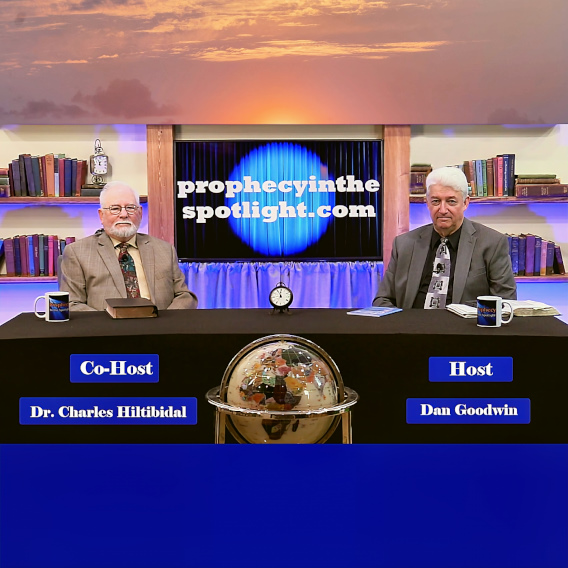
Prophecy In The Spotlight with Daniel Goodwin and Dr. Charles Hiltibidal
Genesis the Book of Beginnings
Genesis as the Prophetic Foundation: Time, Creation, Israel, and the End From the Beginning
Introducing Genesis as the Book of Beginnings
In this episode of Prophecy in the Spotlight, host Daniel Goodwin, joined by co-host Dr. Charles Hiltibidal, introduces a program focused on Genesis and Daniel’s new book, Genesis: The Book of Beginnings. Daniel frames Genesis as essential for understanding the Bible’s foundation, quoting Isaiah 46:9–10 to emphasize that God declares “the end from the beginning.” He argues that the first 11 or 12 chapters of Genesis are among the most important Bible passages for understanding prophecy, doctrine, creation, Israel, and the structure of biblical truth.
Why the First Chapters Matter
Daniel reads from the back cover of his book and explains that readers cannot properly understand the Bible if they skip its beginning, just as they would misunderstand a novel by skipping the opening pages. He argues that many false doctrines and confusing prophecy teachings come from misunderstanding the first chapters of Genesis. Dr. Hiltibidal agrees, saying that errors involving Israel, the law of Moses, Genesis 6, and New Testament interpretation often trace back to misapplication or misunderstanding of Genesis.
Two Parts of Genesis: All Things and the Jewish Nation
Daniel explains that his book separates Genesis into two major parts: the beginning of all things in chapters 1–11, and the beginning of the Jewish nation beginning in chapter 12 with Abram, later Abraham. He says the first section covers creation, mankind as a triune being made in God’s image, sin and its consequences, the flood judgment, and the foundation of nations and globalism. The second section follows Abraham, Isaac, Jacob, and Joseph, tracing the family line that becomes the Jewish people and eventually a nation.
Abraham, Moses, and the Cycle of Movements
The conversation expands into the idea that God often begins major works through one man, such as Abraham or Moses. Daniel and Dr. Hiltibidal discuss how a man becomes a family, then a people, then a nation, while also reflecting on how ministries and movements can begin with conviction and later decay into machines or monuments. They connect that pattern to cycles in Baptist history, Christian history, and Israel’s development, noting that human sin often causes decline until truth seekers separate and begin again on the basis of what they believe is biblical truth.
Moses, Revelation, and the Writing of Genesis
Daniel raises an “interesting thought to ponder” about Moses seeing God’s “back parts” in Exodus 33. He suggests, without presenting it as certain, that this moment may have been connected to how God revealed Genesis to Moses, since Moses was not present for creation or early human history. Dr. Hiltibidal adds that although information may have been passed down through earlier generations, God clearly gave Moses specific insight and understanding as he wrote Genesis. They also note that Genesis is placed first because it is foundational, even though they identify Job as the oldest book.
Genesis 1:1, Time, God, and Creation
The hosts then focus on Genesis 1:1: “In the beginning God created the heaven and the earth.” Daniel identifies several major truths in the verse, beginning with time, then God, then creation. He describes time from humanity’s perspective as past, present, and future, but says that from God’s perspective there is only an eternal present. The hosts connect this to God’s omniscience and fulfilled prophecy. Daniel then emphasizes that “God” appears repeatedly in Genesis 1, saying the chapter makes clear that creation and Scripture are ultimately about God.
Elohim, the Trinity, and the Universe
Dr. Hiltibidal expands on the creation discussion by saying that the Hebrew name Elohim points to plurality and introduces the Godhead from the first verse of Scripture. He argues that Genesis 1:1 reveals time, space, and matter, and that these are inseparable within the created universe. He connects this to Revelation 22:13, where Jesus is called the Alpha and Omega, the beginning and the end, saying this makes sense within the realm of time. The episode closes with Daniel noting that they only had time to “whet” the audience’s appetite, asking viewers to support the ministry, and signing off with the phrase, “keep your eyes on the sky.”
Prophecy in the Spotlight

About Prophecy in the Spotlight
Prophecy in the Spotlight with Evangelist Dan Goodwin and Dr. Charles Hiltibidal
"The most up to date study of prophetical events of our day!” Others have called it “a stunning and even chilling revelation of how close we are to the end of the world!” The purpose of this show is to sound the horn to the people of God. Jesus is coming, and He is coming soon! Global events are happening so fast it is hard to keep up. Everything is in place for the rise of Antichrist. It is time for the saints to awaken; it is time for the church of God to arise from its slumber. The clock is getting ready to strike midnight. Everything on earth is about to change. Woe unto those who are not ready to meet the Lord.
The Show Reveals:
- The 70th and final Jubilee is on the horizon.
- The Bible’s built-in Prophetic calendar.
- The customs of a Jewish wedding and the Bride of Christ.
- The purpose of the Tribulation from the book of Daniel.
- Ten solid proofs of a Pre-Tribulation rapture.
- The reason the Tribulation is measured in days not years.
- The Kinsman Redeemer and the title deed to planet earth.
- Why we may be the last generation.
- A seven thousand year history of the world.
- The identity of the two witnesses.
- When the New Testament really began.
- What in the world is going on.
- The coming blood red moons.
Speaker Identification
Speaker 1 - Host: Daniel Goodwin, also addressed as Brother Dan.
Speaker 2 - Co-host: Dr. Charles Hiltibidal, addressed in the conversation as Doc.
Stage Note - Music or production segment.
Speaker 1 - Host (Daniel Goodwin):
And welcome everybody, Prophecy in the Spotlight here.
I'm your host, Brother Dan Goodwin.
Glad to have everybody listening in today.
We're gonna be doing a show on the book of Genesis.
I have a brand new book.
I've been telling you about, there it is.
Genesis: The Book of Beginnings.
In about 160 pages, I think, and I believe this book's gonna be a tremendous help to you.
It talks about the beginning of all things, as well as the beginning of the Jewish nation.
I wanna read a verse to you, and then we'll bring doc in.
Isaiah 46, nine and 10, I quote these all the time.
Those of you that watch us, you know that I share this a lot.
Remember, well, verse nine, remember the former things of old.
For I am God and there is none else.
I am God and there is none like me.
Then verse 10, declaring the end from the beginning.
And from ancient times, the things that are not yet done.
And I'll stop right there.
God is saying in Isaiah 46 that he tells us the end from way back in the beginning, or where's the beginning, the book of Genesis?
Especially the first 11 or 12 chapters.
And I'm starting to talk about that.
I agree, some of the most important Bible reading you'll ever do in the book of Genesis, the first 11 or 12 chapters.
It sets the foundation for everything.
Very, very important that we get that.
And so we're gonna be talking in today's program about Genesis, the beginning of all things.
And I think you're gonna enjoy it.
I think you're gonna learn something today.
Then go on the website when you get a chance or call the 800 number when it comes by and get on the list to get your book.
Genesis, the beginning of all things.
[Music break.]
Speaker 1 - Host (Daniel Goodwin):
And welcome everybody to the show.
And Doc is with us as usual today, because we had a guest, I think last week we had a guest on.
But we're gonna talk about the book of Genesis.
I've been working on this book for a long time and praise the Lord, it's done.
I'm happy with it.
It went through some changes.
And as all books do, at least when I write a book, things tend to change as you go.
And Doc, let me read for the audience a little bit on the back cover here.
The name of the first book of the Bible is Genesis, which means beginning to fully grasp the truths of the Bible.
It is important to comprehend the principles at the beginning of the Bible.
Of course, that's true if you're reading a novel.
Many of you, I'm sure, have read some books, some novels.
You don't skip the first 10 pages, do you?
No, you're gonna miss the layout of who's who and what's going on in the story.
You gotta have the beginning.
That's true of the Bible.
That's true of biblical truth.
You've got to, there's foundational things set forth for us at the beginning of the Bible.
And almost all false doctrine and hype being spread today by prophecy ministries and preachers across our country has its roots in a wrong understanding of the first 12 chapters of the King James Bible.
And that includes, Doc, that includes this change in our country, people who are having a different view about Israel all the time.
Speaker 2 - Co-host (Dr. Charles Hiltibidal):
Absolutely.
They don't understand what Israel's all about and who they are and what God has in store.
They don't understand what the law that God gave to Moses for Israel.
What's for Israel?
They get it all mixed up and you're right.
Your statement a while ago about these ministries, no matter who they are, have all kinds of ideas of different things out here and are all rooted in a misunderstanding or a misapplication of something out of somewhere in the first 11 chapters or two.
And I've said something similar to this even before I got into prophecy.
One years ago I was telling people a wrong understanding of Genesis 6 leads to a lot of problems later on.
I've shared that here before.
That's just one of the many errors but you're right.
Yeah, absolutely.
That's in the first 11 from chapter.
So that's just proof of what we're talking about.
Not only just a misunderstanding there but then taking out a context versus in the New Testament to try to reinforce their misunderstanding of something out of the Old Testament.
And but it's been an issue for decades of time.
I've been in the ministry over 60 years and I'm telling you what we're talking about here, the misapplicate, it existed in those days in my beginnings.
Yeah, it's just gotten more magnified in those days.
Maybe it's more magnified.
More sci-fi now than ever.
Maybe it's because of the technology of our world today and the ability to discover it in many, many areas where without that you didn't have that contact.
I said here I believe it is vital for the student of prophecy to comprehend the first 12 chapters.
Yes.
Vital.
Yes it is.
And so let me give folks.
I often say Dan, when people come up with some of these ideas that we don't even have to mention who they are or what they are, but when they come up with these ideas that are based in a misunderstanding, I tell them, if you'd just gotten saved and you'd never read a book, you'd never heard a preacher.
You just got saved and you just believe what the Bible said, you wouldn't believe what you're talking about now.
Because the only reason why you believe it now is because somebody inserted those thoughts into your mind and inserted into scripture.
Speaker 1 - Host (Daniel Goodwin):
So in my book, I start off with the preface here.
I say in the following pages, I'm really going to separate the book of Genesis into two parts.
I realize for some of you watching, you've maybe read some study guides and you're saying two parts.
For what I'm doing here, I'm talking about the beginning of things.
For your book.
Yeah.
Yes.
The whole book is a book of beginnings.
And I've separated into two parts.
The bigger part being less versus for some reason, but part one, I call the beginning of all things and that's chapters 1 to 11.
And it's actually two thirds of the book is the first eleven chapters.
Because you could write a whole book just on that.
There's so much in there.
There is.
But if you don't get an understanding of the creation of man and who man is as a triune being in the image of God.
And then you don't understand sin and the consequences.
And you don't understand how that sin brought about the judgment of God in chapter six and chapter six through nine.
And then if you don't understand chapters 10 and 11, you don't understand the foundation of the world and what happened afterward, the globalism and all of that, that we're coming right back to again, just like the Bible says.
Just like you see, you tell, how's it all going to end?
Just like a start.
Yes.
And of course, specifically with a serpent, a bride, and some liberating fruit, serpent being the devil and his minions and the bride, of course, is the church with the bride of Christ, the church, which is his, you know, the bride.
And then the liberating fruit being other sources of truth, other Bibles, other versions, other theological books out there.
When you like to know more, when you like to be able to know more than anybody.
You sound like that serpent now.
Wouldn't you like to have your eyes open and you'd be able to decide what is right and what is wrong?
Let's read these books over here.
You would get a understanding of the scripture.
Yeah.
And I'm not saying that some of these extra biblical books don't have some importance to it.
Sometimes they give you some history.
Sometimes they'll give you an insight to the times in which it was, but it's, it is a scripture.
So part two, of course, the beginning of the Jewish nation.
Yeah.
Chapter 12 of the man named Abram, who's going to become Abraham.
And I wrote here by the way, chapter 12 through chapter 50 ends with Joseph in a coffin in Egypt.
That's right.
And, but that's not the end of my book.
I go further than that, but we'll save that for later.
I wrote this here.
It's Genesis, the beginning of the Jewish nation starts with a man.
And that's, we call him Abraham, but it started out as Abram.
Right.
That's what they man by the way, every great ministry started with a man.
Yeah.
God, God, God, using the man.
God sought a man.
Absolutely.
He didn't seek for a board.
He didn't seek for a, a group of people.
He's God seeks out a man and powers that man.
And that man starts what later on, becomes a movement.
Yeah.
And then the industry.
Yeah.
And then sad to say as time goes by, as years go by and he passes off the scene, he's going to say later on it becomes a machine.
It is.
And then a monument.
And history, you know, that old saying history repeats itself.
Well, I can easily show you and it babbed his history as well as just Christian history.
Everything has a cycle.
Yeah.
Everything has a cycle.
Yeah.
And it always starts the same way and ends the cycle.
Because a man is sinful and things begin to decay.
A man starts something, has principles.
The next guy comes on the scene.
He may change a little bit.
Yeah.
And it's not long.
And it's always the, and it's always the humble, the truth seeker that finally says, okay, I've had enough, you can have it.
We're going over here and start another one based on what we know is the truth.
Yeah.
And it cycles again.
So it starts with a man, Abraham, then a family.
Yeah.
And it's going to be Isaac, Jacob and Joseph.
Yep.
Those four people are going to take us all the way to chapter 50.
That's right.
And I don't remember how many years that is.
We can look it up, but you know, it's a very full generation.
It's almost about from Genesis 1 to chapter 50, you're looking very close to 2000 years.
Yeah.
I mean, from Abraham to Joseph specifically.
Yeah.
That's about four generations.
Yeah.
About 300 or 50 years.
Yeah.
Of course, they lived longer than didn't they?
And then it becomes a people and then a nation.
That's right.
And probably the choosing of Saul is the king.
Would that possibly be the beginning of the nation, so to speak?
Well, the nation, it's obvious the nation developed while they were in bondage.
And they just needed a leader.
They needed Moses, another one of the first.
Here's Moses.
There's going to be the first one to really rally them around God's purpose for them.
They didn't realize their purpose.
They wanted to be like all the other nations of the world.
That developed later.
Yeah.
With the first king of Saul, I guess.
But they'd gone through the judges.
So they spent about 300 years there, but that's another book beyond that.
But yes, they're going to come to a time when they want to be like everybody else.
And I spoke with a preacher today.
And we were talking about some issues in churches.
And he said, the problem today is everybody wants to be, and everybody wants to have casual Christianity.
And it always, it always falls back to that.
But yes, the book is filled with first after first after first.
Yeah.
Moses is the human author.
Yeah.
And I have an interesting thought to ponder.
I don't know if I've ever told you about this brother.
In chapter 33 of Exodus, Moses decides he wants to see.
He says, God, let me see your face.
Of course, God says you can't.
There can no man see me and live.
And another place in the Bible says, in the flesh can no man see God.
You'd be consumed.
And that's the one thing they got right in the in the movie about whatever that movie was.
Raiders of the Lost Ark.
They got that part right when they opened the Ark.
Everybody looked in was consumed.
And I don't know if they got anything else right in that movie from, I think it was in the 70s way back.
Or 80s, I don't know.
But I have a thought about this and I'm not saying I came up with this.
I had a preacher that told me this.
Now, he couldn't tell me where he got it, but he heard it somewhere.
Is it possible that because God said, I can't let you see him, but tell you hide in the cliff of the rock and I'll pass by, but I'll hold my hand up and I'll let you see my back parts. underpart.
That's interesting.
And so is it possible?
And I wrote a little paragraph here about that.
I simply called it an interesting thought to ponder.
I'm not saying that this is true, but it's something to think about.
Could it be that what is being implied in this story is that God gave to Moses the book of Genesis to write down when he showed him his back part?
I mean, Moses wasn't there.
God had to somehow give him the book of Genesis and the beginning of Exodus when he was a baby.
I mean, because his parents could have told that, but Genesis, how could he have known the story of creation and all that?
Because he penned it.
Could it be that these back parts and I do have some scripture for this.
According to John 1 1, the Lord and the Word are one and the same.
In the beginning was the word, the words with God and the words was God.
He's showing himself his back part.
He's showing him the beginning of all things.
Just a thought and not saying them right, but interesting thought.
Somehow or another, God gave him the inside of all of this.
Yes.
And he's going to pin the first five books, Genesis all the way to Deuteronomy there.
And so Genesis tells us the end from the beginning.
The key verse that I chose is Genesis 1 1.
Probably the key verse is probably the entire Bible.
In the beginning, God created the heaven and the earth.
There's a lot in there.
Well, there's a, you know, talking about Moses and having an understanding, it's obvious God gave him what, but you've got to remember that even when Abraham died, Shem was still alive.
So evidently, information had been recorded, information had passed along, but it's obvious that God had to have given specific information and understanding as Moses wrote this.
And let's put it this way, make sure we understand that Genesis is the foundation, but it's not the oldest book.
Right.
Job is the oldest book.
When you study the book of Job, you realize that Job probably lived somewhere around 250 or so years after the flood, just before, I believe, before the time of Abraham.
That's what I've always felt somewhere there.
It seems to be.
And, but when you look at some of the names, Elipaz and other names, and then when you go back and do a little family tree, you realize that some of these are some of the second generation individuals from Shem and Ham and Japheth in that era.
So I'm convinced that.
But as far as the placement of it, it's the beginning of all things.
That's why it's the first book.
And Job goes over into the book of the histories.
Speaker 1 - Host (Daniel Goodwin) and Speaker 2 - Co-host (Dr. Charles Hiltibidal):
In part one, we shed light on the first principles in order of their occurrence.
And that's where I begin chapter one here and begins on chapter and verse, chapter page seven.
And the first thing mentioned that I bring out is beginning in the beginning.
I found four things and there's more than that just in verse one.
And then you shared some things with me and I put those in the book and we're going to talk about that in just a second.
But the first thing that I bring out here is Genesis.
The first thing introduced is time.
Right.
Time, of course, time and space.
I'm always saying he created this universe for 6,000 years inside of time and space, actually 7,000 years, coming to Kingdom Age.
And we say that a lot.
I'm not sure how many people grasp what we're talking about there.
You know, unless you really looked at it in depth and meditated on it, you begin to realize this is so deep.
I could never get to the full understanding of it.
And so I have a whole chapter, a whole section in here about man's perception of time, which is simply we think of time as past, present and future.
And it is from our perspective.
But up there, there is no past or future.
It is.
I call it real time and I can't explain that.
But that's why God said the most as I am.
In fact, I don't know if I- He didn't say I was or a little bit.
I don't know if I changed that.
My proofreader, I was on the phone with him, brother Steve Remi.
He watches our show, I think.
And I had real time in parentheses and neither one of us knew what to do with it.
Yeah.
I mean, it's a modern term in the computer world, real time with cameras.
Now, this is real time.
In other words, I guess it's happening now or something.
But that's all there is in heaven.
In God's it's something he sees, he sees all the way back to Adam.
He sees all the way to- I almost named him, but the Antichrist- but anyway, and I'm just joking.
He sees the beginning from the end.
We don't understand that because we don't understand time.
That's why when we see the fulfilled prophecies, it tells us we have a God that's omniscient, knowing all things, and he has given us information through prophecy to help us have an understanding of our time.
Yeah.
The second thing I see in the beginning, God.
Oh, yeah.
In the beginning, God.
God is introduced in the book.
That's right.
In the first verse, you think maybe this is all about him?
It is.
The first mention of God, and this is a book that's all about God.
And it's everything's about him.
So I did a little looking at the word God.
I found out how many times in the Bible it was.
It was over 3,000 times.
I mean the word God.
Not the word Jesus, the word God.
And I found that 200 times it's in Genesis.
But then I found out 32 times in chapter one.
And in fact, no other chapter in the Bible from Genesis to Revelation has a chapter with that many many times.
Mention of God.
So here at the first chapter, first principles, God wants to make sure we know he's in the middle of this.
Yeah, right.
And the name God comes from the word Elohim.
Eloah, God.
But he means plural.
And in Hebrew, in English, two or more is plural.
We're plural to two of us.
But in Hebrew, you have to have three or more.
So there's the Trinity.
So you have your introduced immediately to the Godhead.
God, the Father, God, the Son, God.
That's why when you get over to John chapter number one, you find out that Jesus who is the word not only was with God, who is God, but not anything was made that he did not make.
In the beginning God.
Yes.
And then we've got the creation story and we're going to get to yours and right here just the second doc.
The creation story in the beginning God created.
Yes.
And I talk here about the theory of evolution.
We were all taught in school is a lie.
Yeah.
It is the first verse of the Bible that says he created everything out of nothing.
That's right.
Webster's and by the way, Webster's 1828 backs up what you told me earlier.
Particle, create means to produce from nothing.
That's right.
So the word, the Hebrew word, bara, you know, a lot of times we will say, we'll see a picture and a artist is drawn or we'll see a sculptor that a sculptor has made.
It's unbelievable.
We said man, what an awesome creation or an architectural man.
I mean, how in the world did they build this magnificent thing?
Wow, what a creation.
No, they had something to start with.
The word, bara, means to bring into existence what did not exist before.
Yeah.
You build a house.
You know, you think you did it, but you started with something.
You got all these materials you got.
But on day number one, the one that brings the most important product, the most important material together on day number one, which didn't exist before that day.
Yeah, I have a paragraph.
I talk about what we call the creative week and I have some interesting stuff here, but we can't give them everything.
Oh, no.
The fourth thing I found was the gap.
The book won't have everything because none of us could explore the depth of the book.
The gap theory is refuted in the first two verses, I should say.
Yeah.
And we won't get into that.
That's the whole lesson in the set.
And in that first verse that we just now talked about, creation.
There was nothing before.
So if there is a gap in time, that must have been something before that.
That's right.
Anyway, so anyway.
Yeah, good point.
So, Doc, I added something that you brought in and it's in the book about this thing about time, but you went a little further with it.
I want you to share that.
Speaker 2 - Co-host (Dr. Charles Hiltibidal):
Well, of course I've been involved in science and creation for 41 years.
And so I often see things maybe different than a lot of people because of that influence.
But when you look at it, you realize and your King James Bible is right when it says heaven.
You're going to read many people will say, what means heavens?
Because they realize there's the heaven and the realm in which we live, the heaven of the celestial and then the heaven above and so heaven.
We can't have it.
And so, but it says in the beginning, that's time.
And I tell folks, well, when you go to the last chapter in the book of Revelation, verse number 13, chapter 22, verse 13.
He said, I'm the Alpha and the Omega.
I'm the beginning and the first and the last.
And I always ask people in the congregation, I said, can anybody tell me what an everlasting, forever being Jesus, God.
What's he the Alpha and the Omega of the beginning and the first and the last of?
What?
It's time because time, as you've already said, outside of creation is not a relevant factor, but in the realm of time, it is a major factor.
And all of that revolves around the person of Jesus.
And so, when you look at it and you realize that on day number one, God brought three things on day number one.
He created time first.
Time, space, and then inside of space, He put matter, the heaven and the earth.
Now the earth is not going to be formed in the form in which we see according to chapter one, until day number four.
So He brings together something that didn't exist before.
Verse number two tells us what it was.
He said, the earth was without form and void and darkness was upon the face of the waters and the spirit of God moved upon the face of the waters.
So on day number one, God brought three things together that is not a trinity, it's three parts, but it's not called a triverse, we call it a universe because it's put together in a way that they do not, one depends on each other, you can't separate them.
So that tells me that when we see the term in the beginning, God, we're introduced immediately to the trinity because God is a uniplural God.
That's why we have a universe.
So we find the trinity.
There are many other things, but in verse number one, it's some wonderful truth.
The trinity and everything in creation literally is a reflection of the character of God.
Time, space and matter.
Speaker 1 - Host (Daniel Goodwin):
Speak at a time.
We're running out of here.
Oh, it's gone.
On the show and didn't get as far as we'd like.
We're just trying to whet your appetite.
Some great stuff in here.
Remember, we're viewer-supported.
We need your help to stay on the air.
I promise you, all your money is put to good use and Doc and I don't get any of it.
It goes to be keeping us on the air.
If you can help, we'd like to hear from you.
Until next time, keep your eyes on the sky.