
Have you ever heard a song and been transported instantly to another time and place?
Perhaps it reminded you of childhood: a holiday, a friendship, a special moment you had not thought about for years, or perhaps a particular smell has triggered a vivid memory. (Think freshly cut grass, the ocean, a favourite meal or a familiar perfume). Before you consciously think about it, your body seems to know.
Many years ago, I experienced something that has stayed with me ever since. As a child, I had to walk across a narrow plank to board a boat during rough weather. I remember the movement beneath my feet, the uncertainty and the feeling of fear as the storm tossed the water around me.
Today, many years later, I can still notice a physical response when boarding a boat. My mind knows I am safe and yet something within my body remembers the experience.
Most of us have examples like this. For example: the body remembers how to ride a bicycle, a dancer's body remembers movement patterns practiced thousands of times, a musician's fingers find notes without conscious thought or a swimmer remembers the rhythm of the water. The body learns through experience and this invites an interesting question. If the body remembers movement, skills and sensations, what else might it remember?
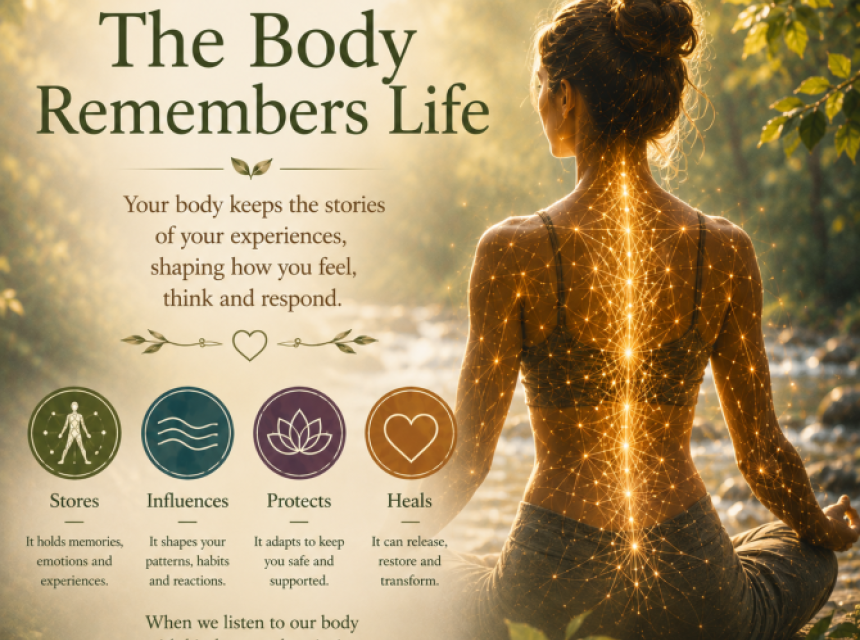
For generations, memory has largely been associated with the brain. Things like remembering names, recalling facts or retaining information. Yet our lived experience suggests that memory may be much richer than this. The body appears to remember life itself.
-
The taste of a childhood medicine.
-
The comfort of a loved one's embrace.
-
The nervous excitement before stepping onto a stage.
-
The feeling of climbing trees.
-
The smell of a place once visited.
The body is constantly learning from experience as every experience leaves some form of imprint. This is not necessarily as a conscious memory, but often as a pattern, a sensation or a familiar response.
Modern science is increasingly exploring the relationship between memory, emotion, physiology and the nervous system. At the same time, many traditional cultures have long recognised that experiences influence the whole being. Stories, movement, ceremony, song, dance and connection to nature were often woven into daily life as ways of helping people process and integrate their experiences. Knowledge was not simply something that lived in the mind but it was lived through the body.
This understanding has important implications for learning. Think about a learner who was laughed at while reading aloud or a student who was told they were "bad at maths." Alternatively, a young person who experienced success while creating, building or performing. Years later, those experiences may continue to influence how they approach learning. Sound familiar? This has nothing to do with ability but because the body and nervous system have learned patterns through experience.
This is true for adults too. Many of us carry stories about who we are and what we are capable of becoming. Some of those stories support us and some limit us. The encouraging news is that the body is not only capable of remembering old experiences. It is capable of learning new ones. Just as a path becomes established through repeated use, new pathways can also be created.
-
New experiences create new possibilities.
-
New experiences create new evidence.
-
New experiences create new stories.
Perhaps this is one of the reasons embodied learning is so powerful because learning is not simply about receiving information but about creating experiences that help us see ourselves and the world differently. There is another fascinating question worth contemplating.
Most of us are familiar with the five senses: sight, sound, touch, taste and smell. Yet many people also describe experiences that seem more difficult to explain: a knowing, a feeling, a sense of resonance or a moment of certainty without obvious evidence. Perhaps these questions belong to another conversation and yet they invite us to remain curious about what it truly means to perceive and experience the world.
For now, perhaps the most important thing to remember is that the body is not simply carrying us through life, it is learning alongside us. Adapting. Responding. Remembering. And perhaps one of the greatest gifts we can offer ourselves is curiosity.
Because when we become curious about our patterns, we create the possibility of choosing new ones. The body remembers life and every new experience offers an opportunity to shape what comes next.
Micro Practice
Body Memory Awareness
Think of a meaningful memory. Not necessarily a difficult memory, simply one that carries significance for you.
Notice:
- What happens in your body?
- Does your breathing change?
- Does your posture shift?
- Do you notice warmth, ease or tension?
Place a hand on your chest. Take a slow breath. Simply observe. There is no need to analyse, just notice.
Reflection Questions
- What memories create a strong physical response in me?
- What smells, sounds or tastes instantly trigger memories?
- What skills or experiences has my body remembered over time?
- What patterns do I notice repeating in my life?
- What new experiences am I ready to create?
Weekly Integration
Throughout the week, notice moments when your body responds strongly to an experience.
Pause and ask: Is this response connected only to the present moment? Or could it also be connected to something my body has learned before?
Approach the answer with curiosity rather than judgement.
Cultivating self-trust. Nurturing wisdom. Inspiring contribution. Strengthening community.
I invite you to connect to a weekly 30-minute podcast, ‘All Learning Reimagined’. https://bbsradio.com/alllearningreimagined
Discussions share wisdom enhanced by a short article with practical activities to assist with exploring, experiencing, expressing and living learning.
In-joy and gratitude!
Teresa
(c) All Rights Reserved 2026