
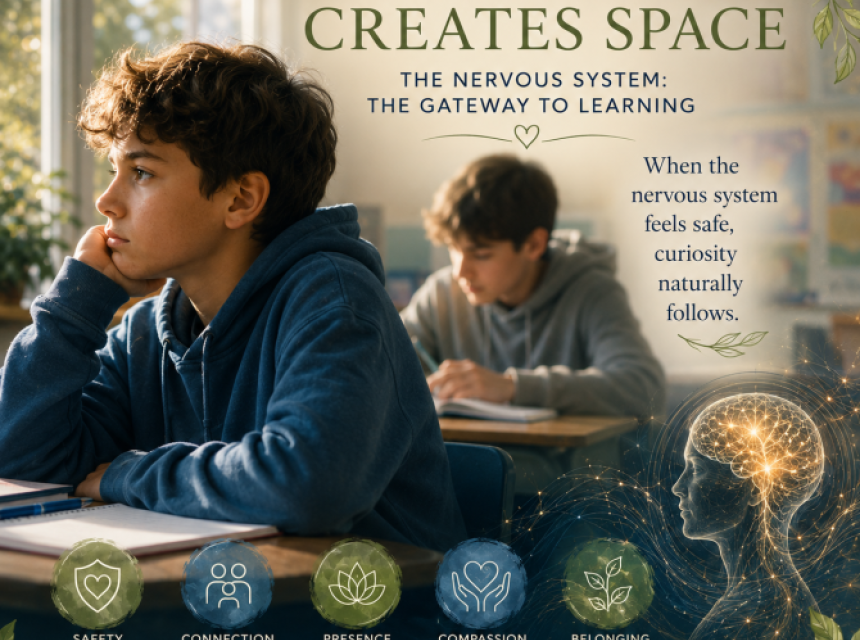
Imagine two students working together on a science project. Earlier in the day, during lunch, they had an argument on the soccer field and harsh words were exchanged and their feelings were hurt. The bell rang and both students returned to class.
The teacher asked them to continue working together on their science investigation. From the teacher's perspective, the conflict was over. The lesson had begun and the timetable had moved on and yet... one student struggled to concentrate. They were distracted. Quiet. Defensive. They contributed very little to the task. The teacher might wonder why they were not engaging. Why weren't they participating? Why weren't they focusing?
But perhaps a different question is needed. What if the student's nervous system was still responding to the conflict from lunch? The body does not always move on as quickly as the timetable does.
This simple example, which actually happened in real life, highlights something increasingly recognised by educators, psychologists and neuroscientists alike: Before we can learn, we often need to feel safe. Many of us have been taught that learning happens primarily in the brain. We tend to focus on intelligence, effort, motivation and behaviour. While these factors certainly matter, they do not tell the whole story.
The nervous system plays a profound role in shaping our ability to learn, connect and grow. At every moment, the nervous system is scanning the environment. Not asking, "Can I learn?" But asking, "Am I safe?" This process happens automatically and largely outside of conscious awareness. It is part of a sophisticated survival system that has helped living beings navigate uncertainty for thousands of years. When the nervous system perceives safety, curiosity naturally expands.
-
Creativity becomes more accessible.
-
Problem-solving improves.
-
Connection deepens.
-
Learning flows more easily.
When the nervous system perceives threat, however, attention narrows. The body prioritises protection. Resources that might otherwise support learning are redirected toward survival. Importantly, the nervous system does not only respond to physical danger.
Social and emotional experiences matter too such as: conflict, embarrassment, rejection, uncertainty, feeling excluded or judged. All can influence our internal sense of safety. This understanding invites us to view behaviour through a more compassionate lens. Sometimes what appears to be resistance may actually be protection. Sometimes what appears to be disengagement may be overwhelm. Sometimes what appears to be lack of motivation may be a nervous system asking for safety.
Ancient cultures have long recognised the importance of relationship in learning. Knowledge was often shared through story, observation, participation and connection to community. Learning was rarely separated from belonging.
Today, modern science is beginning to reveal why these approaches may have been so effective. Humans are relational beings. We learn best when we feel connected: to ourselves, to others, our environment and to a sense of purpose.
This understanding has profound implications for education.
Imagine two learners receiving the same lesson from the same teacher using the same resources. One learner feels calm, connected and supported; the other feels anxious, uncertain or disconnected. The outcomes may be dramatically different even though the learners are of similar intelligence. This is because they are operating from different nervous system states. This is not only true for children but adults experience it too.
Most of us have attempted to focus on a task while replaying a difficult conversation in our minds. Many of us have forgotten information during a presentation despite knowing it well. We have all experienced moments when our body was physically present but our attention was somewhere else. The more we understand the nervous system, the more compassion we can develop for ourselves and others. Rather than asking, "What is wrong with this learner?" Perhaps we can begin asking: "What does this learner need in order to feel safe enough to learn?"
That single shift in perspective has the potential to transform classrooms, families, workplaces and communities because when safety is present, curiosity often follows. And where curiosity flourishes, learning becomes possible.
Micro Practice
Safety Scan
Pause for a moment. Look around your environment. Slowly notice:
- Five things you can see
- Four things you can hear
- Three things you can touch
- Two things you can smell
- One thing you appreciate
Take a slow breath. Notice how your body feels. No need to change anything. Simply observe.
Reflection Questions
- When do I feel most calm and curious?
- What environments support my learning and growth?
- What situations tend to create contraction or stress?
- How does my body communicate that I feel safe?
- What helps me return to a state of calm and connection?
Weekly Integration
Throughout the week, become a curious observer of your nervous system. Notice moments when you feel:
Expansion - Curious, connected, creative or engaged
Contraction – Defensive, distracted, overwhelmed or withdrawn
Rather than judging these experiences, simply notice them. Ask: "What might my nervous system be communicating right now?"
Cultivating self-trust. Nurturing wisdom. Inspiring contribution. Strengthening community.
I invite you to connect to a weekly 30-minute podcast, ‘All Learning Reimagined’. https://bbsradio.com/alllearningreimagined
In-joy and gratitude!
Teresa
(c) All Rights Reserved 2026


