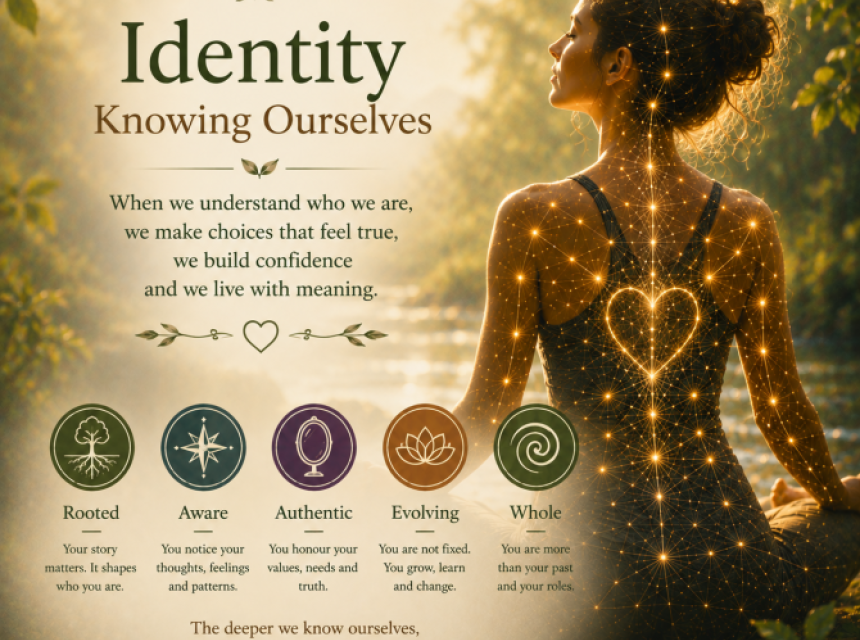
Who are you?
At first glance, the question seems simple. Yet the longer we sit with it, the more interesting it becomes. Many people answer with their name, occupation or role. "I am a teacher." "I am a parent." "I am a student." "I am retired." These descriptions may tell us something about what we do, but do they tell us who we are?
And if those roles changed tomorrow, would we still be ourselves?
Perhaps one of the most important forms of learning is learning to know ourselves. Not who others expect us to be or who we were told to be. Not who we were yesterday but who we are now. Throughout life we are influenced by many things.
-
Family and friends.
-
Culture and stories
-
Schooling and experiences
-
Media and social expectations.
-
Successes and failures.
Over time these influences shape how we see ourselves. Sometimes they support us and sometimes they limit us. And often we carry them so long that we stop questioning whether they are actually ours. This is where awareness becomes powerful.
Have you ever walked into a room feeling calm, only to suddenly feel anxious or unsettled? Have you ever spent time with someone who was stressed and noticed your own mood changing? Have you ever listened to music, watched a film or spent time scrolling online and noticed a shift in how you felt? Many of us experience these things every day. Yet rarely do we stop to ask, ‘Is this mine? Or am I responding to something around me?’
Just as we learn to recognise physical weather, perhaps we can learn to recognise energetic weather. Some environments feel uplifting and others feel heavy. Additionally, some conversations leave us inspired while others leave us drained. Awareness allows us to pause and discern. To notice what belongs to us and what may simply be passing through our experience.
Throughout this Embodied Intelligence Series, we have explored the body as a communicator where the body remembers, responds and perceives. Perhaps the body also acts as an antenna, constantly receiving information from the world around us. This can feel like: a tightening in the stomach, a sense of expansion, a feeling of excitement or a quiet knowing. The body often notices before the mind understands.
This becomes particularly important when we consider identity. Many of us carry labels that were formed years ago. "I am shy." "I am not creative." "I am bad at math." "I am not good enough." Sometimes these identities began with a single experience, other times they were repeated by others. Sometimes they were inherited from our environment. Over time they became familiar and familiarity can easily be mistaken for truth. Yet one of the most powerful realisations we can have is that we cannot consistently outperform the identity we believe ourselves to be. If we believe we are incapable, we often act accordingly. If we believe we are unworthy, our choices frequently reflect that belief. If we believe we are limited, we often remain within those limits.
The challenge is not merely changing our behaviour but the invitation is becoming aware of the identity beneath it. This is where embodied intelligence offers a different perspective. Rather than asking only, "What do I think?" We can also ask, "What do I feel? What does my body notice? What expands me? What contracts me? What feels aligned?
What if self-knowledge begins with learning to listen?
Not only to our thoughts but to our bodies, our experiences, our patterns and our inner knowing. This does not mean every feeling is a message or every thought is truth.
Discernment remains important.
Awareness comes first.
Then observation.
Then choice. And perhaps that is one of the greatest gifts of self-knowledge.
Choice.
The ability to recognise an old story and decide whether it still belongs. The ability to recognise an inherited belief and decide whether it still serves. The ability to ask, does this align with who I choose to be now? Knowing ourselves is not a destination. It is an ongoing relationship, a lifelong conversation or a process of paying attention. Of noticing. Of becoming increasingly familiar with our own signal amidst the many signals surrounding us.
Our goal is to become more fully ourselves instead of a version shaped by expectation but the version shaped by awareness, discernment and conscious choice. Consider perhaps one of the greatest adventures we can undertake is not exploring the world around us, but exploring the world within us. Because the more deeply we know ourselves, the more authentically we are able to live.

Micro Practice
Is This Mine?
Several times throughout the week, pause when you notice a strong emotion, thought or reaction. Ask:
-
Is this mine?
-
Did this begin within me?
-
Am I responding to something around me?
Place a hand on your heart and take a slow breath. Then ask, what feels true for me right now? Notice without judgement, simply observe.
Reflection Questions
- What labels have I carried throughout life?
- Which ones still feel true?
- Which ones am I ready to release?
- What beliefs about myself were inherited?
- What helps me feel most authentic?
- Who do I choose to be now?
Weekly Integration
At the end of each day ask, what did I learn about myself today? Not about the world but about yourself. Even a small insight is worth noticing.
Universal Law Connection
Vibration
Everything communicates through patterns and signals. As awareness deepens, we become better able to recognise:
- our own signal
- the influence of our environment
- the stories we carry
- the patterns we repeat
A question worth contemplating, what frequency am I choosing to cultivate?
Cultivating self-trust. Nurturing wisdom. Inspiring contribution. Strengthening community.
I invite you to connect to a weekly 30-minute podcast, ‘All Learning Reimagined’. https://bbsradio.com/alllearningreimagined
 Discussions share wisdom enhanced by a short article with practical activities to assist with exploring, experiencing, expressing and living learning.
In-joy and gratitude!
Teresa
(c) All Rights Reserved 2026