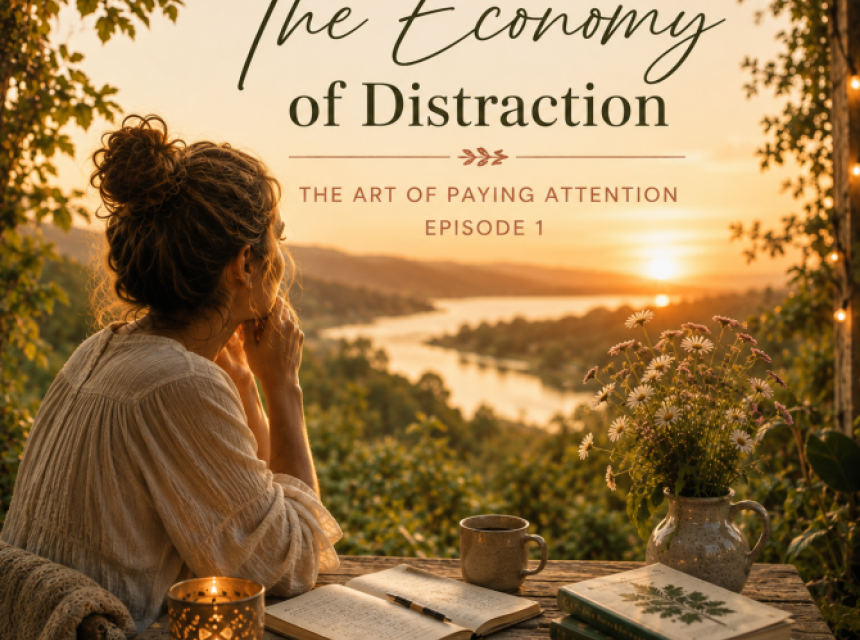
There is something incredibly valuable that each of us carries every day. It cannot be bought back once it has passed, yet it influences what we notice, what we learn, the relationships we nurture, the memories we create and ultimately how we experience our lives. It is our attention, and increasingly, everyone seems to want a piece of it.
We live in an extraordinary time. Technology connects us with people across the planet, gives us immediate access to information and allows us to learn, create and communicate in ways previous generations could scarcely have imagined. There is much to appreciate about this, yet every gift invites responsibility. We also live within what has become known as an attention economy, an environment where our attention has enormous value and where social media platforms, advertisers, news outlets, streaming services, games and apps compete for our eyes, our clicks and our time.
Notifications invite us back, videos automatically begin playing, one piece of content effortlessly rolls into another and personalised feeds become increasingly skilled at offering us more of what holds our interest. None of this requires a blame game. These tools can entertain us, educate us, connect us and inspire us, so perhaps the more useful question is not whether technology is good or bad, but whether we are consciously choosing where our attention goes.
Weapons of mass distraction?
There is something both humorous and uncomfortable about describing social media and our devices as weapons of mass distraction. Our phones can be extraordinary tools, yet how often do we pick one up to check something and discover, ten minutes later, that our attention has travelled somewhere entirely different?
Perhaps the concern is not that we become distracted occasionally. Minds wander, life interrupts us and sometimes we simply enjoy disappearing down an entertaining rabbit hole. The more interesting question is what happens when interruption becomes our normal state, particularly as this increasingly enters the world of children whose brains, habits and ways of relating to their environment are still developing.
Children today are growing within an environment of rapid stimulation, short videos, instant entertainment, notifications and almost unlimited information. Rather than approaching this reality with fear, judgement or a desire to return to some idealised past, we can become curious about the capacities we want children to retain and cultivate alongside their technological fluency. Can they become deeply absorbed in something they love? Can they tolerate moments of boredom long enough for imagination to appear? Can they listen to another person without needing additional stimulation, follow their curiosity for an extended period, observe an insect, build something with their hands, stare at clouds, invent a game or lose themselves in creating something?
Technology does not need to disappear for these capacities to flourish. They simply need somewhere to grow.
Over many years working in education, I noticed changes in the way many children engaged with learning. It wasn't that they were becoming less intelligent; if anything, they had access to more information than any generation before them. What I increasingly noticed was interruption. Sustaining attention could be difficult, yet when we changed the conditions by stepping outside, creating something with our hands, exploring a question that genuinely interested them, moving our bodies or simply slowing the pace, something often shifted. Natural curiosity reappeared.
It made me wonder whether attention is something we need to force at all, or whether it is something we cultivate.
Perhaps distraction isn't even the true opposite of attention.
Perhaps it is disconnection.
When our attention is continually fragmented, we can gradually lose connection with our bodies, with the people sitting beside us, with nature, with creativity and even with our own thoughts. Attention brings us back into relationship with what is actually here.
The things that matter rarely shout
Nature offers an interesting contrast to the attention economy because nature has never sent us a notification, yet it has always invited our attention. A bird doesn't interrupt us to insist that we listen; it simply sings. The wind doesn't compete for our awareness or demand that we look up from what we are doing; it simply moves through the trees. A flower doesn't chase us down the street asking to be admired, and the stars don't need an engagement strategy to keep shining.
Perhaps this is one of nature's quieter lessons. Some of the deepest and most nourishing aspects of life rarely shout for our attention. They remain present, patiently waiting for us to notice.
A child's changing expression, the colour of the evening sky, the sound of someone we love laughing, the feeling of sunshine on our skin, an animal quietly settling beside us, the first new leaf on a plant or a conversation that deserves our full presence can easily be overlooked when our awareness is continually captured by whatever is loudest, newest or most stimulating. There is an important distinction here between something that captures our attention and something to which we choose to give our attention. One is largely automatic; the other involves awareness and choice.
Your body is paying attention too
Attention isn't only happening in the mind. The body participates in the experience, which means we can begin observing how different qualities of attention feel physically.
Consider what happens when you move rapidly between messages, notifications, conversations, news, emails and unfinished tasks. Perhaps your breathing becomes shallower, your shoulders tighten or your thoughts begin racing. Now compare that with a time when you were completely absorbed in something you loved, perhaps gardening, fishing, painting, cooking, walking beside the ocean, playing music or talking with someone who mattered to you. For a while there may have been no desire to check the time or reach for your phone because you were simply there, fully engaged in the experience.
Our bodies can offer valuable information about the quality of our attention if we remember to listen. We can become increasingly familiar with the difference between being captured, being scattered and being deeply engaged.
What are you giving your attention to?
A gardener notices the soil, a fisherman notices the tides, an artist notices light, a parent notices a subtle change in a child's expression and a tracker sees footprints that others walk straight past. Wisdom often begins with noticing, because what we repeatedly give attention to becomes increasingly prominent within our awareness. We become familiar with it, develop a relationship with it and often become more skilled at perceiving its subtleties.
This may be one reason attention is far more powerful than we realise. Before intention comes attention. Before we can consciously choose what we want to cultivate, we first need to notice where our energy is already going.
Reclaiming our attention, therefore, does not require us to delete every app, throw away the television or abandon technology. It begins much more simply with awareness and a willingness to become curious about our own patterns.
Consider:
- What receives most of my attention each day?
- How much of that attention is consciously chosen?
- What continually captures me even when I intended to be doing something else?
- What have I stopped noticing?
- What deserves more of my attention?
- Does the way I spend my attention reflect what genuinely matters to me?
There is no universally correct answer because our lives, responsibilities and priorities are different. These are not questions of right or wrong; they are questions of awareness, discernment and choice.

This week's experiment: Leave your phone inside
Sometime this week, leave your phone indoors and step outside for ten minutes. Don't try to meditate, achieve a particular state or force yourself to be present. Simply sit somewhere and notice.
Allow your attention to move through your senses. What can you hear? What can you smell? How many colours and textures can you see? What is moving and what is completely still? What can you feel against your skin? Notice your body too, including the urge to get up, reach for your phone, think about what needs doing next or mentally fill the silence. There is nothing to fix. It is all simply information.
Perhaps you will notice an ant carrying something impossibly large, hear a bird you have never consciously distinguished before, feel the breeze change direction or watch an insect visiting a flower. Perhaps nothing remarkable will happen at all, and that is part of the experiment too.
When the ten minutes are over, ask yourself:
What was here all along that I had stopped noticing?
Then, sometime during the week, take the experiment into relationship by offering another person your complete attention. Put the phone away, listen without interrupting, resist preparing your response while they are speaking and notice what changes when your attention is no longer divided.
Attention does more than shape our individual experience; it shapes the experience of those around us. In a world where so many things compete to capture our awareness, perhaps one of the most generous things we can offer another living being is remarkably simple: our presence.
Life is always inviting our attention. Perhaps this week, rather than automatically following whatever calls the loudest, we can begin noticing what has been quietly waiting to be seen.

Cultivating self-trust | Nurturing wisdom | Inspiring contribution | Strengthening community
I invite you to connect to a weekly 30-minute podcast, ‘All Learning Reimagined’. BBSRadio 6am Saturday AEST or 3pm Friday CT
https://bbsradio.com/alllearningreimagined
 Discussions share wisdom enhanced by a short article with practical activities to assist with exploring, experiencing, expressing and living learning.
In-joy and gratitude!
Teresa
(c) All Rights Reserved 2026