
All Learning Reimagined, September 4, 2026

All Learning Reimagined with Teresa Songbird
Episode 4 of series on The Art of Paying Attention
Presence Creates Relationship
The Gift of Attention: How Presence Shapes Learning and Connection
Summary
The Final Chapter of the Attention Series
Teresa Songbird closes the four-part Art of Paying Attention series by focusing on how presence creates relationship. She briefly revisits earlier episodes about the economy of distraction, attention shaping reality, and nature training attention. She explains that relationships underpin learning and extend beyond person-to-person interaction to animals, nature, and the environment. Her central question asks when listeners last gave someone their complete attention without devices, distractions, or mentally preparing a reply. She frames genuine listening as an experience that can make a person feel seen, heard, safe, and clearer about themselves. The episode develops from that idea into a broader exploration of attention as a form of care.
Divided Attention and the Value We Communicate
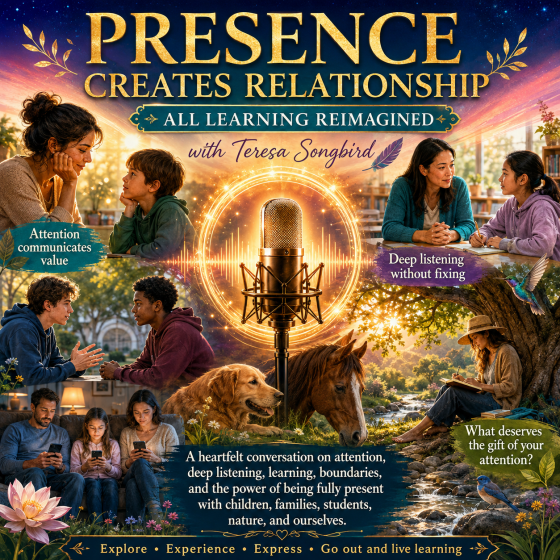
The host examines how phones, television, email, notifications, and multitasking can create divided presence even when people are physically together. She describes families, couples, friends, and adults with children being pulled away from conversations by devices. Teresa does not present this as a judgment and acknowledges that she also falls into these habits. Her concern is what divided attention may unintentionally communicate about the value of the person in front of us. She emphasizes that attention communicates value, especially to children whose inner worlds are being shaped through their interactions with adults. She also expands listening beyond words to include breathing, posture, facial expressions, silence, energy, and bodily cues.
Deep Listening Without Immediately Fixing
Teresa explores relational awareness by asking listeners to notice both what is happening in another person and what is happening within themselves. She reflects on the tendency of teachers, friends, and helpers to move immediately into problem-solving when someone says they are struggling. Although advice often comes from care, she suggests it can interrupt a process in which the other person is discovering an answer for themselves. Deep listening, in her view, communicates trust and creates space for people to hear themselves more clearly. She says presence can sometimes be more useful than advice, while acknowledging how difficult sustained one-on-one presence can be in a busy classroom. She connects her ability to become more present with being outdoors, slowing down, and allowing her nervous system to settle.
Presence Beyond Words and Through Disagreement
The episode broadens from human conversation to animals, nature, and nonverbal communication. Teresa describes connection with dogs, horses, cats, birds, plants, and ecosystems as examples of relationships that can involve proximity, movement, breath, touch, and observation rather than constant words. She also reflects on sensing tension or joy in a room and on her curiosity about what may pass between living beings beyond ordinary verbal communication. A key example involves two teenagers who were disagreeing while still giving one another their complete attention. From that observation, Teresa argues that deep listening does not require agreement and that presence can coexist with different perspectives. She asks whether people can continue listening to comprehend instead of listening only to defeat an opposing view.
Boundaries, Burnout, and Children's Inner Worlds
Teresa makes a strong distinction between presence and unlimited access to another person's energy. Drawing on her own experience of burnout, she says that a lack of boundaries led her to help others at the expense of her relationship with her own inner presence. She encourages parents, teachers, leaders, educators, and others to establish their own presence first, take genuine breaks, seek quiet, and stop treating constant self-sacrifice as sustainable. She then turns to how children often communicate indirectly - while drawing, riding in a car, or telling long stories that may seem unimportant to adults. Rushing children, half-listening, or continually correcting them may teach them that their inner world does not deserve space. By contrast, attentive presence can communicate that they matter and can help shape self-worth, trust, and a child's ability to listen to themselves.
The “Tell Me More” Practice and the Gift of Attention
For the week's micro-practice, Teresa asks listeners to choose one conversation, put the phone away, and release the need to fix, advise, interrupt, compare, one-up, or prepare the next response. She asks listeners to notice the other person's words, pauses, expressions, tone, body language, and their own bodily responses. The central prompt is simply, “Tell me more,” followed by quiet space rather than immediate evaluation. Teresa also recommends acknowledging people through specific observations, such as noticing patience, care, enthusiasm, or initiative, rather than relying only on general praise. She closes the series by connecting attention with relationship to self, body, ideas, possibility, nature, other people, and life itself. Her final question is not what demands attention, but what truly deserves the gift of attention right now.
All Learning Reimagined

Please help support this show!
Support this show by subscribing
$5.99/mo or $9.99/mo or more
Click HERE
All Learning Reimagined: Where passion meets possibility, one story at a time.
All Learning Reimagined is a global podcast exploring the many ways we learn, grow, create, and contribute throughout life. A gathering place for people who know that the future is something we learn, create, and steward together.
While education is often where the conversation begins, this podcast reaches far beyond classrooms and curriculum. Together, we explore learning as a living process that unfolds through relationships, community, nature, creativity, curiosity, experience, and the pursuit of what brings us alive. Through inspiring conversations with parents, educators, authors, visionaries, community leaders, and everyday people, we share stories that expand what learning can be and how it shapes our families, communities, and world.
Drawing from diverse perspectives, indigenous wisdom, practical experience, emerging ideas, and timeless principles, each episode offers insights that nurture self-direction, discernment, contribution, and a deeper connection to what matters most.
Whether you are a parent, educator, learner, creator, community builder, or simply curious about what is possible, All Learning Reimagined invites you to explore meaningful questions, fresh perspectives, and inspiring stories from around the world. Because learning is a living journey to nurture.
Cultivating self-trust. Nurturing wisdom. Inspiring contribution. Strengthening community.
Speaker Identification
Speaker 1 - Teresa Songbird - Host
Details for the speaker
The host identifies herself as Teresa near the beginning of the program, and the closing theme names Teresa Songbird. She delivers the full episode discussion about attention, presence, learning, relationships, boundaries, children, nature, and the weekly micro-practice.
Speaker 2 - Prerecorded Theme / Program Voice
Details for the speaker
A separate prerecorded opening and closing theme introduces and concludes All Learning Reimagined. The transcript does not establish the identity of the theme performer or announcer, so no personal identity has been assigned.
Speaker 2 - Prerecorded Theme / Program Voice:
There is another way to learn, where questions open doorways, where wonder leads us home, where every heart remembers the wisdom it has known. All Learning Reimagined, where passion meets possibility, with Teresa Songbird. Come explore what learning can be for parents, teachers, seekers, and dreamers. Learning comes alive.
Speaker 1 - Teresa Songbird - Host:
G'day, and welcome to All Learning Reimagined. I'm your host, Teresa, bringing you a little ray of sunshine as together we're reimagining the future of education, one inspired story at a time.
I wanted to say welcome back, everybody, and thank you so much to all of the listeners out there who have been reaching out and giving me great feedback on how much you're enjoying the Art of Paying Attention series. This is the fourth episode and the final episode in the series.
If you missed it, episode one was around the economy of distraction: where is my attention going? The activities and micro-practices for that were really quite deep. I found that I personally shifted when I actually slowed down, observed, and took notice of where my attention was going.
Episode two looked at how attention creates our reality, and yes, it has very much to do with how it creates our reality. That was actually my favorite episode. There was so much in there to dive into.
Last week, we looked at how nature trains our attention. Those of you who listen to me regularly know how much I love nature and the natural way. It just feels like - I don't know - I feel really connected with it as the path of going back to the natural way, getting out of my headspace and overthinking constantly, and tapping back into my whole metaphysical body and my heart space.
So that is where we're launching from today. Episode four is about how presence creates relationships, which underpin everything that we do and are especially important when it comes to the topic of learning. It doesn't even have to be a relationship between two people. It could be relationships with animals, nature, and the environment, but that presence is really important.
My opening question to you today - I don't have a story, but sort of a story or a question - is this: When was the last time you gave someone your complete attention? That means no devices, no distractions, and no thoughts in your head where you're nodding and half-listening to them while actually thinking, “What am I going to say next?” or “What do I need to get from the shops this afternoon?” or anything like that.
It's not checking your phone or waiting for your turn to speak. It's actually listening - really listening. And how did that feel? Most of us know the difference immediately, and children sense this. Young children in particular really sense this.
Think of a time when you needed to talk to someone who simply was just with you. They didn't interrupt. They didn't offer solutions or advice. They didn't try to change how you felt. Often, they barely said anything. They were just present.
For me, sometimes when I leave those conversations, I don't remember what that man, woman, or child said. It's how I felt in their presence. I felt seen, heard, safe enough to speak, and sometimes even clearer about myself.
This really makes me stop and wonder if attention is a form of care, because someone who will sit in your presence and give you their whole attention cares for you. Think about a mother or father with a newborn baby and how they can just pour all of their attention into that baby. But as that child grows up, do we still keep that care and attention? Yes, but do we still keep that focus, that presence, when we are with them?
Lately I've been noticing, and these were my questions to ponder this week that I wrote down when I was journaling: When someone's speaking to me, am I listening to them, or am I just preparing my response - what I want to say next? As an educator, this is something we can fall into by natural default. How often do I give the other person my undivided attention?
That's difficult if you're a classroom teacher in a room of 20-plus children, being pulled every which way, particularly if you're in early childhood with lots of young children. I don't know what the magic answer is. But for those who are home tutoring, or for a parent or grandparent who is just sitting and reading a bedtime story, listening to a child's day, or hearing about something they discovered down by the creek, just notice what happens in your body when you feel genuinely heard. Also consider how much attention, or presence, you have when you are with other people.
This one really hits hard for me because it's almost like you can be together, but your mind can be elsewhere. Technology feels to me like an example of divided presence. I've touched on phones, distractions, and devices before, but it's worth repeating: we can physically be together, but our attention can be elsewhere.
You can be scrolling and half-listening to a question. Families sit around restaurant tables while everyone is scrolling. Couples might be sitting and watching television while simultaneously checking their phones. They're multitasking. Children could be telling us stories about what's happened in their day, and here we are checking emails. Friends catch up at a cafe and repeatedly check notifications, pulling their attention away from the conversation.
I'm not saying this is something everyone does, but I've been stopping, slowing down, and looking at the environment around me, and these are the things I am observing. It's not a judgment. We all do it. I put my hand up and admit I do it, and that's why I wanted to bring my attention to this series.
It feels like it's time to bring it up and ask: What does divided attention communicate, even unintentionally? It might communicate that something else is more important than the person - the man, woman, or child - I am with at that time.
Attention communicates value. I know that seems so simple, but for anyone out there who works with children, really let that land: your attention communicates value. Children are taking that on board, and this is helping them shape their own inner world.
Listening is more than hearing words. When we truly attend to someone, we're not just listening to the language. We're noticing the pace, the tone, the breathing, the facial expressions, and their posture. It's also the silence, and it's also the energy. We're picking up on all of these things: what becomes animated, what might cause someone to withdraw or expand, or what might make them hesitate to answer. The whole body is listening.
So, are you in tune with what your body is telling you? Are you reading the play? Can you read the cues from whoever it is that you're spending time with and communicating with?
This connects beautifully with the Embodied Intelligence series that I finished recently. Our whole body is listening. I think I did a whole episode on this. It was amazing. Do I tighten when they say something? Do I immediately feel an urge to defend myself? Do I want to rescue them? Do I become impatient? Or do I feel warmth, openness, and curiosity? Your body is constantly giving you cues.
Listening can take us in a couple of different directions: What am I noticing in you, but also what am I noticing in myself? This is relational awareness, which is really what I wanted to bring up today.
Deep listening asks: Can we listen without fixing? I know teachers - and I'm completely guilty of this over the years - can fall straight into fixing mode. Even with friends, if someone reaches out and says, “I'm struggling. I'd really like to talk to you,” many of us immediately search for a solution for them: “Have you tried this?” “You should do that.” “What you need to do is this.”
Sometimes this comes from care. Usually it comes from care. But sometimes that advice interrupts what's unfolding, and that person just wants your space, your presence. They may not need an answer yet. They're working out the answers for themselves.
Sometimes when we're speaking aloud and offering our advice, we're robbing them of the learning that comes from discovering it on their own. What I've learned over my many decades is that when I actually learn to shut my mouth and just sit, listen, and be - deep listening - it's really communicating, “I trust you. You can be capable of finding something within yourself, and I am going to create space for you to hear it.”
Presence can sometimes, in my opinion, be more useful than advice. That's quite tricky to do. In fact, it's almost impossible when you're in a classroom with many children. It's just not set up for success in that way. But if you do have the opportunity to conference or have a one-on-one conversation with a child, are you distracted, taking notes, scanning the room, or doing something else? Or does that student, that child, have your full attention and presence?
This conversation is really landing for me because I'm feeling into the many decades that I have been in this space, where you're pulled from pillar to post, and it's really quite difficult from a learning perspective. It's probably why I prefer to be outside, because I find that when you're outside, everything seems to relax and slow down. Being away from the technology and the energetic weather of all of the frequencies certainly helps to clear my mind, and then helps my body and my nervous system settle so that I can be more present.
Where will I take this conversation? Let me ask you: Have you ever had a conversation with someone and they're constantly glancing at their phone? Let's flip this around. What about when you were the one who needed or was seeking someone's presence and they were distracted?
Then flip that around again. Is there someone in your life who, when you're talking to them, has their whole body relaxed, their eyes attentive, their posture open, and they're genuinely with you? I know I can feel the difference. Can you? Before they even speak or say anything, our bodies are communicating. Our energy is communicating.
I can probably even connect this to animals. Pets are amazing at choosing to give you attention - or not. Well, cats are a whole other story! But when you're sitting quietly beside a dog or a horse, or a cat that's in the mood, very little language needs to be involved. That relationship is happening through proximity, movement, breath, and touch. It's almost like a state of being.
Animals, in my opinion, can remind us that presence does not require constant words. Sometimes connection occurs between two living beings who simply share the space. I really feel like that's a beautiful idea to bring into human relationships as well.
When you sit back and observe animals, you observe the mother bird who notices the needs of her chicks who are squawking, the animal who is orienting toward the mother, or plants responding to light, water, or touch. There's just so much the environment can tell us about ecosystems and how they notice each other, and I feel like human relationships are no different at all.
That then led me to my journal notes. I like to go outside. I have this beautiful big tree that I like to sit under and ask, “Okay, what do I feel like needs to come out in this episode? What points do I want to say? What is it that I need a reminder of, or what is it that I need to remember or learn myself?” All of these episodes are part of the journey that I am on as well, which is why I'm sharing them.
The thing that came up, and I've underlined it, is: What am I communicating beyond words? I use a lot of words. I love to talk. I talk for the sake of talking because I just love to talk. It's fun. And yet, probably for at least the last five or six years - maybe seven or eight years - I've started learning to sit back and just allow. I go in bursts of enthusiasm, actually, but this was a really key question for me.
When you walk into a room, you can sense tension before anything else, or you can sense happiness and joy before anything else. Sometimes you can think of someone and then they call you. A parent can sense when something isn't right with their child. Horses can become settled or unsettled around certain people. We are constantly communicating beyond words.
That's the space that I really have to play in: the multidimensional space, not just the physical space. I don't want to talk only about intellectual things. I want to get out of the brain. We've been on the intellectual pathway with learning for far too long. It's time to come back to all aspects of ourselves.
For me, how much information passes between living beings is something that I'm still learning. I'm not sure I'm even consciously comprehending how I'm doing that. Maybe I don't need to know the how, so I'm not going to label it. I don't even want to prove anything. I'm just curious, and I really want to explore this.
If there's anyone out there who can help me, please reach out. Go to my landing page, bbsradio.com/all-learning-reimagined, and share, because I'm genuinely interested. I'm extremely curious about this. What becomes possible when two people are fully present at the same time in the multidimensional space? How can that be activated? That light, that inner light that we have that's flowing through our fascia, our mitochondria, all the things - there's just so much there to really feel into.
The other thing that occurred to me was watching two young teenagers the other day. They were having a disagreement. I could tell by their body language that they were having a disagreement, but they were giving each other their full attention. Nothing was going to distract them from what both of them needed to say in that moment.
I was fascinated to observe. They weren't yelling. It wasn't even a heated discussion, but they were focused and they were disagreeing. Their presence was just mastery. I was watching this and going, “Wow.” Presence doesn't mean you agree with what's going on. The disagreement can still be there.
That made me stop and think: Could I remain present with someone whose perspective is different from mine? If someone starts sharing something with me and I disagree, or it butts up against my own belief systems or inner knowing, do I go off on a tangent in my head? Or do I stay and continue to listen to comprehend, instead of listening to try to trump and defeat what they're saying? Am I surrendering to my own discernment?
This takes me to a whole deeper level because disagreement is something that lots of people sweep to the side. “Oh no, we don't want to talk about that. We just want to talk about the pleasant stuff.” Well, newsflash: pleasant stuff is not life. We have to look at all aspects of ourselves. We live in a dualistic world - yin and yang, dark and light, agreement and disagreement. There's always going to be some sort of push and pull with opposites.
Attention and presence, certainly in a relational capacity, need to be part of this conversation. Deep listening does not mean agreement. Presence does not mean abandoning your own boundaries. For me, attention does not mean that the other person receives unlimited access to our energy.
This is something I feel very strongly about because I'm someone who has experienced burnout from my career and my life. I had to walk away, gain some space, and take some time off to really come back and recalibrate. It was my fault because I didn't put in the boundaries. I was trying so hard to help others at the expense of my own relationship with my own presence - my inner presence.
That's a really important state of being. If you're a parent, a teacher, a leader, an educator, a neighbor - whoever you are - always stop and focus on your own presence first and launch from that when you are going into a conversation or a space where there is someone else. Yes, we can be there and present for them, but are we also present for ourselves?
I learned this the hard way, and my boundaries are very strong now. I will not put anything in my field that I feel is a distraction or is going to drag me away from the path that I'm choosing, because it is a choice and, in my view, a superpower. I feel so much more peace for it, and I'm able to be in that creative mode.
Some people actually say, “How do you get so much done?” Well, I know what it is to ignore. I think Bruce Lee even mentioned something like that. I had a quote from him years ago that I used to have sitting up in one of my offices, and I can't even remember what it is. I'll have to go back, find it, and put it in this week's article. It was around knowing what it is to let go of and ignore the distractions - where to direct my attention. We cannot do it all.
That's a really good point to make: tuning into your own attention and the relationship with yourself. Boundaries are really important. If you are a teacher or educator out there, have your breaks. It's really important. Get some sunshine. I don't mean breaks as in going into a staff room if people are whingeing and moaning. No, that is not a break. Sometimes it's having space and quietness and recalibrating yourself.
Carve out that time, because for those of us - and I've been guilty of this over the years - who push through our lunch hours, coach this team, run that tutorial, or conference with this student, you can just keep pushing through. You are helping the world and contributing, but what are you doing to yourself? That's the question I'm constantly asking myself when I find myself going down that operating system, that learned habit, that looped habit which I have chosen to break.
I'm going to switch now and talk about how children learn relationships through attention. Every parent out there, take note: this is really important.
Children communicate, and they often communicate while they're doing something else. They might draw beside us and then suddenly say something very important. A teenager might begin talking while you're driving because eye contact isn't required when they're having a conversation. A young child can tell you a very long, winding story that seems insignificant to the adult but is actually enormously important to them.
If we're continually rushing them toward, “Can you just get to the point?” while correcting their language or only half-listening while doing something else, we may unintentionally be teaching them something about whether their inner world deserves space or not.
When we become present, we're communicating to them, “Hey, I'm interested. You matter. Please keep going.” Sometimes, when you're busy, it's perfectly okay to say, “I really want to hear what you're saying right now. However, I need to do a few things. Can we please come back to this? Because I really want to spend time listening to you.” It's okay to put your boundaries in place and redirect if it's not the right time.
But if you have nothing else to do and nowhere else to be, are you giving your full attention to that child? Because it is literally shaping how they see themselves and their self-worth: “Am I worthy? Am I good enough?” There's so much in the world talking about how this seems to be an underlying belief, and a lot of these beliefs come from our parents and the adults around us shaping us when we are children.
All of us are involved in this, whether we know it or not and whether we want to admit it or not. Our attention can help another person pay attention to themselves. That's pretty significant to me, because I know when someone's deeply listening to me, I hear myself differently.
When I am fully present with someone else, sometimes that can be all they need. Then they can hear themselves differently. They feel different because the attention leads into the relationship, and that relationship helps shape their perception - that connection, that trust. There are so many layers to this. It seems so simple, and yet it has huge consequences that can ripple through lifetimes for some people.
So, my micro-practice this week: For those who are new listeners, welcome. Every week I write an article for free and publish it on the landing page, bbsradio.com/all-learning-reimagined. No capital letters are needed.
This week, the micro-practice I'd like to share is to choose a conversation. Before the conversation happens, put your phone somewhere else. Just be aware, and consciously release the need to fix anything, give advice, interrupt, compare, tell a similar story - you know, the one-up - or prepare what you're going to say next. Whoever you choose to have the conversation with, just listen.
Notice their words, their pauses, their expression, their tone, and their body language. Notice your own body too. If your mind wanders, just gently redirect it and return.
The micro-practice also uses one prompt: “Tell me more.” Tell me more. How often do people actually say that? “Tell me more.” I know people who like to gossip say, “Ooh, tell me more,” because they want that, but I'm not talking about that space at all.
I'm talking about when someone is sharing something with you and you say, “Okay. What else? Tell me more.” And then just shut up. Be quiet. Allow space. Don't evaluate whether you're good at listening. This practice is not about evaluating yourself. It's just noticing: What did I notice that I might normally have missed in other conversations?
It's observing how you interact in your relationships when you're communicating with others. It's a really interesting listening experiment for yourself, and I'll have reflection questions in the article as well.
The thing I really want to know is: How often do we let other people know that they were seen, and then actually speak it and acknowledge them? I did this experiment a couple of weeks ago, and it actually shifted the way I'm operating right now.
It was about giving people acknowledgement. It's not empty praise; it's acknowledgement from what I've observed. I might say to a student, “I noticed how patient you were because I was working with such-and-such, and you were just so patient. That was amazing.” Or, “I noticed how much care you put into that.” Or, “I noticed you really seemed alive when you talked about that idea.” Or, “I noticed that you took initiative and helped that other person without even asking. That's amazing.”
This is different from being complimented because it's a beautiful contribution of practice. It's showing that you are present. Even though you might not be fully present with them in every moment, you have observed them. You've seen them. You've heard them. You've acknowledged them.
That is where I would love to end our beautiful four conversations in this attention series. In my opinion, when we begin noticing how easily our attention can be captured, then we can explore what shapes our perception and open up the possibilities.
For me, paying attention is part of being in relationship with ourselves, a relationship with our bodies and ideas, a relationship with possibilities and nature, and, of course, with one another. For me, all of the above is actually a relationship with life itself, because learning is life.
So my final question to finish off this series is: What deserves the gift of your attention in your life right now? Not what demands it. What deserves it?
Much love to you all. I am going to leave you there. Thank you for joining me on All Learning Reimagined. Until next week: explore, experience, express. Go out and live learning. Carry the wonder with you. Carry the questions home.
Speaker 2 - Prerecorded Theme / Program Voice:
Every seed of understanding has a life of its own. All Learning Reimagined, where learning comes alive. With heart, with hope, with courage, we help the future rise. With Teresa Songbird. Until next time, keep exploring, keep creating, keep remembering.