
Reclaiming Authenticity, November 4, 2026


Reclaiming Authenticity with Dr James Houck
You Are That Which You Seek: Beingness, Oneness, and Destiny
In a solo broadcast of Reclaiming Authenticity, Dr. James Houck explores the difference between intellectual belief and a direct realization of God, linking literary irony, Maslow's hierarchy of needs, and the Japanese ceramic art of kintsugi to show how healing embraces brokenness and reveals innate soul worth.
The Ego, Divine Love, and Literary Irony
Dr. James Houck welcomes listeners to Reclaiming Authenticity, emphasizing that each person already possesses their true soul identity. He contrasts the noisy, self-centered ego, which manufactures grudges, bitterness, and temporary conditional affection, with unconditional divine love that recognizes oneness across all human beings. Citing Dutch theologian Henri Nouwen on communities that heal wounds and celebrate spiritual gifts, Houck introduces the broadcast topic, You Are That Which You Seek: Beingness, Oneness, and Destiny. He reflects on his love for literary irony, where reality delightfully subverts expectations and characters discover what they sought was inside them all along. Highlighting The Wizard of Oz, Houck observes how Dorothy, the Scarecrow, the Tin Man, and the Cowardly Lion journey toward an external wizard only to realize they already possess brains, heart, courage, and home. He notes seeing this exact dynamic among his counseling clients who overlook their innate gifts.
Self-Actualization and the Direct Touch of God
Houck explores the crucial distinction between psychological self-actualization and a direct, experiential realization of God. Referencing Abraham Maslow's famous hierarchy of needs, he outlines the five-tier pyramid ascending from basic physiological survival through physical safety, love and belonging, self-esteem, and finally self-actualization. While acknowledging the utility of Maslow's model in psychology, Houck critiques religious adaptations that twist self-actualization into the prosperity gospel or health and wealth theology. He argues that equating financial riches, status, and physical ease with divine favor falsely frames material poverty as spiritual failure or judgment. For Houck, intellectual belief or adherence to church doctrine remains fundamentally incomplete without personal, direct contact with the Divine. People can love religious institutions yet never experience God directly. Until such awakening happens, individuals must walk by faith, trusting that transformative divine encounters will unfold in this life or the next rather than measuring spiritual health by external wealth.
Hospital Chapel Revelation and Uncle Ed's Song
To illustrate a direct encounter with God, Houck shares a story told by his Uncle Ed. Distraught when his toddler daughter underwent surgery to repair a hole in her heart, Uncle Ed found himself unable to eat or sleep. Desperate for comfort, he retreated alone into the hospital chapel, fell to his knees, and prayed intensely. Suddenly, a bright flash snapped before his eyes like a camera flash, accompanied by an overwhelming warmth and a quiet voice reassuring him that everything would be fine. Transformed by feeling God's hand upon him, Uncle Ed developed a lifelong passion for singing the hymn "He Touched Me." Houck observes that those who have not had an experiential touch of God often intellectualize faith and respond with suspicion or discomfort toward personal testimonies. When people experience God directly, their values shift radically, frequently prompting them to outgrow rigid religious environments or old social circles that run like corporate businesses.
The Echo Cave, Chasing Objects, and Gratitude
Houck stresses that direct realization exposes the illusion of separateness, awakening people to the reality that whatever thoughts, words, and actions they project onto others inevitably rebound onto themselves. He explains this karmic interconnectedness to children by picturing life inside an echoing cave where every shout returns to the speaker. Turning to consumer habits, Houck warns against seeking lasting fulfillment through holiday shopping for Christmas or Hanukkah. He explains that material objects provide only fleeting gratification before the restless mind grows bored and resumes chasing external novelties. Instead of chasing illusions, he encourages listeners to practice conscious gratitude, offering the simple act of blessing the farmers, pickers, roasters, packers, and distributors who bring coffee to a morning cup. Houck affirms that accidental encounters do not exist in an interconnected universe. True inner peace, freedom, and unconditional love reside within each person, waiting for the courage to unlock the interior door.
Jesus Movement Baptisms, Bullying, and Spiritual Surrender
Returning after a musical interlude, Houck shares his own spiritual history, recalling an initial divine encounter around age eight or nine during the Jesus movement of the late 1960s and 1970s. He remembers the cultural impact of rock musicals like Godspell and Jesus Christ Superstar, alongside Wednesday evening prayer meetings held inside an abandoned laundry service building that culminated in late-night car rides to the Susquehanna River in Harrisburg, Pennsylvania, for outdoor baptisms. Despite these spiritual awakenings, Houck faced severe childhood bullying and ridicule from peers unsettled by his presence. In his adolescence, he attempted to fit in by running from God and adopting conventional worldly behaviors, an experiment that left him profoundly miserable and empty. Eventually, exhausted by resistance and acknowledging his inner brokenness, Houck surrendered unconditionally to God during another direct encounter. Letting go of the desperate struggle to conform allowed him to discover lasting peace in authentic spiritual surrender.
Kintsugi Pottery, Wabi-Sabi, and Transformed Wholeness
Houck concludes the broadcast by examining kintsugi, the traditional Japanese art of repairing broken pottery using urushi lacquer dusted with powdered gold, silver, or platinum. Rooted in the wabi-sabi aesthetic of finding beauty within imperfections, kintsugi refuses to hide fractures, treating an object's history of breakage as an integral enhancement of its value. Houck outlines core spiritual principles demonstrated by the craft: accepting imperfection, healing without concealing scars, resilience after hardship, transformation through suffering, honoring personal history, uncovering beauty in perceived damage, and becoming whole without reverting to an identical former self. Applying these insights to trauma recovery, Houck argues that human beings are never ruined beyond redemption. Healing does not erase past pain but illuminates life's visible fractures with grace and resilience. He urges listeners to recognize their boundless worth, release the fear of brokenness, and live freely as lighted, eternal souls united with God and all creation.
Reclaiming Authenticity
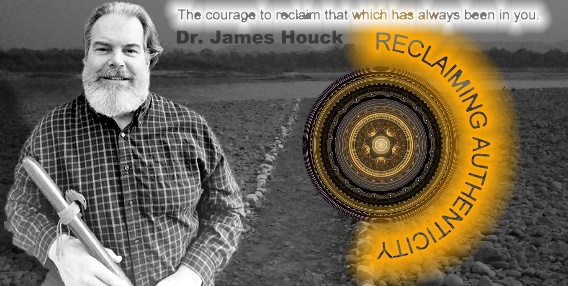
Reclaiming Authenticity: The courage to reclaim that which has always been in you.
No matter who we are, where we were born, and into what family we were placed, ours is a world full of relationships. Indeed, we are social beings who spend our lives making sense of our world by trying to find our place in the world. As social beings, it is often within the context of relationships that we experience tremendous pain and suffering. From overt acts of betrayal and cruelty that someone may have inflicted against us or vice versa, to simply being in the wrong place at the wrong time, many people bear the scars of physical, psychological, emotional, and spiritual wounds. And yet ironically, just as we experience our woundedness in relationships, it is also within the context of healthy relationships that we find our healing and authenticity. The difficulty, then, is often finding the courage to discover that which has always been in you.
For over 25 years, Dr. James Houck has been helping people discover their authentic selves by integrating spirituality into their mental and emotional health. As people are able to integrate these disciplines, they often discover core issues that have been keeping them wounded in relationships.
Speaker Identification
Speaker 1 - Announcer, Announcer
Pre-recorded show opening voice introducing Dr. James Houck.
Speaker 2 - Dr. James Houck, Host
Introduced by the announcer as Dr. James Houck, host of Reclaiming Authenticity.
[Music: intro theme with flutes]
Speaker 1 - Announcer, Announcer:
And now, with over 25 years of experience integrating mental health and spirituality, the author of Reclaiming Authenticity, When Ancestors Weep, and Redeeming the Bereaved, here is Dr. James Houck.
[Music: flute melody continues]
Speaker 2 - Dr. James Houck, Host:
Well, hello everybody. Good evening, wherever you are in the world currently. Welcome to Reclaiming Authenticity, helping you find your courage to reclaim what has always been in you. In fact, taking a little bit deeper, helping you reclaim who you have always been and who you are. It is simply a realization, but it's a realization like no other.
Speaker 2 - Dr. James Houck, Host:
So very delighted to be with you here tonight, and every other Wednesday evening at 9:00 p.m. Eastern Standard Time, 6:00 p.m. Pacific Standard Time. And as you know, if you've been following me for some time, that each and every week these broadcasts are dedicated to integrating spirituality and our mental health, all placed within a greater context of our relationships that we have with ourselves, you know, who we look at in the mirror and who's looking back at us, and our relationships with others, which could be family, friends, co-workers, whoever, and certainly God or the Divine.
Speaker 2 - Dr. James Houck, Host:
I am Dr. James Houck, and if you would like more information about me, or maybe you just want to leave me your comments about tonight's show, I invite you to visit those websites. The first one is www.bbsradio.com/reclaimingauthenticity. That's all one word there. So that's the first website. The second website is www.reclaiming-authenticity.com.
Speaker 2 - Dr. James Houck, Host:
So, very delighted to hear from people and what they think of these shows, and as well as leave me some suggestions of if there's any a topic that you want to hear again or if a topic that I haven't talked about, feel free to leave that as well. And if you want to call in and be part of the show, you know, totally, you know, it's up to you, that number is 888-627-6008. That is 888-627-6008. And as usual, I will be taking any calls after this break.
Speaker 2 - Dr. James Houck, Host:
So just in case you cannot spend the entire hour with me this evening, that's okay, no worries. These broadcasts are certainly in podcast form in case you want to go back and listen again, or you can go back into the archives and listen to previous shows. And they are now available for download on iTunes, Audible, Amazon Music, and Spotify, so you can take your pick of those platforms.
Speaker 2 - Dr. James Houck, Host:
And, you know, this integration of our spirituality and our mental health is very essential, because quite often our minds, you know, interpret what we take in through our senses, okay? That's just how we're hardwired. And based on our previous experiences or our education levels and how we were raised and so forth, the interpretation that our minds go through certainly fails to capture a more accurate understanding of deeper lessons or greater realities and deeper truths, because our egos, which come right on the heels of our mind's interpretation, our egos are very self-centered and very limited.
Speaker 2 - Dr. James Houck, Host:
But it wants to come in and take over and really keep us from knowing ourselves as vast and eternal souls, and living in forgiveness, gratitude, bliss, and love. Because the mind and its ego never stays still, it's always jumping around, going from one thing to the next, to the next, to the next, and, you know, it's like, "Hey, took a look over here, and when you got this, go over here, and do this, and do that." You know, it just leads us astray with all kinds of thoughts and selfish pursuits. It's kind of a, well, not kind of, it is, it's a lower-level consciousness, if you will, which is certainly bound by time and space and causation.
Speaker 2 - Dr. James Houck, Host:
And yet, you know, how often do we fail to pay attention to what our egos are showing us, and how, you know, the distorted templates in our minds are just laid on top of what we think we see, or what we think we know, or what we thought we heard, and so forth? And that the distorted templates teach us more about ourselves and show us where we still need healing and transformation. So the ego is not all bad, it's just we have to be aware of what it's doing, what its nature is, and what's going on.
Speaker 2 - Dr. James Houck, Host:
Because if we are continually led by our egos and self-centeredness and so forth, that's a problem, okay? So that is a great word, place to start when you're like, "Okay, where do I begin with healing?" That's a great place. So certainly, you know, any kind of like distortion that comes from our egos and self-centeredness and so forth, you know, we need to pay attention to. And our egos are very good at just showing us where we still have unforgiveness, or we hold grudges, or we are filled with bitterness, or we have a lack of gratitude, or we come across as very harsh or mean-spirited, you know, and especially having an overall hatred and contempt for others.
Speaker 2 - Dr. James Houck, Host:
And that we might even have all those things as we look at ourselves. You know, where do I need to forgive myself? Where am I bitter with myself? Do I live in gratitude with myself? Do I have a mean-spirited with myself? Do I love myself? Do I have a contempt for myself? You know, and so on and so forth. So certainly beginning with our own selves and working on, you know, where do I need to heal in terms of what and where the ego is taking me? Well, you know, starting with just basic, you know, "Do I love myself? You know, do I care for myself?" and so forth.
Speaker 2 - Dr. James Houck, Host:
You know, I still run into this contrast of, you know, people trying to over-analyze just exactly what love is. And it really breaks down, without, you know, being accused of oversimplifying the matter, you know, there is a huge difference between what I would call like worldly love or society's love, which is probably most familiar to us, versus Godly or divine love. Now, according to my teacher and dear, dear friend, we often use this term, "I love you." But when we start to really take a look at it, you know, we realize that when we say, "I love you," is that love based on conditions? You know, is that love conditional? Because it's temporary.
Speaker 2 - Dr. James Houck, Host:
And maybe it changes as it goes back and forth between conflicting emotions of the mind. You know, and there's the ego again, you know, and it'll stir up things such as envy and jealousy and hatred. That ain't love, okay? But yet on the other hand, godly or divine love, it godly love is not entangled in human emotions. Divine love is it's eternal and it's unconditional. And it helps us and others really to purify our minds by realizing our oneness in relation to all people and all things, right? And certainly this is what Reclaiming Authenticity, that's what this show is all about, and all the other shows that came before this one.
Speaker 2 - Dr. James Houck, Host:
You know, and pretty much Reclaiming Authenticity can really be summed up with one word: Namaste. You know, which is roughly translated that because I see myself as a soul of light, this allows me to greet your lighted soul of who you are even if you don't see it in yourself, yet. And so this integration of spirituality and our mental health begins here, because whenever we examine and implement, you know, a oneness understanding, a oneness integration, we're going to come face to face with the deepest physical, emotional, psychological, and even spiritual wounds in our relationships.
Speaker 2 - Dr. James Houck, Host:
And, you know, in addition, we may believe we will find happiness and joy and contentment, only to discover, well, the ego is getting larger, and larger, and larger, and therein lies the problem, because the larger the ego becomes, the greater the sorrows. Because eventually our ego brings us back to coming to terms with relationships in our lives, especially let's say our woundedness within families, with coworkers and friends, or other relationships. But, you know, Godly or divine love really heals and transforms those wounds into something more life-giving, tangible, and eternal.
Speaker 2 - Dr. James Houck, Host:
And this transformation, this kind of transformation is especially needed for the people whom society deems as unlovable, unreachable, and untouchable. And I don't have to get into specifics. We all know people who society would say are unlovable. We might even consider people, you know, like, okay, well, those people over there, well, they're certainly unlovable, and, you know, they're probably unreachable, and if they're unlovable and unreachable, well, then we'd just better not to interact with them, and so we'll just make them untouchable, okay?
Speaker 2 - Dr. James Houck, Host:
So, you know, but that's why we need this transformation. Because whenever we do the work of integrating healthier ways of suppressing this ego of ours, by embracing ours and others' value, dignity, and worth as souls, we're going to transform. And we're also going to transform others through our presence, our grace, our understanding, all with forgiveness, gratitude, and love. Or let's look at it another way. You know, one of my favorite writers, Dutch priest and professor Henri Nouwen, he puts it this way. He says, "Just by paying attention to what's going on around us, we discover that there are people who certainly heal each other's wounds and forgive one another's offenses. They share their possessions, they foster the spirit of community, they celebrate the gifts that they have received, and they live in constant anticipation of the full manifestation of God's glory."
Speaker 2 - Dr. James Houck, Host:
So, all in all, let's not get trapped in this illusion that we have to go in search of something that we already are. Discover who you are and be that soulful presence in the world. All right. Well, welcome to tonight's show. I think you're really going to enjoy this one. It's entitled You Are That Which You Seek: Beingness, Oneness, and Destiny.
Speaker 2 - Dr. James Houck, Host:
And, you know, when you think about realizing what you seek you already possess, you already are, have you ever noticed that many of the best books out there contain a powerful theme of irony? It's one of my favorite just styles, you know, this literary style, you know, just incorporates irony. You know, it's a popular yet very subtle lesson that comes across in, like I said, the majority of stories that are out there. You know, irony is kind of of a figure of speech that conveys that the intended meaning of something differs from the literal meaning of the word or words.
Speaker 2 - Dr. James Houck, Host:
So, you know, it really contrasts an expectation with reality, okay? Like I said, it's my favorite theme in books and movies and so forth, and it's kind of a gotcha moment in those stories where where, you know, everything that that came before makes sense once reality reveals the opposite of what the characters wanted or expected. And I would have to say, this is just my opinion here, folks, that the most obvious example of irony is used in The Wizard of Oz. I mean, we all know that story. You know, there's Dorothy, the Scarecrow, the Tin Man, and the Cowardly Lion all go off to see the Wizard, hoping to receive from him what they think they lack.
Speaker 2 - Dr. James Houck, Host:
However, in the end, you know, they realize through the Wizard's wisdom that they already possess what they think they lack. I mean, I see this time and time again with clients who often struggle with who they are, and and they're certainly unaware of the gifts and the goodness that they've brought into the world simply by being born. And I've seen this in myself, you know, learning to walk in a newness of life, or from healing, or simply now what do I do when the old way of living is gone? That everything I knew is just evaporated, shattered.
Speaker 2 - Dr. James Houck, Host:
You know, when I was in India, and even back home here, you know, I I still have wonderful discussions regarding the difference between self-actualization and a direct realization of God. You know, for me, my understanding of self-actualization, you know, came from Abraham Maslow, and that model of his, you know, with the hierarchy of needs. It's really a motivational theory in psychology, you know, that comprises a a five-tier model that just lays out human needs, often depicted, you know, like the shape of a pyramid, okay? And to understand it, you know, you have to work from the bottom up, let's just say.
Speaker 2 - Dr. James Houck, Host:
And, you know, he In this model of his, Maslow said that individuals first have to satisfy lower-level needs, so to speak, before they can, you know, reach higher-level needs. So in other words, Maslow argued that individuals must satisfy like basic survival needs, okay? And the higher up the, you know, the hierarchy, let's just say, the more difficult it is to satisfy the needs at that stage, because, well, there's many other, you know, factors or barriers out there which could really frustrate us, okay? And so higher needs become increasingly more, as he put it, psychological and long-term rather than physiological and short-term, you know?
Speaker 2 - Dr. James Houck, Host:
So here, you know, here's the example. You know, at the bottom of this pyramid, you have the physiological needs, okay? Just basic, basic needs: air, food, water, shelter, so on and so forth, okay? And then once those needs are satisfied, you move into your safety needs. And then those are the desire for like a secure life, you know, which includes protection from danger, financial stability, and overall decent health, good health, okay? And then going a little bit higher, you know, we want to satisfy love and belongingness. You know, that emotional need for connection, you know, through that one special person or friendships, you know, and certainly intimacy is a major part of that, maybe even being part of like a supportive group or groups, okay?
Speaker 2 - Dr. James Houck, Host:
And then we strive for esteem needs. You know, in other words, we want to pursue things that would give us self-respect or a desire for status or recognition and appreciation from say people around us. And then comes self-actualization. This personal drive to reach your fullest potential, to really grow your talents, and to find true self-fulfillment. However, I've seen some people use Maslow's model to gain an awareness of God, that is through the health and wealth gospel. And it's still out there, folks. You know, the health and wealth gospel. It's also called the prosperity gospel, and it really teaches that God guarantees financial prosperity and physical health to believers who demonstrate, sufficient faith, or a positive confession, or even generous giving.
Speaker 2 - Dr. James Houck, Host:
But, you know, when did wealth become the standard for judging our relationship with God? I mean, it it's just the material, especially financial success, is seen as evidence of divine grace or divine favor and blessing. While the opposite, which would be poverty, is seen as divine judgment. Well, when it comes to direct realization, you know, simply believing in something is very different from directly experiencing it. Okay, so let's say that I believe in God, but, you know, I don't directly realize, or or have I ever experienced God? Okay, so where does that leave me? You know, it's like, I hope there's a God. I believe there's a God, but I've never experienced God. Well, you're right. You know, something's missing.
Speaker 2 - Dr. James Houck, Host:
You know, because so, so what do you do or what do people do between maintaining their, let's say, self-actualization or belief in God and the time when they will have a direct encounter with God? Well, we walk by faith. We walk by faith. We trust that these things will happen, you know. And trust me, I've been around many, many, many, many people who were born in the church, who love their church, love the people in their church, but have never had a direct experience or a touch of God. And that makes all the difference in the world. Now, my Uncle Ed used to tell a story about when my, you know, my cousin, his daughter, was having surgery to fix a hole in her her heart.
Speaker 2 - Dr. James Houck, Host:
And she must have have only been two or three years old, somewhere around there like that, and he loved to tell this story. He said that that he was just so distraught, he didn't know what to do. He was just he couldn't sleep, he couldn't eat. He had no peace. So all he knew what to do was, "I'm going to go to the chapel in the hospital. I'm going to kneel down and I'm going to pray, you know, just like I've never had before." And he said he went and he did all those things and he never said how long he was in that, you know, condition. It was just there it is, you know, here I am. And then he said all of a sudden he saw a flash before his eyes. You know, kind of like somebody had like snapped a photo.
Speaker 2 - Dr. James Houck, Host:
And he experienced this warmth that that just came over him, and then he heard a very soft voice telling him everything would be fine. And he was the only one in the chapel. He said he felt the hand of God upon him like he had never felt before. And he was never the same after that. And, you know, he loved to sing. He loved to sing before, but he really loved to sing afterwards, you know. And and the reason he really enjoyed singing is because his favorite hymn that he just simply enjoyed every time he had a chance to to sing it in choir or as a solo was "He Touched Me." "He Touched Me." I mean, pull it up on YouTube, listen to it, you'll understand why that was his favorite hymn.
Speaker 2 - Dr. James Houck, Host:
You know, you know, but but I've also seen people who really struggle, you know, good-hearted people. It's like, "Well, I have faith. I believe." And yes, that's true. But there is a tendency, you know, for people who've never had that direct encounter, that direct touch of God. They I I just kind of marvel at what they do with that. You know, they they often intellectualize God or other people's stories. And even though they know beyond a shadow of a doubt that God not only exists, but is ever-present in their lives, okay, but they've never had that direct touch of God. And so they often intellectualize God, okay, or the stories and so forth.
Speaker 2 - Dr. James Houck, Host:
And, you know, when people share their stories or their experiences about their direct encounter with God, sometimes, you know, they're often met with suspicious looks, or questions that want to stay in the objective realm, like, "Well, how do you know God spoke to you? How do you know it was God's voice?" And really, they struggle with the discomfort of, you know, because of somebody's story, if they really took it seriously, it just might move them out of their comfort zones, okay? And again, folks, I'm speaking directly from my experiences of being in companies and religious institutions where I saw it on both sides. You know, people who were genuine and shared stories with me that, you know, they know that God exists because of how God showed up in their lives.
Speaker 2 - Dr. James Houck, Host:
And then there's also people who, "Well, I don't get it. You know, how do we know? How can we trust that what you're saying is real?" and, you know. And it, unfortunately, divides a lot of churches and religious institutions and companies. But, you know, something that I've been seeing now for well over a decade and then some, you know, is that people are hungry for more than just knowledge of God. They want a direct realization. They want a direct encounter with God. Because when this occurs, they are never the same. A total transformation in that moment. And nobody can convince them otherwise. But you know, that's often just the beginning.
Speaker 2 - Dr. James Houck, Host:
People who've had a direct encounter with God often find that sooner or later, well, they can't remain in the same friend circles that they used to be in. You know, even if it's within a religious organization that harbors politics or or follows like a business-like model. You know, they just they say things like, "I just don't fit here anymore. I just cannot relate. My values have changed. You know, I just cannot stay." And a a total transformative experience like none other is what self-realization is all about. But this is not a one-and-done and kind of encounter, uh-uh. Transformation is ongoing if we want to keep learning to walk this way for the rest of our lives.
Speaker 2 - Dr. James Houck, Host:
You know, and to continue growing in our realization of who we truly are, and everything that means, we're going to have to address and release what holds us back. You know, again, I mentioned these, you know, it's it's unforgiveness, it's bitterness, it's resentment, it's contempt, it's discontent, and so forth. Well, we have to be willing to address, you know, those things directly through forgiveness, and then release them to elevate our own understanding and life. But many people want to hang onto these things because they cannot imagine having anything better.
Speaker 2 - Dr. James Houck, Host:
And, you know, not just to stop with forgiveness, but also learning to walk and live in gratitude, which then opens up our hearts to walking in love and compassion. And you've heard me say this before, that Namaste is because I see myself as a lighted soul, this allows me to greet your lighted soul, even if you don't see it in yourself. But what allows me to see myself as a lighted soul and the lighted soul in others? That direct encounter with God.
Speaker 2 - Dr. James Houck, Host:
See, a direct realization or a direct encounter with God brings us into an immediate or a gradual understanding and awakening to the truth that all things and all people are one. There's no separateness from one another, except what our minds want to create. Because of that separation, judgment is based on externals. You know, again, it's what we take in through our senses, and then the mind wants to come in and interpret it. And because whatever is based on externals, that's temporary, because those things can be destroyed, you know. But what cannot be seen is the soul, which is eternal and ever-present. How are you going to destroy the soul?
Speaker 2 - Dr. James Houck, Host:
You can't.
Speaker 2 - Dr. James Houck, Host:
You know?
Speaker 2 - Dr. James Houck, Host:
Therefore, what we do to others, we do to ourselves. And what we say to others, we, you know, we say to ourselves. And what we think about others, we tend to think about ourselves in that way.
Speaker 2 - Dr. James Houck, Host:
And so I'd love to explain this fact to kids, you know? It's like, kids, just think of the fact that we live in an echo. Maybe we live in a cave and you just like shouting all, you know, your little hearts out and you hear your voices bouncing back to you. You know, just as, you know, they went out from you, it's going to come back. And so it's like whatever we think, whatever we say, whatever we do, it's coming back. Not just the, like saying, the bad stuff or the negative stuff, but the good stuff, the positive things as well.
Speaker 2 - Dr. James Houck, Host:
You know, self-actualization, getting back to Maslow's model here, you know, it's it's a good beginning only if it leads us to the awareness that we need a direct encounter with God.
Speaker 2 - Dr. James Houck, Host:
Until then, you know, we walk by faith. We trust that, you know, a direct encounter with God, you know, or an experience of God, will occur someday, whether it's in this life or the next. And so that's what it means to walk by faith, okay? So don't judge another person's walk because perhaps they believe that their practice serves them where they are in life.
Speaker 2 - Dr. James Houck, Host:
You know, don't judge because when we do, we attach ourselves to what we are judging and we sever that oneness connection that we have with God and one another. It just, you know, it creates the other, but we're not the other. We are connected. We are one.
Speaker 2 - Dr. James Houck, Host:
And, you know, this is something that my teacher constantly drills into me, you know, that the root cause of human suffering is that humanity is always searching for happiness outside of themselves.
Speaker 2 - Dr. James Houck, Host:
And yet, external physical objects are they're temporary at best and can only keep us content for a limited amount of time. I mean, think about it this way: How many of you out there have already started Christmas or Hanukkah shopping or another, you know, coming up on holidays and so forth? Now there's nothing wrong with exchanging presents or giving birthday gifts, but what would you do if you started to examine the underlying motivations and assumptions behind your buying?
Speaker 2 - Dr. James Houck, Host:
Do you think that what you're buying will make you happy? Do you think that what you're buying will make them happy? A a short time until the mind gets bored with it, or like, okay, next? You know, no matter what it is, the mind will eventually grow dissatisfied and start looking for something else. And humanity has always searched in vain for unlimited happiness in the limited and the temporary objects because we judge them, as I said, through our five senses, which are very limited.
Speaker 2 - Dr. James Houck, Host:
You know, and until we can correctly discover who we are and and what truly gives us peace, you know, we're going to constantly be chasing and then disappointed, and then chasing again and then becoming disappointed, and then chasing again and being disappointed.
Speaker 2 - Dr. James Houck, Host:
But only that that connectedness with God satisfies the soul.
Speaker 2 - Dr. James Houck, Host:
You know, as a result, we realize our oneness or that connection with all people and all things, you know, just having that, we ought never take anything for granted in our lives, but constantly cultivate that gratitude and a deep sense of compassion for all people who provide the things we use every day, you know? Like even taking a sip of coffee, you know? Do you bless the people who grew the coffee, who picked the coffee, who roasted the coffee, who bagged the coffee, who shipped the coffee, who put it on the stores, and so on and so forth, you know? Everything is, therefore, a gift.
Speaker 2 - Dr. James Houck, Host:
Okay? And therefore there is no such thing as a chance encounter. Everything is connected. And this makes much more sense, you know, because whether or not we realize it, we are connected to everyone and all things, either directly or indirectly, okay? But you know, oneness and connectedness in the spiritual sense goes much, much deeper because they involve who we are at our core rather than who we know.
Speaker 2 - Dr. James Houck, Host:
Okay? And when it comes to really wrestling with life's questions, I mean really wrestling with life's questions and you're struggling, many people are overwhelmed not only by the idea that the answers they seek may lie within themselves, but maybe they also have this belief that that inner freedom and peace and joy and unconditional love are just simply all good all too good to be true, you know, that those things belong to somebody else.
Speaker 2 - Dr. James Houck, Host:
You know, but the truth is we have that so-called key to unlock our doors to this inner freedom and grace and peace like we've never known before. The question then becomes, how open am I to really knowing who I am? Who is this God I pray to? What are my expectations? What are my assumptions and so on and so forth?
Speaker 2 - Dr. James Houck, Host:
Well, I'd really love to hear your heart on this subject. So if you'd like to call in, I'm going to take a little break now, but if you want to call in, that number is 888-627-6008 and I'm going to be taking your calls after this break. So again, you are listening to Reclaiming Authenticity and I'm your host, Dr. James Houck. And I'll be back with you in 1 minute.
[Music performance - Flute meditation]
Speaker 2 - Dr. James Houck, Host:
Hello, everybody. You're listening to Reclaiming Authenticity. I am your host, Dr. James Houck. Well, earlier in the broadcast, I was talking about uh just, you know, what is a direct encounter of God. And, you know, a lot of people say, "Well, that's self-actualization." You know, it's like it's not quite the same thing because a direct realization or a direct encounter with God brings us into that understanding and certainly awakening to the truth that all things and all people are connected. In other words, we're one.
Speaker 2 - Dr. James Houck, Host:
Okay? And I know in the past that that, you know, teaching of oneness was always just met with a lot of suspicion. It's like, what is this? Is this New Age, or what what's going on here? You know, just a lot of people in let's say the West just had a hard time understanding it. But really, it makes a lot of sense because it's true. We are one with each other. We are connected, but our mind wants to create this division, that we're not correct or that we're not connected, I say, sorry about that, because it looks at the externals.
Speaker 2 - Dr. James Houck, Host:
And it's like, well, you're different from me. You don't speak my same language. You go to a different church or synagogue or whatever. You know, you don't eat the same kind of food. You don't have the same kind of education. You know, so it's constantly looking at differences when it would just need to like, stop. Let's start with all of us, let's start with who we are. We're all the soul. And yet, that diversity helps us or should bring us into that deeper understanding that we have more in common than the differences that we fight over.
Speaker 2 - Dr. James Houck, Host:
Right? See, the the mind judges a person's externals, and there's the interpretation, you know, and interprets them through past experiences or education, background, beliefs, and even values handed down from us from great-grandparents, grandparents, parents, teachers, and so forth, okay? However, when a person has that transformative experience with God, it takes us beyond humanity's limited perspectives and shows us that consciousness is all around us and everywhere. I mean, our soul is limitless and vast, filled with light, and it's eternal.
Speaker 2 - Dr. James Houck, Host:
And as my Hindu friends tell me, they say, you know, everybody stands in connection with one another and God. We're just not aware of it yet. You know, we cannot be made one with everything. We already are. And yet, what keeps us from realizing this? I mean, is it unrepented sin? Is it greed? Is it unforgiveness? Is it a lack of gratitude? Is it contempt for others?
Speaker 2 - Dr. James Houck, Host:
You see, when we realize how strong this connection is, we're going to eliminate a desire for revenge on people who have hurt us. You know, we might like, oh, I don't know if I can let go, but, again, what we do to others comes back on us. So if we want to hurt somebody, that's going to come back on us.
Speaker 2 - Dr. James Houck, Host:
You know, but what what would happen if we no longer wish them harm? Now I'm not just say I'm not saying that we should just lay down and let evil persist. No, I mean, certainly set boundaries and stand up for those who are unable to stand up and protect themselves and so forth, okay? But when it comes to like having a deep hatred for somebody, can you imagine how bitter a person has to get to have that deep hatred and contempt for another person?
Speaker 2 - Dr. James Houck, Host:
Do you know what would happen if we no longer wished anybody harm, but instead we wished for their eyes to be open so that they see the truth of who they are and how their thoughts and words and actions come back to them?
Speaker 2 - Dr. James Houck, Host:
You know, what we do to others, we do to ourselves. You know, what we say to others, we say to ourselves. What we think about others, we tend to think about ourselves that same way. Okay, so just keep in mind that that's a go. What we send out comes back to us, okay? So it's awareness, awareness, awareness. We must first be aware before we can be transformed, which creates that opportunity for even more awareness of the truth in our lives.
Speaker 2 - Dr. James Houck, Host:
And interestingly enough, this transformation is not something objective reason can explain thoroughly. Oh, I you know, I'm sure that people who have yet to really grasp this truth of of who they are, they're probably going to see your transformation as ridiculous. I mean, in fact, the more you walk in this awareness of who you are and especially after you've had that direct encounter with God, the more the more you may find yourself growing dissatisfied with humanity's limited perspectives on many, many things.
Speaker 2 - Dr. James Houck, Host:
I mean, your family may not understand you, your friends may not understand you. You may have to change jobs, and you may end up may end up embarking on this wonderful inward journey that, from all outward appearances, seems pointless.
Speaker 2 - Dr. James Houck, Host:
Well, let me tell you a story about my life. I was probably about eight or nine years old when I first had that direct encounter with God. I mean, it was powerful, okay? You see, I I grew up during the the Jesus movement of the late '60s and the '70s. So I was influenced by movies like, you know, Jesus Christ Superstar, Godspell, and others that told biblical stories in very nontraditional ways, okay?
Speaker 2 - Dr. James Houck, Host:
And I also remember tagging along with my mother and a neighbor or two to a Wednesday night prayer meeting group that, interestingly enough, met in an abandoned laundry service building. And yeah, we had to set up chairs and all that stuff, and it was just old-school. And the worship, you know, the singing involved guitars and drums and vocals and so forth. And now and then, we'd all get in the car, you know, and this was probably like 10:00 at night, you know, we'd all get in the cars and then we would drive to the Susquehanna River in Harrisburg, Pennsylvania, and people would want to be baptized.
Speaker 2 - Dr. James Houck, Host:
And you know, I loved it. This was so different from what I was raised in, you know, a traditional mainline church. I thought this was the coolest thing because it met a need in people. It it fulfilled a hunger. In fact, it didn't just satisfy, it kind of like opened them up for even more, like, I want more of God. And and as I said, I felt a direct encounter with God early in my life and several times afterwards as I grew up.
Speaker 2 - Dr. James Houck, Host:
However, I also experienced a lot of teasing, a lot of ridicule, a lot of bullying. And during those times, you know, when I was much younger, I really didn't realize what I was being bullied for. Or should I say, why me? Like, what did they see in me that made them so uncomfortable?
Speaker 2 - Dr. James Houck, Host:
Well, looking back on my young childhood, I've realized that they may have been uncomfortable because a direct encounter with God left me with a light and a presence that made some people hostile, while other people were comfortable with it. But you know, unfortunately, in my teenage years, I fought this light like I was going to win, okay, but like I thought like, oh, I'm going to fight this. Because I wanted to fit in, I didn't want to get bullied anymore, I didn't want to get teased, so I I went into total totally different direction.
Speaker 2 - Dr. James Houck, Host:
You know, I told God, in a sense, stay over there, and I'm going over here to have some fun. Now it's worth noting that God does not do will nor will ever do what we say. Anyway, I digress. I also didn't realize that when God crawls into every nook and cranny in our hearts and in our lives, God's not going anywhere.
Speaker 2 - Dr. James Houck, Host:
So after many years of trying to do things on my own and trying to fit in with others, I was just thoroughly miserable. Nothing satisfied until I had yet another direct encounter with God. God showed up. And this time, I didn't fight it. I surrendered. I mean, I pretty much said, "Okay, look, I'm tired of fighting. I'm tired of trying to fit in with others and other things that leave me miserable and empty. Okay, yeah, I get it. You got me." And I never looked back.
Speaker 2 - Dr. James Houck, Host:
And at that time, I felt as though I was just thoroughly broken: broken beyond repair, beyond healing, beyond worth. But little did I realize that this was just the beginning. Now, any of you out there in internet radioland, excuse me, ever hear of the Japanese practice of kintsugi? I hope I'm saying that right. Kintsugi, it's uh it means a golden joinery or golden repair, in another word close to it. But kintsugi is the Japanese art of repairing broken pottery by mending the broken areas with a urushi lacquer, often mixed with either gold or silver or like a platinum powder.
Speaker 2 - Dr. James Houck, Host:
And the beauty of this art is that the artist begins by seeing a broken vessel and its repair as part of that object's history, which is not something to disguise. You know, and as a result, items restored with this kintsugi technique are often considered even more precious than what they were before.
Speaker 2 - Dr. James Houck, Host:
And the art of kintsugi can be seen as a physical expression of just simply being okay with our imperfections and embracing them as part of who we are in life because, in life, things fall, things break, things need repair. People fall. People break. People need repair.
Speaker 2 - Dr. James Houck, Host:
But you know, a broken and then repaired item is no less useful than when it was new, and we should appreciate it in both states. So, you know, spiritually, kintsugi really symbolizes acceptance of imperfection and healing through the visible scars, and just holding up a resiliency after hardship and a transformation into a renewed, more meaningful wholeness.
Speaker 2 - Dr. James Houck, Host:
Because all in all, folks, brokenness is not a flaw, but an essential part of our story, emphasizing the belief that the repair or, in this case, the healing can create a deeper beauty.
Speaker 2 - Dr. James Houck, Host:
So all right, folks, you know me. I had to do a little bit more research in this area, because I was just hooked. I like, I've got to find out more about this. So I really wanted to delve into, you know, its mental, spiritual integration of this kintsugi. And here's what I discovered, along with the help of AI, okay? That there are at least seven core spiritual meanings associated with this art form, okay? There's this, as I mentioned, the acceptance of imperfection.
Speaker 2 - Dr. James Houck, Host:
You know, in in the Japanese culture, there's this, I again, I hope I'm pronouncing this right, is this wabi-sabi worldview where beauty exists in flaws and and in its wear and the passage of times. And cracks are not hidden, but, actually, the cracks are highlighted, symbolizing that imperfections are just very integral to identity. And there's also, you know, healing without hiding scars. And these golden seams or the silver seams in pottery or vases or whatever, it represents that healing that acknowledges pain rather than erasing it. And therefore, scars become sources of strength and beauty and hope.
Speaker 2 - Dr. James Houck, Host:
And it's also, you know, it speaks loud and clear about this resiliency after hardship. I love that, you know, because a repaired vessel often becomes stronger and more valuable. It really symbolizes the resilience that emerges from surviving difficulties or brokenness. And then there's transformation through brokenness. You know, kintsugi teaches that healing doesn't restore a previous state, you know, like you don't go back to the way things were, but rather it creates a new, transformed wholeness. And I like that. I like that. And it honors personal history.
Speaker 2 - Dr. James Houck, Host:
You know, the visible cracks really honor what has occurred. And rather than discarding or denying the past, this art of kintsugi integrates it into a meaningful whole. In other words, it's captured in the stories that we share with one another.
Speaker 2 - Dr. James Houck, Host:
And there's beauty to be found in what society says is damaged, you know, because the gold-filled fractures, let's just say, show that damage can create unexpected beauty, you know, challenging the idea that value depends on being flawless, okay, which doesn't really exist. Show me somebody who is flawless, and yeah, I don't know about that one. But again, there's this unexpected beauty that that comes from the seams of where it was cracked or broken, and it really fills in and just enhances the beauty. And lastly, you know, becoming whole without becoming the same.
Speaker 2 - Dr. James Houck, Host:
And this, I like, too, because kintsugi also emphasizes that wholeness after a hardship or after brokenness is not a return to the old self, but it's a creation of a new form that is shaped by experiences.
Speaker 2 - Dr. James Houck, Host:
And that's what I felt when I was a kid and I was like, "Okay, God, you got me. I give up. I surrender." And I felt so broken, but yet I felt so whole at the same time. It was the strangest thing. But you know, it's what I've come to understand is this kintsugi, and I'm going to do some more research in this area, I'm just fascinated with it, you know, it really offers a compassionate framework for understanding trauma and loss and healing.
Speaker 2 - Dr. James Houck, Host:
You know, it it certainly affirms that brokenness is universal and that repair, you know, visible and honored and transformative, can be profoundly meaningful. Because, yes, forms can be repaired, okay? Vases can be fixed, glasses can be repaired, so on and so forth, and bodies can be mended. But let's always keep in mind here, folks, that we are more than what we have become so far.
Speaker 2 - Dr. James Houck, Host:
We're more than what we have become so far. And as a result, experiencing a direct realization or a direct encounter with God opens us up to further realization that we are one with all people and all things, that we should never take anything for granted, but always be willing to cherish everything and everyone in our lives.
Speaker 2 - Dr. James Houck, Host:
But you know, oneness and connectedness in a spiritual sense certainly go much, much deeper because they involve, you know, who we are at our core rather than what we've been through and how many cracks we are willing to show to others. Because you know it, I see it a lot in people who are wrestling with life's questions. I mean, and these are very difficult life questions that many people are overwhelmed, you know, not just by the idea that the answers they seek lie within themselves, but do they deserve this wholeness, this inner freedom, this peace, the joy, the unconditional love?
Speaker 2 - Dr. James Houck, Host:
Yes, they do. Yes, they do.
Speaker 2 - Dr. James Houck, Host:
I'm Dr. James Houck, and just wanted to say thank you for spending this hour with me this evening. Remember, you are more than what you have become so far. You have value, you have dignity, and you have worth because you are an eternal soul. Good night.
[Music performance - Flute meditation]
Speaker 1 - Announcer, Announcer:
For an answer or just to leave a thousand comments, or prodding around to buy a book by Dr. Houck, it's all there. Just wander over to reclaimingauthenticity.com and click around. And we'll see you next Wednesday at 9:00 p.m. Eastern Time, 6:00 p.m. Pacific on BBS Radio TV.
[Music performance - Flute meditation]