
LaGrave Live, October 4, 2026
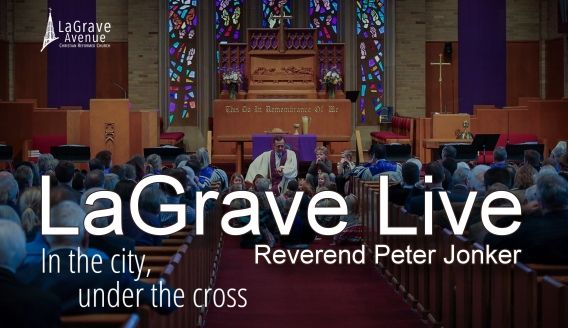


LaGrave Live
The Book of Romans: Abraham, Our Father | 8:40 am (EDT) 10-4-26
About The Service:
Pastor Jonker will continue our sermon series on the book of Romans. His sermon will focus on Romans 4, a passage where Paul uses Abraham as the paradigm of how faith works. It will also be World Communion Sunday, so we will celebrate the Lord's Supper together.
Order of Worship:
https://lagrave.org/wp-content/uploads/2026-10-4-AM-Order-of-Worship.pdf
About the Church:
We are a traditional CRC church in the middle of Downtown Grand Rapids, MI, worshipping at 8:40am, 11:00am, and 6:00pm. (10:00am and 6:00pm during the summer months)
We'd love to hear from you:
Connection: https://www.lagrave.org/contact
Let us pray for you:
Prayer: https://www.lagrave.org/prayerrequest/
Giving: https://www.elexiogiving.com/App/Giving/lagr107178
The September special offering is for the Pregnancy Resource Center. Services include abstinence education, testing, prayer, consultation, information about pregnancy/adoption/birth control and the distribution of food/formulas/diapers/baby clothes.
Listen on the go:
Amazon Music: https://bit.ly/LGPodAmazonMusic
Apple Podcast: https://apple.co/3tuOdwQ
Google Podcast: https://bit.ly/LGPodGoogle
Soundcloud: / lagravecrc https://soundcloud.com/lagravecrc
Spotify: https://spoti.fi/3yXDFaT
Follow us!
Facebook: / lagravecrc https://www.facebook.com/lagravecrc
Instagram: / lagravecrc https://www.instagram.com/lagravecrc
Website: https://www.lagrave.org
#LaGrave #LaGraveCRC
Faith Credited as Righteousness: Romans 4 on World Communion Sunday
On World Communion Sunday at LaGrave Avenue Christian Reformed Church, Reverend Peter Jonker preaches on Romans 4 and Abraham's faith, which is credited as righteousness. The service also includes a children's message on musical instruments from around the world, prayers for the church and its members, and the Lord's Supper.
Welcome and a Prayer for Unity
Reverend Peter Jonker opens worship at LaGrave Avenue Christian Reformed Church on World Communion Sunday, a day when the congregation remembers that the body of Christ is made up of believers from every nation, tribe and language. After the opening music, Jonker greets worshippers in the sanctuary and online with the words of grace and peace from God the Father and the Lord Jesus Christ. He points people to coffee and donuts in the multipurpose room, a special gathering in the parlor for visitors and newer members, and a Global Concerns prayer meeting in room 204. Turning to John 17, Jonker leads a responsive call to confession built on Jesus's prayer that all his followers may be one. Jonker confesses for the church that it often sees more division than unity, and asks God to forgive its selfishness, fears and indifference. Jonker then reads Romans 8, asking who can separate believers from Christ's love, and the congregation answers that they are more than conquerors.
Children's Message on Strange Instruments
A leader calls the children down front for the children's message and brings a series of instruments to share on World Communion Sunday, a reminder that Jesus built his church in many places and in many different ways. The leader first holds up a bagpipe, asking the children to name the kilt and the instrument, and then offers an imitation of its sound, which the leader says is strange but still praises God. Next comes the shofar, a ram's horn that the leader compares to a trumpet, followed by a djembe, a drum played in some services where people dance. The leader saves the most unusual for last: the pipe organ, with its many pipes, a large room and a console of knobs. The children are told that God is praised when any strange instrument is used to worship him. The leader closes with a call and response, asking the congregation to say the blessing, 'The Lord be with you,' and then sends the children back with 'Go in peace.'
Announcements and Prayers for a Divided World
Jonker offers two announcements of members who are hospitalized or recovering at home, then leads a long pastoral prayer that gives thanks for the unity and diversity of God's people. He prays that the church would see unity expressed in its ministries, in partnership with churches of other denominations, and in responses to disasters and to people who are migrating. He looks ahead to a short-term mission team heading to the Dominican Republic next April and asks God to guide the denomination's Global Vision Implementation Team as it seeks greater partnership with churches around the world. Jonker prays for Christians who face persecution, for missionaries returning to West Africa, and for families grieving a member who recently died. He also prays for people facing illness, cancer treatment, hospice care and other continuing needs. The prayer closes by asking that each person enter a new week at school, at work, at home or on the road with God's presence, strength and guidance.
Reading Romans 4 on Abraham's Faith
Jonker announces that the Bible reading comes from Romans 4, part of the Romans series, and that he will read the whole passage. He explains that the chapter centers on a faith that unites Jews and Gentiles, an issue he had raised in an earlier sermon about a church divided. Reading aloud, he begins with the question of what Abraham discovered, and then reads that Abraham believed God and it was credited to him as righteousness. He reads that wages are owed to a worker, while faith is credited as righteousness to the one who trusts God, who justifies the ungodly. He then reads David's words on blessedness and stresses that Abraham's faith was credited before he was circumcised. He reads that Abraham would become the father of many nations, describing an aged man whose body was as good as dead, yet who was fully persuaded that God could do what he promised. The reading ends with the words written for believers who trust him who raised Jesus from the dead, and the congregation answers, 'Thanks be to God.'
Justification, Harold Abrahams, and Faith That Grows
Jonker names justification by faith as a familiar Reformed doctrine, one many listeners defined on a school religion test. He then describes how the phrase can sound distant to an unchurched coworker, and borrows from Tim Keller's use of the film Chariots of Fire. Eric Liddell says that God made him fast and that he feels God's pleasure when he runs, while Harold Abrahams, who won the 100-meter dash at the 1924 Paris Olympics, speaks of '10 lonely seconds to justify my existence.' Jonker says that Abrahams's exhaustion is a picture of many people striving to prove their worth. Paul's good news, he argues, is that no one must win the race to be accepted, since Jesus offers grace as a free gift. Jonker tells of his late friend Jack Kuipers, a Calvin physicist whose mother told him to believe harder, and uses a Chicago Bears example to show that faith grows by focusing on Christ. Near the end, he pictures the last judgment and says only the nail marks on Jesus's hand can justify anyone. He closes in prayer, praising God's work rather than ours.
Lord's Supper, Prayer, and Benediction
Jonker invites visitors who take communion in their home churches to share the meal, noting that people all over the world are gathering at tables like this one. The congregation answers the liturgy line by line, from 'Lift up your hearts' to the Lord's Prayer, which it prays together. A leader asks God to send the Holy Spirit so that the bread and cup may be the body and blood of Jesus. Jonker reads Jesus's words at the Last Supper, 'This is my body, given for you,' and later urges the congregation to take, eat and believe. A second leader reads Jesus's words about the cup of the new covenant and reminds the church that it proclaims the Lord's death until he comes again. The hymn 'In Christ There Is No East or West' follows, as the church sings of unity. Jonker closes with a benediction, asking that the grace of the Lord Jesus Christ and the fellowship of the Holy Spirit abide with all, and the congregation answers, 'Amen.'
LaGrave Live

If you’re looking for a warm church that commits to an intensely pertinent Gospel in the Reformed tradition of the Christian faith, we invite you to worship with us. Our 1,800 members come from across West Michigan and gather weekly in our sanctuary for relevant Biblical preaching, beautiful music, and inspiring worship. We expand our worship through intentional outreach in our community and world, attentive care for our members, and plenty of spiritual enrichment and social opportunities for everyone.
We focus on a living Savior who provides genuine solutions to the deep needs of a hurting world. We are committed to need-meeting ministry in His name, and we are committed to being real people who enjoy real life and who cry real tears. Because we are a fairly large and diverse group in terms of age, occupation, marital status, lifestyle, and physical ability; our members create many accessible opportunities for community service, Bible study, and small social groups.
We worship God, the Almighty Creator of heaven and earth, and we enjoy expressing our vision of His holiness through traditional music and formal liturgy.
Music plays an integral part of our weekly worship gatherings. Congregational singing—of both traditional hymns and newer ones—is typically supported by our pipe organ. Vocal choirs, handbell choirs, small ensembles, instrumentalists, and vocal soloists provide additional music offerings.
Led by the Holy Spirit, we seek to worship and serve God in all of life, transforming His world and being transformed to reflect the character of Christ.
Founded by 36 Dutch immigrants on February 24, 1887, LaGrave Avenue Christian Reformed Church has always been deeply committed to both this local community and worldwide missions. God has seen fit to guide and bless these commitments with sustained growth, spiritual gifting, and a continual stream of new work for our members.
Speaker Identification
Speaker 1 - Peter Jonker, Host (Pastor)
Leads the service, opening greeting, announcements, prayers, and calls to worship at LaGrave Avenue Christian Reformed Church.
Speaker 2 - Congregation, Guest
Responds collectively during the responsive readings and liturgy.
Speaker 3 - Speaker, Host
Leads the children's message segment.
Speaker 4 - Child, Guest
Speaks from the group of children during the children's message.
[Music: Organ prelude]
[Music performance - "Come, Thou Fount of Every Blessing" by Choir]
[Music performance - Organ interlude]
[Music performance - "In Christ There Is No East or West" by Choir and Congregation]
Speaker 1 - Peter Jonker, Host (Pastor):
We join people of all lands and nations in bringing honor to our God and King. He is here with us this morning and greets us in these words: Grace and peace to you from God our Father and the Lord Jesus Christ. Amen.
Speaker 1 - Peter Jonker, Host (Pastor):
Welcome to Sunday morning worship here at LaGrave Avenue Christian Reformed Church. We are glad that you are joining us, whether here in person or worshipping with us online. There will be coffee, fellowship, games, puzzles, and donuts in the multipurpose room right after this service. All are welcome, and that's straight down the hallway and then to your right. There will also be a special coffee, also with donuts, after this service, and that's especially for visitors, for regular attenders, and newer members who've joined us within about the last two years. It's a great opportunity to get to know others and to ask questions about LaGrave.
Speaker 1 - Peter Jonker, Host (Pastor):
That will be in the parlor, which is straight down the hallway and then to your left. Global Concerns prayer meets right after this service in room 204 upstairs. And please take note in the bulletin for other opportunities during the 10:00 hour, later today, and during this week. This is a special, this is a special Sunday in our church calendar, it's called World Communion Sunday. It's a day when we remember that the body of Christ is made up of believers all over the world, of all nations, tribes, languages, and social classes.
Speaker 1 - Peter Jonker, Host (Pastor):
And so we celebrate that unity, especially as we join together in the Lord's Supper later in this service. In John chapter 17, Jesus prayed for the unity among his followers. He started by praying for his disciples, but then went on to pray for all believers, even for us. So please join me, look at the responsive reading in the bulletin, the call to confession as we use these words from Jesus' prayer. My prayer is not for them alone.
Speaker 2 - Congregation, Guest:
I pray also for those who will believe in me through their message, that all of them may be one, Father, just as you are in me and I am in you.
Speaker 1 - Peter Jonker, Host (Pastor):
May they also be in us so that the world may believe that you have sent me. I have given them the glory that you gave me, that they may be one as we are one, I in them and you in me, so that they may be brought to complete unity.
Speaker 2 - Congregation, Guest:
Then the world will know that you sent me and have loved them even as you have loved me.
Speaker 1 - Peter Jonker, Host (Pastor):
Lord Jesus, we stand amazed that you have united us with your followers all over the world, people of so many different nationalities, languages, denominations, rich and poor. We thank you for that rich diversity and how we enjoy it when we worship and cooperate with Christians who are different from us. But we confess that often we see more division than unity. We often have allowed our selfishness, our fears, affluence, traditions, worship styles, our indifference, and nonessentials to pose barriers between ourselves and other Christians.
Speaker 1 - Peter Jonker, Host (Pastor):
That is painful to you, Lord, and we ask that you forgive us in Christ and inspire us to make every effort to keep the unity of the Spirit in the bond of peace, as the Apostle Paul teaches us. In your name, Lord Jesus, we pray. Amen. Who shall separate us from the love of Christ? Shall trouble or hardship or persecution or famine or nakedness or danger or sword?
Speaker 2 - Congregation, Guest:
No, in all these things we are more than conquerors through him who loved us. For I am convinced that neither death nor life, neither angels nor demons, neither the present nor the future, nor any powers, neither height nor depth, nor anything else in all creation, will be able to separate us from the love of God that is in Christ Jesus our Lord. Thanks be to God.
[Music performance - "In Christ There Is No East or West" by Choir and Congregation]
Speaker 3 - Speaker, Host:
All right, children, come on down. It's time for the children's message. I want to talk to you a little bit on this World Communion Sunday about a couple things. Come on down, everyone. Hello. It's good to see you guys. We have some balcony friends today. They are coming. Here they come. All right.
Speaker 3 - Speaker, Host:
Okay. A few more. All right. Oh, still more. All right, a great worldwide communion here. Okay. So, today is World Communion Sunday, which means we're thinking about how when Jesus made the church, he didn't just make it in Grand Rapids, right? He made it all over the world and he made it in all kinds of different ways. And so I was thinking about that, and I thought I would share with you some of the interesting musical instruments, interesting musical instruments that people use to praise God in in worship services. So, for example, this.
Speaker 3 - Speaker, Host:
All right. See this dude? He's playing a musical instrument. He's wearing a skirt, right? You know what you call that skirt? Anyone know? It's a kilt. It's a kilt. And do you know what that instrument is? He's got it under his arm and he's got a thing in his mouth and you squeeze it. Do you know what that instrument is called, any of you? None of you know what a It's a bagpipe. You never heard of a bagpipe? No?
Speaker 4 - Child, Guest:
[unclear] I just forgot.
Speaker 3 - Speaker, Host:
Yeah, you forgot the name. It makes It makes an interesting The sound, it goes like [imitates bagpipe sound]. That's how it sounds. Okay? Which Which maybe doesn't sound so good, but, you know what? I've heard someone play "Amazing Grace"—you know that song—on a bagpipe? Oh, it's so good. God is praised by this strange instrument. Here is another one. See that? It looks like a kind of trumpet.
Speaker 3 - Speaker, Host:
Right? But it's it's actually a horn, it's not a snake. So you know, it's a ram's horn and the name of this instrument is the shofar. And it makes an interesting noise, too. It goes, [imitates shofar sound]. Okay? It's like a trumpet. And I've never been in a service where they use that, but I know people do use it. And it's a strange instrument, but God is praised when people use that strange instrument. Okay, I have one more strange instrument. Okay.
Speaker 3 - Speaker, Host:
See that? You know what that is, right? It's a drum, it's a special kind of drum. You you I you probably don't know that. It's called a djembe. You've seen those, yeah. You might have sometimes you see those in school or something. You put it between your It's called a djembe. You put it and then people play it and they go [imitates vocalizations], and then sometimes in the the church services where people play a djembe, the people kind of dance, all right? That's another strange instrument to us, but it's God is praised when that instrument is used. I have one more strange instrument. I think this is the strangest one of all.
Speaker 3 - Speaker, Host:
It's enormous. It's like the biggest instrument. And what makes it so big is that every single note you got to have a special pipe for it. A special pipe, a special tube. So for the high notes, you have a little tube; for the big notes, you have a big tube. And they have to create a whole room for this instrument. And they have a special machine that blows air through all those pipes, and it's controlled by a guy who sits behind this huge console and he plays like a like keyboards and he pulls all these knobs. You ever heard of this instrument?
Speaker 3 - Speaker, Host:
No, you never have? You know what it is? It's an organ! It's an organ That's what an organ is. If you think about it, the organ is the strangest instrument. But do we like it? I really Yeah, we do. Yay for the organ! Yeah, we love the organ. The organ is a strange instrument, but the Lord is praised when we use it to praise him. That's what I wanted to share with you. Congregation, what is our prayer for these children?
Speaker 2 - Congregation, Guest:
The Lord be with you.
Speaker 4 - Child, Guest:
And also with you.
Speaker 3 - Speaker, Host:
Go in peace.
Speaker 1 - Peter Jonker, Host (Pastor):
Reminds us of Psalm 150, doesn't it? Whatever instrument we have, let's use it to praise the Lord. We have two announcements before we pray. First of all, Dave Vander Ark has been hospitalized at Trinity for testing and expects to be going to Mary Free Bed soon. Sandy Groensma was hospitalized this week with digestive issues, but has been released and is continuing her recovery at home. Let's go to God in prayer.
Speaker 1 - Peter Jonker, Host (Pastor):
Lord, on this World Communion Sunday, we do thank you for the unity and the diversity of your people all around the world. We praise and thank you for the richness of that diversity: so many differing gifts, differing strengths and weaknesses, different ethnic groups, different instruments to praise you. Lord, we just thank you for that. We have confessed that we at times tend to promote more division than unity, and in Christ you have forgiven us for that.
Speaker 1 - Peter Jonker, Host (Pastor):
And so we praise and thank you for ways that we can see that unity in cooperation, right here within our church as we serve one another in various ministries, here in downtown Grand Rapids as we work together with other churches, especially in ministering to our neighborhood, as we cooperate with churches of other denominations, nations, and languages in responding to calamities, in ministering to people who are migrating, in mission work, proclaiming the good news around the world, in worship gatherings.
Speaker 1 - Peter Jonker, Host (Pastor):
We look forward to a taste of this as we prepare to send a short-term mission team to the Dominican Republic next April. And we pray that you will guide our denomination's Global Vision Implementation Team as it strives to find ways that we can engage in greater partnership with other denominations around the world. When there is genuine unity and cooperation, it truly is a witness to the world in answer to your prayer, Lord Jesus, in John 17. May that happen more and
Speaker 1 - Peter Jonker, Host (Pastor):
more, especially for those reaching out to those who have still not heard the Gospel.
Speaker 1 - Peter Jonker, Host (Pastor):
We pray too for our fellow Christians around the world who face persecution. It's hard for us to imagine that, but we think of those in places where there are religious restrictions, those facing severe hardship, rejection, and even torture for following you. Oh Lord, we cry out for your hand at work to end this persecution, to release them, and to help them to experience your presence, and enable them to remain faithful to you, to persevere faithfully, oh Lord.
Speaker 1 - Peter Jonker, Host (Pastor):
We lift up to you today our missionaries of the week serving in West Africa where there is opposition to Christianity. As they complete their home service and return to the field, grant them safe travel and fruitful ministry among an unreached Muslim people group.
Speaker 1 - Peter Jonker, Host (Pastor):
We praise you, Lord, for your faithfulness to Lavon Vandenberg and Cora Senkey, who will soon celebrate significant birthdays. We pray your comfort and peace on the family and friends of Ruth Vander Laan Voss, who passed away September 29. Be present with them in their sorrow and bless them as they celebrate her life.
Speaker 1 - Peter Jonker, Host (Pastor):
We pray, Lord, today for Dan Beamers for his recovery at home, for Margo Mostert who has been hospitalized with portal vein hypertension, for Valerie Visser that her chemo treatments for cancer will be successful. We pray for Sandy Grondsma for healing for her digestive issues as she recovers at home, and for Dave Vander Ark as he receives testing at Trinity Hospital.
Speaker 1 - Peter Jonker, Host (Pastor):
We also pray for those in hospice, those living with cancer, as well as those with other continuing needs. For all these, we pray for your faithful, your powerful, loving, healing hand upon them in the name of our Lord Jesus, and that you will work through the treatments that they receive for healing.
Speaker 1 - Peter Jonker, Host (Pastor):
We pray, Lord, for each and every one of us, as we enter a new week in school, at work, at home, in our neighborhoods, or traveling, may we experience your presence, strength, and guidance in all we do, that we will be your faithful people, glorifying you and serving as your witnesses in this world in word and in action. In Jesus' name we pray. Amen.
[Music performance - "What Grace Is This" by Choir]
Speaker 1 - Peter Jonker, Host (Pastor):
Thank you, young people. That was beautiful, and we were blessed.
Speaker 1 - Peter Jonker, Host (Pastor):
Our Bible reading this morning is from the Book of Romans, part of our Romans series, and I will be reading Romans chapter 4. Yes, the whole passage. Today's meditation, today's passage you will hear is centered around faith, and you will hear as Paul talks that he's very much this is a faith that unites both Jews and Gentiles on this World Communion Sunday. It is a faith that reaches out to the ends of the earth. If you remember when I my first sermon, well actually, no, my second sermon, I talked about how an underlying issue in this in this Gospel, in this in this letter, is uniting Jews and Gentiles who were kind of fighting in the church. You can hear him trying to reconcile in this passage.
Speaker 1 - Peter Jonker, Host (Pastor):
Let's read.
Speaker 1 - Peter Jonker, Host (Pastor):
What then shall we say that Abraham, our forefather according to the flesh, discovered in this matter? If, in fact, Abraham was justified by works, he had something to boast about, but not before God. What does Scripture say? Abraham believed God, and it was credited to him as righteousness.
Speaker 1 - Peter Jonker, Host (Pastor):
Now to the one who works, wages are not credited as a gift, but as an obligation. However, to the one who does not work, but trusts God who justifies the ungodly, their faith is credited as righteousness. David says the same thing when he speaks of the blessedness of the one to whom God credits righteousness apart from works: Blessed are those whose transgressions are forgiven, whose sins are covered. Blessed is the one whose sin the Lord will never count against him.
Speaker 1 - Peter Jonker, Host (Pastor):
Is this blessedness only for the circumcised or for the uncircumcised? We have been saying that Abraham's faith was credited to him as righteousness. Under what circumstances was it credited? Was it after he was circumcised, or before? It was not after, but before! And he received circumcision as a sign, a seal of the righteousness that he had by faith while he was still uncircumcised. So then, he is the father of all who believe, but have not been circumcised, in order that righteousness might be credited to them. And he is then also the father of the circumcised who are not only circumcised, but who also follow in the footsteps of the faith that our father Abraham had before he was circumcised.
Speaker 1 - Peter Jonker, Host (Pastor):
It was not through the law that Abraham and his offspring received the promise that would be the that he would be heir of this world, but through the righteousness that comes by faith. For if those who depend on the law are heirs, faith means nothing and the promise is worthless, because the law brings wrath. And where there is no law, there is no transgression.
Speaker 1 - Peter Jonker, Host (Pastor):
Therefore, the promise comes by faith, so that it may be by grace and may be guaranteed to all Abraham's offspring—not only to those who are of the law, but also to all those who have true who have the true faith of Abraham. He is the father of us all. As it is written: "I have made you the father of many nations." He is our father in the sight of God in whom he believed—the God who gives life to the dead and calls into being things that were not.
Speaker 1 - Peter Jonker, Host (Pastor):
Against all hope, Abraham in hope believed, and so became the father of many nations, just as it had been said to him, "So shall your offspring be." Without weakening in his faith, he faced the fact that his body was as good as dead—since he was about a hundred years old—and that Sarah's womb was also dead. Yet he did not waver through unbelief regarding the promise of God, but was strengthened in his faith and gave glory to God, being fully persuaded that God had the power to do what he had promised. This is why it was "credited to him as righteousness."
Speaker 1 - Peter Jonker, Host (Pastor):
The words "it was credited to him" were written not for him alone, but also for us, to whom God will credit righteousness—for us who believe in him who raised Jesus our Lord from the dead. He was delivered over to death for our sins and was raised to life for our justification. This is the word of the Lord.
Speaker 2 - Congregation, Guest:
Thanks be to God.
Speaker 1 - Peter Jonker, Host (Pastor):
So, in this passage we hear Paul proclaim the doctrine of justification by faith. Justification by faith. If you're a Protestant, if you grew up in a Protestant tradition, if you grew up in a Reformed tradition, that is that doctrine is is not strange to you. From the time you you were very young, you heard we are justified by faith and not by our works. And if you went to a Christian school into middle school into high school, probably at some point on a religion test you had the question, define justification by faith. And you did your best on that question, and I'm sure you did very well.
Speaker 1 - Peter Jonker, Host (Pastor):
Let me step back from that very familiar doctrine, it's familiar on one hand, and and also observe that this concept of justification by faith, while it's very familiar to us in in a religious setting, feels maybe a little distant to our everyday experience in the world. So, for example, if you walked up to a coworker or a neighbor who was unchurched and said with a smile on your face, "Did you know that you have been justified by faith freely through Jesus Christ?" they would probably smile at you and then they would walk away, saying, "What in the name of John Calvin is that guy talking about?"
Speaker 1 - Peter Jonker, Host (Pastor):
I want to help us understand this. Tim Keller is is good. I'm stealing from Tim Keller for this next little bit. He's really good on this, helping to understand why justification by faith is something closer to our experience than maybe it sounds. And to to illustrate it, he uses the movie Chariots of Fire, which many of you've seen, some of you haven't, famous movie from the '80s. It centers around two Olympic sprinters at the 1924 Paris Olympics. And the main character in the story is a Scottish sprinter named Eric Liddell, who is a very devout Christian guy and a wonderful guy. And he famously, you probably heard this quote, when he explains his his reasons why he runs, he says, "God made me fast, and when I run, I feel his pleasure." Right? Remember that? And it's a beautiful, right? That's why does he run? It's for the joy of what God has given him and for the glory of God, right? This beautiful testimony of his internal motivation for running.
Speaker 1 - Peter Jonker, Host (Pastor):
His competitor is a guy named Harold Abrahams. And Harold Abrahams actually wins the 100-meter dash at the 1924 Paris Olympics, you can look it up. And in the movie, he is asked his motivation, and he's asked this way, he's asked, "Mr. Abrahams, when you're at the starting line of the race, when you're sitting at the starting line about to run, what is going through your mind?" And he said, "10 lonely seconds to justify my existence." Did you hear that? 10 lonely seconds to what? Justify my existence. Justification.
Speaker 1 - Peter Jonker, Host (Pastor):
And we understand what Harold Abrahams means when he says that, right? You understand that. He's saying, if I run this race and I win, all the reporters will come up to me, all the fans will look towards me, I will go home and they will have a parade in my honor and everyone will love me and I will have my place in the world. If I finish second or third, the reporters will ignore me and I will be forgotten. Harold Abrahams wants to justify his position in the world by running fast.
Speaker 1 - Peter Jonker, Host (Pastor):
Everyone is looking for justification in this sense. Everyone wants their life to matter, to have meaning, to be noticed. Harold Abrahams does that by standing at a starting line and trying to run fast. All of us, every single morning, are standing at the starting line of our morning and are trying to run fast after something: professional success, family happiness, power, wealth, other people's good opinions. You know the list. Whatever it is, the world is full of people who, just like Harold Abrahams, are crouched at the starting line of their day. They are showered and blue-blazered, their teeth are gritted, and they're saying, "Another day to prove my worth in the world." They are looking for justification.
Speaker 1 - Peter Jonker, Host (Pastor):
And how's that going for them? For us? It's pretty clear that when Harold Abrahams says what he says, "10 lonely seconds to justify my existence," he's not happy about that, right? That's not a happy statement. He's tired. He's exhausted. This work of trying to justify himself and prove himself race after race after race is eating him up. And this is true even though he's winning. He's the guy on top of the world. He's the one winning the medals, and he's still being chewed up by this race for self-justification. And that's many of us, too. Everywhere you look in this world, people are so, so, so tired by this constant work of having to prove themselves day after day after day.
Speaker 1 - Peter Jonker, Host (Pastor):
And now here comes Paul, and he comes and he announces good news, and he doesn't just announce it to the Jews, he's announcing it to the whole world. It's good news in Jesus Christ. He comes to Gentiles who are worn out by their trying to justify themselves in their Gentile way. He comes to Jews who are worn out from trying to justify themselves in their Jewish way, which means keeping the law really, really well. He comes to us who are worn out from trying to prove ourselves every day and says, "Stop it! That's not how any of this works. You do not have to justify yourself. You do not have to win the race. Jesus Christ comes to you at the starting line of your race, and he offers you acceptance, and he offers you grace through his sacrifice on the cross. It is a free gift, and all you have to do is accept it in faith. Put down your to-do list for a second and receive what he's offering."
Speaker 1 - Peter Jonker, Host (Pastor):
I used Harold Abrahams, or Keller used Harold Abrahams, as an example of that self-justifying path. Paul uses another Abraham, the biblical Abraham, to show the path of faith. And he says, think about Abraham. In the passage he refers to is Genesis 15. He says, in Genesis 15, was Abraham justified because he proved himself to God? Had he kept the law so well? Had he done some amazing things and that's why God accepted him? He says, no. God came to him and offered him these promises, and he received them in faith. It was just credited to him. It was credited to him. He didn't earn them. Oh, and when did he receive that gift? Was it before or after he was circumcised? It was before. So this isn't just a promise to those who are circumcised, to you Jews. It's a promise for the whole world: every nation, tribe, and language. Salvation, justification by faith.
Speaker 1 - Peter Jonker, Host (Pastor):
This is a beautiful offer. I've already looked at the life of striving. I think I've described it pretty well, Harold Abrahams trying to prove yourself, how exhausting that is. The alternative Paul is offering, Jesus is offering, is faith. What does faith feel like? We know what the life of striving feels like. What does faith feel like, and how do you grow that faith? How does justification by faith look and feel in the texture of your everyday life?
Speaker 1 - Peter Jonker, Host (Pastor):
Years ago, I had a friend who's in heaven now so I can tell his stories. His name is Jack Kuipers. Some of you probably know him. He taught physics at Calvin College for years and years and years, Calvin University, it was college then. Jack was a smart, smart, smart, smart guy, as all physicists are. And because he was so smart, as a young person he he tended to ask impertinent questions about his faith. He was the kind of person who always had questions about his faith and then would verbalize those questions often to his mother. And I'm talking about questions like, "Mom, did Adam and Eve have a belly button?" Or questions like, "Did God make a rock so big that even he couldn't lift it?" right? Those kinds of questions. His poor mother. And his mom was a person who didn't have that sort of questioning faith. She just had this sort of accepting faith. So, at one point she got so sick of Jack's questions, Jack told me that she turned to him and said, "Jack, you know what your problem is? You just need to believe harder."
Speaker 1 - Peter Jonker, Host (Pastor):
Believe harder. Let's call that the Winnie-the-Pooh method of faith formation. Kids, you you know Winnie-the-Pooh. So, Winnie-the-Pooh, right, he was a bear of very little brain. What did Winnie-the-Pooh do when he wanted to sort of build up his intelligence? He would say to himself, "Think, think, think, think," right? So, Jack Kuipers' mom kind of wanted him to take that approach with faith: faith, faith, faith, faith. Just sort of increase it by force of will. That's not how it works. That's not how faith grows.
Speaker 1 - Peter Jonker, Host (Pastor):
How does faith grow? Let me give you a very homey example. The Chicago Bears. Okay, so last weekend the Chicago, on Monday night, the Chicago Bears were on Monday Night Football. And I have a colleague in the office who's a big Bears fan. And I asked him before the game, "How do you think the Bears are going to do tonight?" And he was a man of very little faith. Because the week before, the Bears had only scored six points and they'd looked terrible, and they were playing the Philadelphia Eagles, who, as most of you know, really good team. He thought they're going He said, "They're going to get crushed," okay? No faith. But then on Monday night, what happened? They they they were, even though they were playing this journeyman quarterback, Case Keenum, who is 38 years old and hadn't played in ages, Case Keenum threw three touchdowns, the Bears won, they won by a lot.
Speaker 1 - Peter Jonker, Host (Pastor):
So, I came to my friend again this week. I said, "Hey, the Bears are playing the Jets this week. How are you feeling now?" He said, "I'm feeling pretty good. I like our chances." His faith had increased. Why? Because he'd looked at the person and work of Case Keenum, and he'd looked at the performance of the Chicago Bears. That's how faith grows, not by focusing on what we're thinking or what we're feeling. Faith grows by focusing on the person of Jesus Christ, and what he's done for us on the cross, and what God does for his people throughout Scripture, and what he's done in our lives, and what he's given to us in the beauty of this world and the beauty of salvation. Focusing on his person and his work, when we do that, our faith starts to grow.
Speaker 1 - Peter Jonker, Host (Pastor):
This is worth saying because there's something in us, even in those of us who have heard justification by faith our whole life, there's something in us that wants to turn faith into a work, that wants to turn faith into another form of self-justification, like we're going to win the gold medal in faith. So, when I was young, going through a Reformed Christian school around Reformation Day, we'd always hear about justification by faith, right? But we'd always hear it over against the Catholics, and we would hear a rather simplistic version: "Oh, we we figured out in the in the Reformation that we are justified by faith. Those Catholics believe that they're justified by works. So, we've been reading our Bible better, and we're..." So, and so while the message was justification by faith without works, the body language was we're just a lot better at reading the Bible and figuring things out. You know, I think the Catholics will get to heaven, but we'll be we'll be front of the line and they'll be somewhere behind us.
Speaker 1 - Peter Jonker, Host (Pastor):
It is entirely possible to proclaim the doctrine of justification by faith in a way that is proud and self-justifying and leads to boasting, which is exactly what Paul does not want in this book. It is possible to read Romans 4 and to say, "How do I become really good at faith? How do I win the gold medal?"
Speaker 1 - Peter Jonker, Host (Pastor):
That's why the most important verse in this passage, I think, is verse 17. Because in that verse, Paul shows us who God is, the person and work of our of our God. And he describes our Lord as, and I love this, this is one of my favorite verses in all of Romans, "the God who gives life to the dead and calls into being things that were not." Who is God? He's the God who brings life from the dead and calls into being things that were not.
Speaker 1 - Peter Jonker, Host (Pastor):
He's a God who can take the dark, formless void and say, "Let there be light," and turn it into a world of flourishing and beauty. He's a God who can take these two hopelessly old people whose faith, frankly, is not that strong, who have lots of doubts, and say, "Let them be pregnant. I'm going to make my my promise go through them." And he's a God who can take a church full of people who can turn faith into a work and who are relentless in our pride, and he can say about us, "You are my beloved children."
Speaker 1 - Peter Jonker, Host (Pastor):
As I wrestled with this passage and the picture of God presented in verse 17, and I and I wanted to make that come alive for you, I found myself thinking about the last judgment and how that might go. Now to be to be clear, what I'm going to describe is not like a camcorder version of how the last judgment is going to go, but I think it's maybe gives the feel of it.
Speaker 1 - Peter Jonker, Host (Pastor):
So at the end of our life, we'll cross the river and we'll come into God's presence, and he'll be sitting there on the royal throne. Jesus will be sitting there. He'll have his arms on his armrests. We'll come into his presence and he'll look at us and say, "Tell me, what is there that can justify me letting you into my eternal kingdom? What is there that can justify me allowing you in?" And our minds will start to race as we think about how to respond. And if it's me, maybe I start thinking about all the Sundays I spent in church, but then I realize how small a portion of a week that is and how really unimpressive. And maybe I think of my kids and how I tried to parent them, and then I realize I was really just an ordinary parent, and any good thing that developed in their life, I can't take credit for that. And maybe I think of all those sermons I wrote, worked so hard on, but then I realize how much of that is driven by vanity and pretension.
Speaker 1 - Peter Jonker, Host (Pastor):
The longer I stand there, the more I realize that any shiny object I would lift up out of my life and put in front of him will look like dime-store trash compared to his glory and grace.
Speaker 1 - Peter Jonker, Host (Pastor):
So, I look up, and I say, "Lord, I've got nothing in my life that can justify myself." And I hang my head, and I start to turn away. And he says, "Wait, you've got one thing." And he holds up one of his hands, and I can see the mark where the nail went. And he says, "You got this." And as soon as he says it, I feel myself start to change.
Speaker 1 - Peter Jonker, Host (Pastor):
I will feel my fear and pride start to give way to wonder, love, and praise. Paul talks about human faith in this passage. Paul talks about the faith of David and the faith of Abraham.
Speaker 1 - Peter Jonker, Host (Pastor):
But ultimately, he does not want you to be focused on your state of mind or your state of feeling when it comes to your faith. He wants you to be focused on the God who gives life to the dead and calls into being things that were not. He wants you to focus on the Jesus of verse 24, the Jesus who was delivered over to death for our sins and raised to life for our justification.
Speaker 1 - Peter Jonker, Host (Pastor):
Our faith is messy and uncertain. His work is strong and unshakable. And he loves us in a way that will make us new. Amen.
Speaker 1 - Peter Jonker, Host (Pastor):
Thank you, Lord Jesus, for this work of yours, not ours. This work of yours at the center of our life, at the center of our hope, at the center of the gospel. We take refuge in that hope this morning, and we claim nothing but our need for your grace. Amen.
[Music performance - Hymn sung by choir and congregation]
Speaker 1 - Peter Jonker, Host (Pastor):
Please turn with me to your liturgy of the Lord's Supper. If you're a visitor in our midst today and you take communion in your home church, we warmly welcome you to share this good food with us on this World Communion Sunday. Today, all over the world, in every nation, tribe, and language, people are sitting, standing at a table like this one, ready to partake of the body and blood of our Lord and Savior.
Speaker 1 - Peter Jonker, Host (Pastor):
Congregation, the Lord be with you.
Speaker 2 - Congregation, Guest:
And also with you.
Speaker 1 - Peter Jonker, Host (Pastor):
Lift up your hearts.
Speaker 2 - Congregation, Guest:
We lift them up to the Lord.
Speaker 1 - Peter Jonker, Host (Pastor):
Let us give thanks to the Lord our God.
Speaker 2 - Congregation, Guest:
It is right for us to give thanks and praise.
Speaker 1 - Peter Jonker, Host (Pastor):
With joy we praise you, gracious God, for you created heaven and earth, made us in your image, and you were patient with us even when we fell into sin.
Speaker 2 - Congregation, Guest:
We give you thanks for Jesus Christ, our Lord, who by his life, death, and resurrection opened to us the way of everlasting life.
Speaker 1 - Peter Jonker, Host (Pastor):
We praise you for sending your Spirit, who renews our hearts, equips us for service, and shows us your will for our lives.
Speaker 2 - Congregation, Guest:
We thank you for the church, a community of forgiven saints drawn from every nation, tribe, and language, redeemed by your Son and sanctified by your Spirit.
Speaker 1 - Peter Jonker, Host (Pastor):
Therefore we join our voices with all the saints and angels and the whole creation to worship the glory of your name.
Speaker 2 - Congregation, Guest:
Worthy is the Lamb who was slain to receive power and wealth and wisdom and strength and honor and glory and praise.
Speaker 3 - Speaker, Host:
Lord, our God, send your Holy Spirit so that this bread and cup may be for us the body and blood of our Lord Jesus Christ. May we and all your saints be united with Christ and remain faithful in hope and love. Gather your whole church, oh Lord, into the glory of your kingdom. We pray this in the name of Jesus, who taught us to pray, saying,
Speaker 2 - Congregation, Guest:
Our Father who art in heaven, hallowed be thy name. Thy kingdom come, thy will be done, on earth as it is in heaven. Give us this day our daily bread, and forgive us our debts as we forgive our debtors. And lead us not into temptation, but deliver us from evil. For thine is the kingdom and the power and the glory forever. Amen.
Speaker 1 - Peter Jonker, Host (Pastor):
On the night when he was betrayed, our Lord Jesus took bread, and after he gave thanks for it, he broke it. And he said, "This is my body, given for you. Do this in remembrance of me."
[Music performance - Hymn: "Let Us Break Bread Together"]
Speaker 1 - Peter Jonker, Host (Pastor):
Friends, take, eat. Remember and believe that Christ gave his body for the complete forgiveness of all your sins.
Speaker 3 - Speaker, Host:
After the supper, Jesus took the cup and said to his disciples, "This cup is the new covenant in my blood, which is poured out for you for the forgiveness of sins. Do this whenever you drink it in remembrance of me."
Speaker 3 - Speaker, Host:
So, whenever we eat this bread and drink this cup, we are proclaiming the Lord's death until he comes again.
[Music performance - Instrumental hymn / Organ music during communion]
Speaker 3 - Speaker, Host:
Remembering our unity with Christians all over the world, take, drink, remember, and believe that the blood of our Lord Jesus Christ was poured out for the complete forgiveness of all of our sins.
[Music performance - Hymn: "In Christ There Is No East or West"]
Speaker 1 - Peter Jonker, Host (Pastor):
Congregation, the Lord has fed you, and now he blesses you. The grace of our Lord Jesus Christ, the love of God, and the fellowship of the Holy Spirit be and abide with you all.
Speaker 2 - Congregation, Guest:
Amen.
[Music performance - Organ postlude]